Ordinary Council Meeting
Agenda
Wednesday 14 June 2017
Commencing at 7:00pm
Wycheproof Supper Room
367 Broadway, Wycheproof
Lucy Roffey
Chief Executive Officer
Buloke Shire Council
Ordinary Council Meeting
Agenda
Wednesday 14 June 2017
Commencing at 7:00pm
Wycheproof Supper Room
367 Broadway, Wycheproof
Lucy Roffey
Chief Executive Officer
Buloke Shire Council
Buloke Shire Council Ordinary Meeting Agenda Wednesday, 14 June 2017
1. COUNCIL WELCOME and statement of acknowledgement
WELCOME
The Mayor Cr David Pollard will welcome all in attendance.
STATEMENT OF ACKNOWLEDGEMENT
The Mayor Cr David Pollard will acknowledge the traditional owners of the land on which we are meeting and pay our respects to their Elders and to the Elders from other communities who maybe here today.
2. RECEIPT OF APOLOGIES
3. CONFIRMATION OF MINUTES OF PREVIOUS MEETING
|
Recommendation: That Council adopt the Minutes of the Ordinary Meeting held on Wednesday, 10 May 2017. |
4. REQUESTS FOR LEAVE OF ABSENCE
Recommendation:
That Council approves the request from Cr Vis for Leave of Absence from 8 July 2017 to 23 July 2017.
5. DECLARATION of PECUNIARY AND conflictS of interest
In accordance with Sections 77A, 77B and 78 of the Local Government Act Councillors are required to disclose an "interest" in a decision if they would receive, or could be reasonably perceived as receiving a direct or indirect financial or non-financial benefit or detriment (other than as a voter, resident or ratepayer) from the decision.
Disclosure must occur immediately before the matter is considered or discussed.
6....... Questions from the Public
7.1 Report of Assembly of Councillors Meetings
7.2 Correspondence Initiated by Council
7.3 Letters of Congratulations and Recognition of Achievement/Awards
7.4 Building Permits - Monthly Update
7.5 Planning Applications Received - Monthly Update
8.1.1 Rates and Charges Financial Hardship Policy
8.1.2 Risk Management Framework and Policy
8.2.1 Community Grants and Sponsorship
8.2.2 Country Football Netball Program - Sport and Recreation Victoria
8.2.3 Donald Caravan Park - Lease
8.2.4 Public Holidays Act 1993 - Melbourne Cup holiday arrangements 2017
8.2.5 Central Murray Regional Transport Forum Terms of Reference
8.2.6 Adoption of Road Management Plan 2017-21
8.2.7 Submissions for the Buloke Shire Council Draft Budget 2017-2018
8.2.8 Organisation Development Strategy
8.2.9 Mt Wycheproof Telecommunications Tower lease
8.2.10 Annual Review of the Buloke Domestic Animal Management Plan for 2017
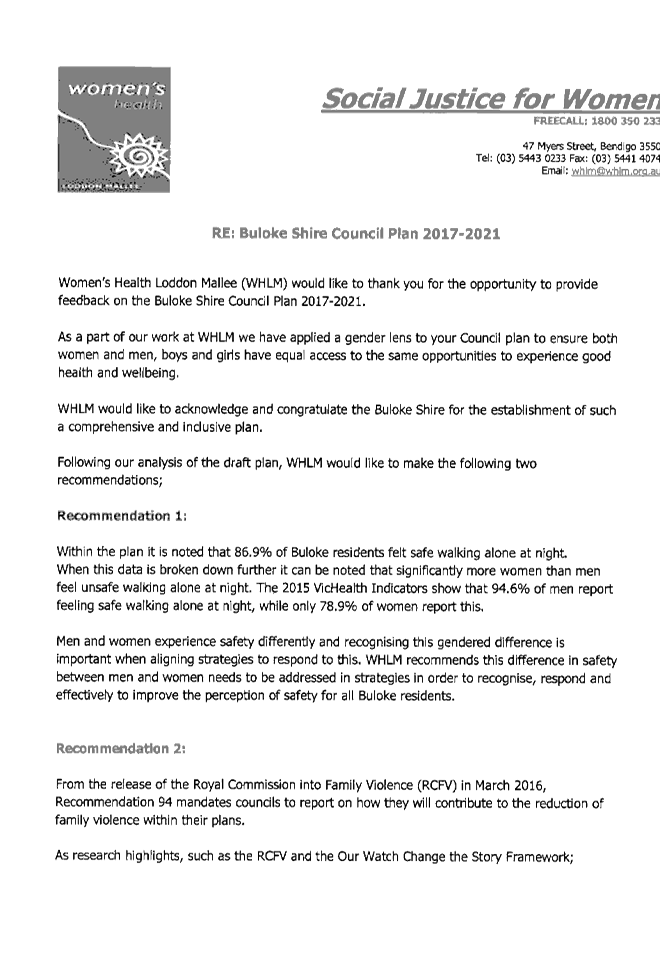
8.2.11 Submission for the Buloke Shire Draft Council Plan 2017-2021
8.3.1 Draft Minutes Audit Advisory Committee 28 April 2017
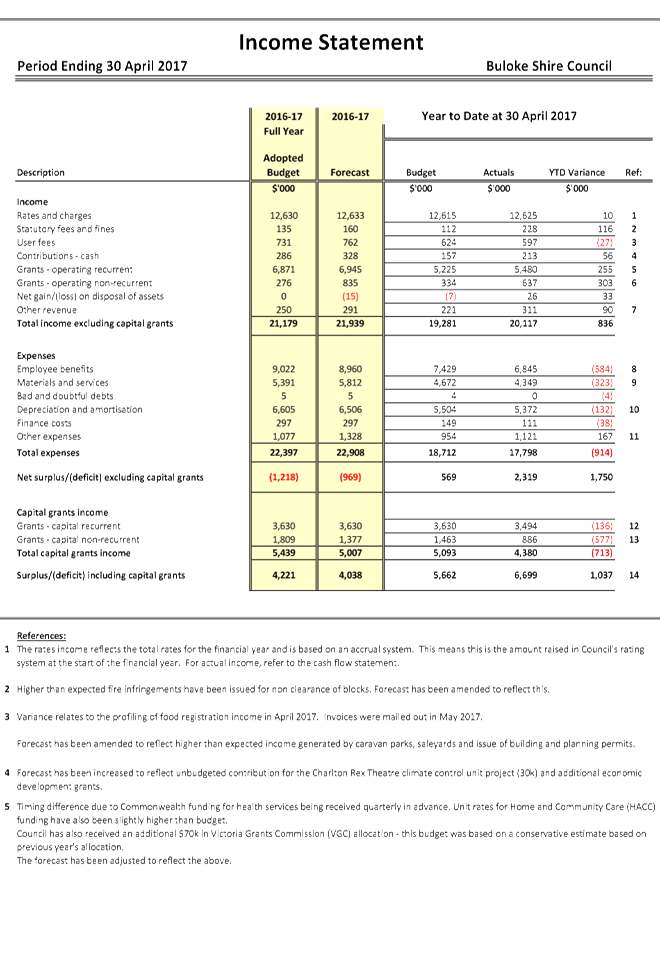
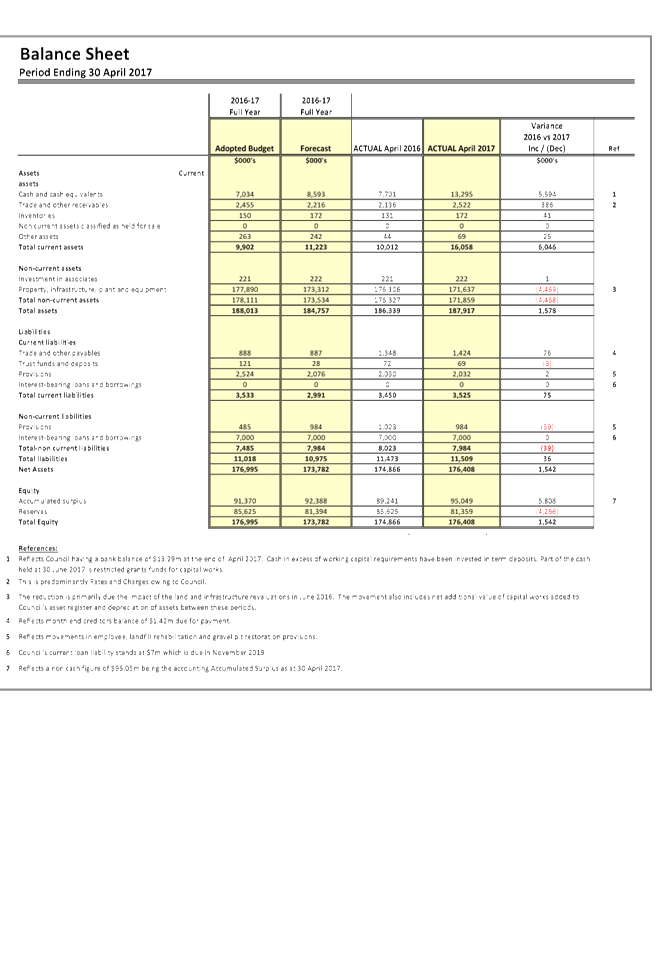
8.3.2 Financial Performance as at 30 April 2017
8.6 Matters Which May Exclude The Public
The Meeting may be closed to members of the public to consider confidential matters.
8.6.1 Contract C39 2016/17 Construction of Wycheproof Swimming Pool Change Facilities
If the meeting has been closed it will be brought back into open session by resolution
9.1.1 Buloke Shire Council support for the Victorian Renewable Energy Targets
9.2 Questions from Councillors
NEXT MEETING
The next Ordinary Meeting of Council will be held in Wycheproof Supper Room, 367 Broadway, Wycheproof on Wednesday, 12 July 2017 at 7:00pm.
LUCY ROFFEY
CHIEF EXECUTIVE OFFICER
6. Questions from the Public
7. Procedural Items
7.1 Report of Assembly of Councillors Meetings
Author’s Title: Governance Officer
Department: Corporate Services File No: GO/05/04
|
That Council adopts the record of Councillor Briefings held on 3 May and 17 May 2017.
|
1. Key Points/Issues
The Local Government Act 1989 (the Act) provides that a record must be kept of any Meeting of Councillors and Staff deemed to be an Assembly of Councillors Meeting as defined in the Act.
An Assembly of Councillors Meeting is defined in the Act as a meeting of Councillors if the meeting considers matters that are likely to be the subject of a Council decision or the exercise of delegation and the meeting is:
· A planned or scheduled meeting that includes at least half of the Councillors and a member of Council Staff; or
· An Advisory Committee of the Council where one or more Councillors are present.
The Act also provides that the record of any Assembly of Councillors is to be reported to the next practicable Council Meeting and recorded in the Minutes.
A record of the Councillor Briefings held on 3 May and 17 May 2017 are attached.
Buloke Shire Council Ordinary Meeting Agenda Wednesday, 14 June 2017
7.1 Report of Assembly of Councillors Meetings
Attachment 1 Councillor Briefing Record 3 May 2017
RECORD
|
Date and Time: |
3 May 2017 |
Time: 5.00pm to 8.00pm |
|
Location: |
Charlton Council Chambers |
|
Attendees: |
Cr- David Pollard (Mayor) Cr- Graeme Milne (Deputy Mayor) Cr- Ellen White Cr- Carolyn Stewart Cr- David Vis Cr- John Shaw Cr- Daryl Warren Lucy Roffey –Chief Executive Officer Hannah Yu – Director Corporate Services Anthony Judd – Director of Works and Technical Services Jessie Holmes – Director Community Development Travis Fitzgibbon-Media and Communications Officer |
|
Apologies: |
|
|
Visitors: |
Louise Staley – MP |
ITEMS
|
NO. |
TOPIC |
PURPOSE |
|||
|
1. |
Councillor Only Session (5.00-5.30pm) |
|
|||
|
2. |
Declarations of Conflicts of Interest |
|
|||
|
3. |
Councillor Briefing Notes (19 April 2017) |
|
|||
|
4. |
Presentations |
|
|||
|
|
4.1 |
Louise Staley MP (5.30-6.30pm) |
|
||
|
|
Dinner 6.30 |
|
|||
|
5. |
Items for Discussion |
|
|||
|
|
5.1 |
Ordinary Meeting Agenda |
|
||
|
|
5.2 |
Councillor Agenda Planner |
|
||
|
6. |
Councillor Matters |
|
|||
|
7. |
CEO Updates |
|
|||
Next Briefing:
|
Date and Time: |
17 May 2017 |
Time: 3.00pm to 6.00pm |
|
Location: |
Wycheproof Supper Room |
|
Buloke Shire Council Ordinary Meeting Agenda Wednesday, 14 June 2017
7.1 Report of Assembly of Councillors Meetings
Attachment 2 Councillor Briefing Record 17 May 2017
RECORD
Councillor Briefing
|
Date and Time: |
17 May 2017 |
Time: 3.00pm to 6.00pm |
|
Location: |
Wycheproof Supper Room |
|
Attendees: |
Cr- David Pollard Cr- Graeme Milne Cr- Ellen White Cr- Carolyn Stewart Cr- John Shaw Cr- Daryl Warren Lucy Roffey –Chief Executive Officer Hannah Yu – Director Corporate Services Anthony Judd – Director of Works and Technical Services Jessie Holmes – Director Community Development Travis Fitzgibbon-Media and Communications Officer |
|
Apologies: |
Cr- David Vis |
|
Visitors: |
Sonny Neale – Central Green House Alliance Inc. Executive Officer Cr Mary Laios –MAV President Mark Williams- GWM Water Managing Director Peter Vogel- GWM Water Board Chairman |
ITEMS
|
NO. |
TOPIC |
PURPOSE |
|
|
1. |
CEO/Councillor Only Session |
Due to number of external presentations CEO/Councillor time is deferred to 7 June Briefing |
|
|
2. |
Declarations of Conflicts of Interest |
|
|
|
3. |
Councillor Briefing Notes (3 May 2017) |
|
|
|
4. |
Presentations |
|
|
|
|
4.1 |
MAV President Cr Mary Laios 3.00pm – 4.00pm
|
|
|
|
4.2 |
CVGA Presentation Sonny Neal 4.00pm |
|
|
|
4.3 |
AFL Facilities Strategy DWTS |
|
|
|
4.4 |
Business Unit Presentation |
|
|
|
4.5 |
Service Review/Business Unit Presentation - Insurance DCS |
|
|
|
4.6 |
GWM Water Presentation |
|
|
5. |
Items for Discussion |
|
|
|
|
5.1 |
Sale of Council Properties DCS |
|
|
6. |
Councillor Matters |
|
|
|
7. |
CEO Updates |
|
|
|
|
7.1 |
State and Federal Budget overview Presentation |
|
Next Briefing:
|
Date and Time: |
7 June 2017 |
Time: 5.00pm to 8.00pm |
|
Location: |
Birchip Council Chamber |
|
7.2 Correspondence Initiated by Council
Author’s Title: Administrative Support Officer - Executive Office
Department: Office of the CEO File No: GO/06/09
|
Nil |
|
That Council notes the record of correspondence sent and responses received.
|
Table of correspondence
|
Council Initiative |
Correspondence sent to |
Date sent |
Date of response |
Summary of response |
|
To write to local members inviting them to meet with Council. |
The Hon Peter Crisp MLA Member for Mildura
|
20.03.2017
Follow Up
|
|
|
|
To write to local members inviting them to meet with Council. |
Luke O’Sullivan Member for Northern Victoria |
20.03.2017
Follow Up 25.05.2017 |
|
|
|
Rail Freight Alliance – VLine’s decision to alter service standards |
Hon. Daniel Andrews MP Premier of Victoria |
March 2017 |
12.05.2017 |
The Premier is monitoring the independent review of V/Line closely and is ensuring any recommendations are carefully considered by Government. |
|
To write to Member for local government regarding Federal Financial Assistance Grants |
Minister for Regional Development, Local Government and Territories Senate– Fiona Nash |
11.05.2017
|
26.05.2017 |
Indexation has been reinstated for 2017/2018. Two quarterly payments for 2017/18 will also be brought forward to 2016/17. |
|
Petition for Patchewollock-Sea Lake Road |
Mal Kersting VicRoads Regional Director – Northern Victoria |
30.03.2017 |
21.05.2017 |
VicRoads will meet with Council and Local Community Representatives to discuss possible options. |
|
State Taxation Acts Amendment Bill |
Leader of Opposition, Hon Matthew Guy, Shadow Minister for Local Government, Hon David Davis, Victorian upper house MPs |
May 2017 |
|
|
7.3 Letters of Congratulations and Recognition of Achievement/Awards
Author’s Title: Governance Officer
Department: Corporate Services File No: CR/13/01
|
Nil |
|
That Council acknowledges and congratulates the persons and groups mentioned in the report for their achievements.
|
1. Executive Summary
This report acknowledges and congratulates community persons and groups for their success in being recognised for significant achievements or receiving an award.
The report also informs Council of any letters of congratulations or any particular recognition of achievement that Council has received or been awarded in the past month.
2. Recognition of Achievement Items
|
Provider |
Recipient |
Date |
Purpose for Recognition |
|
|
|
|
|
|
|
|
|
|
7.4 Building Permits - Monthly Update
Author’s Title: Compliance Administration Officer
Department: Planning and Community Support File No: DB/14/02
|
Nil |
|
That Council notes the information contained in the report on Building Permits approved by staff from 18 April 2017 to 31 May 2017.
|
1. Executive Summary
This report provides information on the Building Permits approved by staff from 18 April 2017 to 31 May 2017.
List of Building Permits Approved by Council Surveyor
|
Permit No. |
Address |
Project Description |
Date Approved |
|
20170023 |
26 Menzies Street, CHARLTON |
Extension: To Existing Dwelling, Garage and Verandah Detached |
18/04/2017 |
|
20170026 |
Back St Arnaud Road, CHARLTON |
New Building: Storage Shed |
11/05/2017 |
|
20170027 |
21 Sherwood Street, BIRCHIP |
Remove Building: Removal of Detachable Bungalow/Office |
18/05/2017 |
|
20170028 |
74 Cumming Avenue, BIRCHIP |
Re-erect Building- Relocate Detachable Building (Bungalow/Office) |
18/05/2017 |
|
20170029 |
1741 Ninda-Turriff Road, NINDA |
Other: Swimming Pool & Pool Safety Barrier |
18/05/2017 |
2. List of Building Permits Approved by Private Surveyors
|
Permit No. |
Address |
Project Description |
Date Approved |
|
20170024 |
42 Watson Street, CHARLTON |
Other: Re-Stump part of Dwelling |
21/04/2017 |
|
20170025 |
11 Corack Road, WYCHEPROOF |
New Building: Dwelling & Garage |
08/05/2017 |
7.5 Planning Applications Received - Monthly Update
Author’s Title: Planning Officer
Department: Planning and Community Support File No: LP/09/01
|
Nil |
|
That the Council note information contained in the report on planning applications under consideration by staff and the status of each of these applications.
|
1. Executive Summary
This report advises provides information on planning applications under consideration by staff and the status of each of these applications.
2. List of Planning Applications
|
Application No |
Applicant |
Address |
Date Rec |
Summary of Proposal |
Status |
|
PPA697/17 |
Averyll Loft -Wyche community resource centre |
280 Broadway, Wycheproof |
28/03/17 |
Construction of a lockup garage |
Awaiting report |
|
PPA700/17 |
MR & MA Allan |
538 Calder Hwy., Sea Lake |
04/04/17 |
Use and development of land for a camping and caravan park (10 cabins and assoc. buildings), helipad |
Referral - Vicroads |
|
PPA701/17 |
Buloke Shire Council |
Aitken Avenue, Donald |
24/04/17 |
Upgrade two existing earthen flood levee banks, the extension of one existing earthen flood levee |
Referral - DEWLP |
|
PPA702/17 |
Jason Stone |
54 Tower Rd., Donald |
23/05/17 |
Construction of a rural store (hay shed 68m x 30m x 8.5m) |
Notice of application |
|
PPA703/17 |
Rian Caccianiga – Mallee CMA |
CA 2B Parish of Tyrell (Robinvale –Sea Lake Rd., Sea Lake |
29/05/17 |
Carry out works to repair a road and repair a culvert crossing |
Awaiting Cultural Heritage due diligence report |
Buloke Shire Council Ordinary Meeting Agenda Wednesday, 14 June 2017
8.1.1 Rates and Charges
Financial Hardship Policy
Author’s Title: Director Corporate Services
Department: Corporate Services File No: CM/14/10
Relevance to Council Plan 2015 - 2019
Strategic Objective: An organisation that is responsibly governed with a strong emphasis on sustainable financial and risk management.
|
That Council adopts the Rates and Charges Financial Hardship Policy
|
1. Executive Summary
The Internal Audit 2016-03 Rates and Billing identified that Council did not have a formal policy in relation to the waiving of rates and charges.
The adoption of this policy will ensure a consistent approach in line with best practice.
2. Discussion
The Internal Audit 2016-03 Rates and Billing identified that Council did not have a formal policy in relation to the waiving of rates and charges. Council had been following Municipal Association of Victoria (MAV) guidelines when considering applications for to waive interest on rates or charges, or deferring the payments of rates.
The attached policy has been developed taking into account Council’s requirements under the Local Government Act198 and MAV guidelines.
The aim of the policy is to:
(i) Provide a deferment of rates and charges or grant a waiver of interest on rates and charges to ratepayers experiencing demonstrated financial hardship;
(ii) Provide guidelines, templates and establish principles to apply when a deferment or waiver of interest on rates and charges application is received;
(ii) Identify the type and amount of assistance that may be granted prior to a deferment or waiver of interest on rates and charges application being approved;
(iii) Ensure that Council’s debt collection practices are sensitive and responsive to ratepayer’s financial hardship issues; and
(iv) Alleviate the potential for rates to become a factor in domestic economic violence.
3. Financial Implications
The implementation of this policy will result in a loss of interest income. The policy does not allow for the waiving of rates or legal costs which has been incurred.
4. Cost Shift Considerations
There are no cost shift implications in this report.
5. Community Consultation
The public will be made aware of this policy through Council’s website.
6. Internal Consultation
Consultation with the Senior Management team has been an integral part of the development of the Rates and Charges Financial Hardship Policy. The development of the Policy also included consultation with Council’s Audit Advisory Committee.
The Director of Corporate Services will ensure relevant employees are provided within information and training on the Rates and Charges Financial Hardship Policy to ensure Council’s response to those persons identified as experiencing, or potentially experiencing, financial hardship is sensitive and appropriate to their needs.
7. Legislative / Policy Implications
The policy is in line with relevant sections of the Local Government Act 1989.
8. Environmental Sustainability
There are no Environmental Sustainability implications.
9. Conflict of Interest Considerations
The author has no conflict of interest in writing this report
10. Conclusion
The adoption of this policy is in line with an internal audit recommendation and meets best practice guidelines from the MAV.
Buloke Shire Council Ordinary Meeting Agenda Wednesday, 14 June 2017
8.1.1 Rates and Charges Financial Hardship Policy
Attachment 1 Rates and Financial Hardship Policy
|
|
Policy Location |
Corporate Services |
||
|
Policy Title |
Rates and Charges Financial Hardship Policy |
|||
|
Policy Number |
|
Date Adopted |
|
|
|
Revision Number |
1 |
Revision Date |
June 2017 |
|
1. Introduction
This policy relates to the deferring of payment of any rates or charges, or the granting of a waiver of outstanding interest on rates or charges, whether whole or in part to individual persons in accordance with the provisions of sections 170 and 171(a) of the Local Government Act 1989 (the Act).
The aim of the policy is to:
(i) provide a deferment of rates and charges or grant a waiver of interest on rates or charges to ratepayers experiencing demonstrated financial hardship;
(ii) provide guidelines, templates and establish principles to apply when an application for the deferment or waiver of interest on outstanding rates or charges is received;
(ii) identify the type and amount of assistance that may be granted prior to an application for the deferment or waiver of interest on outstanding rates or charges being approved;
(iii) ensure Council’s debt collection practices are sensitive and responsive to ratepayer’s financial hardship issues; and
(iv) Alleviate the potential for rates to become a factor in domestic economic violence.
The policy is aimed to assist ratepayers that are experiencing financial difficulty to pay their outstanding rates and charges. The deferment or waiver of a debt under the Act will be considered after the ratepayer has exhausted other means of assistance provided by Council in paying the outstanding amount.
Council will assist the ratepayer to initiate an achievable repayment plan to limit the outstanding debt to be paid within a reasonable timeframe. It is expected that if Council is prepared to put payment plans in place, the ratepayer will reciprocate by making a concerted effort to repay the debt outstanding.
2. Relationship with Council Plan
This proposal is in line with the following strategic goal of the Council Plan:
Our People and Organisation (Leadership and Governance)
“Ensuring that Council is well governed and its finances and risks are managed sustainably and responsibly”.
3. Objectives
The objective of this policy is to formulate a process of assistance to ratepayers to minimise the applications for deferment or waiver of interest on rates or charges due to financial hardship.
If Council is able to offer flexible arrangements that suit individual ratepayers in settling their outstanding debt, then the process creates a win: win situation for the ratepayer and Council.
There are significant issues for ratepayers that have to declare themselves as bankrupt. Issues arise for ratepayers concerning credit ratings and future borrowing applications as well as social implications with friends and family.
4. Scope
This Policy applies to deferring rates or charges, or waiving interest on rates or changes, whether whole or in part, for reasons of financial hardship.
This policy excludes applications for waiving rates or charges, whether whole or in part, under section 171(2) of the Act. Where an application for waiving rates or charges is received, such application will be reviewed by Council in a closed session of Council.
5. Rates and Charges
5.1 Current Rate Payment Process
Council sends out annual rate notices in late August or early September which are due for payment in full by 15 February each year.
Ratepayers who elect to pay by quarterly instalments will receive a separate notice for the second, third and fourth instalments. The four instalments are due on 30 September, 30 November, 28 February and 31 May respectively.
Council also offers a 9 monthly instalment plan (September to May) via direct debit, whereby ratepayers agree to have a monthly deduction made direct from their bank account to clear the annual rates and charges.
Ratepayers may also put in place an agreed payment plan to pay their rates.
Council uses the following options to receive payment for rates and charges
· Over the Counter (Wycheproof Office)
· Over the telephone
· BPay
· In person at Australia Post of Australia Post Billpay
· By mail
· Centrepay
A Final Notice is sent in early March to all ratepayers with an outstanding rates balance (excluding instalment payers and payment arrangements).
Ratepayers with accounts with a balance greater than $500 remaining unpaid or for which no payment plan has been arranged are then referred to Council’s debt collection agency for initiation of legal action.
5.2 Charging of Interest
Interest is charged on all outstanding balances in accordance with the provisions of section 172 of the Act.
5.3 Waiving Interest
Interest waivers fall under two categories:
· Administration Waivers
Ratepayers may have interest only waived in the event of an administrative issue, error or omission which has caused or significantly contributed to the failure to pay rates in a timely manner.
· Compassionate Waiver
Ratepayers may have interest waived where they have demonstrated compassionate grounds for a payment being late, and thus attracting interest.
5.4 Sale of Property for Debt Recovery
Under the provisions of section 181 of the Act, Council may sell a property for the recovery of unpaid rates and charges.
Sale of a property for debt recovery purposes will only be undertaken as a last resort where all other means of recovering outstanding rates have failed or where all attempts to locate the owner of the property have been unsuccessful.
5.5 Staff Training
Council will provide training to rates and customer service staff that deal with ratepayers on a day-to-day basis. Training will increase awareness of hardship issues, available counselling resources, focus on ratepayer needs and ensure communication strategies are compassionate and confidential.
6. Policy
In accordance with the Act, deferring or waiving of rates or charges or interest is only available to a ratepayer’s principal place of residence on properties rated as Residential or Retirement Village Properties. No option is available to defer or waive rates and charges on properties rated as vacant, commercial, industrial, or farm land (unless clause 7(c) of this policy applies) .
Ratepayers may have interest on outstanding rates or charges or part thereof, waived or rates or charges or interest deferred subject to compliance with the following conditions:
(a) The ratepayer must be experiencing undue and unavoidable hardship; and
(b) The ratepayer is:
(1) a pensioner (eligible to claim the State Government pensioner rate rebate); or
(2) receiving Centrelink benefits for a minimum period of six consecutive months; or
(3) able to provide evidence of severe financial hardship as certified by an assessment carried out by Council.
Notwithstanding the above, ongoing rates and charges will continue to be levied.
In all applications for deferral of rates or charges or interest the applicant will be encouraged to continue to pay the portion of rates or charges or interest that is affordable given their individual circumstances.
The total amount deferred on a single assessment should not exceed 5% of the Capital Improved Value of the subject property.
7. Guidelines for Consideration of an Application
Applications from ratepayers for financial assistance by means of flexible payment options will be considered by Council officers under delegation.
The following guidelines should be considered when assessing an application for waiving of interest on rates or charges.
a) the interest payable must relate to the applicants principal place of residence;
b) applications for waiving of interest on rates or charges for residential investment, commercial or industrial properties and vacant will NOT be granted;
c) applications for waiving of interest on rates or charges for farms or commercial properties that are also used for residential purposes will NOT be granted, unless the residential part of the property is separately assessed for rates. In such cases, the relationship of the applicant to the adjoining business activity and gross income generated by that activity will be taken into consideration;
d) the amount to be waived or deferred must not be more than 5% of the Capital Improved Value of the residential property in the application;
e) the ratepayer must be experiencing demonstrated financial hardship;
f) the ratepayer must be able to demonstrate the requirement to pay the full amount outstanding would exacerbate existing financial hardship;
g) the ratepayer must show they are prepared to contribute towards the longer term payment of any outstanding amount. To this end, a “Debt Finalisation Date” must be nominated by the debtor;
h) the ratepayer must demonstrate they are able to honour payment arrangements they have entered into;
i) Council expects that the ratepayer is making legitimate attempts to ensure money is available to make rates and charges payments;
j) Council accepts that the ratepayer’s commitment to a mortgage on their principal place of residence, utility services, property and health insurance and car loan and registration payments are essential and take precedence over rates and charges payments. That being so, it does not exclude the rates and charges debt from being paid and does not mean penalty interest will not be charged;
k) Council requires the ratepayer to advise Council if they decide to sell the property before the Debt Finalisation Date. Interest on the outstanding balance may then be applied if it is deemed appropriate;
l) Council requires the ratepayer to provide a Statutory Declaration of all income and expenses, assets and liabilities and potential sources of income. This includes details of shares portfolios, business partnerships, joint ventures etc. Copies of documentary evidence (e.g.: Tax returns etc.) may be required to be presented at Council’s discretion;
m) Council may arrange for the information provided above to be assessed by independent professionals if considered necessary;
n) Council may require the ratepayer to meet with financial counselling professionals involved in the assessment of the application;
o) Any legal costs incurred against the property will remain, as this is a cost Council has incurred.
All information received by Council or professionals engaged in the assessment process will be treated as strictly confidential.
8. Implementation and Review
Applicants are able to apply for assistance at any stage throughout the year. All applications are to be received by Council’s Revenue Officer.
The application will be assessed against the above criteria by the Revenue Officer. All applications will be assessed on their merits as it is acknowledged that applicants may not meet all of the above principles/criteria. Therefore, a flexible approach will be taken in regard to provision of the above information.
If necessary, the application will be referred to a Financial Counselling Service or a similar service, for independent assessment. This referral may be at the instigation of the Revenue Officer or the applicant.
A report and final recommendation will be presented to the Director Corporate Services. The report must include details of the appraisal of the application by either the Revenue Officer or the independent assessor.
9. Related Legislation
· Local Government Act 1989
· Privacy and Data Protection Act 2014
10. Review
Council may review this policy at any time but unless otherwise requested at least four years from the date of adoption.
Minor amendments to the policy may be authorised by the Chief Executive Officer at any time where such changes do not alter the substance of the policy.
8.1.2 Risk Management Framework and Policy
Author’s Title: Director Corporate Services
Department: Corporate Services File No: CM/14/18
Relevance to Council Plan 2015 - 2019
Strategic Objective: An organisation that is responsibly governed and values and supports the development of its people
|
That Council: 1. Adopt the Risk Management Policy and Risk Management Framework.
|
1. Executive Summary
A review of Council’s risk management function has been undertaken following an internal audit conducted in May 2015 by Council’s internal auditors. The review incorporates a number of key initiatives to promote consistency of risk management within Council, taking into account strategic and operational objectives, and changes to operations and processes.
The underlying objective of the risk management review was to promote risk management as an essential component of Council’s processes through the review of Council’s Risk Management Policy and the development of a Risk Management Framework appropriate to Council’s size and complexity.
A summary of the Risk Management Policy and Risk Management Framework is set out in the discussion below.
2. Discussion
An internal audit report received in May 2015 noted there were opportunities to improve Council’s risk management function, including through the establishment of a comprehensive risk management framework appropriate to the size, business mix and complexity of Council.
The review of Council’s risk management function was undertaken to ensure Council treated risk management activities as an integral component of its service delivery and processes, through:
- Improving the transparency of risk management processes within Council;
- Protecting Council and the community against reasonably foreseeable loss and injury; and
- Protecting Council and the community against personal, physical and financial losses within the control of the Buloke Shire Council.
A summary of the key components of the Risk Management Policy and Risk Management Framework is set out below:
(a) Risk Management Policy
The purpose of this Policy is to clearly document Council’s commitment to risk management principles and practices.
In meeting this objective Council recognises risk management activities should not be separate from its main activities – effective risk management is an essential component in the framework of good corporate governance, and good decision making and management practice.
(b) Risk Management Framework
The Framework provides details of the requirements and processes supporting Council’s Risk Management Policy. It is designed to assist managing uncertainty, its associated risks and opportunities, and enhance Council’s ability to achieve its objectives.
The Framework outlines the key principles, elements and processes to guide all staff in the effective management of risk, as a component of day-to-day decision making and business practice.
3. Financial Implications
The Risk Management Policy and Risk Management Framework will improve accountability and transparency; improve efficiency and make savings in operational costs, and; contribute to the reduction of insurance premiums.
4. Cost Shift Considerations
Nil
5. Community Consultation
Nil
6. Internal Consultation
Consultation with the Senior Management team has been an integral part of the development and review of the Policy and Framework. The review process also included consultation with Council’s Internal Auditors and Audit Advisory Committee.
Where appropriate, discussion was also held with Risk Management professionals from other Local Government Authorities and Water Authorities.
7. Legislative / Policy Implications
The Risk Management Policy and Framework address a number of legislative requirements, regulatory requirements and industrial instruments. Reference to specific legislation, regulations or industrial instruments has been made within the documents.
8. Environmental Sustainability
Nil
9. Conflict of Interest Considerations
Nil
10. Conclusion
The Risk Management Policy and Risk Management Framework clearly document Council’s commitment to risk management principles and practices. It is recommended Council adopt the Policy and Framework listed in this report.
Buloke Shire Council Ordinary Meeting Agenda Wednesday, 14 June 2017
8.1.2 Risk Management Framework and Policy
Attachment 1 Risk Management Framework
|
|
Document Title: |
Risk Management Framework |
|
Document Location: |
Risk and Human Resources |
|
|
Responsible Person: |
Manager Risk and Human Resources |
SECTION 1 - INTRODUCTION
Background
Our Vision
Our Mission
Our Values
Introduction
Purpose
Scope
Definitions
SECTION 2 – FRAMEWORK
Risk Attitude Statements
Risk Management System
Audit Advisory Committee
Business Continuity
Occupational Health and Safety (OHS)
Risk Management awareness
The Risk Management Process
1. Establishing the context
2. Risk Assessment
a. Risk Identification
b. Risk analysis
c. Risk evaluation
3. Risk Treatment
4. Communication and Consultation
5. Monitor and Review
Risk Register
Risk Reporting
SECTION 3 – RESPONSIBILITIES
Council
Audit and Risk Advisory Committee
Chief Executive Officer (CEO)
Manager Risk and Human Resources
Employees, Volunteers, Contractors
SECTION 4 – REFERENCES, SUPPORTING DOCUMENTATION AND GOVERNANCE
APPENDIX A – CONSEQUENCE TABLE
APPENDIX B – LIKELIHOOD TABLE
APPENDIX C – RISK MATRIX
SECTION 1 - INTRODUCTION
Background
The Buloke Shire Council is a public statutory body incorporated under the Local Government Act 1989.
The Shire covers more than 8,000 square kilometres of the Mallee region in the state’s northwest, stretching between Lake Tyrrell, Victoria’s largest salt lake, and the northern reaches of the Avoca River.
Buloke Shire Council serves the communities of Wycheproof, Charlton, Donald, Birchip and Sea Lake, as well as the smaller townships of Berriwillock, Culgoa, Nandaly, Nullawil and Watchem.
Agriculture, specifically grain production, is the primary source of income and employment in the area. Other forms of farming, education, retail, community service sectors and light industry also provide employment and income.
Services, projects and activities of Council are conducted in accordance with the Council Plan and the Strategic Resource Plan. These Plans form the basis for how resource budgets and staff support are provided.
Our Vision
A sustainable Council for a liveable community.
Our Mission
To work with people of Buloke to provide a supportive and positive environment enabling them to work to achieve satisfying and productive lives.
Our Values
Council addresses its key values through:
§ Constructive engagement;
§ Good communication;
§ Transparency in decision making;
§ Accountability for actions;
§ A collaborative approach working with partners;
§ Taking responsibility;
§ Representation of the community and its needs; and
§ Being responsive and timely.
Introduction
The Buloke Shire Council is committed to an integrated approach to risk management in order to:
§ Protect its staff, assets, liabilities and community against potential exposures;
§ Minimise uncertainty in achieving its goals; and
§ Maximise opportunities to achieve Council’s Strategic Objectives.
The risk management process is not static, nor does it operate in a vacuum. It requires integration with key business drivers and activities as part of good management practice. Effective identification, assessment and evaluation of defined risks are critical to Council achieving its strategic objectives, as outlined in the Council Plan 2015 – 2019 and meeting overall community expectations.
Council’s Framework is developed to ensure the objectives of the Risk Management policy are achieved. The Framework describes the key principles, elements and processes to guide all staff to effectively manage risk, as a component of day-to-day decision making and business practice.
Purpose
The purpose of the Framework is to provide details of the requirements and processes supporting Council’s Risk Management policy. It is designed to assist managing uncertainty, its associated risks and opportunities, as well as enhancing Council’s ability to achieve its objectives.
The Framework will:
§ Align to the objectives of the policy
§ Ensure consistent application of reporting assessment and treatment of Council’s identified risks
§ Provide clarity around the accountability for controls, reporting, strategies and actions
§ Assist in the development of a continuous improvement culture integrating the risk management process into management structures.
Scope
The Framework applies to the following categories:
§ Strategic risks: associated with high level goals that align to Council’s community, annual and business plans which may affect Council’s corporate objectives
§ Operational risks: associated with departmental functions and daily operations
§ Project risks: associated with project management
§ Compliance risks: associated with regulatory and legislative requirements.
Definitions
Within the Risk Management Framework –
"Council" means Buloke Shire Council.
“Operational Risks” are risks associated with departmental functions and day-to-day activities which deliver essential services.
“Project Risks” are risks associated with project management that impact milestones connected to delivering a specific project.
“Strategic Risks” are risks associated with high level goals which align to Council Plans (such as the Council Plan and Strategic Resource Plan). Strategic risks may affect the achievement of Council’s corporate objectives.
“Risk Management” is the effect of uncertainty (either positive or negative) on objectives. It describes the planned and systematic approach used to identify, evaluate and manage the whole range of business risks and opportunities facing Council. Risk management involves both the management of potentially adverse effects as well as the fulfilment of potential opportunities. The risk management process will enable Council to minimise losses and maximise opportunities.
SECTION 2 – FRAMEWORK
Risk Attitude Statements
Risk attitude statements (formerly risk appetite statements) are intended to provide a broad outline upon which management can base risk acceptance decisions, i.e. what is justifiable, what is not and what is in line with Council’s objectives. Decisions about the acceptance or non-acceptance of risk should also consider consequences to Council within the criteria set out in Appendix A.
It should be noted a change in the acceptance/non-acceptance of a risk attitude statement may be subject to Council resolution, where such a change is not in breach of a legal, statutory or legislative requirement.
|
Category |
Acceptance/Non-Acceptance |
|
Operational/Business |
· Acceptance of decisions which result in benefits to the community, organisation and infrastructure · Non-acceptance if decisions or actions which may cause significant degradation to standards to the community, organisation and infrastructure |
|
Environmental |
· Acceptance of decisions which result in benefits to the environment · Non-acceptance of decisions or actions which cause harm to the natural environment |
|
Financial |
· Acceptance of decisions or actions which strengthen Council’s financial sustainability · Non-acceptance of decisions which impact negatively on Council’s long term financial sustainability |
|
Occupational Health and Safety |
· Acceptance of decisions or actions which improve Council’s ability to provide a safe and healthy working environment · Non-acceptance of any actions which compromise health and safety of the public or staff |
|
Compliance, governance and legal |
· Acceptance of decisions which support Council’s ability to comply with legal, professional and regulatory requirements · Non-acceptance of any non-compliance with legal, professional and regulatory requirements |
|
Public Image and Reputation |
· Acceptance in decisions which result in improvements to service delivery or productivity gains · Non-acceptance for actions which may damage Council’s reputation |
Risk Management System
A risk management system includes the methods and processes used to manage risks and identify opportunities – to achieve defined objectives. Risk management is not just about the risk assessment process nor is it a stand-alone discipline. In order to maximise risk management benefits and opportunities, it needs to be integrated with existing business process.
Annual (strategic) risk assessments must be undertaken by the Senior Management team to address key strategic risks. Extreme and High rated risks will be reported to the Audit and Risk Advisory Committee and monitored on a quarterly (or meeting frequency) basis.
Audit Advisory Committee
The audit process plays an important role in evaluating internal controls (and risk management processes) currently employed by Council. The Audit Advisory Committee carries out the following risk management activities:
§ Monitor the systems and process via the Buloke Shire Council’s risk register to ensure that material operational risks to the Buloke Shire Council are treated.
§ Monitor the systems and process via the Buloke Shire Council’s Fraud register to ensure that material Fraud risks to the Buloke Shire Council are treated.
§ Monitor the process of review of the Buloke Shire Council’s risk profile.
§ Consider the adequacy of actions taken to ensure that the material business risks have been dealt with in a timely manner to mitigate exposures to the Buloke Shire Council.
Business Continuity
Council’s Business Continuity Plan (BCP) is designed to re‐establish functions and services in a timely and efficient manner, with minimal disruption to stakeholders. By understanding the environment, vulnerabilities and criticalities of the organisation, Council is committed to ensuring there is a clear understanding of what accountabilities and responsibilities are in place when emergency, continuity and recovery response are in effect.
Risks relating to a disruption of Council’s operations are gathered through Business Impact Statements, testing and desktop exercises and reviews following significant incidents resulting in disruption to Council’s core services.
Occupational Health and Safety (OHS)
Risk management is the generally accepted method of systematically managing OHS. Council has in place a suite of policies and procedures to assist in managing work related risk.
Risk Management awareness
The Framework, and supporting policies and tools will be made available to all staff. Risk Management awareness strategies, including training and workshops, will be completed by workers to increase Council’s risk management culture.
The Risk Management Process
Council’s risk management methodology is consistent with the principles of AS/NZS ISO 310000:2009 Risk Management – Principles and Guidelines. It aims to integrate risk management into all corporate governance, strategic and business planning processes and provides for risk-based decision making and planning through understanding the potential threats and opportunities associated with a specific scope of work.
The Risk Management Process consists of:
1. Establishing the context
2. Risk assessment, including identification, analysis and evaluation
3. Treatment
4. Communication and consultation
5. Monitoring and review
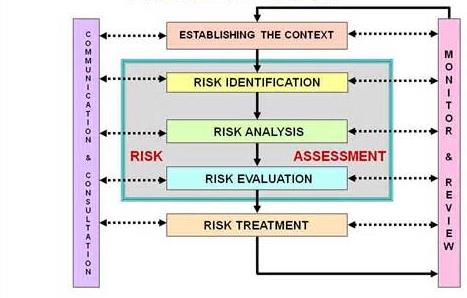
1. Establishing the context
Establishing the context is the first and most important step of the risk management process. It provides assistance in defining the scope of work to which the risk assessment will apply and considers the internal context and external context.
When establishing the context of a risk assessment, you should first determine what the objectives of the assessment are, as well as considering the objectives of the service, activity or event.
Examples of potential risk factors include:
§ Assets and Infrastructure – such as condition, maintenance, renewal, replacement and planning
§ Customer service and reputation – such as the current and potential future needs of Council’s customer base
§ Environment – such as environmental compliance and consequences of Council activities to the environment
§ Finance – such as cash flow, budget requirements, tax obligations, and creditor and debtor management
§ Governance – such as organisational structure, roles and accountabilities, and policies
§ Human Resources – such as the attraction, development and retention of staff, succession planning and remuneration
§ ICT – such as implementation, maintenance and upgrades
§ Political – such as meeting Council’s commitments as outlined in its Plans
§ Project – such as finances, resources, contractor management and delivery dates
§ Regulatory and legal – such as compliance with Acts, Regulations and Standards
§ Safety – such as individual, public and workplace safety
2. Risk Assessment
Risk assessment is the overall process of risk identification, risk analysis and risk evaluation.
a. Risk Identification
Council identifies, assesses and treats strategic, operational and project risks. Identification will include recognising which risks need to be managed on an ongoing basis or which may have significant implications for Council in the future. A useful way to identify these risks is to ask:
§ What can happen
§ Where could it happen
§ When could it happen
§ Why could it happen, and
§ How can it happen
Ideally this process should involve as many stakeholders as possible in a structured identification exercise via, for example, workshops. These exercises should establish a list of risks associated with a scope of work or project, including risks associated with not pursuing an opportunity. All significant causes and consequences should be considered.
This principle is demonstrated below:

Using the above principle, a breakdown on the identification process may be as follows:
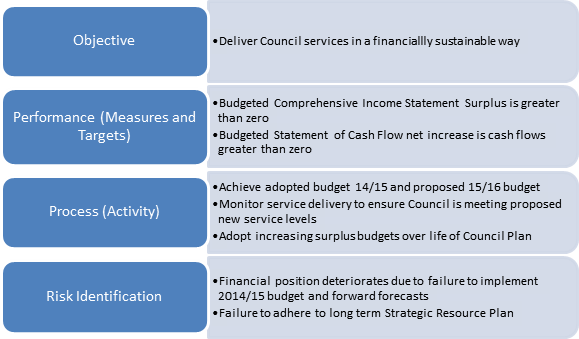
b. Risk analysis
Risk is measured by the consequence (or impact) on Council and the likelihood the risk will become an actual event. In simple terms, this is about developing an understanding of the risk itself, which in turn will enable an effective risk evaluation, decisions on whether risks need to be treated, and the most appropriate risk treatment strategies and methods.
The risk assessment criteria requires the application of two measures when determining the risk level:
§ Consequence (impact)
§ Likelihood (probability)
A risk rating can then be obtained by the following:
Risk = Consequence x Likelihood
The consequence categories in the risk assessment criteria are those which reflect the business drivers of Council. Council’s consequence categories are defined below (Council’s full consequence table is outlined in Appendix A):
|
Operational, Process and Business Interruption |
The impact on Council operations and delivery of service in terms of outage time and operations |
|
Environmental |
The impact on the natural environment (ecosystems), including flora, fauna and atmosphere |
|
Financial |
All revenue, savings, direct and indirect costs such as fines, legal expenses (including claims and settlements), operational costs (including workarounds and additional resources) and capital expenses |
|
Human |
Any injury, illness, disease and fatalities which may occur to staff, contractors, volunteers, customers and the public |
|
Compliance, Governance and Legal |
Any potential breach of regulations, statutes or contracts, as well as any legal proceedings, prosecution, suspension of activity or financial penalties |
|
Public Image and Reputation |
Perceived impact on image of Council derived from media, political or community attention and expectations |
The likelihood is the probability that the particular consequences will occur. In this step, it is important to assess or focus on the consequences and not the event itself. This may include a review of historical data, and existing controls and their effectiveness in mitigating the risk.
Controls are methods for evaluating impacts and taking action to reduce or eliminate the potential for the event occurring. There are a number of ways controls can be implemented, including procedures, training, checklists, process changes, audits, and business decisions. Questions to test the effectiveness of current controls may include:
§ How does the control impact the likelihood and consequence of the risk?
§ Is the control reliable?
§ Is the control understood and being applied as intended?
Council’s Likelihood table is outlined in Appendix B.
A ‘risk rating’ can now be obtained by using the Likelihood and Consequence tables. Council’s defined levels of risk are: Low, Medium, High and Extreme. Council’s Risk Matrix is outlined in Appendix C.
c. Risk evaluation
Risk evaluation is essentially the process of prioritising which risks are going to be treated and how quickly treatment action is required. It gives Council an indication of whether a risk is ‘acceptable’ or ‘unacceptable’, where ‘unacceptable’ risks need to be reduced through further controls.
The assessment of ‘acceptable’ and ‘unacceptable’ risks will largely be determined by Council’s risk attitude (also referred to as risk appetite), as outlined earlier in this framework.
Ultimately, there are two options available in the risk evaluation process – to accept or treat the risk – and the decision to do so will be unique to the risks’ context and take into account the wider context of the risk (i.e. alignment with Council objectives and legislative and regulatory requirements).
The risk ratings within Council’s Risk Management Matrix will assist in guiding Council’s response to the identified risk. As a rule of thumb extreme risks require urgent and immediate action, and high risks require management attention and specific action within set timeframes, to bring the risk to a more acceptable level.
Moderate risks and low risks should be subject to ongoing review and action within the relevant department. Mitigation of these risks should be undertaken when it is considered the current controls in place will not be appropriate in the future as a result of any changes to the operating and external environments.
Prior to developing and implementing treatment plans (outlined below), the effectiveness of current controls and costs associated with the management of the risk should be considered. In some cases, this review may identify all reasonable steps to control the risk are already in place and any further action would be uneconomical.
3. Risk Treatment
Risk treatments involve identifying possible methods for reducing, removing or managing the risk. Treatment will involve one or a combination of the following:
1. Accept the risk – take no further action
2. Mitigate the risk – do something to treat, reduce or change the risk. This is the most common approach to risk treatment and may include an action to reduce the likelihood, consequence or both
3. Avoid the risk – do not start or eliminate any activity associated with the risk. The key consideration is whether the activity is inherently risky and unavoidable. The elimination of the activity may be impossible as it is critical to Council’s objectives
4. Transfer the risk – allocate or share the risk with third parties, such as through insurance or contractor management activities.
Key questions when considering the most appropriate risk treatment strategy may include:
§ Are stakeholders prepared to accept the mitigation strategy?
§ Is it aligned, and consistent, with Council practices?
§ Is it cost effective? Can the same result be achieved at a lower cost and/or through an alternative approach?
§ Is it sustainable?
§ How does it meet with our regulatory and legislative requirements?
§ Does it introduce new risks to Council?
4. Communication and Consultation
Communication and consultation recognises the need to promote and embed risk management concepts within Council. Effective communication should occur at an early stage in the risk management process to ensure those involved with, and affected by, decisions understand why those decisions were made.
5. Monitor and Review
The ongoing monitoring and review of risk assessments and plans will ensure any changes in risks can be recorded. Risks can and do evolve during the lifecycle of any project or Plan, and a regular review of strategies and actions will ensure treatment strategies remain relevant by:
§ Ensuring implemented controls are effective
§ Providing further information to improve risk assessments
§ Identifying possible emerging risks
§ Considering any new activities which may influence established risk management strategies.
The following monitoring and review programs should be in place:
§ Operational risks – annual review
§ Medium/Low risks – annual review
§ Extreme/High risks – quarterly review
§ Project risks – reviewed at transition between project phases and at conclusion of project.
Risk Register
Council’s risk register underpins the risk management framework and is essentially a comprehensive library of risks. It provides clear information on the current risk profile by documenting risks, current controls and future management strategies. It also allows Council to monitor and review the timeliness and effectiveness of controls, with the ultimate aim of reducing risks as far as reasonably practicable.
Risk Reporting
Council’s risk reporting structure is a critical component of the risk management process. Effective reporting will provide information on key and emerging risks, and may also uncover trends in data. In addition, risks identified in one area may have implications across Council in a broader sense and can be captured as part of the reporting process.
Buloke Shire Council Ordinary Meeting Wednesday, 14 June 2017
8.1.2 Risk Management Framework and Policy
Attachment 1 Risk Management Framework
In relation to the application of this document, the following roles and responsibilities shall apply:
Council
§ Endorse the systematic approach to managing risk and opportunity across Council operations.
§ Facilitate resources and guidance in relation to the Risk Management policy and associated Framework.
§ Review and consider any report or recommendations regarding the Risk Management Framework.
Audit and Risk Advisory Committee
§ Review and endorse the Risk Management Framework.
§ Ensure a Framework is in operational and delivers a consistent approach to risk management.
§ Review reports from management and Auditors and monitor that effective risk and opportunity management controls have been implemented.
§ Liaison with external auditor.
§ Review annual financial statements.
§ Review the adequacy of the accounting, internal control, reporting and other financial management systems and practices.
Chief Executive Officer (CEO)
§ Review, endorse and implement the Risk Management policy and Framework.
§ Promote a strong risk management culture by providing firm and visible support for risk management including ensuring appropriate delegations for the management of risk.
§ Ensure a Framework is in operation and delivers a consistent approach to risk management.
§ Ensure managers have the necessary knowledge and skills to effectively fulfil their risk management responsibilities and are accountable for risks arising from the activities of their departments.
§ Ensure annual risk management planning is undertaken.
Manager Risk and Human Resources
§ Provide guidance and assistance to staff in relation to the application of this framework and reporting within the Risk Register.
§ Ensure relevant risk information is reported and escalated to the Senior Management Team, CEO and/or Audit Committee, or cascaded to staff, as appropriate.
§ Maintain the Risk Management policy and framework (including associated templates) to ensure its currency and accuracy.
§ Provide support and advice to managers and staff in the application and use of the Framework.
Employees, Volunteers, Contractors
§ Understand the risk management processes which are integrated into all Council activities.
§ Identify, evaluate, report and manage risks in daily activities and projects.
SECTION 4 – REFERENCES, SUPPORTING DOCUMENTATION AND GOVERNANCE
|
References |
|
Local Government Act 1989 |
|
AS/NZS ISO 31000: Risk Management – Principles and Guidelines |
|
Occupational Health and Safety Act 2004 |
|
Council Plan 2015-2019 |
|
Buloke Shire Council Code of Conduct for Councillors |
|
Buloke Shire Council Code of Conduct for Staff |
|
Buloke Shire Council Risk Management Policy |
|
Buloke Shire Council Occupational Health and Safety Policy |
|
Supporting Documentation |
|
Buloke Shire Council Risk Register |
|
Change History |
|||
|
Version |
Approval Date |
Approved By |
Change |
|
|
|
|
|
|
|
|
|
|
|
|
|
|
|
APPENDIX A – CONSEQUENCE TABLE
|
Score |
Consequence |
Operational, process and business interruption |
Environmental |
Financial |
Human |
Compliance, Governance and Legal |
Public Image and Reputation |
|
1 |
Insignificant |
Negligible or no impact or brief loss of service for less than one day |
No measurable impact on environment or brief non-hazardous and transient effect |
Less than $5,000 |
Injuries or illness no requiring first aid or medical treatment |
Possible minor breach of statute/regulation. Little or no impact |
Resolved in day-to-day management. Little or no impact |
|
2 |
Minor |
Some inefficiencies and/or delays in delivery of support services and non-critical functions. No impact on client service standards. Brief service interruption for one day |
Small impact on environment with no lasting effects e.g. remote, temporary pollution |
Up to $100,000 |
Minor injuries/first aid only required |
Minor breach of statute/regulation or minor delays in meeting legal requirements |
Sporadic localised unfavourable publicity. Customer complaint. No impact on staff morale |
|
3 |
Moderate |
Inability to provide key support services according to expected service levels (e.g. payroll). No notable impact on client service standards. Temporary recoverable service failure between two and three days |
Some impact on environment with no long-term effect or small impact on environment with long-term effect e.g. residual pollution requiring clean-up work |
$100,000 to $300,000 |
First Aid and ongoing medical treatment required |
Some breach of material terms of key contracts or agreements. Formal warning from regulator. Threat of legal action against Council, but able to be resolved through negotiation/remedial action by Council |
Localised negative publicity/local community concern. Loss of community trust or confidence in service delivery. Limited impact on staff morale |
|
4 |
Major |
Significant delays and inefficiencies in core processes and systems impacting significantly on customer service levels. Service or provider needs to be replaced or modified. Essential process/system not available for between three to five days |
Significant impact on environment with long term effects and requiring restorative work e.g. harm requiring restorative work |
$300,000 to $600,000 |
Life threatening injury or multiple serious injuries requiring hospital admission |
Suspension of activity and prosecution/financial penalty. Noticeable increase in claims and legal liability. Most exposures covered by existing insurance cover |
Significant/continued adverse state-wide and local political media scrutiny and exposure. Requires intervention of the CEO and/or Council to answer public concerns |
|
5 |
Extreme |
Essential process/system not available for greater than five days. Prolonged inability to provide basic services. Inability to perform core client functions and/or loss of revenue |
Extensive impact on environment and/or permanent damage e.g. pollution causing irreversible damage |
Equal to or greater than $600,000 |
Death or permanent disability to one or more persons or multiple life threatening injuries |
Prosecution (civil and/or criminal proceedings). Financial penalty or cessation of activity. Significant increase in volume and value of legal exposures and claims. Critical services impacted by cancellation of contracts. Exposures not covered by current insurance cover |
Council or external enquiry, commission inquiry or significant/continued adverse national, state and local media scrutiny or exposure. Permanent loss of community trust. Withdrawal of funding/key grants, etc. Low staff morale resulting in loss of key staff |
APPENDIX B – LIKELIHOOD TABLE
|
Score |
Description |
Example |
Indicative Frequency |
|
A |
Rare |
The incident may only occur in exceptional circumstances. Its predictability is negligible |
Highly unlikely to occur in the next five (5) years. No history of adverse event in the Council |
|
B |
Unlikely |
The incident could occur at some time and is unpredictable |
Event not likely to occur in the next five years, but there is a slight possibility of occurrence |
|
C |
Possible |
The incident should occur at some time and has a low predictability |
50/50 chance of the event occurring in within the next three to five (3 to 5) years. Event is equally likely to occur as not |
|
D |
Likely |
The incident will probably occur occasionally and is predictable |
There is a strong likelihood that the event will occur at least once in the next three (3) years. History of event/s in Council or other Councils |
|
E |
Almost Certain |
The incident is expected to occur regularly and is predictable |
The adverse event is likely to occur at least one in the next 12 months |
APPENDIX C – RISK MATRIX
|
Likelihood |
|
1 |
2 |
3 |
4 |
5 |
|
Almost Certain |
E |
High |
High |
Extreme |
Extreme |
Extreme |
|
Likely |
D |
Medium |
Medium |
High |
Extreme |
Extreme |
|
Possible |
C |
Low |
Medium |
High |
High |
Extreme |
|
Unlikely |
B |
Low |
Low |
Medium |
High |
Extreme |
|
Rare |
A |
Low |
Low |
Medium |
High |
High |
|
|
Consequence |
Insignificant |
Minor |
Moderate |
Major |
Extreme |
Buloke Shire Council Ordinary Meeting Agenda Wednesday, 14 June 2017
8.1.2 Risk Management Framework and Policy
Attachment 2 Risk Management Policy
|
|
Policy Location |
Risk and Human Resources |
||
|
Policy Title |
Risk Management |
|||
|
Policy No |
|
Date approved |
|
|
|
Revision No |
4 |
Revision Date |
|
|
Purpose
The purpose of this Policy is to clearly document Buloke Shire Council’s (Council) commitment to risk management principles and practices. Council acknowledges that risk management is essential for sound strategic, financial and operational planning and the achievement of Council’s objectives.
Risks are an everyday occurrence that potentially impact on Council’s ability to meet its objectives to internal and external stakeholders, residents and the community.
Council recognises that while many risks cannot be eliminated they can be identified, prioritised, controlled and managed. It requires a balance between the cost and effort of managing and treating the risks and the anticipated benefits that will be derived.
In meeting its objectives Council thus recognises that risk management activities should not be separate from the main activities and processes of the organisation - effective risk management is an essential element in the framework of good corporate governance and is an integral part of good decision making and management practice.
Council is thus committed to establishing and promoting an organisational culture that implements effective risk management practices within all activities and business processes, to prevent adverse incidents and advance Council’s objectives. Council will ensure that, as far as is reasonably practicable, the organisation’s operations do not expose people, property or the environment to unacceptable levels of risk or harm.
Economic prosperity, financial sustainability, environmental quality and social equity are treated as core considerations in managing risks, encompassing both disadvantageous effects and also opportunities for improvement.
The Australian Standard AS/NZS ISO 31000:2009 Risk Management – Principles and Guidelines (the Australian Standard) will guide the approach for managing risk within Council.
The above approach supports sustainability objectives and protects Council’s assets - infrastructure, environment, people, finances and reputation. In addition, it ensures the sustainable delivery of services and amenities to ratepayers, residents and visitors.
Scope
Council requires the development and provision of an effective risk management framework and process to mitigate risks to Council and to capitalise on sustainable opportunities present in Council’s operations.
This Policy is applicable to all Council staff and contractors across all services and departments of the organisation and encompasses risk management principles pertaining to all classes of risk.
The intent of this Policy is to provide support and guidance for all departments to implement the risk management framework in a practical way into business processes and functions, to ensure an effective process for the identification, analysis and management of enterprise and operational risks.
Definitions
In this Policy the following definitions apply:
Risk: the effect (both positive and negative) of uncertainty on objectives.
Strategic Risk: Risks that could affect the
achievement of the Council’s vision and strategic
objectives.
Operational Risks: Risks that could impact on the organisation’s effectiveness and efficiency.
Risk management: the principles, framework and
processes in place for managing risk
effectively.
Risk management framework: the set of components that provide the foundations and organisational arrangements for designing, implementing, monitoring, reviewing and continually improving risk management within Council.
Risk identification: the process of finding, recognising and describing risks.
Risk treatment: the process of modifying risk.
Policy Statement
Buloke Shire is actively committed to:
a) Applying sound risk management principles and practices, including identifying, prioritising and managing risks in a coordinated manner;
b) Improving strategic planning processes as a result of structured consideration of risk;
c) Protecting the organisation, its employees, contractors, community, assets and the environment against reasonably foreseeable loss and injury;
d) Providing assistance to improve the quality of decision-making throughout the Council; and
e) Preventing and minimising exposure to risk and adverse impact on the Council’s operations.
The Council recognises that risk management is essential for sound strategic and financial planning. The following objectives are fundamental to Council’s ability to create a positive, viable future:
· To ensure compliance with legislative requirements and current industry standards;
· To identify and analyse the Council’s liability associated with risk exposure;
· To select the most advantageous method for minimising the Council’s exposure to injury, loss or damage;
· To protect employees, contractors, visitors and the community against personal, physical and financial losses that are within the control of the Buloke Shire Council;
· To protect Council’s corporate image as a professional, responsible and ethical organisation;
· To promote and support risk management practices and encourage and empower staff in managing risk by educating employees about good risk management practices;
· To facilitate accountability for risk management, recognising that risk management is the responsibility of all employees;
· To monitor risk management practices of the Council to ensure continued effectiveness, consistency and efficiency and to provide an audit trail;
· To promote and support risk management practices throughout the Council;
· Utilising risk management as an essential part of project management; and
· Demonstrating responsible risk management processes that align with best practice and the identification, analysis, evaluation and treatment of risks as detailed in the Australian Standard.
In particular, Council recognises that in order to achieve the objectives and capitalise on opportunities as contained in the 2015-19 Council Plan, it will need to accept some level of well managed risk inherent in the following activities:
· Engagement with communities to identify and meet their needs;
· Supporting and enhancing the local economy;
· Working with our partners and communities to enhance and protect our natural environment; and
· Influencing governments to improve livability for rural communities.
Council has a low tolerance for risks which foreseeably may:
· Compromise its ability to deliver its services in a financially sustainable way; or
· Constitute a breach of its legislative requirements; or
· Compromise the health and safety of staff, members of the public or any third party.
Guidelines
1. All employees are responsible for effective risk management practices and ensuring that management is aware of risks associated with Council’s assets or operations. This extends to recommending suitable plans to manage risks and obtaining appropriate approval prior to action and sharing and communicating information.
2. Each Senior Manager is accountable for implementing this Policy in their department and for the implementation of risk management practices within their particular areas of responsibility. They are responsible for reviewing and updating any allocated risks and for ensuring appropriate resources are made available and effective monitoring, review and reporting is undertaken.
3. Each Councillor and member of staff is accountable for compliance with the conflict of interest provisions as contained within the Councillor Code of Conduct and Staff Code of Conduct, respectively.
4. The Manager Risk and Human Resources is responsible for overseeing the development, facilitation and implementation of a risk management culture, framework and strategic across the Council.
5. The Chief Executive Officer is the Senior Executive responsible for establishing and facilitating a risk management process across the Council.
6. Council is responsible for ensuring adequate resourcing is available for the continued development, implementation and maintenance of risk management programs and activities.
7. Council is responsible for ensuring that Council strategy and operations are managed within an effective risk management framework.
8. The Buloke Shire will:
i. Maintain high standards for services provided;
ii. Adopt a strategic framework which allows for impacts on natural, social and economic capital to be appropriately considered, thereby supporting sustainability and safeguarding Council’s assets, namely people, finances, property and reputation;
iii. Create an environment that enables Council to deliver services and meet performance objectives in line with our best value principles;
iv. Ensure resources and operational capabilities are identified and deployed responsibly and effectively; and
v. Demonstrate transparent and responsible risk management processes which align with best practice, including commitment to the development of relevant key performance measures for risk management.
References
· Local Government Act 1989 (Vic)
· Australian Standard AS/NZS ISO 31000:2009 Risk Management – Principles and Guidelines
· 2015-19 Buloke Shire Council Revised Council Plan
· Buloke Shire Council Risk Management Framework
· Buloke Shire Council Councillor Code of Conduct
· Buloke Shire Council Staff Code of
Conduct
8.2 Management Reports
8.2.1 Community Grants and Sponsorship
Author’s Title: Community Development Officer
Department: Planning and Community Support File No: CD/11/09
Relevance to Council Plan 2015 - 2019
Strategic Objective: An organisation that is responsive to the evolving needs of the community.
|
That Council: 1. Allocate $1000 as a Project Support grant to the Fit To Drive Foundation for their Road Safety workshop in Buloke. 2. Allocate $2000 as a Project Support grant to the Buloke Tourism Network for their Buloke Country publication 3. Allocate $500 to sponsor the attendance of five Buloke residents at the 2017 Tri State Games and; 4. Allocate $1000 as a Project Support grant to the Donald High School and Donald Football, Netball and Hockey Club for the ‘A Whole New World’ Presentation. 5. Allocate $319 as a Small Capital Equipment Grant to the Donald Senior Citizens for the purchase of a new microwave. 6. Allocate $2000 as a Project Support grant to support the erection of a federation wire and wooden proof fence around the boundary of the park. |
1. Executive Summary
The purpose of this report is to recommend that Council approves the allocation of funds
from the Community Grants and Sponsorship Program to the projects listed above.
2. Discussion
The project proposed by the Fit To Drive Foundation focuses on Year 11 workshops
which constitute a half-day road-safety education program designed to support young
people to consider their role as road-users and their power to mitigate a risky situation as
the passenger, and in the future as drivers. It will be attended by four of the Buloke
schools.
The Buloke Tourism “Buloke Country” publication is an important tool to promote tourism
and travel stopovers in Buloke. The Buloke Country project has also been an important
business engagement model for Council and the Buloke Tourism Board
McCallum Disabilities Enterprises provides a range of services to Buloke residents with
disabilities. The McCallum Tri State Games team will include five Buloke resident’s in
2017.
The project proposed by the Donald High School and Donald Football, Netball and
Hockey Club is to run ‘A Whole New World’ seminars for all Year 9-12 students
through the school and then a community presentation in the Blue Room. The seminars
look at safe partying, drugs and alcohol use amongst young people.
Donald Senior Citizens is used frequently by a number of groups to provide activities and entertainment to the wider district of seniors and would like a microwave to assist with catering events.
The Watchem Progress Association has requested funds to assist in installing a fence around their park to ensure the safety of patrons, in particular of children. The fence will have gates and vehicular access along the two boundaries that are not currently fenced.
3. Financial Implications
This allocation of $6,819 will bring allocations to date this year to $ 14,789 for the 2016-17 budget year. The total budget for this program is $20,000.
4. Cost Shift Considerations
No cost shift implications
5. Community Consultation
Nil
6. Internal Consultation
No officer involved in the preparation of this report had a conflict of interest
7. Legislative / Policy Implications
The community grants and sponsorship program has been developed in response to the Local Government Investigations and Compliance Inspectorate guidelines
8. Environmental Sustainability
Council officers have consulted with the applicants and reviewed all documentation associated with the sponsorship applications
9. Conflict of Interest Considerations
No officer involved in the preparation of this report had a conflict of interest.
10. Conclusion
It is recommended that Council notes and approves the allocation of funds to the applicants.
Buloke Shire Council Ordinary Meeting Agenda Wednesday, 14 June 2017
8.2.1 Community Grants and Sponsorship
Attachment 1 Community Grants
8.2.2 Country Football Netball Program - Sport and Recreation Victoria
Author’s Title: Coordinator Community Facilities
Department: Works and Technical Services File No: GS/03/09
|
Nil |
Relevance to Council Plan 2015 - 2019
Strategic Objective: A Shire where roads, drains, public spaces, community facilities, parks and other essential infrastructure are fit for purpose, well maintained and contribute to the well-being of the community.
|
That Council submits a funding application for $80,000 from Sport and Recreation Victoria for the installation of Football ground lighting at the Sea Lake Community Centre through the 2018-2019 Country Football Netball Program. |
1. Executive Summary
Sport and Recreation Victoria has recently released the 2018-2019 Country Football Netball Program (CFNP). The CFNP provides funding to assist grassroots country football and netball clubs, associations and umpiring organisations to develop facilities in rural, regional and outer metropolitan locations. The funding is calculated at a ratio of $2 (state): $1 (Council/community). This round of the Community Sport Infrastructure Fund closes on 26 July 2017.
2. Discussion
Council has had a long history in writing successful proposals to the CFNP. Most recently, Council was successful in receiving $100,000 under the Country Football Netball Program for the construction of new netball change rooms at Donald Recreation Reserve as a part of the Donald Community Precinct project.
The Sea Lake Nandaly Football Netball Hockey Club approached Council in early 2017 requesting an upgrade to the football ground lighting in Sea Lake. The Draft AFL Central Victoria Facilities Strategy has highlighted that safe lighting at football and netball facilities across the region is poor, and therefore investment in this area is important into the future. It also highlights that the lighting at Sea Lake is ‘below low level/training level’. This project will see the lighting improved to a training standard as prescribed under the AFL Preferred Facilities Guide. In addition, this project complements new training level standard lighting installed at the netball tennis courts as a part of their upgrade this year.
The Sea Lake Nandaly Football Netball Hockey Club have committed the matching funding of $40,000 for the project, as they see this project as important in ensuring a safe and compliant facility into the future. The lighting design has been completed and project is ‘shovel ready’.
3. Financial Implications
If Council is successful in receiving the funding for the project, it will be responsible for delivery and acquittal. There is no financial commitment proposed by Council.
4. Cost Shift Considerations
There are no cost shift considerations in this report
5. Community Consultation
The Sea Lake Nandaly Football Netball Hockey club have been consulted through the development of this project. The club has formally committed the matching funding to deliver the project.
6. Internal Consultation
Senior Management have been engaged throughout the planning process of this project
7. Legislative / Policy Implications
There are no legislative implications within this report. The new lighting will comply with AFL Facility standards and the project has been highlighted in the draft AFL Central Victoria Regional Strategy and the Sea Lake Community Centre Master Plan.
8. Environmental Sustainability
The lighting to be installed will be LED, which will reduce electricity usage and carbon footprint.
9. Conflict of Interest Considerations
No officer involved in the preparation of this report had a conflict of interest.
10. Conclusion
It is recommended Council proceed with submitting a funding application under the Country Football Netball Program for $80,000 to install ground lighting on the football oval at Sea Lake Community Centre.
8.2.3 Donald Caravan Park - Lease
Author’s Title: Coordinator Community Facilities
Department: Works and Technical Services File No: CS/14/03
|
Nil |
Relevance to Council Plan 2015 - 2019
Strategic Objective: An organisation that is responsibly governed with a strong emphasis on sustainable financial and risk management.
|
That Council: 1. Notes that a 28 day consultation period was undertaken for the intention to lease the Donald Caravan Park and no submissions were received. 2. Enter into a 21-year lease with Donald Football Club Inc. subject to Ministerial approval for the management of the Donald Caravan Park and affixes the Common Seal of Council
|
1. Executive Summary
After the prior lease of the Caravan Park in Donald ended on 31 December 2015, Council undertook and Expression of Interest process. Negotiations with the preferred tenant have been undertaken in compliance with the required legislation and policies, with the recommendation that Council enter into a new lease for the management of the Donald Caravan Park.
2. Discussion
The existing lease for the Donald Caravan Park concluded on 1 January 2016. The lessee had held the lease of the Caravan Park for an extended period, following a Transfer dated 1 July 2003. In March 2015, Council decided to undertake a competitive selection process for the management of the park into the future.
After undertaking an Expression of Interest process, Council has been negotiating with the Donald Football Club Inc. to establish a community managed park in compliance with all the regulations outlined in the Residential Tenancies Act (2010) and the Best Practice Management Guidelines for Committees of Management: Managing Caravan and Camping Parks on Crown Land.
The negotiations have concluded and will provide significant benefit for the community and Council should the Donald Football Club Inc. be confirmed as the lessee. A development plan has been established which will see Donald Football Club Inc. invest in the development of the park, with any profits invested back into the Donald Community. Key requirements of the lessee in the development plan over a five year period include:
· Installation of compliant moveable cabins
· Connection of all services to the cabins
· Improved signage along Borung Highway
The lessee has also highlighted a range of other improvements that they intend on making to ensure the site is accessible to wider community as part of the wider Donald Community Precinct.
As part of the Crown Land (Reserves Act), Council as the Committee of Management requires in-principle approval from the Minister before entering into a lease of Crown Land. This approval is underway with an expected outcome in the middle of June.
Council undertook a 28-day consultation process regarding the intention to lease the park. This Notice pursuant to Sections 190 and 223 of the Local Government Act 1989 highlighted Councils intention to grant a lease in respect to the Donald Caravan Park and the portion of surrounding land contained on Part of CA 6E Sec 7 in the Township of Donald, Parish of Banyenong. This period closed on 17 May 2017 with no submission received.
3. Financial Implications
As was the case with the previous lease, the new lease has been negotiated at a peppercorn rent, which is appropriate given the significant capital investment that the lessee will have to make in the first five years. Operational costs and development costs would be expended by the lessee.
Currently Council is directly managing the caravan park with income not currently meeting expenditure. Through leasing the management of the park, these costs would be reduced. Furthermore, it is expected that the lessee can reduce operational costs and increase revenue through improved marketing into the future.
4. Cost Shift Considerations
There are no cost shift considerations in this report.
5. Community Consultation
Community consultation was undertaken throughout the transition process from the prior lessee to Council and through the negotiation process over the past 18 months.
6. Internal Consultation
Senior Management and Council have been consulted throughout the process.
7. Legislative / Policy Implications
There are a number of formal requirements that have been complied with through the process:
· Local Government Act 1989
· Crown Land (Reserves) Act 1978
· Property Law Act 1958
· Residential Tenancies Act 1997 and the Residential Tenancies (Caravan Parks and Moveable Dwellings Registrations and Standards) Regulations 2010.
· Council’s Procurement Policy
· Crown Land Caravan Parks – Best Practice Management Guidelines
· DELWP Leasing Policy for Crown Land
8. Environmental Sustainability
There are no apparent environmental sustainability implications.
9. Conflict of Interest Considerations
No officer involved in the preparation of this report has any conflict of interest
10. Conclusion
It is recommended that Council grant a lease for the management of the Donald Caravan Park, to Donald Football Club Inc. subject to Ministerial approval, for a period of 21 years.
8.2.4 Public Holidays Act 1993 - Melbourne Cup holiday arrangements 2017
Author’s Title: Community Development Officer
Department: Planning and Community Support File No: 0000
|
Nil |
Relevance to Council Plan 2015 - 2019
Strategic Objective: A Buloke community connected and involved in shaping decisions that affect them.
|
That Council: 1. Nominates 18 October 2017 (Wycheproof Show Day) as a substitute full day Public Holiday for Melbourne Cup Day for Wycheproof and District including Nullawil.
2. Recognises the Melbourne Cup Day as the gazetted full day Public Holiday for the rest of the Shire. |
1. Executive Summary
Council annually receives a request from the State Government, seeking advice on a preferred holiday/s it may wish to declare as an alternative local public holiday in lieu of Melbourne Cup Day.
This report proposes changes to the existing Melbourne Cup Day in some parts of Council’s area which are consistent with the days proclaimed in previous years.
2. Discussion
The Public Holidays Act 1993 provides the ability for regional councils, if preferred, to nominate one full day, or two half-day public holidays in one or more parts of their municipal districts as a substitute public holiday in lieu of Melbourne Cup Day.
In accordance with the Act, Council is required to submit its request for alternative arrangements to the Minister for Employment and Trade, at least ninety days prior to Melbourne Cup Day.
Areas of a municipality, not subject to a substitution arrangement will continue to automatically receive the Melbourne Cup Day Public Holiday on the first Tuesday in November.
Proposed arrangements for Melbourne Cup Day across the Shire in 2017 are as follows:
•Donald and District – Melbourne Cup Day Public Holiday
•Charlton and District – Melbourne Cup Day Public Holiday
•Birchip and District – Melbourne Cup Day Public Holiday
•Culgoa and District – Melbourne Cup Day Public Holiday
•Sea Lake and District – Melbourne Cup Day Public Holiday
•Wycheproof and District including Nullawil – Wycheproof Show Day as a full day public holiday in lieu of Melbourne Cup Day
3. Financial Implications
There are no financial implications for Council from this report.
Council will continue to observe Melbourne Cup Day as the designated Public Holiday in accordance with its operational activities.
4. Cost Shift Considerations
No cost shift implications with this report.
5. Community Consultation
The community has been consulted during consideration of this matter through direct approach to local representative associations.
6. Internal Consultation
There has been no internal consultation called for on this matter.
7. Legislative / Policy Implications
This report addresses the provisions of the Public Holidays Act 1993.
8. Environmental Sustainability
No environmental issues arise from this report
9. Conflict of Interest Considerations
No officer involved in the preparation of this report has a conflict of interest.
10. Conclusion
The Public Holidays Act 1993 provides for regional and rural Councils to apply to the Minister to nominate substitute public holidays for Melbourne Cup Day.
It is recommended that Council continue to support the Wycheproof Show Day as an alternative public holiday for the respective district as specified in the report.
8.2.5 Central Murray Regional Transport Forum Terms of Reference
Author’s Title: Director Works and Technical Services
Department: Works and Technical Services File No: GR/09/08
Relevance to Council Plan 2015 - 2019
Strategic Objective: Influencing governments to improve liveability for rural communities
|
That Council endorses the revised Terms of Reference for the Central Murray Regional Transport Forum. |
1. Executive Summary
The Central Murray Regional Transport Forum has recently made changes to the structure of the committee and reviewed its Terms of Reference. Each member council has been asked to review and endorse the Terms of Reference.
2. Discussion
The Central Murray Regional Transport Forum was established in 2011 as a consortium of councils in northern Victoria and southern New South Wales to develop a regional transport strategy.
The strategy has since been developed and the Forum remains a key transport lobbying and regional planning group. Buloke Shire Council was one of the founding members and sends representatives to each meeting.
The Forum have undertaken a change to their governance structure, with the introduction of a Technical Committee to provide more timely evidence based data to the Steering Committee in the review of the Forum’s Strategy. Council’s representative on the Technical Committee will be the Director Works and Technical Services and Cr Ellen White is the current delegate to the Steering Committee.
The key objectives of the Central Murray Regional Transport Forum have been amended to include:
· Review and provide recommendations to Steering Committee to update Central Murray Regional Transport Study.
· Develop a strategic document to support the Central Murray Regional Transport Study.
· Identify top ten Key Strategic projects and assess them against the triple bottom line evaluation tool to prioritise infrastructure opportunities across the region.
· Develop summary pages for each of ten priorities outlining background and objectives.
· Develop working groups to address key deliverables for each of the priority projects.
· Assess any new potential identified projects for assessment against bottom line tool.
· Assist members to develop individual and joint application for funding.
3. Financial Implications
There are no financial implications associated with this recommendation. The membership fee for Central Murray Regional Transport Forum has been in Council’s recurrent budget since 2011.
4. Cost Shift Considerations
There are no cost shift considerations in this report.
5. Community Consultation
There has been no community consultation considered with these recommendations.
6. Internal Consultation
Council’s Works and Technical Services team have met to review the Terms of Reference.
7. Legislative / Policy Implications
The work of the Central Murray Regional Transport Forum will feed into key local plans, such as the Road Management Plan and Council Plan, and also relevant regional plans such as Mallee Regional Partnership and the Loddon Mallee Regional Growth Plan.
There are no legislative impacts.
8. Environmental Sustainability
There are no environment sustainability considerations within the report.
9. Conflict of Interest Considerations
No officer involved in the preparation of this report has a conflict of interest.
10. Conclusion
The revised governance structure and Terms of Reference will provide the Central Murray Regional Transport Forum with a enhance ability to deliver quality outcomes for the region. It is recommended that Council endorse the revised Terms of Reference for the Forum.
Buloke Shire Council Ordinary Meeting Agenda Wednesday, 14 June 2017
8.2.5 Central Murray Regional Transport Forum Terms of Reference
Attachment 1 CMRTF - Terms of Reference
Terms of Reference
Introduction
In 2011 Swan Hill Rural City Council led a consortium of Councils in Northern Victoria and Southern New South Wales to develop a study as a Transport Strategy for the Region.
The development of this study has led to success in the regions ability to attract funding for transport initiation and projects since its inception.
Currently a committee made up of industry representatives, Councillors and Senior Officers meet on a regular basis to discuss projects and priorities.
With the advent of Regional Transport Committees the minimum level of information required for funding applications has changed. Funding applications require clear links to Regional Strategies with evidence based data. This will then be considered as part of the assessment process.
To facilitate this change a Technical Committee will be developed to generate this evidence based data to enable the Steering Committee to advocate and seek funding opportunities. This will ensure that the region can continue to meet the objectives set out in the study.
Purpose
The role of the Central Murray Regional Transport Technical Committee (TC) is to provide the Central Murray Regional Transport Steering Committee (SC) advice in relation to the ongoing development of a Regional Strategy and to identify regional transport projects to benefit industry across the region.
Membership of TC
· Executive Support
· DEDJTR
· Swan Hill Rural City Council, Mildura Rural City Council, Gannawarra Shire Council, Buloke Shire Council, Wentworth Shire Council, Balranald Shire Council and the newly formed Murray River Council.
· VicRoads, V/Line, DOT, RDV, RMS
Terms of Reference for TC
Each of the membership organisations will provide a delegate to meet periodically to progress action items as directed by the Steering Committee.
These meetings will be chaired by the executive support that will provide updates and feedback to the Steering Committee.
Objectives
· Review and provide recommendations to SC to update Central Murray Regional Transport Study.
· Develop a strategic document to support the Central Murray Regional Transport Study.
· Identify top ten Key Strategic projects and assess them against the triple bottom line evaluation tool to prioritise, infrastructure opportunities across the region.
· Develop summary pages for each of ten priorities outlining background and objectives.
· Develop working groups to address key deliverables for each of the priority projects.
· Assess any new potential identified projects for assessment against bottom line tool.
· Assist members to develop individual and joint application for funding.
Outcomes
The TC will provide the SC with advice in relation to a priority order for the identified future projects.
This advice will include:
1. If further study is required
2. If projects require advocacy
3. If a project has the priority score and evidence to apply for funding opportunities.
The TC will develop evidence based documentation to support funding applications as directed by SC.
Working groups will be developed under the direction of the TC. These groups will be made up of Council representatives with specific skills to further investigate and progress identified projects.
Meetings
Meetings will be held every two months, or as agreed through the consultative process.
8.2.6 Adoption
of Road Management Plan 2017-21
Author’s Title: Director Works and Technical Services
Department: Works and Technical Services File No: RO/15/08
Relevance to Council Plan 2013 - 2017
Objective: An organisation that is responsibly governed and values and supports the development of its people
Strategy: Improving local road and transport networks to facilitate safe and efficient transport movement within and across the Shire.
Priority: Keep local roads maintained to a high standard as specified in Council’s Road Management Plan.
|
That Council: 1. Adopt the Road Management Plan 2017-21 (Version 4.0)
2. Give public notice of the decision to adopt the Road Management Plan 2017 in accordance with the provisions of the Road Management Act 2004. |
1. Discussion
A Road Management Plan is a statutory plan under the Road Management Act 2004 that sets out the maintenance regime for management of the municipal road network for Buloke Shire. It establishes the management system for Council to inspect, maintain and repair its public roads based on policy and operational objectives having regard to available resources.
The purpose of this Road Management Plan is to:
· Detail the management systems for the road management functions under the control of Buloke Shire Council,
· Set the relevant standards in relation to the discharge of duties in the performance of those road management functions within the approved budget,
· Ensure the provision of a safe and efficient road network for use by road users and the community.
An internal process of review has taken place with staff in the development of a draft Road Management Plan. As Council most recently reviewed and adopted the Road Management Plan in 2016, there were only minor changes made with regard to inspections and intervention levels. This includes the requirement to conduct night time inspections of link and collector roads every two years, which is considered good practice and consistent with the approach from neighbouring municipalities. In addition, consideration was given to the classification of Goddard’s Road, Wycheproof and the Ninda-Turriff Road, Nandaly and both have subsequently been upgraded to access roads in the final plan.
At the March 2017 Ordinary Meeting of Council, it was resolved to endorse the draft plan and put the plan out for consultation. The draft plan was exhibited and listening posts were held in each town at the same time as the Council Plan consultations. No submissions were received on the draft Road Management Plan.
2. Financial Implications
Road management and maintenance is the largest cost in Council’s annual operating and capital budget.
The inclusion of night-time defect inspections within the Plan will be completed within the current budget parameters. The re-classification of Goddard’s Road, Wycheproof (1.59km) and the Ninda-Turriff Road, Nandaly (10.4km) to an access track will add approximately $20,000 per year to Councils renewal requirements, based on 15-year resheeting cycle.
3. Community Consultation
Listening posts were held in each of the ten townships, which were attended by members of the public. Council advertised for submissions in local papers and the plan was available on Council’s website and the Wycheproof office. No submissions were received.
4. Internal Consultation
An internal staff working party has led the review.
5. Legislative / Policy Implications
The Road Management Act 2004 sets out the requirement and procedures for making a Road Management Plan. The contents of the plan and the recommendations for public consultation are in line with this Act.
The Plan reflects the purpose and objective of Council as specified under Sections 6 and 7 of the Local Government Act 1989.
This Road Management Plan sets the key policy framework of how Council manages its road, footpaths and related assets. This Plan, combined with Council’s Road Asset Management Plan, sets the service levels of the Buloke Shire road network.
6. Environmental Sustainability
There is no reference to environmental sustainability in this report.
7. Conflict of Interest Considerations
No officers involved in the preparation of this report have a conflict of interest.
8. Conclusion
The Road Management Plan gives Council an increased strategic and sustainable approach to managing and maintaining our extremely large and important road network. The minor changes allow it to better align with work practices.
It is recommended that the Council adopt the Road Management Plan 2017-21.
Buloke Shire Council Ordinary Meeting Agenda Wednesday, 14 June 2017
8.2.6 Adoption of Road Management Plan 2017-21
Attachment 1 Road Management Plan 2017-21
BULOKE SHIRE COUNCIL
Road Management Plan
2017-21
Version 4.0
Record of changes
|
Version Number |
Date |
Number of figure, table, paragraph or page |
Description |
|
3.0 |
April 2014 |
Throughout |
Total review of the plan, including re-classification to functional hierarchy |
|
3.1 |
February 2016 |
Section 7.1 (page 7) |
Included reference to ‘all weather’ condition standard for an Access Road |
|
3.1 |
February 2016 |
Section 7.1 (page 7) |
Changed name of classification from ‘limited access/track’ to ‘Minor Road’ for consistency. |
|
3.1 |
February 2016 |
Section 10.0 Inspection frequency table (page 9) |
Changes to inspection frequency: - Link roads from quarterly to six monthly - Minor Roads from once every five years to ‘no periodic inspections – by necessity or request only’ - All night time inspections to be done by necessity or request |
|
3.1 |
February 2016 |
Appendix C – Hazard response table (page 14) |
Inclusion of a column for minor roads to state that hazards will be responded to based on instruction from Coordinator Works. |
|
3.1 |
February 2016 |
Appendix C – Hazard response table (page 14) |
Alterations to the response times for collector and link road defects to align with resource availability and work schedules. |
|
4.0 |
February 2017 |
Title Page (page 1) |
Change of title to Road Management Plan 2017-21 |
|
4.0 |
February 2017 |
Appendix D – Road and Footpath Hierarchy (page 16) |
Alteration to the Register of Public Roads |
|
4.0 |
February 2017 |
Inspection frequency table (page 9) |
Link and collector roads to have night inspections once every two years. |
Table of Contents
1. Introduction
2. Purpose of the Plan
3. Legislative Basis for the Plan
4. Roads for which the Plan Applies
5. Management System
6. Asset Standards
7. Classification System
7.1 Road Classification
7.2 Footpath Classification
8. Standards for Upgrading and Renewal of Road Assets
9. Maintenance Standards
10. Monitoring System and Response. 9
11. Force Majeure
12. Off-Road Paths
APPENDIX A – ASSET MANAGEMENT SYSTEM
APPENDIX B – STANDARDS FOR UPGRADING AND RENEWAL OF ROAD ASSETS
APPENDIX B – STANDARDS FOR UPGRADING AND RENEWAL OF ROAD ASSETS
APPENDIX C – DESCRIPTION OF HAZARD AND HAZARD RESPONSE
APPENDIX C – DESCRIPTION OF HAZARD AND HAZARD RESPONSE
APPENDIX D – ROAD AND FOOTPATH HIERARCHY MAPS
Buloke Shire Council Ordinary Meeting Agenda Wednesday, 14 June 2017
8.2.6 Adoption of Road Management Plan 2017-21
Attachment 2 Hierarchy map
The Buloke Shire Council (Council) is committed to ensuring that accessible, quality services and facilities are provided to our community.
The development of the Road Management Plan compliments the Council’s Council Plan by addressing specific elements of the maintenance and management of the road network, as well as the legislative responsibilities under the Road Management Act 2004.
2. Purpose of the Plan
The purpose of this Road Management Plan is to:
· Detail the management systems for the road management functions under the control of Buloke Shire Council,
· Set the relevant standards in relation to the discharge of duties in the performance of those road management functions,
· Ensure the provision of a safe and efficient road network for use by road users and the community.
3. Legislative Basis for the Plan
This Road Management Plan is prepared in accordance with, Division 5 of the Road Management Act 2004 (the Act), and in accordance with Ministerial Code of Practice – Road Management Plans.
The Plan reflects the purpose and objective of Council as specified under Sections 6 and 7 of the Local Government Act 1989.
In developing the relevant standards detailed in this Plan, Council has had regard to the following Best Value Principals specified under Section 208B of the Local Government Act 1989.
All services must be:
· Measured against quality and cost standards;
· Responsive to the needs of its community;
· Accessible to those members of the community for whom the service is intended;
· Subject to continuous improvement;
· Linked to a program of regular community consultation; and
· Report regularly to the community.
4. Roads for which the Plan Applies
This Plan applies to all roads and pathways for which Council is the coordinating road authority in accordance with Sections 36 and 37 of the Act. The roads are listed in Council’s Register of Public Roads.
The register provides a list of the roads for which Council is the Responsible Authority, and includes (where applicable) the following;
· Road name
· Locality
· Date Road became a Public Road
· Start and end description
· Length
· Road Classification
· Footpath Classification
· Surface Type
· Ancillary Areas
· Demarcation Responsibility
Council has determined that those roads and footpaths on the Register of Public Roads are those roads that are considered to be reasonably required for public use. The Register of Public Roads has been adopted by Council and is amended from time to time as required. The Register of Public Roads is available for inspection at Council offices.
Council’s responsibility for the operation of arterial roads is detailed in the Code of Practice- Operational Responsibility for Declared Freeways and Arterial Roads.
Where applicable, the details of agreements between the Council and other road authorities, made pursuant to Section 15 of the Act, are also included in the Register of Public Roads.
This Plan does not apply to any driveway or pathway providing access from private property to a public road.
5. Management System
Council’s Road Management Plan has been developed within an overall planning framework, which guides Council in identifying community needs and aspirations.
Information flow and the decision making process is complex, with the Council Plan, Financial Plan and Annual Budget, providing the framework to a range of supporting Plans and Strategies.
Council’s Road Asset Management Plan is a key document in detailing the strategic guidelines and identifying maintenance, renewal and upgrade improvements for the road network. The Road Asset Management Plan takes a lifecycle approach to the management of our road network and identifies the elements necessary for the long term sustainability of our asset. It provides details of the particular actions and resources required to manage the road system.
The management system that Council uses for its road management functions can be summarised in the diagram provided in Schedule A. The flowchart outlines the process for determining asset standards, allocating resources and prioritising works.
6. Asset Standards
Council’s road management standards have been developed within the overall planning framework, taking into account community expectations, industry standards, relevant risk factors and available resources.
Maintenance standards and asset performance targets will vary across the road network in line with relevant risk factors such as the nature and volume of traffic using the road, operating speed, the susceptibility of assets to deterioration, the cost effectiveness of repairs and the competing priorities for funding.
For the purposes of the Road Management Plan standards have been defined in terms of:
· The Road and Footpath Classification;
· Standards for Expansion Upgrade and Renewal;
· Standards for Maintenance; and
· Condition Monitoring and Response.
7. Classification System
A new classification system has been developed for both roadways and footpaths, to ensure that appropriate management, engineering standards and planning practices are applied to a road based on its function.
The new functional based classification system also enables more efficient use of resources by allocating funding to those roads that are of higher priority and the costs are better justified.
7.1 Road Classification
In developing the road classification system the following guiding principles have been used:
· Classification system is linked with, and consistent to the Austroads National Functional Road Classification system;
· Classification system is function based;
· Traffic volumes, vehicle type, existing road structure, abutting property use, future demand etc, assist in determining appropriate classification; and
· Width of a road or whether it is sealed is not necessarily criteria that influence a classification.
|
ROAD CLASSIFICATION |
|
|
LINK ROAD |
A Link Road provides primarily for collecting and distributing traffic from local areas to the wider Arterial Road Network.
It provides connectivity to significant town and rural industries, including farm produce, quarries and tourist’s activities.
Link Roads cater generally for higher traffic volumes (>150ADT), heavy vehicles and higher travel speeds.
|
|
COLLECTOR ROAD |
A Collector Road provides primarily a feeder service to Link Roads. It provides access to local properties in both rural and town areas and access to moderate local rural industries, including farm produce, quarry and tourist activities.
Collector Roads generally cater for moderate traffic volumes (50 - 100 ADT), and medium travel speeds
|
|
ACCESS ROAD |
An Access Road provides primarily all weather direct access to occupied residential properties and industries in urban and rural areas.
It provides access to limited local rural industries, including some intensive farm produce, quarry, and tourist activities.
Access Roads cater generally for lower traffic volumes (20 – 100 ADT), and low travel speeds.
|
|
MINOR ROAD |
A Minor Road provides primarily dry weather access to undeveloped properties in rural areas.
It is not required to provide daily access to residences, and may be used for paddock access and fire access
Minor Roads cater for very low speeds, low traffic volumes (<10 ADT)
|
7.2 Footpath Classification
The footpath classification system has been developed based on the expected usage of the network.
|
FOOTPATH CLASSIFICATION |
|
|
PRIMARY ACCESS ROUTE |
Provides services to areas with expected high volumes of pedestrian traffic.
Generally confined to commercial areas.
|
|
SECONDARY ACCESS ROUTE |
Provides services to areas with lower expected volumes of pedestrian traffic.
Predominantly confined to residential areas.
|
8. Standards for Upgrading and Renewal of Road Assets
The Standards for construction of new rural local roads and for the expansion, upgrading and renewal of existing rural local roads, have been developed in accordance with the standards described in Schedule B Standards for Urban streets are determined on an individual basis depending on site conditions, traffic and amenity.
The standards take into account road user requirements relating to operational comfort, convenience, safety and the funding resources available to Council.
Compatible cross-section, horizontal and vertical alignment will provide users with an consistent quality of service in terms of ride comfort, convenience and a safe facility.
It is not intended that all roads will comply with adopted Standards, however any new or refurbishment work should be constructed to the desirable Standard, where practicable. In instances where adopted standards cannot be achieved, professional judgements will be adopted.
9. Maintenance Standards
Maintenance Standards have been developed in consultation with internal stakeholders, the community, an assessment of available historical data and industry standards.
Standards will vary across the road network in line with relevant risk factors such as the nature and volume of traffic using the road, operating speed, the susceptibility of assets to deterioration, the cost effectiveness of repairs and the competing priorities for funding. The variation of maintenance standard across the network is reflected in Council’s road classification system.
Council has identified critical maintenance defects for all roads for which it is responsible. For each defect, the following criteria have been developed:
· The level at which the defect is a potential safety hazard; and
· The level at which a defect reaches a desirable performance standard.
In determining the point at which a defect is identified as a potential hazard, Council has referred to industry standards developed by Austroads and VicRoads.
Schedule C provides the hazard description adopted by Council for roads for which it is responsible. The desirable performance standards describe the standard at which maintenance works are to be implemented. They are based on community consultation, available resources and the optimal time to intervene to maximise the life of the road. The performance standards are under development and will form part of Council’s Road Asset Management Plan.
10. Monitoring System and Response
Council inspects all roads for which it is responsible on a cyclic basis to identify potential safety hazards, and defects which exceed accepted maintenance standards.
The inspection program reflects the road priority identified in the road classification system and appropriate use of resources.
|
INSPECTION TYPE |
INSPECTION FREQUENCY BY CLASSIFICATION |
||||
|
|
Footpaths (all) |
Link Road |
Collector Road |
Access Road |
Minor Road- |
|
Day Time |
Yearly |
Twice Per Year |
Twice per year |
Once per year |
No periodic inspections – by necessity or request only |
|
Night Time |
No periodic inspections – by necessity or request only |
Once every two years |
Once every two years |
No periodic inspections – by necessity or request only |
No periodic inspections – by necessity or request only |
In addition to being identified through the routine monitoring system, defects are logged into Council’s Customer Service Request System from other sources, including identification by a customer or road user.
When a defect is identified through routine inspection, or reported from a customer, the defect is logged electronically to identify the nature of the defect, its location, the responsible officer, and the appropriate response.
Bridge Structures are inspected once per year. The VicRoads Level 1 Bridge Inspection form is used to record the annual inspections.
Once identified the defects are then assessed and actioned. Appendix C describes the hazard response adopted by Council for each classification of road.
11. Force Majeure
Council will make every endeavour to meet all aspects of its Road Management Plan. However, in the event of natural disasters and other events including, but not limited to, fires, floods, droughts, and the like, together with human factors, such as lack of Council staff or suitably qualified Contractors, because of Section 83 of the Victorian Wrongs Act 1958, as amended, Council reserves the right to suspend compliance with its Road Management Plan.
In the event that the CEO of Council, has to, pursuant to Section 83 of the above Act, consider the limited financial resources of Council an its other conflicting priorities, meaning Council’s Plan cannot be met, they will write to Council’s Officer in charge of its Road Management Plan and inform them that some, or all, of the timeframes and response times are to be suspended.
Once the events beyond the control of Council have abated, or if the events have partly abated, Council’s CEO will write to Council’s Officer responsible for Council’s Plan and inform them which parts of Council’s Plan are to be reactivated.
12. Off-Road Paths
Paths, walking tracks and trails which are not located on the Public Roads are not included in the Council Register of Public Roads and are excluded from this Road Management Plan.
These paths are considered off-road and are located in recreation
reserves, parklands, or properties for which Council has responsibility. These
paths are inspected and maintained by Council in a similar way to the Minor Road-”
as detailed in the Appendices of this plan.
APPENDIX A – ASSET MANAGEMENT SYSTEM
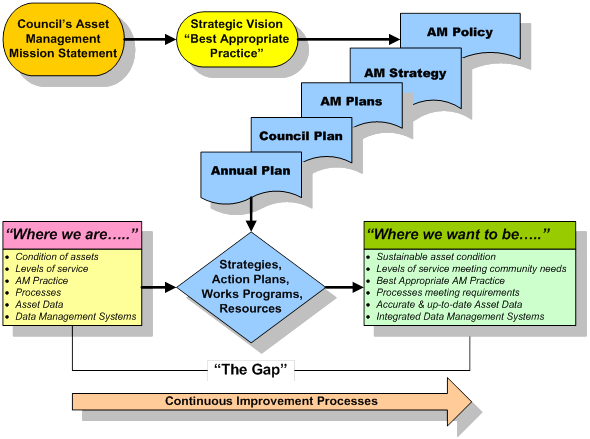
Chart –Planning Process Linkages
Council has commenced the process of developing a robust strategic planning process built around a policy framework established through a careful analysis of economic capacity, risk mitigation and soundly based service standards.
A strong relationship has been developed between asset maintenance, asset renewal and the annual budget decision-making process based on an informed assessment of the resources required to achieve continuous improvement to Council's asset base.
Road expenditure, capital and maintenance, is assessed on the basis of road category, traffic type and volume, road condition, maintenance consumption, associated risk and customer request. A process for evaluating all asset improvement requests has been developed and is in the process of being implemented.
Each year’s annual program is based on an annual review of the 10 year forward capital program with current year works being prioritised on the basis of road category, traffic type & volume, road condition, maintenance consumption, associated risk and customer request.
The 10 year forward capital program is regularly reviewed by Council taking into account economic capacity, road category, traffic type and volume, road condition, maintenance consumption, associated risk and customer request.
APPENDIX B – STANDARDS FOR UPGRADING AND RENEWAL OF ROAD ASSETS
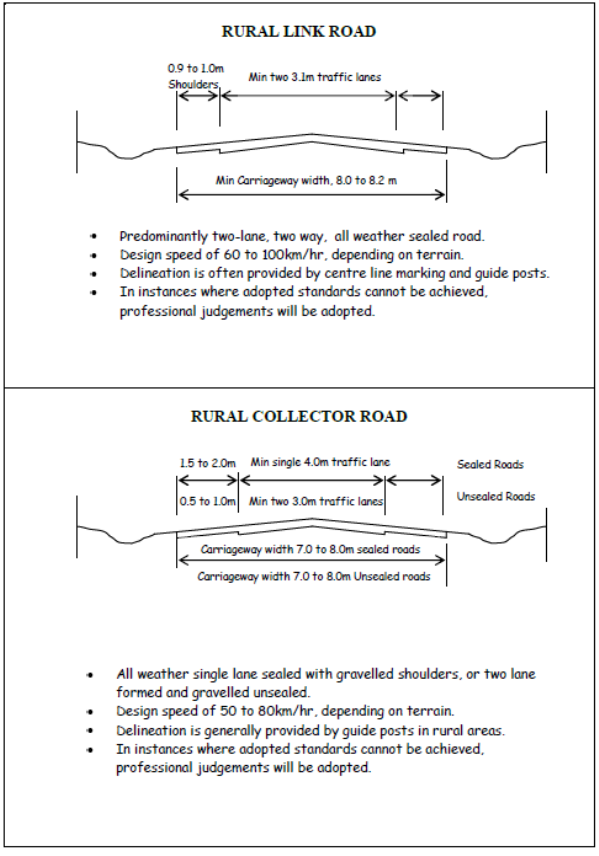
APPENDIX B – STANDARDS FOR UPGRADING AND RENEWAL OF ROAD ASSETS
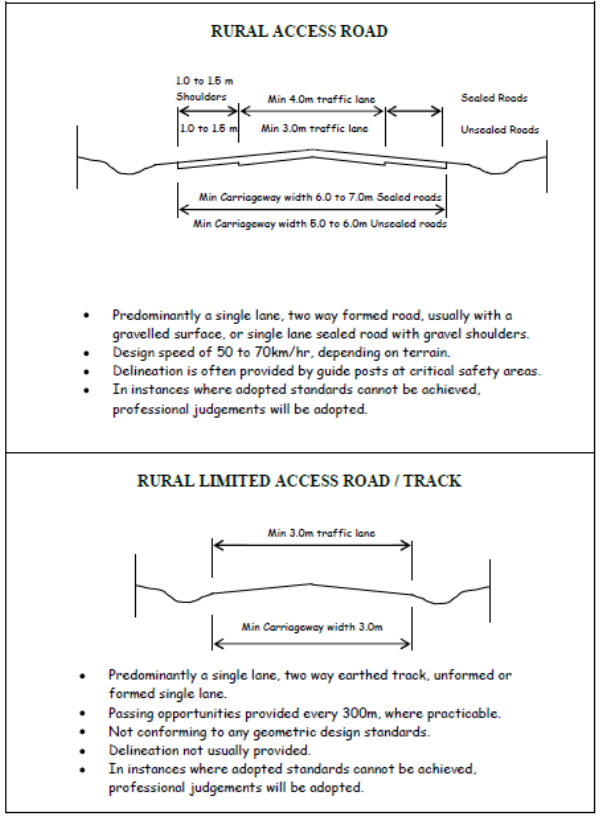
APPENDIX C – DESCRIPTION OF HAZARD AND HAZARD RESPONSE
|
PAVEMENTS |
||||
|
Description of Hazard |
Response Time by Classification |
|||
|
|
Link Road |
Collector Road |
Access Road |
Minor Road |
|
Obstructions and Substances in Traffic Lane |
||||
|
Materials fallen from vehicles, dead animals, wet clay and other slippery substances, hazardous materials, accumulation of dirt or granular materials on the traffic lane of sealed roads |
3 days |
1 week |
1 week |
Minor Roads not generally maintained – recognition of defects and hazards to be in accord with instruction from Coordinator Works |
|
Ponding of water >300mm deep, fallen trees, oil spills, stray livestock. |
24 hours |
3 days |
1 week |
As above |
|
Pavement of Surface Defects |
||||
|
Potholes in traffic lane of a sealed pavement greater than 300mm in diameter and greater than 100mm deep or in the traffic lane of an unsealed pavement greater than 500mm diameter and 150mm deep |
1 month |
2 months |
3 months |
As above |
|
Deformations greater than 100mm under a 3m straight edge |
1 month |
2 months |
3 months |
As above |
|
Edge drops onto unsealed shoulder greater than 100mm |
1 month |
2 months |
3 months |
As above |
|
Drainage |
||||
|
Damaged or missing drainage pit lids, surrounds, grates, in pedestrian areas or traffic lanes. |
1 Month |
2 months |
3 months |
As above |
|
ROADSIDES |
||||
|
Vegetation - Trees, Shrubs and Grassed Areas |
||||
|
Tree limbs or trees that have been classified as in danger of falling and causing a danger to the public |
24 hours |
3 days |
1 week |
As above |
|
Trees, shrubs or grasses that have grown to restrict design sight distance to intersections or restrict viewing of safety signs |
1 month |
2 months |
3 months |
As above |
|
Vegetation intruding within an envelope over roadways from the back of shoulder and/or kerb and a minimum of 5m height clearance over pavement and the trafficable portion of shoulders. |
3 months |
6 months |
12 months |
As above |
|
Safety signs missing, illegible or damaged making them substantially ineffective |
1 month |
2 months |
3 months |
As above |
|
Guideposts missing or damaged at critical locations making them substantially ineffective |
3 months |
6 months |
12 months |
As above |
|
Safety barriers and fencing missing or damaged at critical locations making them substantially ineffective |
3 months |
6 months |
12 months |
As above |
|
Pavement markings missing, illegible or confusing at a critical location |
1 month- |
2 months |
3 months |
As above |
|
STRUCTURES |
||||
|
Damage affecting structural performance. |
24 hours |
24 hours |
1 week |
As above |
APPENDIX C – DESCRIPTION OF HAZARD AND HAZARD RESPONSE
|
FOOTPATHS AND PATHWAYS |
||
|
Footpath Classification |
Primary Access Route |
Secondary Access Route |
|
Defective pedestrian areas with a step greater than 25mm |
6 months |
12 months |
|
Vegetation which presents a physical hazard to the public over pedestrian/bicycle paths, intruding into a clearance envelope between the edges of path and a minimum of 2.5m height clearance over path. |
6 months |
12 months |
When Council inspects or is notified of a hazard, Council will rectify it if possible, or provide appropriate warning within the response time indicated. Where, because of the nature of the repair required, level of resources required or workload, it is not possible to rectify within the time shown, appropriate warning of the hazard is to be provided until the repair can be completed
Appropriate warning could include, for example:
· Provision of warning signs,
· Traffic control action
· Diverting traffic around the site,
· Installation of a temporary speed limit,
· Lane closure,
· Closure of the road to use by certain vehicle (eg a load limit), or
· Road closure
· Or any other measure which reasonably addresses the duty of care to road users.
Minor roads are inspected on an as needed basis and repair works will be attended to when resources become available.
APPENDIX D – ROAD AND FOOTPATH HIERARCHY MAPS
Buloke Shire Council Ordinary Meeting Agenda Wednesday, 14 June 2017
8.2.6 Adoption of Road Management Plan 2017-21
Attachment 3 Footpath maps
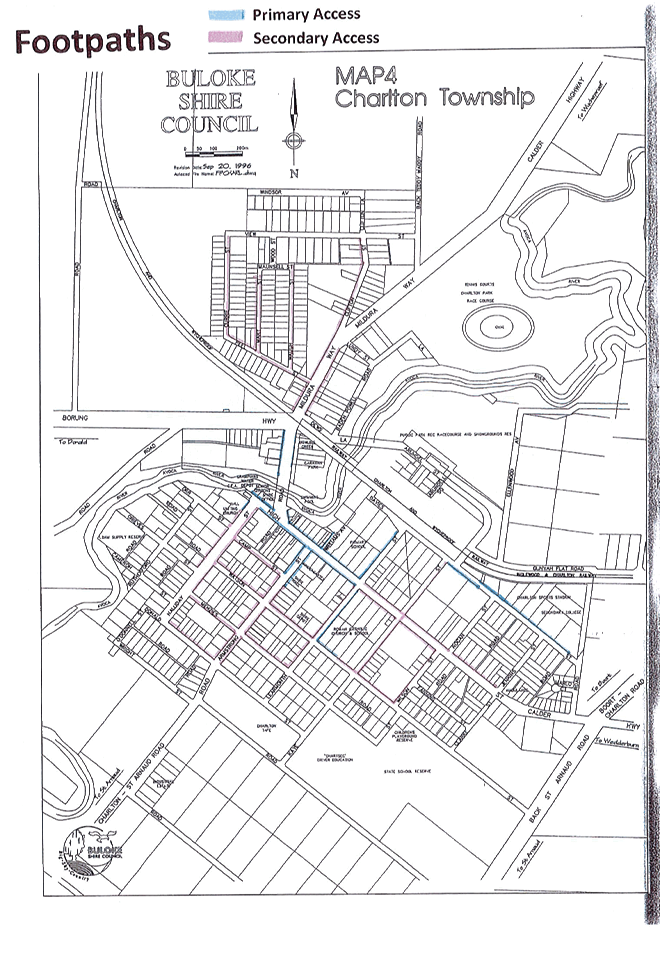
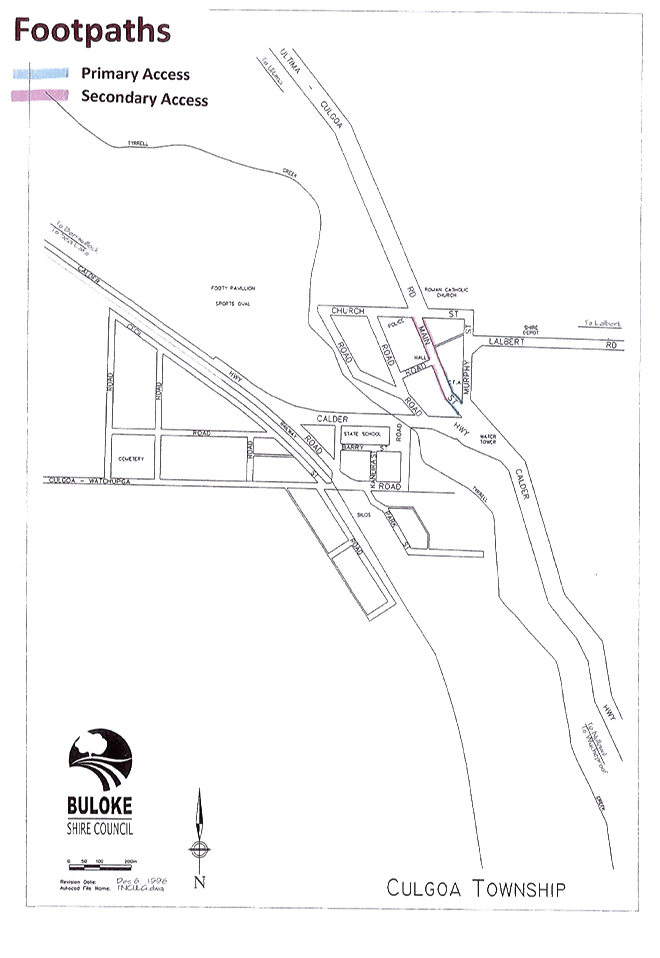
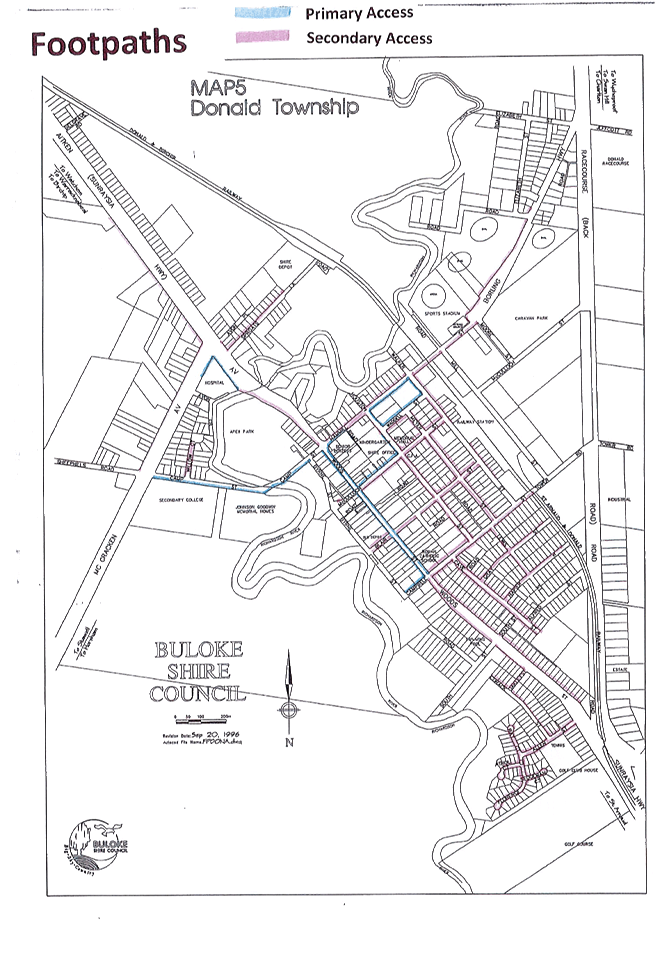
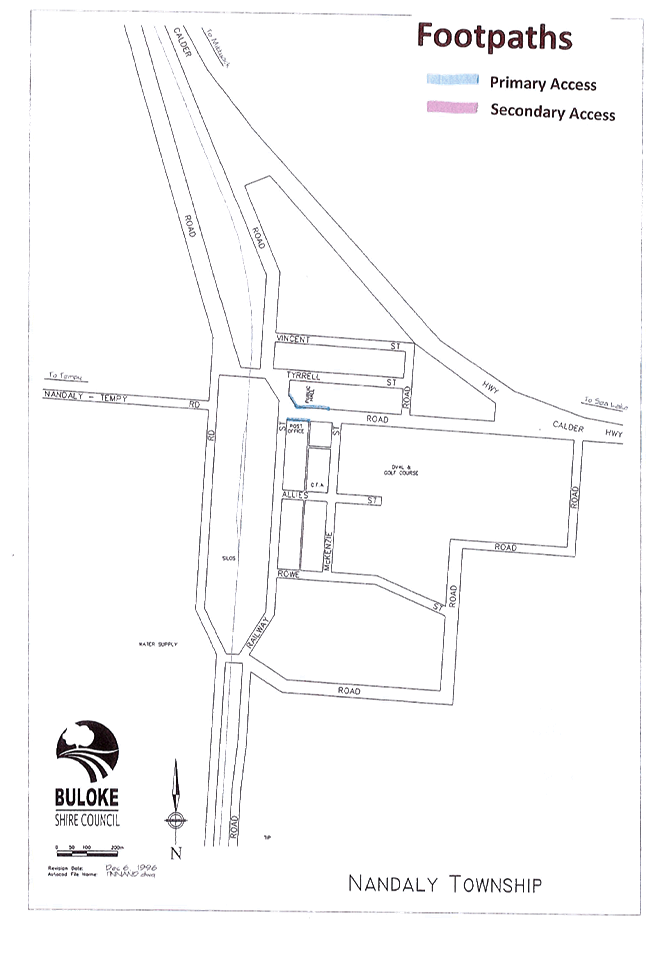
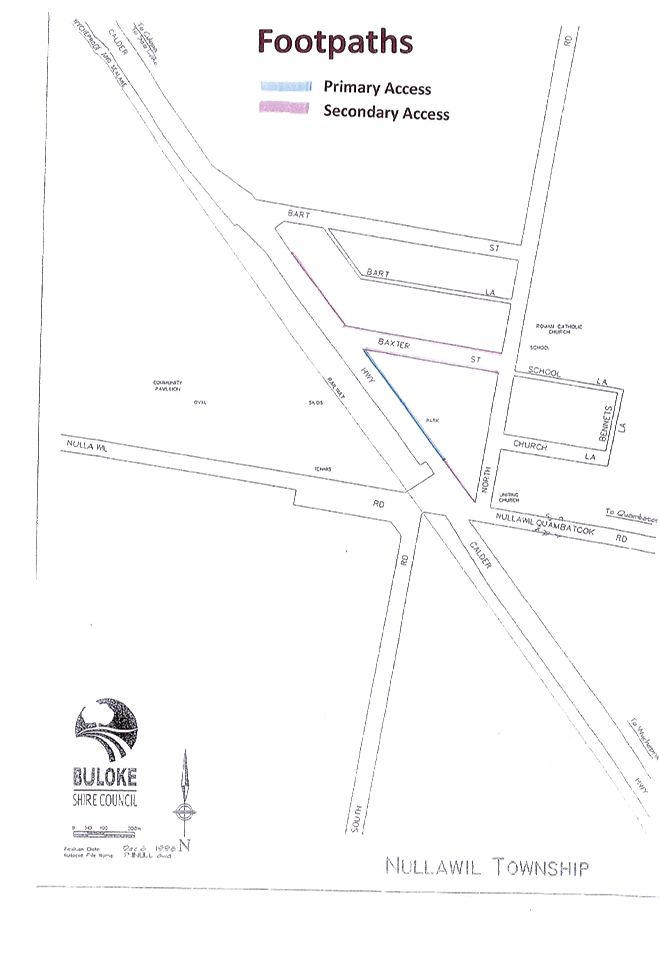
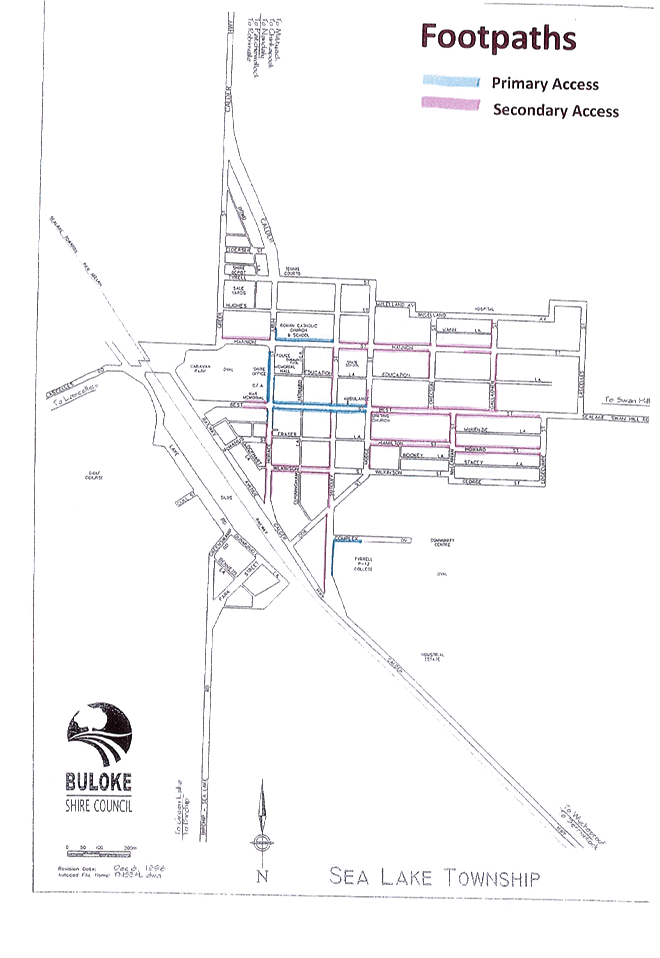
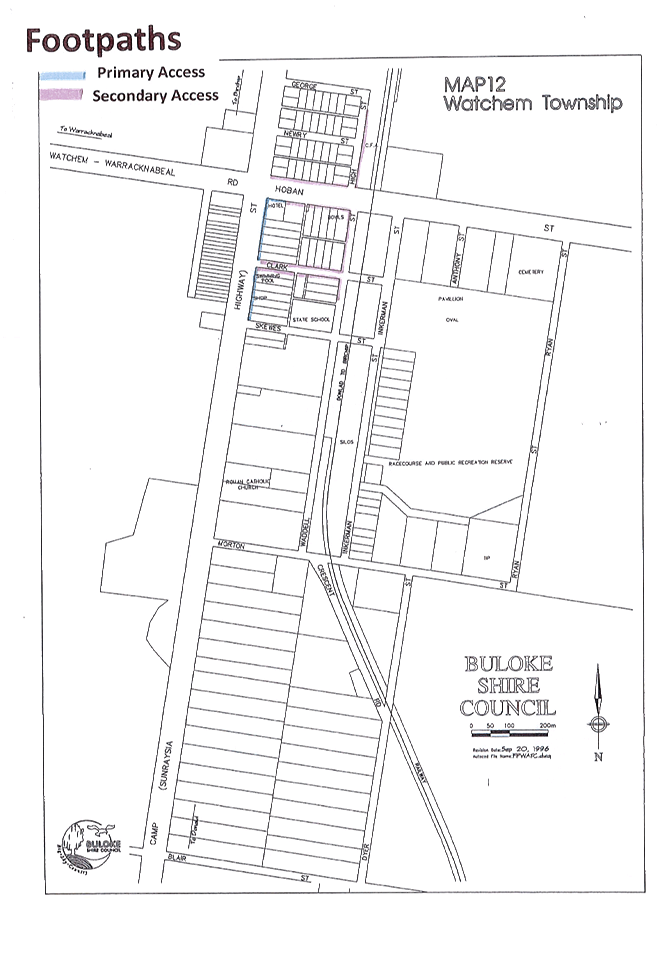
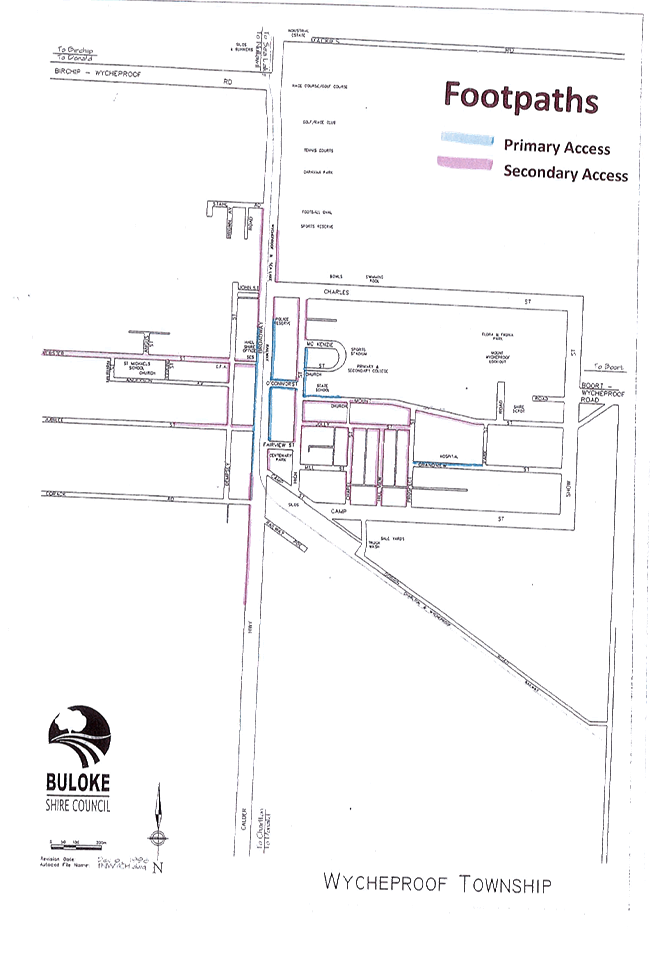
8.2.7 Submissions for the Buloke Shire Council Draft Budget 2017-2018
Author’s Title: Director Corporate Services
Department: Corporate Services File No: FM/05/02
|
1 Sub No. 1 - 2017/18 Draft Budget 2 Sub No. 2 - 2017/18 Draft Budget |
Relevance to Council Plan 2015 - 2019
Strategic Objective: Delivering our services in a financially sustainable way
|
That Council: 1. Receive submissions in respect of the Draft Budget 2017-2018 adopted for public exhibition on 10 May 2017 in accordance with section 223 of the Local Government Act 1989. |
1. Executive Summary
At the Ordinary Meeting of Council 10 May 2017, Council adopted the Draft Budget 2017-2018 for public exhibition. Written submissions were received until 12 June 2017 and the public were invited to present their submissions to Council at its Ordinary Council Meeting of 14 June 2017. Council will then adopt a 2017/18 budget at the Special Council Meeting on 21 June 2017 after considering these submissions
2. Discussion
As at the date of this Report, the following written submissions have been received by the Buloke Shire Council:
|
Sub No. |
Submitter |
Subject |
|
1 |
Brock Crowe |
Request for funding a skate park in Sea Lake |
|
2 |
Donald 2000 Inc. |
Request to investigate possibility of early partial repayment of $7.0million loan under Victorian Local Government Funding Vehicle (LGFV) |
|
3 |
Mark Phayer |
Request for capital works to enhance visual amenity and address lack of storm water drains |
|
4 |
Buloke Tourism Board |
Request freeze of registration fees for small businesses for next five years |
Any further submissions will be tabled at the 14 June 2017 Ordinary Meeting.
3. Financial Implications
The information received will inform Council’s deliberations on the Budget for 2017/18.
4. Cost Shift Considerations
Nil
5. Community Consultation
A Community Forum Summit was held on 10 April 2017 to discuss key assumptions and factors considered as part of the Draft Budget preparation process.
Council advertised the Draft Budget in local papers and make it available for inspection at the Wycheproof Council office and on Council’s website. Members of the public were invited to make written submissions by 4pm on 12 June 2017. Those who have made a written submission were invited to make a verbal submission to the Ordinary Council Meeting on 14 June at 7.00pm at the Wycheproof Supper Room
6. Internal Consultation
Councillors received a briefing on the key assumptions underpinning the Draft Budget in February 2017. A further briefing with Councillors was held on 5 April 2017, which included a presentation of proposed capital projects. The financial reports, as contained within the Draft Budget document (including the Strategic Resource Plan) were provided for Councillors for consideration and discussion on 19 April 2017. The 2017/18 Draft Budget was provided to the Audit Advisory Committee on 28 April 2017.
7. Legislative / Policy Implications
This process is an integral part of the requirements of the Local Government Act 1989.
8. Environmental Sustainability
Environmental matters were considered as part of the Council services to be delivered under the proposed budget.
9. Conflict of Interest Considerations
There are no conflict of interest considerations associated with this report.
10. Conclusion
Submissions received and presentations provided will form part of Council’s consideration in respect of the budget to be adopted for 2017/18.
Buloke Shire Council Ordinary Meeting Agenda Wednesday, 14 June 2017
8.2.7 Submissions for the Buloke Shire Council Draft Budget 2017-2018
Attachment 1 Sub No. 1 - 2017/18 Draft Budget
Buloke Shire Council Ordinary Meeting Agenda Wednesday, 14 June 2017
8.2.7 Submissions for the Buloke Shire Council Draft Budget 2017-2018
Attachment 2 Sub No. 2 - 2017/18 Draft Budget
Buloke Shire Council Ordinary Meeting Agenda Wednesday, 14 June 2017
8.2.7 Submissions for the Buloke Shire Council Draft Budget 2017-2018
Attachment 3 Sub No. 3 - 2017/18 Draft Budget
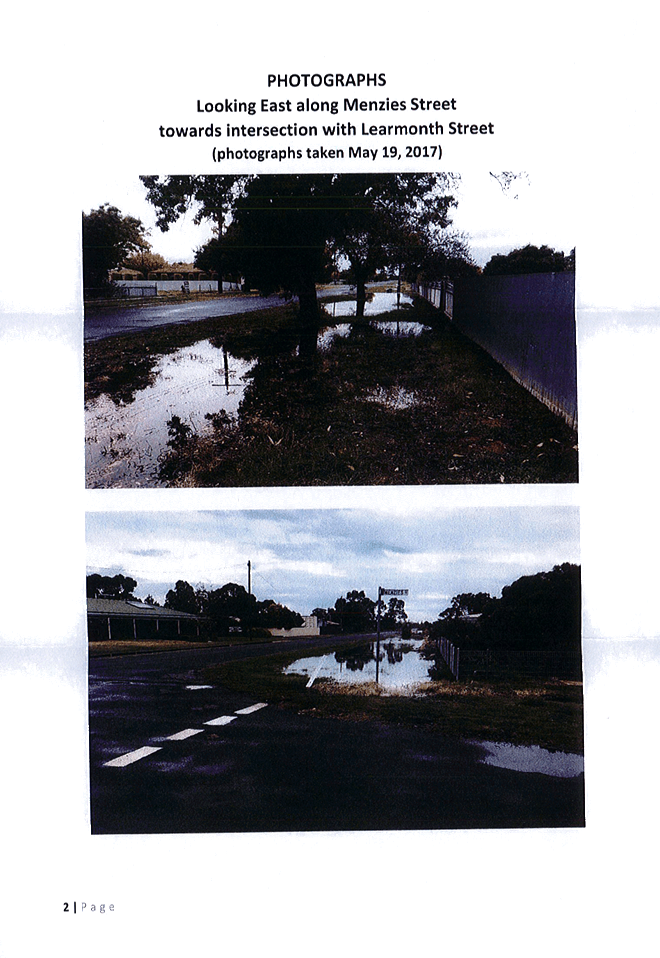
Buloke Shire Council Ordinary Meeting Agenda Wednesday, 14 June 2017
8.2.7 Submissions for the Buloke Shire Council Draft Budget 2017-2018
Attachment 4 Sub No. 4 - 2017/18 Draft Budget
8.2.8 Organisation Development Strategy
Author’s Title: Acting Manager Risk and Human Resources
Department: Risk and Human Resources File No: PE/06/10
Relevance to Council Plan 2013 - 2017
Objective: An organisation that values and supports the development of its people and is an employer of choice.
Strategy: Continuing to improve the organisation and its people to provide our community, businesses and visitors with the best possible services.
Priority: Build the future workforce through continuation of the apprenticeship, trainee and graduate programs across the organisation.
|
That: 1. That Council endorse the Buloke Shire Organisation Development Strategy.
|
1. Executive Summary
Section 94A of the Local Government Act 1989 (Vic) sets out the functions of a Council’s Chief Executive Officer, which include establishing and maintaining an appropriate organisational structure for the Council and the day-to-day management of the Council’s operations in accordance with the Council Plan.
A key component of the development of an appropriate organisational structure and, in turn, the management of Council’s business is ensuring that values and commitments are strategically aligned with individual performance and development, to achieve an interconnected, sustainable and high-achieving workplace.
In view of this, an Organisation Development Strategy has been developed, setting out Council’s plans, ambitions and commitment to staff and the community, in order to bring about significant improvements in organisational effectiveness, including the maximisation of employee performance.
This strategy will provide a framework for managers to make staffing decisions based on Council’s Vision and Values, in addition to the Budget and other key plans and strategies. In other words, it integrates Human Resource Management with broader business planning and organisation development.
2. Discussion
The needs of the community and financial pressures demand that we continually review and seek improvements to efficiencies and work practices. A process of continuous improvement requires Council to establish relevant measures in key areas to support development and change. Organisational development allows Council to continue as a sustainable and effective organisation within a competitive environment and against budget and service delivery pressures. Workforce planning forms a key strategic activity to ensure there are sufficient people, and the right people, to carry out the organisation’s purpose.
The Strategy details the way in which Council intends to work with staff to help everyone reach their potential whilst ensuring that the values and commitments set out reflect the direction of the organisation and appropriately recognise and respond to the strategic pressures facing Council. Key strategic themes include leadership and skills development, maximising staff engagement, recruitment and retention of high quality staff, supporting cultural transformation, learning, development and a continued focus on providing safe systems of work.
3. Financial Implications
This Strategy requires the organisation, and individual departments, to consider their long-term strategic requirements. Some actions within the Strategy require high level developmental and organisation input from the Human Resources and Risk Department, with minimal financial cost to Council, for example, recruitment, policy and procedural actions. Other costs have been considered as part of the current projected budget allocation and forecasts.
However, some items such as those arising from a Workforce Plan and an expanded human resource information system and employee self-service kiosk may require a more considerable budgetary investment. A suitable human resources information system and employee self-service technologies will enable Council to be more effective in managing its workforce. The new corporate information system scope will include this functionality.
4. Cost Shift Considerations
There are no cost shift implications.
5. Community Consultation
Community consultation is not required.
6. Internal Consultation
The Organisation Development Strategy has been discussed and reviewed by the Senior Management Team. Further consultation with individual departments will be required as the actions are implemented and reviewed by the Senior Management Team.
7. Legislative / Policy Implications
Consistent with Council’s legislative requirements and best practice, the Senior Management Team continually review the operational requirements and structure of their Departments to ensure they are meeting the changing needs of Council.
In line with legislative requirements and the changing needs of the organisation, Council continually reviews the organisational structure to ensure that the composition of departments meets current and future requirements.
8. Environmental Sustainability
There are no environmental sustainability considerations.
9. Conflict of Interest Considerations
No staff member involved in the preparation of this report has a direct or indirect conflict of interest.
10. Conclusion
The Organisation Development Strategy aims to develop Council’s capacity and capability to respond to internal and external challenges and changes and to increase Council’s effectiveness and efficiency. It provides an implementation plan for actions which address culture change, leadership development, learning and development, talent management, attraction and retention and a continued focus on Workplace OH&S. This document sets out the role of the Human Resources area in this process.
Buloke Shire Council Ordinary Meeting Agenda Wednesday, 14 June 2017
8.2.8 Organisation Development Strategy
Attachment 1 Organisational Development Strategy
Introduction
– Chief Executive Officer
The Buloke Shire Council Organisational Development (OD) strategy has been developed to ensure that we have the right people, capability and culture to deliver efficient and effective services to the Buloke community and a culture of performance and innovation to respond to the challenges that face the sector.
The strategy responds to the new Council Plan 2017-2021 and in particular will deliver on Objective 5 “Support our Councillors, staff, volunteers and the community make informed and transparent decisions” and Strategy 5.2 “Ensure the Buloke Organisational Development Strategy supports our culture”
This document sets the direction for the organisation for the next few years and beyond.
It is important to acknowledge that Buloke Shire Council is a strong and loyal organisation. The organisation possesses people, knowledge, assets and financial resources that form the foundation for a strong future even though we still face many challenges.
The strategy identifies aspects of the organisation that will benefit from initiatives to deliver improvements and prepare us for the future.
Our OD strategy focuses on five key areas.
1. Culture – we want to create an organisation where employees are inspired to perform at a high level and deliver quality outcomes, while building a culture of continuous improvement
2. Leadership development –we want to build the capability and confidence of our leaders and provide career paths for our employees
3. Learning and development and talent management—we need to build our employees’ capability to achieve their potential and ensure robust succession plans are in place
4. Attraction and retention-we want Buloke to develop a reputation and work environment that will attract and retain high calibre staff
5. Occupational health and safety – We must continue strengthen our safe systems of work and build a health and safety focussed work culture. We want all staff to return home safely at the end of each work day.
To ensure the successful implementation of the Buloke Shire Council Organisational Development strategy will take commitment, drive and enthusiasm from all levels within our organisation. I encourage you to get involved wherever you can. By working together, we will be able to respond to our future challenges with the knowledge, skills and structure to deliver excellent services to our Community.
What is Organisational Development and why is it important?
Organisational Development is based upon a set of underlying values which recognise the importance of managing change in an incremental and developmental fashion. It focuses on Council’s formal structures and processes, as well as the development of individual staff who work within our organisation. The ultimate aim of organisational development is to consolidate change through recognition and promotion of desired behaviours, continuous review of Council processes and identification of new projects and actions which will assist Council’s staff to deliver on objectives outlined within its Council Plan.
A secondary, but nevertheless important, function of Council’s organisational development strategy is ensuring, wherever possible, Council’s legislative responsibilities are consistently and effectively managed. These functions include, but are not limited to, Occupational Health and Safety and Equal Opportunity.
The link between the strategic pressures facing Council and the critical area objectives within Council’s organisational development strategy are outlined below. Efforts will be focussed on five critical areas which will help reach the desired changes to the organisation.
1. Line of sight to Business Direction
The key
people strategy issues Council will need to work on in order to effectively
deliver on Business and Council Plans.
|
Strategic Pressures facing Council |
Strategic response to these pressures |
People-related impact |
Focus for People Strategy |
Critical Area Objective |
|
Rising community expectations of service delivery resulting in resource pressures |
Council has now placed itself in a financially sustainable position but this position is subject to many external pressures which can affect it |
Need to align employees with the business direction and values |
Foster an inclusive, open and innovative organisation based on a sharing team orientated culture |
Culture/ Attraction and Retention |
|
Higher cost of service delivery and budget pressure against a State Government rate capping program
|
Flexible, customer-focused service delivery and responsible negotiations of enterprise agreements |
Develop values and behaviours that reflect an inclusive, open and innovative culture and that can be demonstrated by all employees. Create an effective and efficient up-skilling process |
HR’s role becomes strategic and customer/development-focused rather than ‘administrative and enforcement’ focused |
Leadership Development |
|
Scrutiny from compliance-based organisation and increased reporting requirements |
Continuous improvement of information technology and information sharing |
Strong leadership and management. Good governance, financially viable and accountable organisation |
Leadership roles based on building strong relationships and creating a work environment that engages staff |
Learning Development and Talent Management |
|
Increasing workforce capabilities to ensure that accountability is an inherent part of role responsibilities |
Continued development and implementation of culture development program |
Work environment that engages, retains and attracts staff |
Management and development of employees by leaders. Creation of self-sufficient and resilient teams |
Learning Development and Talent Management/ Attraction and Retention |
|
Increased service delivery pressures resulting in possible increased risk of accidents and injury to people and staff, and resulting in possible financial and other penalties to Council |
Proactive identification of OHS risks, and development and implementation of a Health and Safety Management Plan |
Safe working environment that fosters proactive approach to OHS within the workplace |
Training and Development for all employees, with focus on management training in proactive OHS management. Regular analysis of workforce incidents and investigations |
OHS |
2. Areas of focus for the Organisational Development Strategy
|
EMT |
Extended Management team |
SMT |
Senior Management team |
RHR |
Risk and Human Resources team |
MCO |
Media and Communications Officer |
Culture
Create an organisation where employees are inspired to perform at a high level and deliver quality outcomes, while building a culture of continuous improvement.
|
Priority |
Actions |
2017/18 |
2018/19 |
2019/20 |
Responsibility |
|
Promote positive behaviours within extended management team |
Develop the appropriate behaviours and undertake peer feedback behaviours that demonstrate the organisational values |
l |
|
EMT |
|
|
Work with business units to develop behaviours |
Workshop with employees per unit basis |
l |
|
SMT |
|
|
Assess employees against the desired positive behaviours as part of the annual review process |
Update performance review package, distribute and educate supervisors and staff |
l |
l |
l |
RHR |
|
Create a culture conducive to equal treatment of employees |
Adopt Equal Opportunity Program and promote to staff |
l |
|
RHR |
|
|
Establish high quality communication and consultation between management and employees |
Develop and implement an effective communication process |
l |
l |
l |
SMT |
|
Assess employee and culture alignment, including satisfaction with the organisation |
Undertake workplace survey every two years and develop and implement improvement plans to address key staff issues |
|
l |
|
RHR |
|
Ensure organisational compliance with external requirements and alignment with strategic objectives |
Conduct audit on all HRM policies and procedures |
|
l |
|
RHR |
|
Investigate ICT options to enable provision of timely, comprehensible information |
Investigate possible corporate system providers, with capacity to deliver HRIS requirements |
|
l |
|
RHR DCS |
Leadership Development
Build the capability and confidence of leaders and provide a career path
|
Priority |
Actions |
2017/18 |
2018/19 |
2019/20 |
Responsibility |
|
Develop the skills and capabilities of emerging leaders |
Develop and implement emerging leadership program across Council based on capability framework, with particular focus on performance management, coaching, team building, conflict resolution and Council systems and processes. |
l |
|
l |
RHR |
|
Support managers and supervisors to build on knowledge of specific topic areas. |
Ensure individual leadership development needs are captured during formal and informal performance discussions, and supported through provision of online resources, mentoring and coaching relationships, external providers and on-the-job training activities. |
l |
l |
l |
SMT |
|
Promote professional and personal development for emerging leaders |
Create opportunities for emerging leaders though cross-departmental working groups, higher duties, networking opportunities and secondments |
l |
l |
l |
SMT |
Learning and Development, and Talent Management
Build employee capability to achieve potential
|
Priority |
Actions |
2017/18 |
2018/19 |
2019/20 |
Responsibility |
|
Develop ability of staff to deliver current and future services in accordance with Council’s strategic objectives |
Continue to update and review Council’s workforce matrix, identifying skills and delivery gaps to align personal and professional development needs to Council and community objectives |
l |
l |
l |
RHR |
|
Design and develop corporate training program comprising of compliance and discretionary training |
Incorporate group training identified in individual performance reviews into corporate training plan |
l |
l |
l |
RHR |
|
Monitor effectiveness of training and development |
Provide opportunity for feedback on training activities, including course content and objectives, to ensure relevance to organisation |
l |
l |
l |
RHR |
|
Proactively recognise and develop possible successors to critical positions |
Develop a succession plan which establishes a 2IC for each critical position as part of long-term workforce plan |
l |
l |
l |
SMT |
Attraction and Retention
Develop a reputation that attracts and retains high calibre staff
|
Priority |
Actions |
2017/18 |
2018/19 |
2019/20 |
Responsibility |
|
Continue to improve Council’s recruitment and branding |
Review and improve employment page on website and explore opportunities to better utilise social media as part of recruitment strategy |
l |
|
|
RHR |
|
Improve retention of new employees |
Review and update induction and on-boarding practices |
|
l |
|
RHR |
|
Improve retention of existing staff |
Establish effective exit process, including updates to exit interviews and trend reporting |
|
l |
|
RHR |
|
Encourage and reward staff by recognising significant contributions to Council and the community |
Continue celebrating staff milestones on a regular basis |
l |
l |
l |
EMT |
|
Communicate Council’s commitment to demonstrating effective attraction and retention strategies |
Enter Buloke Shire Council into Employer of Choice awards |
|
|
l |
RHR |
|
Review of performance management system and established performance objectives |
Continue to review and update position descriptions as required to ensure salary is relative to duties undertaken |
l |
l |
l |
SMT |
|
Ensure staff are provided with fair pay, conditions and recognition consistent with industry standards and organisational goals |
Negotiate and implement Buloke Shire Council Enterprise Agreement |
l |
|
|
SMT |
|
Ensure staff can access and benefit from a range of services and initiatives to maintain their health and wellbeing |
Continue development of Staff Wellbeing Program |
l |
l |
l |
RHR |
Occupational Health and Safety (OHS)
Provision of safe systems of work
|
Priority |
Actions |
2017/18 |
2018/19 |
2019/20 |
Responsibility |
|
Develop and support a culture which embraces wellbeing, health and safety as key priorities |
Develop and implement OHS training and education process for managers, supervisors and staff |
l |
l |
l |
RHR |
|
Prevent and minimise injury and lost-time through proactive hazard identification process |
Review opportunities to implement an incident reporting system to enable effective reporting on trends |
l |
|
|
RHR |
|
Ensure up-to-date knowledge and compliance with OHS legislation |
Conduct audit on all OHS policies and procedures |
l |
|
|
RHR |
ATTACHMENT 1
1. Workforce metrics (as at 30 April 2017)
|
Full time |
91 |
|
Part time |
46 |
|
Casual |
29 |
|
Female |
73 |
|
Male |
93 |
|
Age |
|
|
21-25 |
1 |
|
26-30 |
6 |
|
31-35 |
12 |
|
36-40 |
26 |
|
41-60 |
100 |
|
61-40 |
40 |
|
Classification |
|
|
CEO |
1 |
|
Senior Executive Officers |
4 |
|
Band 1 |
12 |
|
Band 2 |
19 |
|
Band 3 |
55 |
|
Band 4 |
24 |
|
Band 5 |
22 |
|
Band 6 |
17 |
|
Band 7 |
7 |
|
Band 8 |
1 |
|
Maternal and Child Health Nurse |
2 |
|
Immunisation Nurse |
2 |
2. Workplace profile:
Buloke Shire Council has offices and depots in Birchip, Charlton, Donald and Wycheproof. Council operates a Depot in Sea Lake; and home and community care services out of Birchip, Charlton, Donald, Sea Lake and Wycheproof.
As at 30 April 2017, the Buloke Shire Council had 110.12 FTE staff.
· 2 full time and 1 (.4 FTE) vacancies
· 91 full time staff (comprised of 72 male and 19 female staff)
· 49 part time staff (comprised of 10 male and 39 female staff)
· 29 casual staff (comprised of 14 male and 15 female staff)
Overall, the Buloke Shire Council’s FTE workforce is made up of around 56% male employees and 44% female employees. The gender balance varies within each department.
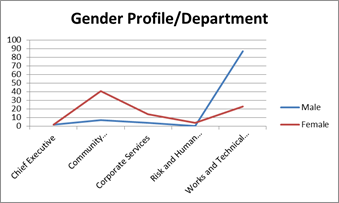
4. Length of Service: 69% of Buloke Shire Council staff have been with Council for 10 years or less. 10% of staff have worked with Council for over 20 years.
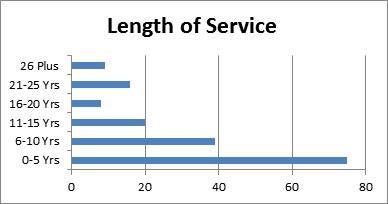
5. Turnover: The staff turnover rate is identified in the graph below. Exit interviews with staff are recommended however not compulsory. A renewed focus on obtaining exit surveys is now in place with a view to build information as to why staff chose to leave Council.
Reasons for turnover could include position no longer required, to pursue other job opportunities, family reasons and possible with Council/working environment.
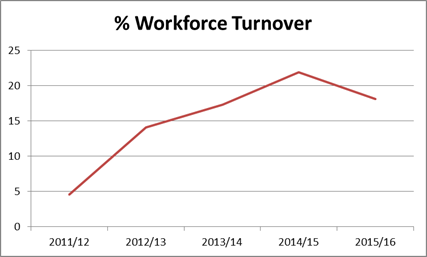
*NB: % workforce turnover increases during 2013/14, and 2014/15 years related to Council’s decision to refocus on core service delivery in order to meet financial constraints
6. Age: 45% of Council’s workforce is aged 55 or over, with the highest percentage in Community Development (24) and Works & Technical Services (47).e.
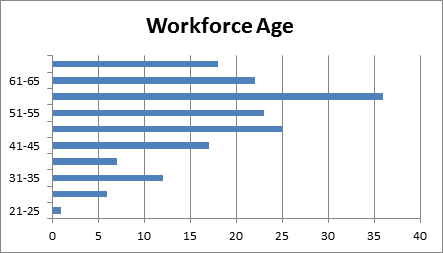
8.2.9 Mt Wycheproof Telecommunications Tower lease
Author’s Title: Coordinator Community Facilities
Department: Works and Technical Services File No: PR/02/01
|
Nil |
Relevance to Council Plan 2015 - 2019
Strategic Objective: An organisation that is responsibly governed with a strong emphasis on sustainable financial and risk management.
|
That Council: 1. Publically advertises its intention under Section 223 of the Local Government Act 1989 to enter into a lease with Telstra Corporation Limited for a telecommunications tower on Mt Wycheproof.
2. Receives a subsequent report at the conclusion of the Section 223 period to consider any submissions. |
1. Executive Summary
The existing lease of land for the purposes of a telecommunications tower by Telstra has concluded, and a new lease needs to be established. As the land resides on Crown land, an appropriately constructed Crown 17D lease is required under the Crown Land (Reserves) Act 1978.
2. Discussion
The current lease with Telstra Corporation Limited for the use of Mt Wycheproof as a location for a telecommunications tower concluded on 31 May 2017. Council officers have been negotiating with Telstra to establish a new lease for the site. In order to pursue this lease, the appropriate process under the Local Government Act 1989 s190 is to undertake a 28 day public consultation period for the proposed lease.
Mt Wycheproof is gazetted as a Public Park and Council appointed as the Committee of Management The lease of the land requires approval by the State Government and in-principle approval of the new lease is currently being sourced from the Department of Environment, Land, Water and Planning.
The proposed lease is an initial five-year term, with two additional five year options.
The previous lease attracted an annual rent of $4,000 per annum. Currently Council directs $2,000 income from the existing lease to Wycheproof VISION to support in-kind community work on the mountain.
The tower has significant community benefit as it provides telecommunication signal to the Wycheproof area.
3. Financial Implications
The new lease will attract a rental of $5,418.33 per annum and increase by 3% CPI each year. Should Council decide to not enter into a lease there would be a loss of income from the lease, and also implications for Telstra to remove its infrastructure.
4. Cost Shift Considerations
There are no cost shift considerations within this report.
5. Community Consultation
Council is required to undertake a public consultation process under section 223 of the Local Government Act 1989.
6. Internal Consultation
Senior Management has been consulted through the process of forming this report.
7. Legislative / Policy Implications
Council is required to comply with the requirements of the Local Government Act 1989 and the Crown Land (Reserves) Act 1978 in the establishment of this lease.
8. Environmental Sustainability
There are no environmental aspects to this report.
9. Conflict of Interest Considerations
No officer involved in the formation of this report holds a conflict of interest.
10. Conclusion
It is recommended Council publically advertises its intention under Section 223 of the Local Government Act 1989 to enter into a lease with Telstra Corporation Limited for a telecommunications tower on Mt Wycheproof, and receives a subsequent report to consider any submissions.
8.2.10 Annual Review of the Buloke Domestic Animal Management Plan for 2017
Author’s Title: Director Community Development
Department: Planning and Community Support File No: EM/01/01
Relevance to Council Plan 2015 - 2019
Strategic Objective: An organisation that is responsibly governed with a strong emphasis on sustainable financial and risk management.
|
That Council: 1. Adopt the annual review of the Buloke Domestic Animal Management Plan for 2017. |
1. Executive Summary
Council is required to have a four year Domestic Animal Management Plan (DMAP) under the Domestic Animal Act 1994. In addition they are required to submit an annual review of the DAMP by November of each year to the Minister. The annual review has been undertaken and figures within the DAMP altered to reflect the new data.
2. Discussion
The annual review has been undertaken and figures within the DAMP altered to reflect the new data. The review was undertaken as a desktop exercise with no community consultation as a new DAMP will be required in 2018 and as such consultation including with the community and relevant stakeholders will commence in the latter half of 2017.
A new format is being proposed for the DAMP and it is expected sessions about how to undertake the new format DAMP will be hosted by the Department in the following months.
The DAMP covers a range of domestic animal management areas including:
- Our data and statistics
- Our staff and qualifications
- Emergency management for domestic animals
- Dangerous dogs and dog attacks
- Domestic animal businesses
The review made changes to the:
- Staffing and structure to reflect recent changes
- Updated statistics on registrations and complaints
The Plan looks at a range of strategies employed by our authorised staff to manage domestic animals.
3. Financial Implications
There are no financial implications in relation to the annual review, however a new DAMP may have implications on operational resources.
4. Cost Shift Considerations
There are cost shift considerations in relation to the annual allocation of registrations collected on behalf of the State by Council that is then transferred to the Bureau of Animal Welfare. Buloke Shire Council contributes approximately $4,000 per year with no assistance provided for that amount.
5. Community Consultation
There has been no community consultation in the process of undertaking the annual review, however as detailed in the discussion a new DAMP will be required from 2018 onwards and considerable community consultation will occur at that time.
6. Internal Consultation
There has been internal consultation undertaken with the Planning Department in relation to any domestic animal business permit applications and with Customer Service in relation to inquiries and complaints received.
7. Legislative / Policy Implications
It is a requirement under the Domestic Animal Act 1994 that Council submit a new DAMP every four years and also submit an annual review of the DAMP by the 3rd November 2017.
8. Environmental Sustainability
The environmental impacts of feral domestic animals on the environment are considered within the DAMP.
9. Conflict of Interest Considerations
No officer involved in the preparation of this report had a conflict of interest.
10. Conclusion
It is recommended that Council adopt the annual review of the Buloke Domestic Animal Management Plan for 2017.
Buloke Shire Council Ordinary Meeting Agenda Wednesday, 14 June 2017
8.2.10 Annual Review of the Buloke Domestic Animal Management Plan for 2017
Attachment 1 Domestic Animal Management Plan - Annual review

BULOKE SHIRE COUNCIL
DOMESTIC ANIMAL
MANAGEMENT PLAN 2013-2017

1. Introduction:
The Domestic Animals Act 1994 requires that every four years a Council prepare a Domestic Animal Management Plan. The plan must identify issues prescribed by the Domestic Animals Act 1994, relating to responsible pet ownership and animal management as well as requirements in Council’s Local Law dealing with animal ownership and animal control.
1.1 The Legislative Requirements
The relevant provisions of the Domestic Animals Act are as follows:
68A Councils to prepare domestic animal management plans
(1) Every Council must, in consultation with the Secretary (of the Department of Primary Industries), prepare at 4 year intervals a domestic animal management plan.
(2) A domestic animal management plan prepared by a Council must—
(a) set out a method for evaluating whether the animal control services provided by the Council in its municipal district are adequate to give effect to the requirements of this Act and the regulations; and
(b) outline programs for the training of authorised officers to ensure that they can properly administer and enforce the requirements of this Act in the Council's municipal district; and
(c) outline programs, services and strategies which the Council intends to pursue in its municipal district—
(i) to promote and encourage the responsible ownership of dogs and cats; and
(ii) to ensure that people comply with this Act, the regulations and any related legislation; and
(iii) to minimise the risk of attacks by dogs on people and animals; and
(iv) to address any over-population and high euthanasia rates for dogs and cats; and
(v) to encourage the registration and identification of dogs and cats; and
(vi) to minimise the potential for dogs and cats to create a nuisance; and
(vii) to effectively identify all dangerous dogs, menacing dogs and restricted breed dogs in that district and to ensure that those dogs are kept in compliance with this Act and the regulations; and
(d) provide for the review of existing orders made under this Act and local laws that relate to the Council's municipal district with a view to determining whether further orders or local laws dealing with the management of dogs and cats in the municipal district are desirable; and
(e) provide for the review of any other matters related to the management of dogs and cats in the Council's municipal district that it thinks necessary; and
(f) provide for the periodic evaluation of any program, service, strategy or review outlined under the plan.
(3) Every Council must—
(a) review its domestic animal management plan annually and, if appropriate, amend the plan; and
(b) provide the Secretary with a copy of the plan and any amendments to the plan; and
(c) publish an evaluation of its implementation of the plan in its annual report.
This plan is the current plan with a planned expiry date of November 2017, Consultation will begin six months prior to the expiry of this plan.
1.2 Facts about Buloke Shire
The Buloke Shire covers an area of 8,001 square kilometres in the North-West of Victoria. The length of the Shire is approximately 160 kilometres in a north south direction and approximately 80 kilometres wide from east to west. There is a lot of distance to cover for compliance purposes.
Buloke Shire is mostly a dry farming area with grains and sheep being the predominant farming activity.
There are five main townships in the municipality being Birchip, Charlton, Donald and Sea Lake, Wycheproof. Smaller townships within the municipality are, Berriwillock, Culgoa, Nandaly, Nullawil and Watchem.
The largest population is at Donald (1355) and the smallest population is Sea Lake which has a population 616.[1] . During the 2015/2016 year most complaints regarding domestic animals come from urbanised areas within the Shire. The towns with the largest populations have generated the largest amount of animal complaints as demonstrated in the table below:-
|
Township |
Population |
Approx dog registrations 2015/2016 |
Approx cat registrations 2015/2016 |
Complaints received 2015/2016 |
|
Charlton |
968 |
187 |
73 |
29 |
|
Donald |
1355 |
218 |
71 |
44 |
|
Birchip |
662 |
101 |
20 |
20 |
|
Wycheproof |
628 |
103 |
53 |
26 |
|
Sea Lake |
616 |
102 |
34 |
12 |
|
Other areas |
2155 |
469 |
60 |
42 |
These figures appear to be consistent with patterns emerging in other urbanised areas in Victoria.
2. APPROACH TO AND STRUCTURE OF THE PLAN
The Plan follows the template provided by the Department of Environment and Primary Industries who are primarily responsible for the legislation.
The Plan contains:
Part 1 – Introduction and overview of the Buloke Shire.
Part 2 outlines how:
· The Plan was developed; and
· Factors in Buloke Shire that influences current animal management practices in the shire and will continue to influence future approaches.
Part 3 describes how:
· Council will achieve and implement its objectives and goals.
· The plan will address each objective and include discussion that explains the issues
Part 4 identifies how:
· The Buloke Shire will be monitor and review and evaluate if the proposed goals and objectives were successfully achieved.
2.1 Process applied in developing the Plan
In determining the key issues for this Plan, including the factors identified in paragraph 1.2 above, the following matters were also considered:
· Statutory requirements applying to animal management
· Recommendations made by the Department of Environment and Primary Industries
· Expectations from community based on “call outs”, administration and enforcement of the legislative requirements
· Data analysis based on Council’s Customer service system
· Information obtained from networking with Animal Management Officers from other local government areas.
As a result of the analysis, key issues identified are:
· Ongoing training of authorised officers;
· Registration and identification of animals;
· Management of cats, specifically nuisance and feral cats;
· Management of dogs, including attacks & rushes, nuisance dogs and dogs at large
· Management of dangerous, menacing and restricted breed dogs; and
· Emergency management (welfare of dogs and cats)
2.2 Local issues in domestic animal management
There are several factors that influence the day to day practices associated with animal management. These are:
· 5 main towns and 5 smaller townships interspersed amongst rural properties which increases the risk of dogs attacking stock and being at large;
· a rural lifestyle which appears to encourage increased domestic animal ownership;
· an ageing population and low income households which appears to contribute to unregistered animals being kept;
· limited resources of Council and the sheer size of Shire; and
· no veterinary services located within the Shire.
2.3 Local enforcement functions
Authorised Officers enforce the Domestic Animals Act in relation to:
· nuisance dogs, primarily arising from barking dogs and dogs at large;
· nuisance cats arising from feral populations and cats at large;
· dog attacks/rushes;
· dangerous, menacing and restricted breed dogs;
· domestic animal businesses;
· registration and identification of dogs and cats;
· operation of Council domestic animal pound; and
· compliance with Local Law requirements.
In addition, Authorised Officers with responsibility for domestic animals assist with enforcement of relevant matters under Council’s Planning Scheme, such as compliance with conditions on a planning permit for breeding and domestic animal businesses.
2.4 Council Local Laws and Orders
Council’s Community Local Law No 10 2011 contains a number of requirements about domestic animal control and management as well as amenity and welfare issues related to animal ownership. These provisions are:
· Clause 14 - Keeping Excess Animals which prescribes the numbers of animals and specifically dogs and cats, that can be kept on land at any one time.
· Clause 15 Animal Housing – which prescribes standards and requirements to reduce noise and nuisance and appropriate housing for the type of animals being kept on the land.
· Clause 19 subclauses (1), (2) and (5) contains requirements relating to animals in public places.
2.5 Animal Management Statistics
Analysis of current data shows that there has been a small decline in the number of registered domestic animals in the municipality and in the number of estimated domestic animals in the municipality.
Table 1: Key Animal Management Statistics
|
|
Buloke Shire 2013/2014 |
Buloke Shire 2014/2015 |
Buloke Shire 2015/2016 |
|
Population |
6982 |
|
|
|
Area |
8000 sq km |
|
|
|
No. EFT Authorised Officers |
1 |
1 |
1 |
|
No. of registered dogs |
1214 |
1201 |
1180 |
|
Estimated owned dog population |
1835 |
1835 |
1835 |
|
No. of registered cats |
328 |
321 |
293 |
|
Estimated owned cat population |
516 |
516 |
516 |
|
No. of registered declared[2] dogs |
2 |
3 |
1 |
|
No. of reported dog attacks/rush |
29 |
47 |
25 |
|
No. of nuisance complaints |
147 |
54 |
40 |
|
No. of impoundments (dogs) |
36 |
25 |
23 |
|
No. of dogs returned to owner |
28 |
13 |
15 |
|
No. of dogs rehoused |
4 |
8 |
5 |
|
No. of dogs euthanised |
2 |
4 |
3 |
|
No. of impoundments (cats) |
63 |
31 |
0 |
|
No. of cats returned to owner |
3 |
0 |
0 |
|
No. of cats rehoused |
16 |
4 |
0 |
|
No. of cats euthanised |
44 |
27 |
0 |
2.6 Staffing and organisation structure
Currently Council has 2 effective full time staff in the Compliance Section who are responsible for administering a range of legislation that regulates animals, including domestic animals.
These Officers also undertake further duties including local laws, livestock control and fire prevention. In respect to the Domestic Animals Act, a shared role results in 1 effective full time officer with responsibility for animal management.
One full time officer is experienced and the other has commenced in early 2017 with Council and will be learning on the job whilst undertaking a Certificate IV in Local Government (Compliance).
Staffing and Operational Structure
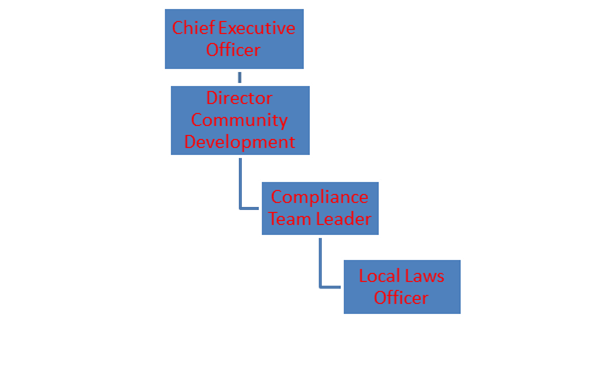
2.7 Current programs and services
Buloke Shire Council provides the following domestic animal services to the community.
· identification and registration;
· random registration checks and doorknocks;
· investigation of dog attacks & nuisance complaints;
· management of Council’s domestic animal pound;
· euthanasia;
· registration and auditing of domestic animal business;
· investigation and enforcement of dangerous and restricted breed dog legislative provisions;
· developing and maintaining partnerships with organisations such as veterinary clinics, animal welfare groups and other stakeholders;
· educating residents and promoting responsible pet ownership; and
· routine patrols undertaken by officers to throughout Shire.
3. STRATEGIC APPROACH TO DOMESTIC ANIMAL MANAGEMENT IN THE BULOKE SHIRE
Section 68A of the Domestic Animals Act prescribes the content of a Domestic Animal Management Plan. The following sections respond to that requirement.
3.1 Training of authorised officers - Section 68A(2)(b)
3.1.1 Current situation - summary
Training options are annually reviewed to ensure relevant and up to date skills and knowledge. While training options can be limited Council endeavours to provide a variety of training programs is offered and provided for all Authorised Officers.
Staff members have completed or commenced Certificates in Animal Control and Regulation to improve skills in animal behaviour assessment and handling, welfare and impounding.
Staff has also completed or commenced Certificate IV or equivalent in Government (Statutory Compliance) that addresses communication skills, customer service, Occupational Health and Safety, ethical behaviour, regulatory powers, undertaking investigations, preparing a brief of evidence and court procedures including the presentation of evidence.
Staff are encouraged to attend regular briefings and conferences provided by the Bureau of Animal Welfare. Topics include updates on amendments to legislation and case studies of topical issues.
Within the North West Victoria context, training opportunities are sometimes limited because of distance, cost and competing priorities. Council officers use alternative methods to be informed of contemporary issues in animal management such as regional authorised officers group meetings and dedicated websites that have been developed to assist officers in the field such as the Bureau of Animal Welfare extranet.
3.1.2 Our plans
Objective 1: Ensure all staff involved in animal management posses the knowledge and skill necessary to carry out their work
|
Activity |
When |
Evaluation |
Outcome |
|
Current Training Level · Investigate future training opportunities that will enhance officer knowledge · Provide ongoing training opportunities |
Ongoing
Ongoing |
Annual review will identify relevant and topical staff training needs and assess their value |
Ongoing |
|
Staff to attend Bureau of Animal Welfare forums and training days |
Ongoing |
Measure and report on application of information |
Achieved |
|
Conduct a skills audit |
Annually |
Incorporated into staff performance reviews |
Achieved |
3.2 Registration and identification - Section 68A(2)(c)(v)
3.2.1 Current situation - summary
Analysis of current data shows that there is a small decrease in the number of domestic animals registered in the municipality. There is also a decline in the number of domestic animals that are sterilised. The assumption for decline is the overall decline in the Buloke population and an argument could also be made that the cost of pet ownership is prohibitive for some people.
Our data:
|
Class of Registration |
2012/2013 |
2013/2014 |
2014/2015 |
2015/2016 |
|
Registration Dogs |
1311 |
1214 |
1201 |
1180 |
|
Registration Cats |
369 |
328 |
321 |
293 |
|
Permits to keep excess animals |
9 |
6 |
3 |
0 |
|
Sterilised Dogs |
598 |
584 |
652 |
651 |
|
Sterilised Cats |
335 |
301 |
298 |
281 |
Our Orders, local laws, council policies and procedures:
Council has previously resolved to require that all dogs registered in the Shire be permanently identified by microchip and that there be no exemptions to that requirement for registration requirements.
Our education/promotion activities
Council uses its website and its community newsletter “Community Matters” which is distributed through local press to residents to advise of key animal management matters and specifically, registration of animals. This includes registration “reminders” in the Community Matters edition before April 10 in each year.
Council provides and actively uses information pamphlets from the Bureau of Animal Welfare to provide information to residents.
As part of the administration and enforcement process Council officers also provide information regarding animal registration and identification requirements under the Act.
Our compliance activities
Council approaches its domestic animal registration and identification requirements proactively. Compliance activities include:
· Advertise in Community Matters advising that registration must be effected by April 10
· annual mail out of dog and cat registration renewal form which occurs in mid March
· Issue animal registration renewal reminders
· follow up of non-renewals by telephone or visit.
· random doorknocking is targeted to specific areas.
· microchip scanners are provided to all Animal Management Officers and Customer Service Centres.
· Ensure that all Impounded animals that are released are registered and microchipped prior to release.
· Enforcement of non compliance with legislative requirements.
3.2.2 Our Plans
Objective 2: Increased dog and cat registration compliance
|
Activity |
When |
Evaluation |
Outcome |
|
Send out early reminders of registration requirements - mail out of registration renewal forms |
Annually (Feb/Mar) |
Pets registered by 10 April |
Achieved |
|
Use Councils website to promote and advise residents of the benefits of microchipping |
Ongoing |
Increased numbers of microchipped animals |
Achieved |
|
Provide information with “on hold” phone calls |
Annually/ongoing |
|
Achieved |
|
Using Council publications and Council website notifying residents of the requirement to register dogs and cats |
February/March |
Record of media releases |
Achieved |
|
Registration renewal reminder notices sent to owners |
April/May |
Ensure registration |
Achieved |
|
Conduct an annual telephone and doorknock to follow up outstanding registrations to gain compliance |
Ongoing |
Number of unregistered dogs and cats detected |
Achieved |
|
Regularly update/audit registration database to ensure information is current (e.g. amend data to reflect notifications of deceased animals, change of address, change of owner) to ensure owners are not distressed or annoyed by receiving unnecessary or incorrect renewal notices or not receiving a renewal notice at all
|
Annually |
Demonstrate accuracy and accurate reporting of registration numbers. |
Ongoing |
3.3 Nuisance - Section 68A(2)(c)(vi)
3.3.1 Current situation - Summary
Complaints regarding nuisance dogs and cats is ongoing. Staff will continue to address these issues and work towards further educating owners to be more responsible to ensure their animals are not a nuisance to the community.
Our data[3]
CUSTOMER REQUEST SYSTEM DATA - ANIMALS
|
Complaint type |
2012/2013 |
2013/2014 |
2014/2015 |
2015/2016 |
|
Animal Found |
71 |
27 |
16 |
10 |
|
Animal Lost |
12 |
46 |
27 |
38 |
|
Barking dog |
12 |
25 |
4 |
28 |
|
Cat Trap request |
111 |
44 |
18 |
5 |
|
Nuisance/Feral Cats |
25 |
60 |
15 |
12 |
|
Cruelty to animals |
12 |
6 |
17 |
5 |
|
Dog wandering |
83 |
47 |
39 |
60 |
|
Animal welfare |
9 |
16 |
17 |
14 |
|
TOTAL |
335 |
271 |
153 |
156 |
Our orders, local laws, council policies and procedures
The objectives of the Community Local Law No. 10 are directed at community amenity (nuisance) and community safety.
Clause 14 requires a local law permit to keep more than 2 dogs or 2 cats on each property in a township and more than 6 dogs or 6 cats outside townships.
The Local Law also contains requirements to ensure that nuisance is not caused because of the way in which animals are kept. This includes nuisance from noise. Owners of animals must ensure that animal housing is kept in a clean, sanitary and inoffensive condition so that nuisance is not caused because of smell, rubbish or pests and vermin attracted to land because of food kept on the land. (clause 15).
The Local Law also regulates animal control in public places. Requirements in clause 19(1), (2) and (5) require dogs to be on a leash other than in areas designated by the Council[4], require animal faeces to be removed by the person in control of the dog and require that a person not keep animals in a way that is a nuisance or which could be dangerous or injurious to the health of another person.
Our education/promotion activities
Provide information on
· Council’s website and local media about responsible pet ownership.
· messages for on hold phone calls.
Our compliance activities
Compliance undertakes the following activities relating to nuisance animals:
· Record all nuisance complaints on Council’s Customer Service database to track resolutions, repeat offenders and ensure Officers follow set tasks and procedures.
· respond to calls on a priority basis
· response immediate during office hours to alleged dog attacks.
· investigated as soon as possible all reports of nuisance dogs
· Impound wandering dogs and cats.
· Provide education programs to owners regarding nuisance problems
· Maintain Councils domestic animal pound.
3.3.2 Our plans
Objective 3: Ensure dogs and cats are confined to their property
Summary
Dogs and cats at large are a constant source of complaint
|
Activity |
When |
Evaluation |
Outcome |
|
Investigate and undertake patrols to locate animals wandering at large |
Ongoing |
Measure and evaluate on previous statistical information |
Ongoing |
|
Educate the public and promote awareness of the need for dogs and cats to be confined to their property |
Ongoing |
Decrease in the number of complaints of wandering dogs and cats |
Ongoing |
|
Impound animals found at large |
Ongoing |
Ensure animals are registered prior to release |
Ongoing |
|
Pursue appropriate enforcement action against owners who fail to confine animals to their property |
Ongoing |
Type and frequency of enforcement action |
Ongoing |
Objective 4: Prevent nuisance caused by barking dogs
|
Activity |
When |
Evaluation |
Outcome |
|
Investigate all barking dog complaints as soon as practicable, ( forward barking dog complaint information to both parties) |
Ongoing |
Decrease in the number of complaints |
Ongoing |
|
Encourage owners of barking dogs to seek advice from Council/professional dog trainer/animal behaviourist on how to reduce their dog’s barking |
When a barking dog complaint is received. |
Reduction in complaints |
Ongoing |
Objective 5: Prevention of dog faeces in public places
|
Activity |
When |
Evaluation |
Outcome |
|
Advise dog owners of legal requirements relating to cleaning up dog excrement by distributing education material on Council website, media reports and signage in public places |
Ongoing |
Reduction in complaints |
Ongoing |
|
Purchase and installation of dog excrement bag dispensers in recreation and shopping areas |
2013 |
Purchased and to be installed during 2013 |
Installed |
|
Audit dispensers for location and usage |
2014 |
Audit results |
Ongoing |
3.4 Dangerous, menacing and restricted breed dogs - Section 68A(2)(c)(vii)
3.4.1 Current situation - summary
All complaints regarding suspected undeclared restricted breed dogs are investigated. Investigations often reveal there is confusion by the public regarding the actual breed description of a dog. Currently there are no known restricted breed dogs within the Shire. Council will continue to monitor this situation and will deal with any issues as they arise.
Our data
Currently there are no known or declared dangerous dogs or restricted breed dogs registered in Buloke Shire. There has been no incidents which has resulted in an animal being declared dangerous or restricted. Two menacing dog declarations were made in 2011/2012 being for rush or minor attack. During 2013, 1 menacing dog declaration has been made to date.
Our orders, local laws, council policies and procedures
Local Law staff have been delegated authority to declare a dog dangerous or menacing.
Our education/promotion activities
Provide information on Council’s website and local media about responsible pet ownership and the consequences of failing to comply with requirements applied to declared dangerous or menacing dogs or restricted breed dogs.
Our compliance activities
Council does not accept new registrations of restricted breed dogs.
Reports or complaints of suspected menacing or dangerous dogs are investigated and enforcement action taken, including prosecution, when appropriate.
Suspected dogs are checked against the Victorian Declared Dog Register.
3.4.2 Our plans
Objective 6: Identify and regulate dangerous, menacing and restricted breed dogs within the Buloke Shire
|
Activity |
When |
Evaluation |
Outcome |
|
Develop procedures for dealing with declaring dogs dangerous or menacing |
2014 |
Procedure to be developed |
Ongoing |
|
Review registration fee schedule to reflect the cost of managing dangerous, menacing and restricted breed dogs |
2014 |
Review completed |
Ongoing |
Objective 7: Identify Restricted Breed Dogs within Buloke Shire
|
Activity |
When |
Evaluation |
Outcome |
|
Investigate all reports of suspected restricted breed dogs |
Ongoing |
Record of investigations |
Ongoing |
|
Audit registration data base for known or suspected restricted breed dogs |
Ongoing
|
Audit completed |
Achieved |
|
Educate the community about what is a restricted breed dog |
2014 |
Information available on web sites and media releases |
Ongoing |
3.5 Dog attacks - Section 68A(2)(c)(iii)
3.5.1 Current situation - summary
Dog attack allegations are investigated by Council.
Our data
Twenty five reports of dog attacks were received in 2015/2016 consisting of:-
· 14 reports of dog rushing
· 7 attacks on animals
· 4 attacks on people.
In the period July 2015 to March 30,2017 6 owners have been prosecuted in the Magistrates Court for allowing their dog/s to rush or attack.
Our orders, local laws, council policies and procedures
· Clause 19(1) of the Community Local Law requires dogs to be on a leash in a public place unless the council has designated an area in which dogs can be unleashed.
· No current order made under section 26 of DAA. by Council
Our education/promotion activities
Education and prevention activities include:
· Information is provided in Council’s “Community Matters” and also on Council’s website. Information and brochures from the Bureau of Animal Welfare are distributed to animal owners emphasizing the need to keep dogs under effective control, which includes the containment of dogs on the property so they cannot escape.
Our compliance activities
· Council undertakes regular patrols throughout the Shire to ensure that dogs are not allowed to wander at large.
· Any dog that is impounded and offered for adoption is assessed to ensure that it is suitable for rehousing.
· Dog attacks matters are attended to immediately. The matter is thoroughly investigated to ensure that if a prosecution is required the investigations undertaken and the evidence gathered will satisfy the evidentiary requirements of a court.
Council will prosecute an owner in court if required. In some cases Council is unable to act due to insufficient evidence or unreliable witnesses. On occasions the owner of the attacking dog/s has taken their own action and euthanised the dog. Council requires evidence of such actions.
3.5.1 Our plans
Objective 8: Decrease number of dog attacks
|
Activity |
When |
Evaluation |
Outcome |
|
Continue to investigate all reports of dog attacks |
Ongoing |
Decrease in number of attacks |
Achieved |
|
Continue to attend all reports of dogs wandering at large |
Ongoing |
Decrease in number of attacks |
Ongoing |
Objective 9: Improve reporting of dog attacks
|
Activity |
When |
Evaluation |
Outcome |
|
Improve public awareness of the need to report dog attacks |
Ongoing |
Web site and media reports |
Ongoing |
3.6 Overpopulation and high euthanasia rates - Section 68A(2)(c)(iv)
3.6.1 Current situation - Summary
There is a continual issue regarding feral cats within urban areas. This issue can be compounded by residents who feed and encourage feral cats to frequent an area or property.
Council staff will attend each town on a rotational basis for a period of three days throughout the year to target trap feral cats in areas identified beforehand by the community.
Council has entered into agreements under section 84Y of the Domestic Animals Act with animal welfare and foster groups. These organisations assist Council to rehouse suitable animals. All domesticated cats and dogs that are unsuitable for rehousing are humanely euthanised.
 Our data
No cats were impounded in 2015/2016.
23 dogs were impounded in 2015/2016.
· 15 dogs were claimed by their owners
· 5 dogs were re-housed
· 3 dogs were euthanised.
Our orders, local laws, council policies and procedures
Clause 14 of the Community Local Law restricts the number of dogs and cats that can be kept on a property. While the objective is primarily one of community amenity, there are a number of benefits arising from the restriction. The requirement to obtain a permit to have excess animals is generally a deterrent to a person having more than the numbers of animals prescribed, resulting in a reduction in the number of dogs and cats. Further, the requirement assists with ensuring that the practice “backyard breeding” is minimised. These benefits assist with over population and the need to euthanise unwanted animals.
Our education/promotion activities
Education and promotion activities conducted by Council include:
· promote the benefits of de-sexing to pet owners including receiving reduced registration costs
Our compliance activities
The following activities that are undertaken in an attempt to address high rates of euthanasia include:
· investigate reports of animal hoarding, and where required work with the owners to reduce numbers.
· working with residents to discourage feeding of wild cat populations.
· assessment of impounded dogs and cats for rehousing in the community.
3.6.2 Our plans
Objective 10: Raise awareness about feral cats and undertake activities to reduce populations
|
Activity |
When |
Evaluation |
Outcome |
|
Identify any cat colonies, try to identify “feeder” and coordinate a trapping program |
Ongoing |
Decrease number of feral cats in community |
Ongoing |
|
Encourage cat owners to be responsible and contain cats and adopt a night time curfew |
Ongoing |
Number of cats trapped |
Ongoing |
Objective 11: Removal of unwanted dogs from community
|
Activity |
When |
Evaluation |
Outcome |
|
Impounding dogs wandering at large |
Ongoing |
Decrease number of unwanted dogs in community |
Ongoing |
|
Use website and media to promote the benefits of de-sexing a dog |
Ongoing |
Report and measure number of impounded dogs which are desexed |
Achieved |
3.7 Domestic animal businesses - Section 68A(2)(c)(ii)
3.7.1 Current situation - summary
Buloke Shire has 2 domestic animal businesses. One is privately owned and Council operates the domestic animal pound. An audit is undertaken annually to ensure compliance with the relevant Code of Practice. Council relies on information supplied by the public to assist with the possible identification of suspected illegal activities. Officers investigate all reports received.
The minimum accepted standard for the operation of a domestic animal businesses is set out in the relevant Department of Environment and Primary Industries Code of Practice.
Our data
Buloke has 2 registered Domestic Animal Businesses consisting of:
· 1 breeding establishment
· 1 Council domestic animal pound
Domestic animal businesses are audited annually with particular emphasis on the relevant Department of Environment and Primary Industries Code of Practice. Any non-compliance issues are enforced in accordance with Council’s Planning Scheme and Local Law requirements.
Our orders, local laws, council policies and procedures
The Community Local Law is not applicable.
The provisions of the Domestic Animals Act and the Planning and Environment Act are considered prior to the approval of a domestic animal businesses.
Our education/promotion activities
Provide guidance and provide a copy of the relevant Code of Practice to proprietors of existing and proposed domestic animal businesses .
Ensure domestic animal businesses are advised of any changes to the Code of Practice or relevant legislation.
Our compliance activities
Council actively investigates any reports received regarding registered and unregistered Domestic Animal Businesses. In addition, there is:
· Inspection and audit of all identified domestic animal businesses within the municipality
· investigation of all reported complaints about domestic animal businesses and all reports of unauthorised “backyard breeders” to ascertain whether they should be registered as a domestic animal business
· Check notice boards and other classifieds advertising animals for sale.
3.7.2 Our plans
Objective 12: Annually inspect and audit all registered domestic animal businesses and investigate any suspected unregistered business
|
Activity |
When |
Evaluation |
Outcome |
|
Conduct annual audit of all registered domestic animal businesses located within the municipality |
Annually |
Audit report |
Achieved |
Objective 13: Investigate any suspected unregistered domestic animal businesses
|
Activity |
When |
Evaluation |
Outcome |
|
Investigate all reports of suspected unregistered domestic animal businesses |
Ongoing |
Investigation of reports |
Ongoing |
|
Ensure all known domestic animal businesses are registered and comply with the statutory requirements of the Planning Scheme and Codes of Practice |
Ongoing |
Number of notices to comply issued Number of notices of contravention issued |
Ongoing |
|
Monitor notice boards and newspapers for evidence of suspected Domestic Animal Businesses |
Ongoing |
Measure and report results during review |
Ongoing |
3.8 Emergency management - Section 68A(2)(e)
3.8.1 Current situation - Summary
Council’s current Municipal Emergency Management Plan references the Buloke Local Laws Department as being responsible for domestic animal management as a particular recovery function. The Municipal Fire Management Plan 2010 (a sub plan of the Municipal Emergency Management Plan) recognises animals, including companion animals as a risk in the Risk Register component of the Plan. It prescribes a risk treatment being liaison with animal welfare support agencies to deliver animal welfare services including accessing injured and affected animals in emergencies, with an emphasis on the needs of commercial primary producers.
The Department of Environment & Primary Industries is the lead agency in respect to animals during an emergency, but the focus is primarily on livestock, not domestic animals.
Further expansion in the Plan could be given to how domestic management of animals in an emergency situation may take place.
Our data
No data in relation to this matter currently exists.
Our orders, local laws, Council policies and procedures
With the exception of the recognition of animal welfare as a risk in the Municipal Fire Management Plan and the Buloke Local Laws Department as being responsible for domestic animal management as a particular recovery function there is no extensive regulation in this area.
Our education/promotion activities
There are no specific education programs targetted at the owners of domestic animals about the management of domestic animals in an emergency. Such programs could be developed to provide owners of domestic animals with advice regarding their responsibilities and possible options for the care of domestic animals during emergencies.
3.8.2 Our plans
Objective 14: Emergency Management Planning
|
Activity |
When |
Evaluation |
Outcome |
|
Encourage the Municipal Emergency Management Planning Committee to include further domestic animal management procedures into the plan |
2017 |
Municipal Emergency Management Plan to be reviewed to expand on domestic animal issues |
Ongoing |
|
Educate owners regarding emergencies |
Ongoing |
Council website and local press releases |
Ongoing |
Objective 15: Promote emergency planning to ensure the welfare of animals in emergencies
|
Activity |
When |
Evaluation |
Outcome |
|
Liaise with domestic animal businesses about their emergency plans |
2014 |
Number of visits to discuss emergency management |
Ongoing |
|
Discuss emergency animal welfare plans and assess Council policy for evacuation/ relief centres with Municipal Emergency Response Officer |
2014 |
Item considered by Council Municipal Emergency Management Planning Committee |
Ongoing |
|
Provide education to residents regarding planning for their pets in emergencies |
2014 |
Department of Primary Industry information distributed and link available on website |
Ongoing |
ANNUAL REVIEW OF PLAN AND ANNUAL REPORTING - Section 68A(3)
Summary
The Domestic Animals Act 1994 requires Council to undertake an annual review of the Domestic Animal Plan. This review will allow Council to gather statistics to monitor overall performance and ascertain if the objectives in the plan are being achieved in a timely manner. The information relating to the annual review of the Domestic Animal Pound must be included in Council’s Annual Report.
3.2 Current Situation - summary
The Plan is reviewed annually.
Our Data
Not applicable.
3.3 Our plans
Objective 16: Review and report on the plan annually
|
Activity |
When |
Evaluation |
Outcome |
|
Review activities in the Domestic Animal Management Plan and make amendments if changes are identified, including any necessary amendments of other plans |
Annually |
Review completed and amendments reported to the Department of Primary Industry |
Achieved |
|
Report on the review |
Annually |
Council Annual Report |
|
Buloke Shire Council Ordinary Meeting Wednesday, 14 June 2017
8.2.10 Annual Review of the Buloke Domestic Animal Management Plan for 2017
Attachment 1 Domestic Animal Management Plan - Annual review






8.2.11 Submission for the Buloke Shire Draft Council Plan 2017-2021
Author’s Title: Director Community Development
Department: Planning and Community Support File No: CD/11/01
Relevance to Council Plan 2015 - 2019
Strategic Objective: An organisation committed to active communication and engagement with our community.
|
That Council: 1. Receive submissions in respect of the Draft Council Plan 2017-2021 adopted for public exhibition on 10 May 2017 in accordance with section 223 of the Local Government Act 1989. |
1. Executive Summary
At the Ordinary Meeting of Council 10 May 2017, Council adopted a draft Council Plan for public exhibition. Written submissions were received until 12 June 2017 and the public were invited to present their submissions to Council at its Ordinary Council Meeting of 14 June 2017. Council will then adopt a Council Plan 2017-2021 at the Special Council Meeting on 21 June 2017 after considering these submissions
2. Discussion
At the time of writing Council had received one submission from Loddon Mallee Women’s Health requesting the inclusion of clarifying statements around:
- The difference between the safety needs for women and men
- Highlight and clarify the different types of violence the Council Plan intends to address and the different strategies and approaches needed for the various types of violence.
3. Financial Implications
The information received will inform Council’s deliberations on the Draft Strategic Resource Plan and Budget for 2017/18 which fund the Council Plan deliverables.
4. Cost Shift Considerations
Nil
5. Community Consultation
Community consultation in relation to the draft Council Plan included:
- Advertising through media
- Online survey portal
- Physical distribution of surveys to Home and Community Care Clients
- Listening posts in the ten townships
- Community Forum
Approximately 101 responses were received in relation to the draft council plan development
A Community Forum Summit was held on 10 April 2017 to discuss key assumptions and community consultation results considered as part of the Draft Council Plan preparation process.
Council advertised the Draft Council Plan in local papers and make it available for inspection at the Wycheproof Council office and on Council’s website. Members of the public were invited to make written submissions by 4pm on 12 June 2017.
6. Internal Consultation
Councillors participated in workshops to develop the Draft Council Plan in February and April 2017.
7. Legislative / Policy Implications
This process is an integral part of the requirements of the Local Government Act 1989.
8. Environmental Sustainability
Environmental matters were considered as part of the Council services to be delivered under the proposed Council Plan.
9. Conflict of Interest Considerations
There are no conflict of interest considerations associated with this report.
10. Conclusion
Submissions received and presentations provided will form part of Council’s consideration in respect of the Council Plan to be adopted for 2017-2021.
Buloke Shire Council Ordinary Meeting Agenda Wednesday, 14 June 2017
8.2.11 Submission for the Buloke Shire Draft Council Plan 2017-2021
Attachment 1 WHLM Submission
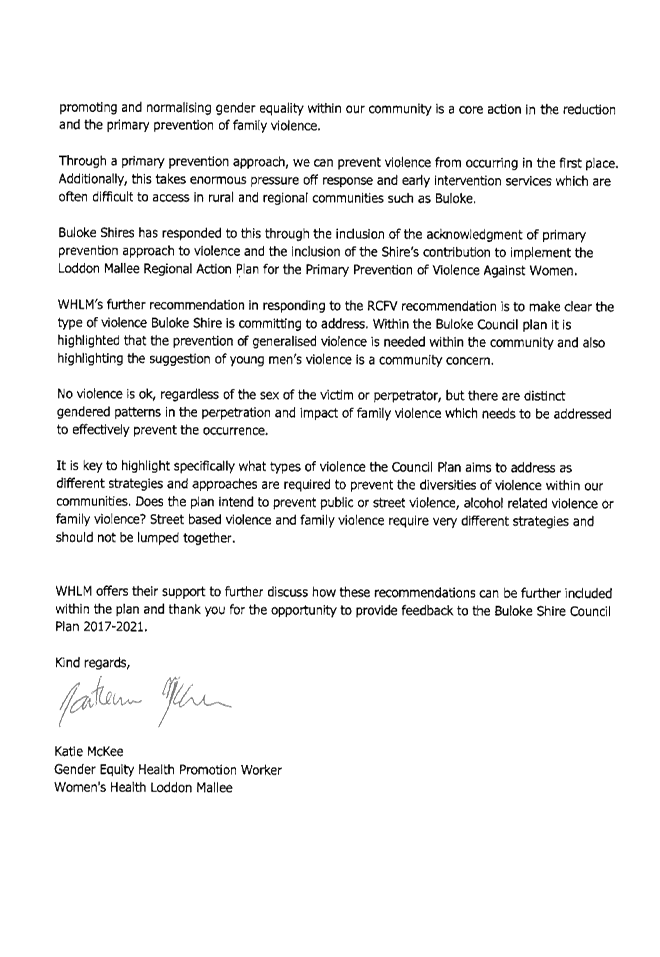
8.3 Financial Reports
8.3.1 Draft Minutes Audit Advisory Committee 28 April 2017
Author’s Title: Director Corporate Services
Department: Corporate Services File No: FM/02/09
|
1 Draft Audit Advisory Committee Meeting Minutes - 28 April 2017 |
Relevance to Council Plan 2015 - 2019
Strategic Objective: An organisation that is responsibly governed and values and supports the development of its people
|
That Council notes the draft minutes of the Audit Advisory Committee held on 28 April 2017
|
1. Executive Summary
The Audit Advisory Committee is a statutory committee of Council which considers matters of governance, finance and risk management. The committee is comprised of three independent members who offer professional advice and comment as per the committee’s charter.
The meeting of the Audit Advisory Committee on the 28 April 2017 dealt with several issues including:
· Council’s financial performance as at 28 February 2017
· Progress on achievement of outstanding audit actions
· Draft Rates and Charges Financial Hardship Policy
· 2017/18 Draft Budget
· Related Party Disclosures
· Council’s Risk Management Policy and Framework
· Council’s performance against the Local Government Performance Reporting Framework (LGPRF)
· Initial Risk Assessment undertaken by Council’s Internal Auditors
· Draft Internal Audit Program 2017-19
The draft minutes will be adopted by the Audit Advisory Committee at its next meeting on 13 September 2017.
2. Discussion
The Audit Advisory Committee met to consider various issues as part of its meeting held on 28 April 2017.
Following the meeting, the following statement was expressed by the chair of the Audit Advisory Committee, Tom Evans.
The Audit Advisory Committee was pleased to note Buloke's financial performance year to date but did raise concerns about the ability to meet its capital program for 16/17 as budgeted. The Committee was again complimentary about the standard of financial reporting.
It was noted that the 17/18 budget is well on track and that it maintains short term sustainability. Longer term sustainability continues to be a challenge for all rural municipalities with Buloke having done much to address this but more will need to be done in the absence of increased funding from other levels of government.
The Committee was pleased with the proposed Audit Program and looks forward to its implementation over the coming years while stressing the need for flexibility to meet issues that might arise. In particular the Committee is concerned to foster a nexus between internal audit, Council's formal risk management and its risk management culture.
3. Financial Implications
The cost of the Audit Advisory Committee is part of the 2016/17 Annual Budget.
4. Cost Shift Considerations
There are no cost shifting implications
5. Community Consultation
Not applicable
6. Internal Consultation
Resolutions from the Audit Committee will be communicated to relevant staff members.
7. Legislative / Policy Implications
Council is required under the Local Government Act 1989 to create and maintain an Audit Committee.
8. Environmental Sustainability
Not applicable
9. Conflict of Interest Considerations
No officer involved in the preparation of this report had a conflict of interest.
10. Conclusion
The draft Audit Advisory Committee minutes are attached for noting by Council.
Buloke Shire Council Ordinary Meeting Agenda Wednesday, 14 June 2017
8.3.1 Draft Minutes Audit Advisory Committee 28 April 2017
Attachment 1 Draft Audit Advisory Committee Meeting Minutes - 28 April 2017
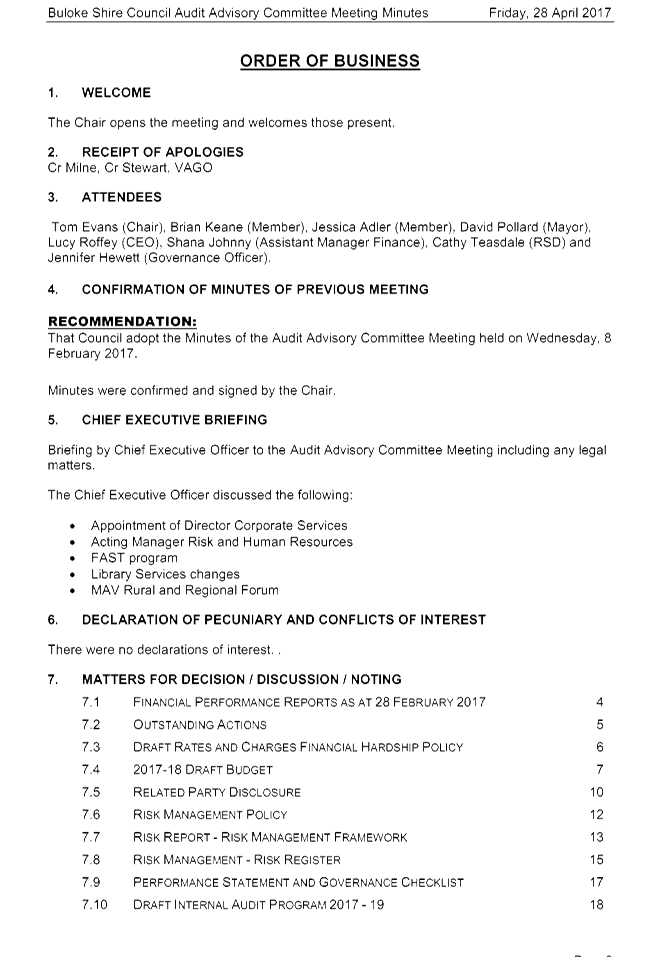


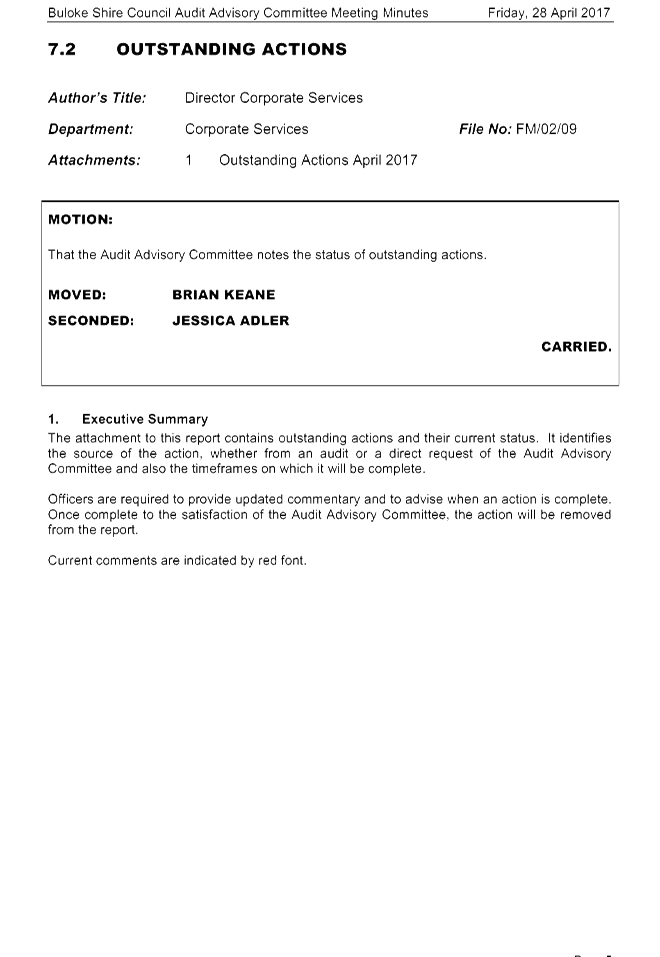
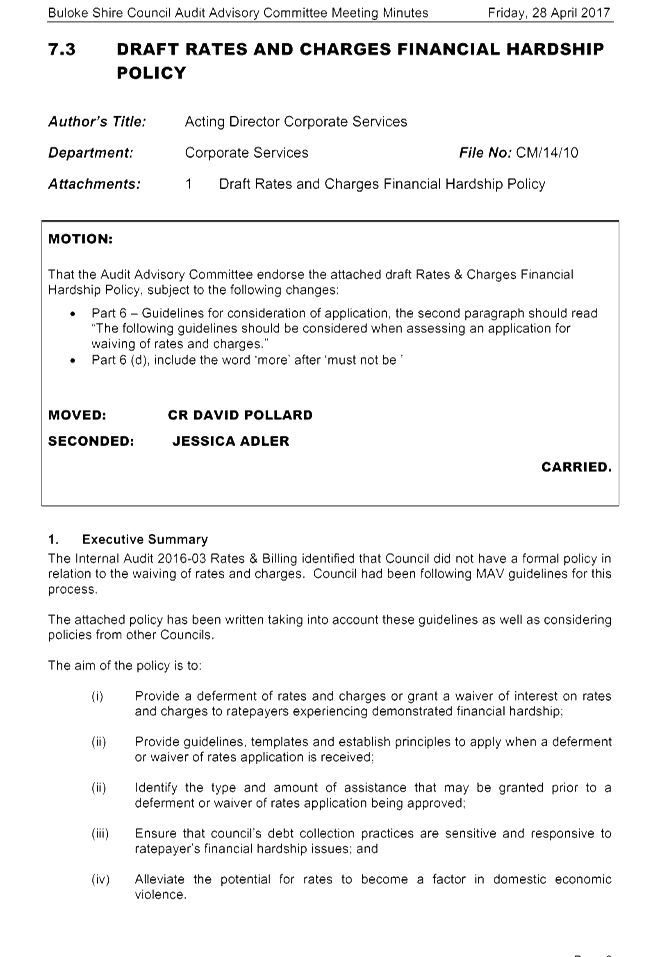
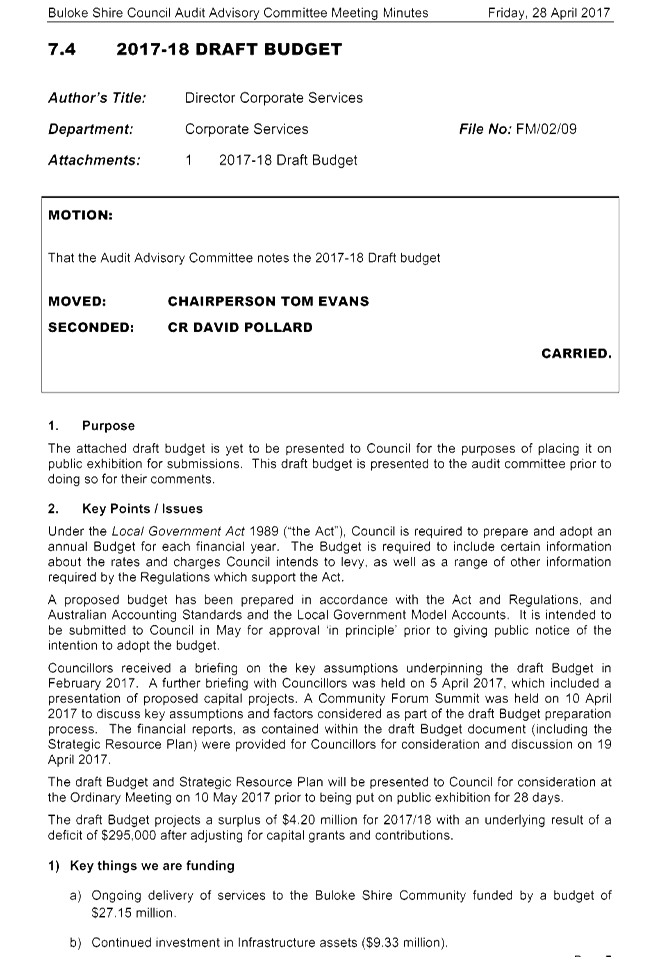
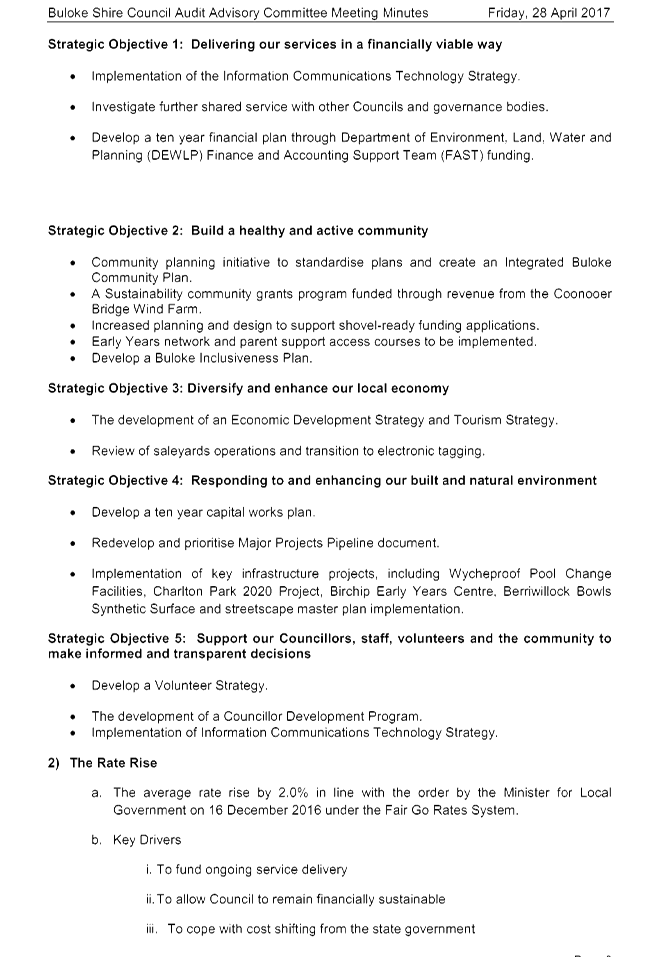
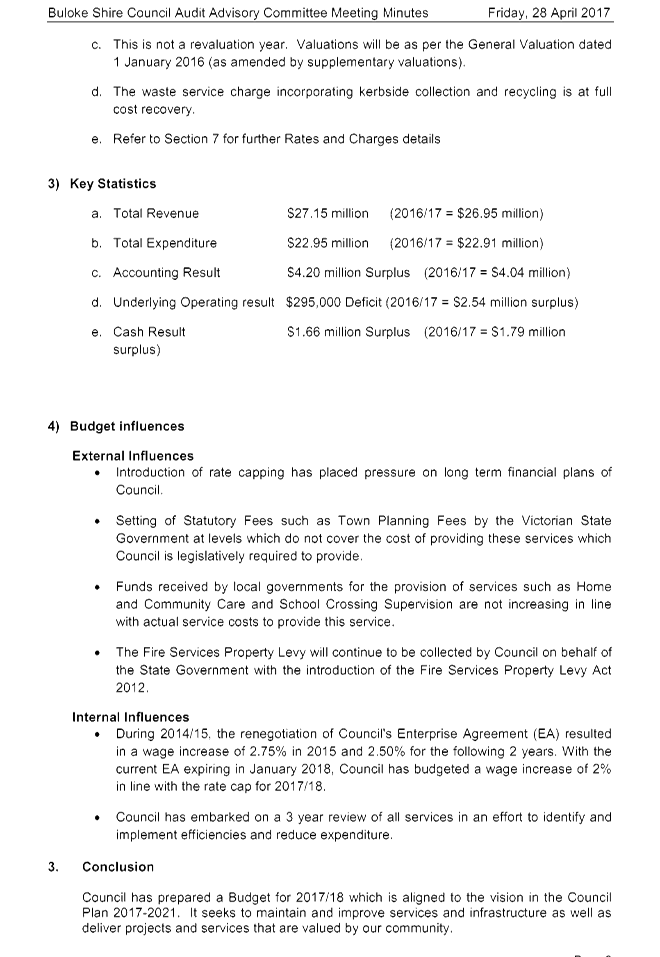



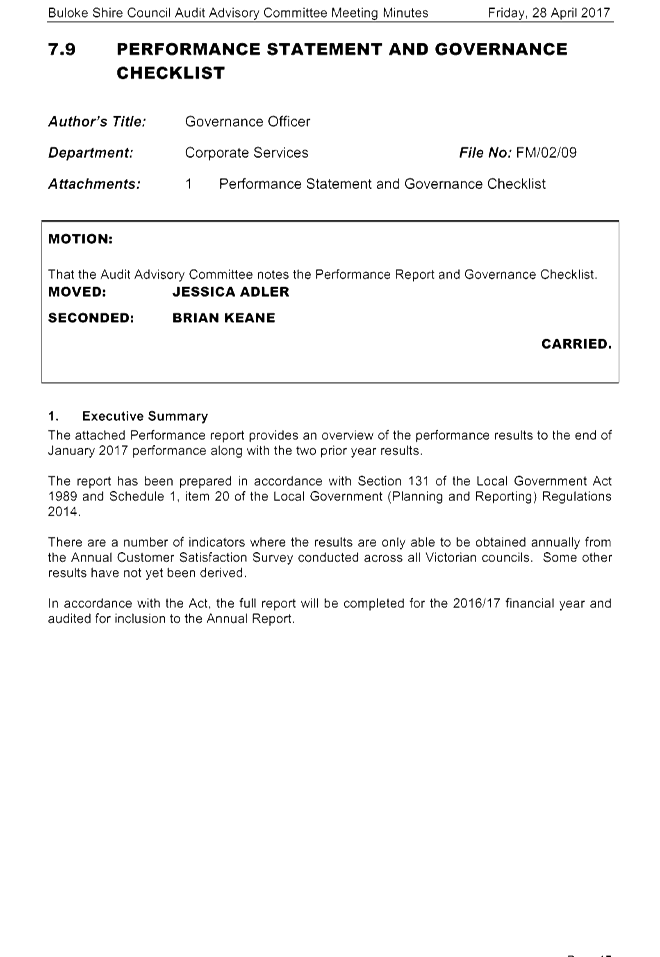
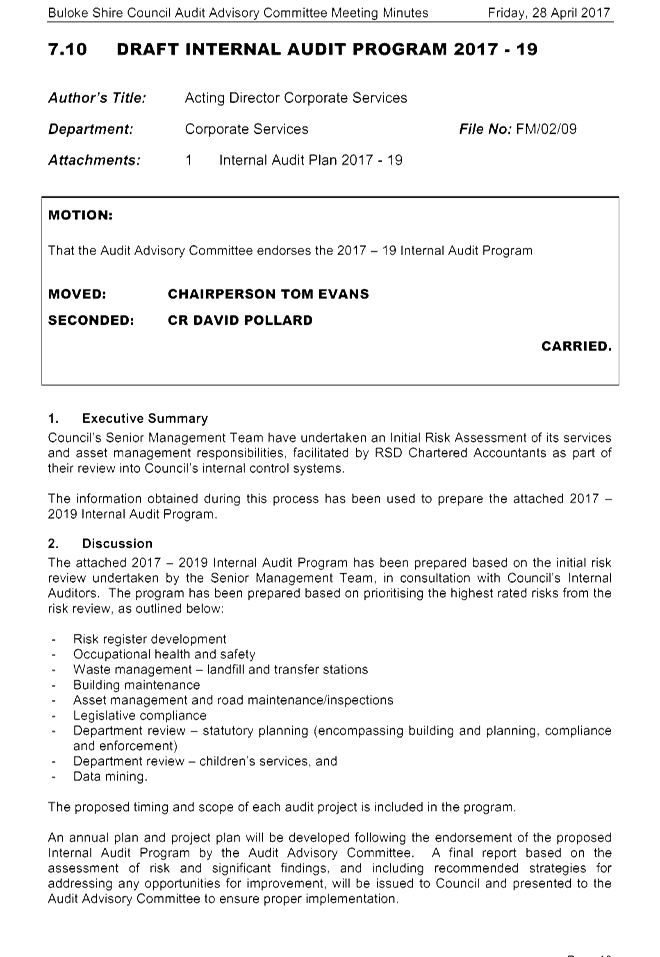



8.3.2 Financial Performance as at 30 April 2017
Author’s Title: Director Corporate Services
Department: Corporate Services File No: FM/19/03
|
1 Income Statement - April 2017 3 Cash Flow Statement - April 2017 4 Cash Flow Statement (Graph) - April 2017 |
Relevance to Council Plan 2015 - 2019
Strategic Objective: An organisation that is responsibly governed and values and supports the development of its people
|
That Council: 1. Receives and notes the Financial Performance Report for the period ending 30 April 2017 |
1. Executive Summary
The Income Statement provides a summary of the total income and total expenditure relating to the Council’s annual recurrent operations. It also specifically includes capital income but never includes capital works expenditure.
For the period ending 30 April 2017, the year to date (YTD) surplus is $6.69m. Total income excluding capital grants is a surplus of $2.32m.
The Balance Sheet effectively shows a summary of the value of Assets (what we own) and our Liabilities (what we owe), both of which balance off against each other to show Equity (our net worth).
At the 30 April 2017, the Balance Sheet shows Council’s bank balance at $13.29m.
The Cash Flow Statement is formatted to show a rolling 12 month forecast. At 30 April 2017, the Cash Flow Statement shows Council with a bank balance of $13.29m of which $1.96m is grant restricted for capital works.
The Capital Works Program report reflects 62% of forecasted capital works i.e. $4.72m of capital works has been expended as at the 30 April 2017. The Donald levee bank project is now expected to be carried forward into 2017/18.
2. Financial Implications
This report continues to show that Council’s tight financial management is placing it in a sounder position. It is critical that Council continues to have a positive cash flow and at present it is in line with its forecast position.
3. Community Consultation
No consultation with the community was required for the production of this report.
4. Internal Consultation
The reports have been prepared in consultation with the budget managers directly responsible for Council budgets.
5. Legislative / Policy Implications
The report is consistent with the requirements of the Local Government Act 1989.
6. Environmental Sustainability
This report has no direct impact on environmental sustainability.
7. Conflict of Interest Considerations
No officer involved in the preparation of this report had a conflict of interest.
8. Conclusion
The summary financial statements results for year to date show a positive operating variance. The forecast end of year operating result excluding capital grant (underlying result) is an improved result from budget. The forecast surplus including capital grants is $183,000 (5%) less than budget due to two unsuccessful grant applications, offset by a number of smaller unbudgeted grants.
Buloke Shire Council Ordinary Meeting Agenda Wednesday, 14 June 2017
8.3.2 Financial Performance as at 30 April 2017
Attachment 1 Income Statement - April 2017
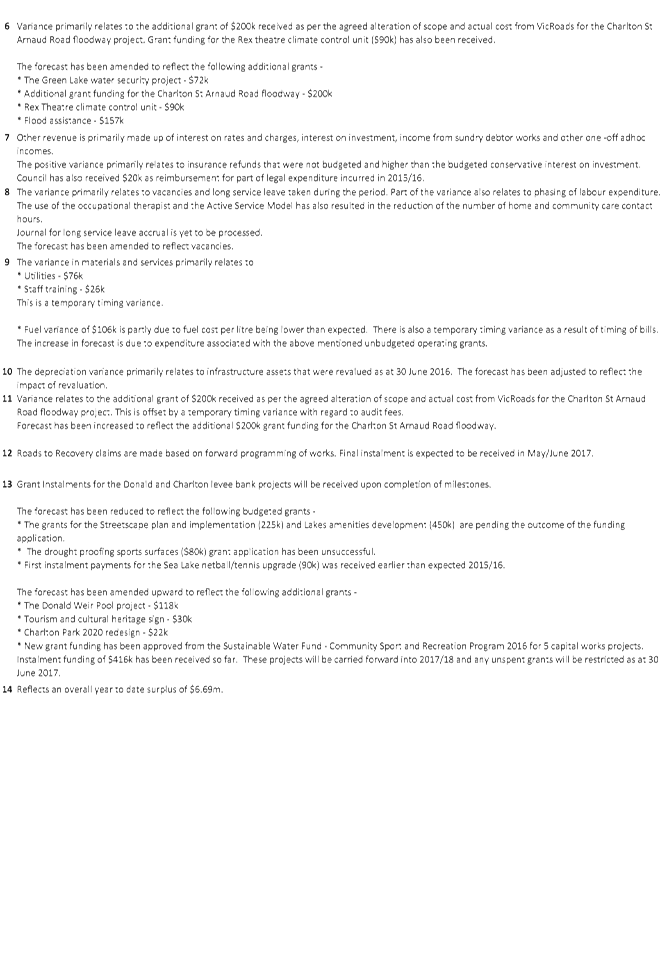
Buloke Shire Council Ordinary Meeting Agenda Wednesday, 14 June 2017
8.3.2 Financial Performance as at 30 April 2017
Attachment 2 Balance Sheet - April 2017
Buloke Shire Council Ordinary Meeting Agenda Wednesday, 14 June 2017
8.3.2 Financial Performance as at 30 April 2017
Attachment 3 Cash Flow Statement - April 2017
Buloke Shire Council Ordinary Meeting Agenda Wednesday, 14 June 2017
8.3.2 Financial Performance as at 30 April 2017
Attachment 4 Cash Flow Statement (Graph) - April 2017
Buloke Shire Council Ordinary Meeting Agenda Wednesday, 14 June 2017
8.3.2 Financial Performance as at 30 April 2017
Attachment 5 Capital Works Program - April 2017
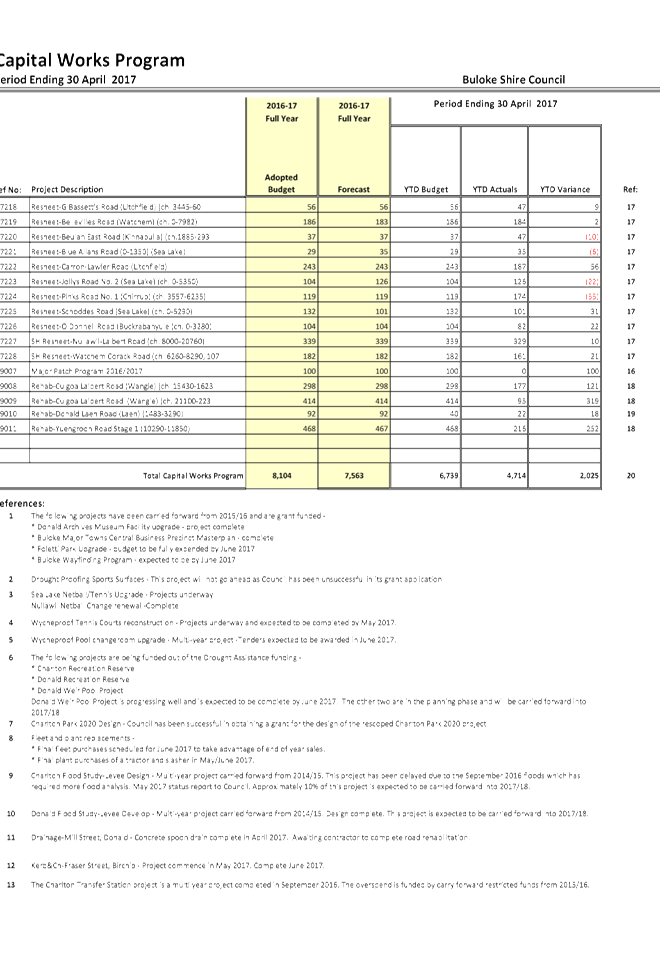
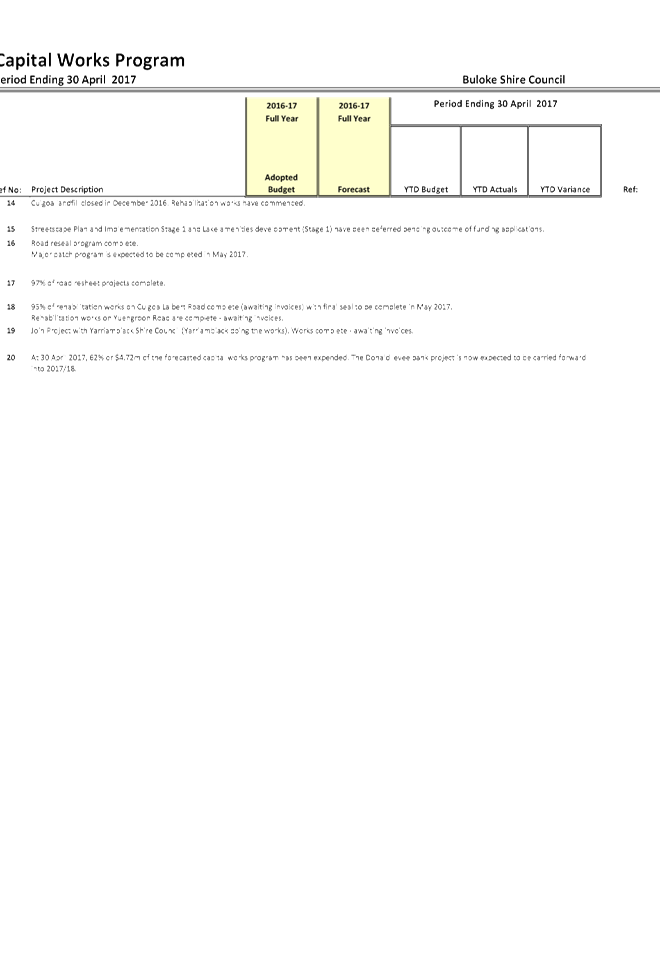
Buloke Shire Council Ordinary Meeting Agenda Wednesday, 14 June 2017
8.3.2 Financial Performance as at 30 April 2017
Attachment 6 Capital Works Program (Graph) - April 2017
8.6 Matters Which May Exclude The Public
|
That Council reopens the meeting to the public pursuant to Section 89(2) of the Local Government Act 1989 and brings resolutions from the closed session into open session. |
9. OTHER BUSINESS
9.1.1 Buloke Shire Council support for the Victorian Renewable Energy Targets
Author’s Title: Governance Officer
Department: Corporate Services File No: EM/13/07
|
Nil |
Relevance to Council Plan 2015 - 2019
Strategic Objective: A Shire working with the community to reduce our carbon footprint, protect and enhance the natural environment and share experiences and information.
|
That Council: 1. Welcomes the State Government’s Victorian Renewable Energy Targets (VRET) and supports passage of the legislation in the Victorian Parliament. 2. Notes that the VRET will assist Buloke to attract investment in renewable energy projects. 3. Write to the Premier, Minister for Environment, Minister for Regional Development and our local members informing them of our support.
|
1. Background
Notice of Motion received from Cr Ellen White
The energy sector in Victoria is in transition as investment moves away from traditional sources of energy such as coal, oil and gas to cleaner renewable forms of energy such as wind and solar. In the Buloke Shire we have supported a wind farm development at Coonooer Bridge, which is directly benefiting our communities.
The Victorian Government have proposed a Renewable Energy Target (RET) of 25% by 2020 and 40% by 2025. A policy like this will bring certainty to the renewable energy sector and attract more investment. The Buloke Shire has an opportunity take advantage of these targets, as it is in an ideal location for solar or wind farm development. There are limitations due to the distribution network, but many of our communities are interested in developing community energy projects, and the Victorian RET can support them to do this. An increased RET would allow even more certainty.
In the new Buloke Council Plan, we have identified that renewable energy options in the Shire are a driver of economic growth and environmental sustainability. Attracting investment is a crucial part of achieving our goals in this area. The Victoria RET will attract approximately $9Billion of investment in the sector, and Buloke communities wish to share in that investment.
Buloke already partners with other organisations such as the CVGA to reduce greenhouse gas emissions, with a major project recently undertaken to replace all street lights with LEDs. The Victorian RET will reduce greenhouse gas emissions in Victoria by an additional 12%.
Climate Change is already having an impact on the agricultural sector, and the Buloke Shire can support its primary economic base by supporting an increase in the amount of power that is generated in Victoria from renewable energy sources.
[1] Based in information from the 2011 Census conducted by the Australian Bureau of Statistics.
[2] In Buloke Shire 1 dog has been declared as menacing dogs.
[3] The tables above lists the types of complaints received by Council’s Customer Service Staff. These matters are referred to the Animal Management Officers for further investigation.
[4] To date no such areas have been designated.