Ordinary Council Meeting
Agenda
Wednesday 8 July 2015
Commencing at 7.00pm
Wycheproof Supper Room
367 Broadway, Wycheproof
John Hicks
Chief Executive Officer
Buloke Shire Council
Ordinary Council Meeting
Agenda
Wednesday 8 July 2015
Commencing at 7.00pm
Wycheproof Supper Room
367 Broadway, Wycheproof
John Hicks
Chief Executive Officer
Buloke Shire Council
Buloke Shire Council Ordinary Meeting Agenda Wednesday, 8 July 2015
1. COUNCIL WELCOME and statement of acknowledgement
WELCOME
The Mayor Cr Reid Mather will welcome all in attendance.
STATEMENT OF ACKNOWLEDGEMENT
The Mayor Cr Reid Mather will acknowledge the traditional owners of the land on which we are meeting and pay our respects to their Elders and to the Elders from other communities who maybe here today.
2. RECEIPT OF APOLOGIES
3. CONFIRMATION OF MINUTES OF PREVIOUS MEETING
|
Recommendation: That Council adopt the Minutes of the Ordinary Meeting held on Wednesday, 10 June 2015 and Council adopt the Minutes of the Special Meeting held on Wednesday, 17 June 2015. |
4. REQUESTS FOR LEAVE OF ABSENCE
5. DECLARATION of PECUNIARY AND conflictS of interest
In accordance with Sections 77A, 77B and 78 of the Local Government Act Councillors are required to disclose an "interest" in a decision if they would receive, or could be reasonably perceived as receiving a direct or indirect financial or non-financial benefit or detriment (other than as a voter, resident or ratepayer) from the decision.
Disclosure must occur immediately before the matter is considered or discussed.
6.1 Building Permits - Monthly Update
6.2 Report on Assemblies of Councillors
6.3 Planning Applications Received - Monthly Update
7.1.1 Councillor Expenses Entitlement Policy
7.2.2 Inquiry into Rate Capping
7.2.3 Inquiry into Unconventional Gas in Victoria
7.2.4 Buloke Shire Council grant application process for community transport funds
7.2.6 Community Grants and Sponsorship
7.2.7 Birchip Community Housing Committee
7.3.1 Financial Performance As At 31 May 2015
8....... REPORTS FROM COUNCILLORS
9.3 Questions from Councillors
9.5 Any Other Procedural Matter
10..... MATTERS THAT MAY EXCLUDE THE PUBLIC
The Meeting may be closed to members of the public to consider confidential matters.
NEXT MEETING
The next Ordinary Meeting of Council will be held in Wycheproof Supper Room, 367 Broadway, Wycheproof on Wednesday, 12 August 2015 at 7.00pm.
JOHN HICKS
CHIEF EXECUTIVE OFFICER
6. Procedural Items
6.1 Building Permits - Monthly Update
Author’s Title: Compliance Administration Officer
Department: Planning and Community Support File No: DB/14/02
|
Nil |
|
That Council notes information contained in the report on Building Permits approved by staff from 1 June 2015 to 30 June 2015.
|
1. Executive Summary
This report provides information on Building Permits approved by staff from 1 June 2015 to 30 June 2015.
2. List of Building Permits Approved by Council Surveyor
|
Permit No. |
Address |
Project Description |
Value |
Date Approved |
|
20150045 |
51 Abbott Street, BIRCHIP |
Demolition: Dwelling |
$5,000 |
24/06/2015 |
3. List of Building Permits Approved by Private Surveyors
|
Permit No. |
Address |
Project Description |
Value |
Date Approved |
|
20150036 |
2 Halliday Street, CHARLTON |
New Building: Carport |
$23,000 |
07/05/2015 |
|
20150037 |
8-12 Camp Street, WYCHEPROOF |
New Building: Shed |
$260,700 |
02/06/2015 |
|
20150038 |
18 Mount street, WYCHEPROOF |
New Building: Underpin |
$8,000 |
24/05/2015 |
|
20150039 |
6 Maunsell Street, CHARLTON |
Extension: Verandah |
$10,850 |
12/05/2015 |
|
20150040 |
65 Best Street, SEALAKE |
Extension: Extension to existing Building |
$100,000 |
14/05/2015 |
|
20150041 |
15-17 Wright Street, CHARLTON |
New Building: Dwelling & Garage |
$306,977 |
01/06/2015 |
|
20150042 |
10-12 Florence Court, DONALD |
New Building: Dwelling & Garage, Swimming Pool & Safety Barrier |
$360,000 |
30/05/2015 |
|
20150043 |
83 Woods Street, DONALD |
Alteration: Underpin |
$20,095 |
25/05/2015 |
|
20150044 |
1 Campbell Street, Donald |
Alteration: Underpin |
$10,983 |
18/06/2015 |
6.2 Report on Assemblies of Councillors
Author’s Title: Executive Assistant
Department: Office of the CEO File No: GO/05/04
|
That the Council notes the records of the Councillor Briefings held 3 and 17 June 2015. |
1. Key Points/Issues
The Local Government Act 1989 (the Act) provides that a record must be kept of any meeting of Councillors and staff deemed to be an Assembly of Councillors as defined in the Act.
The Act also provides that the record of any Assembly of Councillors is to be reported to the next practicable Ordinary Meeting of Council and recorded in the Minutes.
A Record of the Councillor Briefings held 3 and 17 June 2015 is attached.
Buloke Shire Council Ordinary Meeting Agenda Wednesday, 8 July 2015
6.2 Report on Assemblies of Councillors
Attachment 1 Report on Councillor Briefing - 3 June 2015
RECORD
Councillor Briefing
|
Date and Time: |
3 June 2015 |
Time: 5.00pm to 8.00pm |
|
Location: |
Birchip District Office (22 Cumming Avenue) |
|
Attendees: |
Cr Reid Mather – Mayor Cr Ellen White Cr David Pollard Cr Gail Sharp Cr Graeme Milne Cr Leo Tellefson
John Hicks –Chief Executive Officer Bill Hutcheson – Manager Finance Anthony Judd – Director of Works and Technical Services Ann Twyford –Manager Corporate Systems Bill Keane – Manager Community Services Jessie Holmes – Manager Planning and Community Support |
|
Apologies: |
Cr Stuart McLean |
ITEMS
|
NO. |
TOPIC |
ACTION |
|
|
1. |
Declarations of Conflicts of Interest |
Nil |
|
|
2. |
Councillor Only Session |
|
|
|
3. |
Presentations |
|
|
|
|
3.1 |
Bill Keane, Patrice Rickard, Pamela Barber (Early Years, Maternal and Child Health) 5.30pm |
|
|
|
3.2 |
Naga Sundararajah (Asset Management) 5.50pm |
|
|
|
Dinner (6.15pm – 6.45pm) |
|
|
|
NO. |
TOPIC |
ACTION |
|
|
|
3.3 |
Birchip Forum representatives – Community Transport and Childcare (6.45pm) |
|
|
|
3.4 |
Lachlan Bell – Maitreya Festival (7.15pm – 8.00pm) |
|
|
4. |
Items for Discussion |
|
|
|
|
4.1 |
Draft Agenda – Ordinary Meeting 10 June 2015 (Attachment) |
|
|
5. |
Councillor Matters |
- Memo to Councillors
on the Fire Tank Project – (DWTS) - Report to briefing recommending criteria for distribution of funds from sale of buses – (MPCS) |
|
|
6. |
CEO Updates |
|
|
Next Briefing:
|
Date and Time: |
17 June 2015 |
Time: 5.00pm to 8.00pm |
|
Location: |
Wycheproof Supper Room (367 Broadway) |
|
Buloke Shire Council Ordinary Meeting Agenda Wednesday, 8 July 2015
6.2 Report on Assemblies of Councillors
Attachment 2 Report on Councillor Briefing - 17 June 2015
RECORD
Councillor Briefing
|
Date and Time: |
17 June 2015 |
Time: 5.00pm to 8.00pm |
|
Location: |
Wycheproof Supper Room (367 Broadway) |
|
Attendees: |
Cr Reid Mather – Mayor Cr Ellen White Cr David Pollard Cr Gail Sharp Cr Graeme Milne Cr Leo Tellefson
John Hicks –Chief Executive Officer Bill Hutcheson – Manager Finance Ann Twyford –Manager Corporate Systems Bill Keane – Manager Community Services |
|
Apologies: |
Cr Stuart McLean |
ITEMS
|
NO. |
TOPIC |
ACTION |
|
|
1. |
Declarations of Conflicts of Interest |
Nil |
|
|
2. |
Councillor Only Session |
|
|
|
3. |
Presentations |
|
|
|
|
3.1 |
Paul Fernee(Swimming Pools and Recreation) 5.30pm |
|
|
|
Dinner (6.15pm – 6.45pm) |
|
|
|
|
3.2 |
Local Logic - Councillor Session – Development of Municipal Early Years Plan and Youth Strategy – (6.45pm to 7.30pm) |
The Municipal Early Years Plan and the Youth Strategy to be provided to Council for public comment prior to adoption at a later Council Meeting. |
|
|
3.3 |
Wycheproof Vision Representatives – Streetscape Landscaping Matters and Unsightly Properties (7.30pm) |
|
|
NO. |
TOPIC |
ACTION |
|
|
4. |
Items for Discussion |
|
|
|
5. |
Councillor Matters |
CEO to provide report into efficacy of MAV membership to briefing. |
|
|
6. |
CEO Updates |
CEO to provide reports on Inquiry into Unconventional Gas and Inquiry into Rate Capping Policy. |
|
Next Briefing:
|
Date and Time: |
1 July 2015 |
Time: 5.30pm to 8.30pm |
|
Location: |
Culgoa Hall Supper Room (43 Main Street, Culgoa) |
|
6.3 Planning Applications Received - Monthly Update
Author’s Title: Manager Planning and Community Support
Department: Planning and Community Support File No: LP/09/01
|
Nil |
|
That the Council note information contained in the report on planning applications under consideration by staff and the status of each of these applications.
|
1. Executive Summary
This report advises provides information on planning applications under consideration by staff and the status of each of these applications.
2. List of Planning Applications
|
Application No |
Applicant |
Address |
Date Rec |
Summary of Proposal |
Status |
|
611/15 |
GWM Water |
Adjacent to 22 Camp St, Donald |
11/06/15 |
Utility instillation (replacement of sewer line) |
Issued 18/06/15 |
|
612/15 |
B & A Gleeson |
90 Mullane Road, Watchem |
20/05/15 |
Intensive Animal Husbandry (free range chickens) |
Issued 26/06/15 |
|
613/15 |
Ces Hopper & Sons |
85 Camp Street, Watchem |
24/06/15 |
Instillation of a telecommunication mast |
Further information request |
|
614/15 |
S Ramsey |
Corner of Saits Road and Charlton-Boort Rd, Charlton |
29/06/15 |
Intensive Animal Husbandry (free range chickens) |
Notice of Application |
Buloke Shire Council Ordinary Meeting Agenda Wednesday, 8 July 2015
7.1.1 Councillor Expenses Entitlement Policy
Author’s Title: Finance Manager
Department: Finance File No: CM/14/11
Relevance to Council Plan 2015 - 2019
Strategic Objective: An organisation that is responsibly governed and values and supports the development of its people
|
That Council: 1. Adopts the Councillor Expenses Entitlement Policy
2. Places a copy of the policy on Council’s website |
1. Executive Summary
The original Councillor Expenses Entitlement Policy was developed and adopted by Council in 2004. This policy has been reviewed, taking into account any legislative changes and to allow for Councillor use of private mobile communication devices. The policy will also now have a regular review process of every three (3) years.
2. Discussion
This policy establishes the entitlements for a Councillor to have necessary out-of-pocket expenses, incurred while performing their civic, statutory and policy making duties as a Councillor, either reimbursed or paid by Council.
This policy gives a broad overview of how Council provides assistance to its Councillors in carrying out their duties. The Local Government Act 1989 (Section 75) provides for the reimbursement of “necessary out of pocket expenses” incurred while performing the duties of a Councillor.
3. Financial Implications
Any expenses paid to Councillors will be done so within budgets adopted as part of the broader budget process.
4. Cost Shift Considerations
Not applicable
5. Community Consultation
As a public document this policy will be placed on Council’s website
6. Internal Consultation
The policy was reviewed by the Senior Management Team.
7. Legislative / Policy Implications
The Local Government Act 1989 (Section 75) provides for the reimbursement of “necessary out of pocket expenses” incurred while performing the duties of a Councillor.
Local Government (General) Regulations 2004, Council must also report to the community on all Councillor expense reimbursements and maintain a Councillor Expenses register and make it available for public viewing.
8. Environmental Sustainability
Not applicable.
9. Conflict of Interest Considerations
No officer involved in the preparation of this report has a conflict of interest.
10. Conclusion
This policy is part of a suite of policies which ensure good governance and legislative compliance.
Buloke Shire Council Ordinary Meeting Agenda Wednesday, 8 July 2015
|
|
Policy Location |
Governance |
||
|
Policy Title |
Councillor Expenses Entitlement |
|||
|
Policy No |
16 |
Date Approved |
|
|
|
Revision No |
2 |
Revision Date |
2018 |
|
Purpose
To establish the entitlements for a Councillor to have necessary out of pocket expenses incurred while performing their civic, statutory and policy making duties as a Councillor either reimbursed or paid by Council.
Scope
This Policy applies to Councillors with regard to the expenses incurred in the process of carrying out Council business.
Policy Statement
Intent:-
These guidelines give a broad overview of how a Council can provide assistance to its Councillors in carrying out their duties
The Local Government Act 1989 (Section 75) provides for the reimbursement of “necessary out of pocket expenses” incurred while performing the duties as a Councillor
Objectives:-
To establish the entitlements for a Councillor to have necessary out of pocket expenses incurred while performing duties as a Councillor either reimbursed or paid by Council.
Compliance with the Local Government Act 1989, Sections 75, 75A, 75B and 75C.
Statement:-
1. The basic test that will be applied to determine whether or not an expense is lawfully incurred is whether the expenditure is “necessary” to complete duties as a Councillor.
2. Where this criteria is satisfied and a Councillor has incurred an out of pocket expense they may be reimbursed by Council
Guidelines
Annually as part of the budget process an amount will be set aside for reimbursement of Councillor expenses.
Note that this is separate to the annual allowance remuneration set out in Section 74 of the Local Government Act 1989.
Councillor expenses are specified for the following purposes
1. Travelling Expenses
Upon the completion and forwarding of an expenses claim form to the CEO’s Department (Appendix 1), travelling expenses will be paid to Councillors under the following circumstances:
· To attend Council and Special Council meetings and meetings of Committees of Council.
· To attend formal briefing sessions and civic or ceremonial functions convened by Council or the Mayor
· To attend meetings scheduled by Council
· To attend a meeting, function or undertake other official duties as a representative of Council or the Mayor
· To attend meetings of community groups, organisations and statutory authorities to which the Councillor has been appointed Council’s delegate or is authorised by Council to attend, but the reimbursement by Council is to be diminished by however much the Body pays travelling expenses directly
· To attend an inspection of a road, property or area or to discuss with any person any matter related to Council business, and/or to carry out activities in the capacity of a Councillor
· To attend discussions with Council officers on any matters relating to the Shire
· To attend meetings or to participate in deputations to which the Councillor has been appointed as a representative of Council or Mayor
The rate of reimbursement of motor vehicle expenses shall be based on the rates set out in the Australian Taxation Act for reimbursement or employees’ use of vehicles for business purposes.
In the first instance Councillors should attempt to utilize
2. Interstate Travelling Expenses
Travelling expenses associated with conference airfares, accommodation and taxi is available. The reimbursement requires the CEO’s authorisation prior to payment.
A Council resolution is required to approve any interstate travel before it occurs.
3. Stationery
Council shall upon request, provide Councillors with standard stationery held or obtained general for the organisations requirements.
The stationery may include, but not necessarily be limited to, paper, business cards, writing implements, writing pads, envelopes and the like.
Requests for stationery should be made to the CEO’s office.
4. Memberships
Councillors will be reimbursed for payment of memberships. Memberships must relate to the duties of a Councillor.
This requires the CEO’s authorisation prior to reimbursement or payment
5. Child Care
Councillors incurring bona fide child care expenses (for children being cared for up to and including the age of 14 years) paid to:
1. A recognised child care provider; or
2. To a person who does not:
a) Have a family or like relationship with the Councillor; or
b) Reside either permanently or temporarily with the Councillor, or
c) Have a relationship with the Councillor or his or her partner such that it would be inappropriate for Council to reimburse monies paid to the care provider; will be reimbursed such child care expenses when the child care is necessary to allow the Councillor to attend:
· Council meetings and functions involving Council business;
· Council functions;
· Meetings arising as a result of a Councillor being appointed by the Council to an external body.
6. Communication Expenses
Councillors shall be provided with communication equipment which may include:
· Mobile phone
· Laptop computer
· Tablet/iPad
· Printer
with Broadband connection to the Internet to ensure that they can be adequately and efficiently perform their duties as a Councillor.
Where a Councillor has opted to use their personal phone/smart phone and/or tablet for Council business and has completed the declaration form (Appendix 2), the following shall apply.
· Councillors with a smart phone will be reimbursed $15 for data and $30 for calls per month
· Councillors with a mobile phone will be reimbursed $30 for calls per month
· Councillors using their own tablet or iPad will be reimbursed $25 per month for data usage
Note: These amounts will be reviewed on an annual basis and be applicable from 1 July each year
7. Conferences & Seminars
Council will provide the following facilities to Councillors attending conferences or seminars which have been authorised by Council or as determined by the CEO and Mayor:
a) Registration fees
The payment of registration fees for attendance at conference/seminar sessions
b) Conference Dinner/Meals
Payment for the main conference/seminar dinner, if not covered by registration cost, together with all meals, within reasonable limits, for the duration of the conference or seminar.
c) Accommodation
The payment of accommodation costs on the following basis:
Accommodation, dinner and breakfast costs only.
Any additional accommodation costs incurred as a result of the attendance of partners and/or children shall be borne by the Councillor
Lunches and alcohol will not be reimbursed
d) Car Parking Fees
Council will meet the cost of the following car parking fees
I. Hotel/motel parking – additional car parking fees not included in accommodation cost
II. Airport parking, costs included in the parking of a Councillor’s private vehicle at the airport for the duration of the conference/seminar
III. Commercial car parking fees associated with attending meetings or functions on behalf of Council
IV. City Link toll fees
Further Information
1. Receipts
Councillors are to provide fully accredited receipts for any expenses incurred. The expenses will, unless authorised by the CEO, be paid in arrears. Copies of receipts should be attached to the claim form.
2. Timeframe
All expense claims must be lodged with the CEO’s office within three (3) months of being incurred. At the end of the financial year all claims must be received within two weeks after June 30. Any claims received after this time will require a Council resolution to be paid.
3. Exclusions
Any expenses arising from a breach of road, traffic parking or other regulations or laws, will not be reimbursed or funded in any way by Council.
If a Councillor does not claim a particular expense, this cannot be offset against a claim for any additional amount of some other expense.
Claims for expenses, other than those included in this policy, will not be reimbursed, except when they are subject to a Council resolution.
References
Legislation
This Policy was developed in accord with the following legislation:
· Local Government Act 1989
· Australian Taxation Act
Documents
This Policy is implemented in conjunction with the following documents:
• Buloke Shire Council Risk Management Policy
· Buloke Shire Occupational Health and Safety Policy
· Buloke Shire Staff Code of Conduct
Appendix 1
 Councillor Expenses Claim Form
Councillor……………………………………………………………………………………
Date Submitted……………………………………………………………..
Vehicle Size (circle) for travel claim 4cyl 6cyl
|
Date |
Details of Expenses |
Total kms |
Value |
|
|
|
|
|
|
|
|
|
|
|
|
|
|
|
|
|
|
|
|
|
Total Reimbursement |
|
||
I certify that the costs claimed for reimbursement have been incurred by me while performing my duties as a Councillor with the Shire of Buloke.
Signature ______________________________________ Date____________________
Authorised by___________________________________ Date____________________
Account Code ___________________________/_______________________
Please ensure copies of all receipts are attached
Appendix 2

Councillor Declaration of communication devices and reimbursement
Name: _______________________________________________________
Personal mobile/smart phone number _____________________________
During the financial year of 2015/2016 I nominate (circle appropriate) to use my own equipment and will reimbursed accordingly
personal mobile ($30.00 per month calls)
smart phone ($15.00 per month phone data usage and $30.00 per month phone calls)
tablet/iPad ($25 per month data usage)
The reimbursed amount will be renewed on an annual basis by the Manager Corporate Systems with a recommendation to the CEO.
Signed (Councillor) ………………………………………………….. Date: ……………….
Name …………………………………………………………………………
Signed (CEO) ………………………………………………. Date: ………………
Name……………………………………………………………………………
7.2 Management Reports
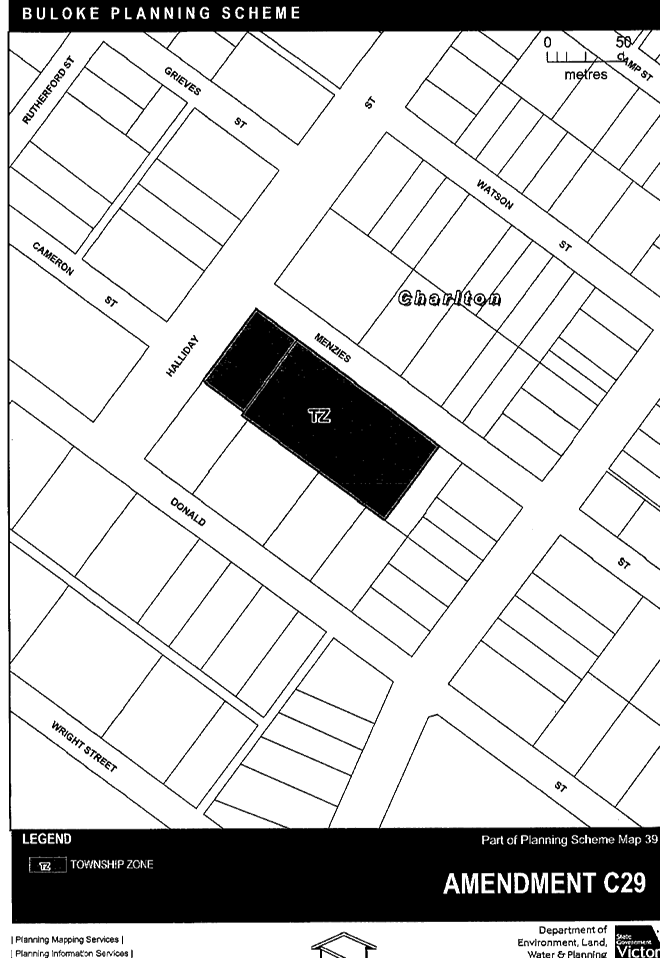
7.2.1 Permission to seek authorisation from the Minister to prepare Planning Scheme Amendment C29 - Rezoning of 4-8 Menzies Street, Charlton
Author’s Title: Manager Planning and Community Support
Department: Planning and Community Support File No: LP/09/10
Relevance to Council Plan 2015 - 2019
Strategic Objective: Engaging with, and facilitatiing our community to identify and meet its needs
|
That Council: 1. Notes the information provided as part of seeking authorisation from the Minister for the preparation of Amendment C29 which proposes to rezone land at 4-8 Menzies Street, Charlton (former Charlton Hospital site) from Public Use Zone to Township Zone.
2. Approves the request to seek authorisation from the Minister for Planning to prepare amendment C29. |
1. Executive Summary
Council Planning staff have received a request from a consultant on behalf of the East Wimmera Health Service to rezone the land at 4-8 Menzies Street, Charlton from Public Use Zone to Township Zone.
2. Discussion
A request for an amendment to the Buloke Planning Scheme Map 39, being the rezone of land at 4-8 Menzies Street, Charlton from Public Use Zone to Township Zone has been made.
The request is a result of the land being surplus to the needs of the health service as a result of the new Charlton Hospital being built on an alternative site.
In order to auction the land, the
zone must reflect the purpose and Public Use Zone Schedule 3 Health Services is
no longer an accurate reflection of the intended use of the land. Further to
that, Public Use Zone land is only permissible to be owned by a government
authority, so a rezone to Township Zone would allow for a wider range of
purchasers and future uses.
The planning scheme amendment process requires Council to;
- seek authorisation from the Minister to prepare an amendment,
- exhibit the prepared amendment and deal with any submissions received in relation to
the proposal and;
- seek approval for the amendment from the Minister.
The process should take approximately four months, dependent on the volume and complexity of any submissions received regarding the exhibited amendment.
3. Financial Implications
The proposed amendment has been requested by East Wimmera Health Service and it is responsible for the scheduled fee and related advertising costs.
4. Cost Shift Considerations
Nil
5. Community Consultation
If the Minister authorises the preparation of amendment C29 then exhibition of the amendment will include advertising in the locally circulating newspaper and letters to the adjoining properties.
6. Internal Consultation
Not required.
7. Legislative / Policy Implications
The amendment process is detailed in the Planning and Environment Act 1987.
8. Environmental Sustainability
No implications
9. Conflict of Interest Considerations
No officer involved in the preparation of this report has any conflict of interest.
10. Conclusion
It is recommended that Council approve the request to seek authorisation from the Minister of Planning to prepare amendment C29 for the rezone of the land at 4-8 Menzies Street, Charlton from Public Use Zone to Township Zone.
Buloke Shire Council Ordinary Meeting Agenda Wednesday, 8 July 2015
7.2.1 Permission to seek authorisation from the Minister to prepare Planning Scheme Amendment C29 - Rezoning of 4-8 Menzies Street, Charlton
Attachment 1 Explanatory report



Buloke Shire Council Ordinary Meeting Agenda Wednesday, 8 July 2015
7.2.1 Permission to seek authorisation from the Minister to prepare Planning Scheme Amendment C29 - Rezoning of 4-8 Menzies Street, Charlton
Attachment 2 Planning scheme amendment map 39
7.2.2 Inquiry into Rate Capping
Author’s Title: Chief Executive Officer
Department: Office of the CEO File No: GR/18/01
Relevance to Council Plan 2015 - 2019
Strategic Objective: Influencing governments to improve liveability for rural communities
|
That Council provides the attached submission to the Victorian Legislative Council Environment and Planning Committee Inquiry into Rate Capping. |
1. Executive Summary
The Victorian Legislative Council Environment and Planning Committee has requested submissions to its Inquiry into Rate Capping by 10 July 2015. The attached submission is a summary of the relevant parts of the submission Council made to the Essential Services Commission earlier in the year.
2. Discussion
Small rural shires have major barriers to their capacity to provide basic services to their residents. Shires such as Buloke are not financially sustainable if they are to provide the minimum basic services that should be available to all Victorians whether rate capping exists or not. However, small rural shires certainly do not want to see a further costs arising from such a process and the consequent further erosion of services that might otherwise have been provided.
3. Financial Implications
Rate capping processes will incur costs on Councils that can only be funded by increased efficiencies or reduction in services. Council has recently undergone, and will continue to undergo, efficiency measures to maximise the services it can provide to its residents. Additional costs will generally necessarily see a reduction in service provision.
4. Cost Shift Considerations
The costs related to the provision of rate capping are a cost shift from the Victorian Government to Council.
5. Community Consultation
Rate capping has been discussed with the community at individual forums, during the budget process and at the Forum Summit.
6. Internal Consultation
Senior Management Team
7. Legislative / Policy Implications
Rate capping is a state government requirement administered through the Essential Services Commission.
8. Environmental Sustainability
Nil
9. Conflict of Interest Considerations
No officer involved in the preparation of this report has a conflict of interest.
10. Conclusion
That Council provides the attached submission to the Victorian Legislative Council Environment and Planning Committee Inquiry into Rate Capping.
Buloke Shire Council Ordinary Meeting Agenda Wednesday, 8 July 2015
7.2.2 Inquiry into Rate Capping
Attachment 1 Submission to the Inquiry into Rate Capping
Submission to the Victorian Legislative Council Environment and Planning Committee Inquiry into Rate Capping.
Buloke Shire Council’s submission needs to be considered within the context of the general environment it operates within.
Small rural shires have major barriers to their capacity to provide basic services to their residents. A number of reports have demonstrated this in the past and small rural shires have responded positively by focusing on improving efficiencies, sharing services, innovative service provision and enhanced management. A great deal of progress has been made, and continues to be made, with many of these shires reaching high levels of efficiency but the problem remains.
The major barriers include communities with a capacity to pay typically half of the capacity of metropolitan communities and inherent costs that are typically three times per unit higher than those of metropolitan municipalities. These costs and lack of capacity arise from a range of factors outside the control of Council including:
Ø Lack of economies of scale
Ø Large distances and time required to deliver services.
Ø More people with lower incomes and other socio-economic factors.
Ø A higher proportion of aged people in the population.
Ø Lack of competition from service providers and suppliers.
Ø Difficulties in the recruitment of staff and skilled contractors.
Ø Frequent market failure resulting in premium prices for goods and services.
Ø Small population sizes and a consequent lack of capacity to pay for services.
When these matters are factored in, even with the typically higher grant revenues received by small rural shires, the financial circumstances of Buloke Shire are the worst in the State (Whelan Model, 2013). Many small rural shires are similarly hamstrung in the long term and cannot provide a decent level of services under the current financial arrangements.
Over the years the Shire has seen high levels of rate increase as these issues have continued to be addressed by increased calls on ratepayers to make up for these barriers to financial sustainability. It is doubtful that the previous rate of increase in rates could be sustained by the Shire’s population in any case.
These matters are addressed in this submission. A key matter that needs to be addressed by the Victorian government is the potential for rate capping to introduce yet another cost resulting in a further deterioration of services.
There comes a time when it becomes apparent the residents of these shires have been left with inferior services and poor community outcomes and liveability. The residents of these shires make a considerable contribution to the nation’s GDP, as well as paying rates, income tax and GST in the same manner as their metropolitan colleagues but do not receive the minimum level of services. This is clearly inequitable.
This situation reflects poorly on the Victorian Local Government Sector, as the small rural municipalities created at amalgamation are not financially sustainable under the current funding models if they are to deliver a reasonable standard of services to their constituents. Under the Local Government Act 1989, local government is a partnership between local, state and federal government. Clearly this partnership is not working.
The terms of reference and actions of the Essential Services Commission so far, infer that generally Councils lack discipline and have not vigorously pursued the efficient delivery of services. In actual fact, small rural shires have been keen advocates of innovation and continuous improvement for decades; principally arising from the discipline necessitated by their heavily disadvantaged financial circumstances and their role as a “price taker” of other levels of government.
Small rural shires have seen levels of funding continuously reduced or withdrawn and have been keen to continually become more efficient and cut their cloth accordingly. Compared to the discipline exerted by these continual reductions in real revenue, the rate cap is unlikely to be able to create any significant further efficiencies that would not have occurred in any case, no matter how well intentioned the rate cap might be.
Local governments are set up as separate entities and provide audited annual accounts as going concerns. They cannot continue to spend more than they receive. The level of rate increases in small rural shires has been too high but even this level of rate increase has not been sufficient to maintain a minimum set of service levels. The pressure of being able to provide these services generates discipline and efficiencies far more effectively than any rate cap will.
There is very little benefit that small rural shires will receive from the operation of a rate cap than would not have occurred in any case. There are, however, significant costs and these will see funds diverted to rate capping processes and a consequent further reduction in services.
Council would also like to have the following matters taken into account:
· The ESC Terms of Reference notes the constrained financial environment for Councils but does not appear to mention three key elements:
o The loss of the Country Roads and Bridges fund. This was a key flexible funding source for small rural shires equivalent to 10% of the Buloke Shire’s annual rate revenue p.a. In comparison, the freezing of FAGS is equivalent to a loss of 2% of rate revenue p.a.
o The gradual reduction over time of the proportion of the overall tax take provided to Local Government. Over the past 20 years this has halved. This is a key driver of the need for Council rates to increase.
o The continued shifting of costs to local government from other levels of government.
· Rate capping will interfere with communities’ decisions in regard to priorities, resource allocation and service delivery. At the current time small rural communities do not receive basic needed services even with rate increases. The imposition of a cap will see further reductions to services.
· Rate capping will involve an extra cost, both for submissions and for the actual ESC mechanism involved. Given the process provides no benefits that do not already occur, this will see a further, unnecessary loss of resources and, therefore of service provision, for the residents of small rural shires.
· The ESC Principles for above cap increases do not, as yet, allow for the provision of basic services that are not currently being provided. This needs to be included, given that many small rural shires cannot currently provide these basic services.
In summary there are much bigger issues for small rural shires than rate capping. The fact is that these shires are not financially sustainable if they are to provide the minimum basic services that should be available to all Victorians whether rate capping exists or not. However, small rural shires certainly do not want to see a further costs arising from such a process and the consequent further erosion of services that might otherwise have been provided.
7.2.3 Inquiry into Unconventional Gas in Victoria
Author’s Title: Chief Executive Officer
Department: Office of the CEO File No: GR/18/01
|
1 Submission into Inquiry into Unconventional Gas in Victoria |
Relevance to Council Plan 2015 - 2019
Strategic Objective: Influencing governments to improve liveability for rural communities
|
That Council provides the attached submission to the Victorian Legislative Council Environment and Planning Committee Inquiry into Unconventional Gas in Victoria. |
1. Executive Summary
There are real concerns about the short and long-term health implications of the unconventional natural gas extraction methods, and Council has a duty of care to represent its community’s interests.
2. Discussion
The Interim Report on the Community and Stakeholder Engagement Program for Onshore natural gas summarises initial findings from across Victoria. The main themes of the concerns raised include:
· The view that existing reserves are adequate to provide enough time to transition to renewable energy resources;
· The view that the costs and risks last for generations, and outweigh the benefits which are very short-term and experienced by those not impacted by the physical development;
· Concerns regarding the substantial and long-lasting impact on the landscapes in which the development occurs (including the natural environment, agricultural areas, residential areas and areas used for tourism);
· Concerns regarding the potential impact on the environment, including use and contamination of underground aquifers;
· Concerns regarding public health including mental issues deriving from anticipated or actual development, and impacts on the character of the community;
· Concerns that there is limited understanding of the potential risks and their management;
· Concerns regarding the capacity of regulators to manage the development and operations of the industry;
· Concerns with the amount of community consultation and knowledge to date.
It is proposed that the moratorium on the exploration of unconventional onshore natural gas be extended.
3. Financial Implications
There are no clear financial implications to Council.
4. Cost Shift Considerations
There are no clear cost shift considerations for Council.
5. Community Consultation
Nil
6. Internal Consultation
Nil
7. Legislative / Policy Implications
Council may provide its views to the Inquiry.
8. Environmental Sustainability
The implications of unconventional gas production in Buloke would be extensive.
9. Conflict of Interest Considerations
No officer involved in the preparation of this report has a conflict of interest.
10. Conclusion
That Council provide the attached submission to the Victorian Legislative Council Environment and Planning Committee Inquiry into Unconventional Gas in Victoria.
Buloke Shire Council Ordinary Meeting Agenda Wednesday, 8 July 2015
7.2.3 Inquiry into Unconventional Gas in Victoria
Attachment 1 Submission into Inquiry into Unconventional Gas in Victoria
Submission to the Legislative Council Environment and Planning Committee Inquiry into Unconventional Gas in Victoria.
Unconventional onshore natural gas includes coal seam gas, shale gas, and tight gas; the difference is in the type of sedimentary rock in which the gas is found, and how the gas is stored. Extracting onshore natural gas requires a process called hydraulic fracturing, commonly known as ‘fracking’. Fracking is a technique that involves pumping a fluid consisting of water, sand and selected chemicals under high pressure into the rock containing gas. The fluid creates narrow fractures in the rock and the sand grains hold the fracture open to provide a pathway for the gas to flow from the surroundings to the gas well for extraction.
Conventional natural gas extraction involves tapping into gas reserves at a greater depth and is typically undertaken offshore. Currently, there is no unconventional gas extraction such as coal seam, tight or shale gas production in Victoria. The unconventional onshore natural gas extraction industry has been developing in Queensland over the past 20 years and more recently has expanded to NSW. It has been in operation overseas for a longer period of time.
The European Commission report into Shale Gas Fracking states that it may not be possible to fully restore sites in sensitive areas following well completion or abandonment, particularly in areas of high agricultural, natural or cultural value. Such residual effects could result in a significant loss or fragmentation of valuable farmland or natural habitats.
Due to strong community concerns about the potential environmental and health impacts of onshore gas production, in particular coal seam gas, production is not yet established in Victoria. Alarming reports have come out of the USA, the UK, and now Queensland regarding the impacts of fracking and the many unknown risks, and a lack of detailed credible information and long-term studies is contributing to stakeholders feeling ill- equipped to develop an informed opinion about the industry, its methods, and the impacts.
The ecosystems in the Buloke Shire are fragile, and already impacted by agriculture and transport industries, as well as more recent drought, floods and extreme temperatures. The impact of unconventional gas extraction in the Buloke Shire may exacerbate any negative impact on these fragile ecosystems. Research would be needed to demonstrate a lack of impact from hydraulic fracturing.
Development of fracking or other unconventional gas activities is also likely to result in increased damage to the local road network. The decentralized nature of this industry is likely to see heavily loaded vehicles accessing remote and poorly services areas with heavy loads and repeated use.
After concerns from many communities across the state, a moratorium was introduced by the Victorian government in August 2012 covering fracking, exploration drilling and the issuing of new exploration licenses for all types of unconventional onshore natural gas. This was introduced to allow time for more information to be gathered on the potential environmental and health risks posed by the industry. In late 2013 the moratorium was extended until July 2015 to allow for a more robust Parliamentary Inquiry to take place.
It is possible that the moratorium will be lifted once the findings of the Inquiry are handed down. So far, an Interim Report on the Community and Stakeholder Engagement Program has been produced but the complete findings of the Parliamentary Inquiry are yet to be released. In the meantime however, a ban on the addition of BTEX (benzene, toluene, ethylbenzene and xylene) chemicals in hydraulic fracturing fluids has been legislated. This is significant because the use of these chemicals has been one of the main health concerns consistently raised in relation to onshore natural gas exploration. Resident health is a major concern for Council related to the chemicals used in this type of gas extraction sourced from wastewater ponds and possibly contacted by breathed in vapours.
The Interim Report on the Community and Stakeholder Engagement Program for Onshore natural gas summarises initial findings from across Victoria. The main themes of the concerns raised include:
· The view that existing reserves are adequate to provide enough time to transition to renewable energy resources;
· The view that the costs and risks last for generations, and outweigh the benefits which are very short-term and experienced by those not impacted by the physical development;
· Concerns regarding the substantial and long-lasting impact on the landscapes in which the development occurs (including the natural environment, agricultural areas, residential areas and areas used for tourism);
· Concerns regarding the potential impact on the environment, including use and contamination of underground aquifers;
· Concerns regarding public health including mental health issues deriving from anticipated or actual development, and impacts on the character of the community;
· Concerns that there is limited understanding of the potential risks and their management;
· Concerns regarding the capacity of regulators to manage the development and operations of the industry;
· Concerns with the amount of community consultation and knowledge to date.
It is proposed that the moratorium on the exploration of unconventional onshore natural gas be extended.
Conclusion
Hydraulic fracturing is known to require very large amounts of water, and cause contamination of groundwater resulting from the extraction process. Buloke Shire is heavily dependent on its agriculture which could be at risk of being negatively impacted by onshore natural gas extraction.
There are real concerns about the short and long-term health implications of the unconventional natural gas extraction methods, and Council has a duty of care to represent its community’s interests.
The Buloke Shire Council requests the Victorian Government not allow the extraction of onshore gas by hydraulic fracturing
7.2.4 Buloke Shire Council grant application process for community transport funds
Author’s Title: Manager Planning and Community Support
Department: Planning and Community Support File No: PS/05/02
Relevance to Council Plan 2015 - 2019
Strategic Objective: Engaging with, and facilitatiing our community to identify and meet its needs
|
That Council adopts the grant application form attached for disseminating the funds collected from the sale of the community buses. |
1. Executive Summary
As a result of two recent community bus sales, Buloke Shire Council now has an available budget of $7, 600 to grant Buloke communities that have a community transport initiative.
2. Discussion
When Council decided to cease providing community transport in the 2014/15 budget as a result of financial constraints the community buses in Birchip and Charlton were decommissioned for sale at the end of their useable life span.
The proceeds from the sale of these two community buses was quarantined for the purpose of providing support to communities that initiated their own community transport projects.
Now that the buses have been sold, it is proposed that the attached application form be used to disseminate the funds to community transport projects.
The proposed application form is concise and directs the applicant to respond to several questions about how the project will;
- Reduce transport disadvantage
- Benefit and provide value to the town
- Benefit and provide value to the wider Buloke community
It is proposed that the Community Development Officer will review the application and recommend successful applications to Council.
3. Financial Implications
There is provision in the budget for the funds to be granted
4. Cost Shift Considerations
Nil
5. Community Consultation
Consultation with the community was held when the community buses were sold and the Council resolved the money collected from the sales would go back to community transport projects.
6. Internal Consultation
The Senior Management Team and Community Development Officer have discussed the application form and process.
7. Legislative / Policy Implications
Nil
8. Environmental Sustainability
Nil
9. Conflict of Interest Considerations
No officer involved in the preparation of this report has any conflict of interest.
10. Conclusion
It is recommended that Council adopt the grant application form attached as a way of distributing the funds collected in the process of selling the community buses. This will assist in meeting the intention of using the funds to assist with community transport projects.
Buloke Shire Council Ordinary Meeting Agenda Wednesday, 8 July 2015
7.2.4 Buloke Shire Council grant application process for community transport funds.
Attachment 1 Application form
Applications are welcome from relevant community organisations in Buloke Shire for funds to be directed towards a local Buloke community project(s) that provides transport assistance to persons at a disadvantage by current transport options.
Following the sale of the community buses, $ 7,600 is currently available. Successful proposals will demonstrate broad community support and should give evidence of collaboration by organisations within communities or between communities.
Name of Lead Organisation: ...............................................................................................................
Postal Address: ....................................................................................................................................
Contact Name: ....................................................................................................................................
Phone : .....................................................
Mobile: .....................................................
Email: ........................................................
ABN:
..........................................................
Amount being applied for:
………………………………………………
How does your project reduce the transport disadvantage of persons?
......................................................................................................................................................................................................................................................................................................................................................................................................................................................................................................
Could the project proceed if only partial funding was received? yes No
If YES: How? ......................................................................................................................................................................................................................................................................................................................................................................................................................................................................................................
How many people will benefit and how will the project be of value to them and the community?
......................................................................................................................................................................................................................................................................................................................................................................................................................................................................................................
How will the project benefit the wider Buloke community?
....................................................................................................................................................................................................................................................................................................................................
..................................................................................................................................................................
7.2.5 Adoption of draft Municipal Early Years Plan and Children & Youth Strategy for public exhibiiton
Author’s Title: Manager Planning and Community Support
Department: Planning and Community Support File No: GS/09/41
Relevance to Council Plan 2015 - 2019
Strategic Objective: Engaging with, and facilitatiing our community to identify and meet its needs
|
That Council: 1. Adopts the draft Municipal Early Years Plan and the Children and Youth Strategy. 2. Places the draft Municipal Early Years Plan and the Children and Youth Strategy on public exhibition for comment from 31 August for a period of 28 days. |
1. Executive Summary
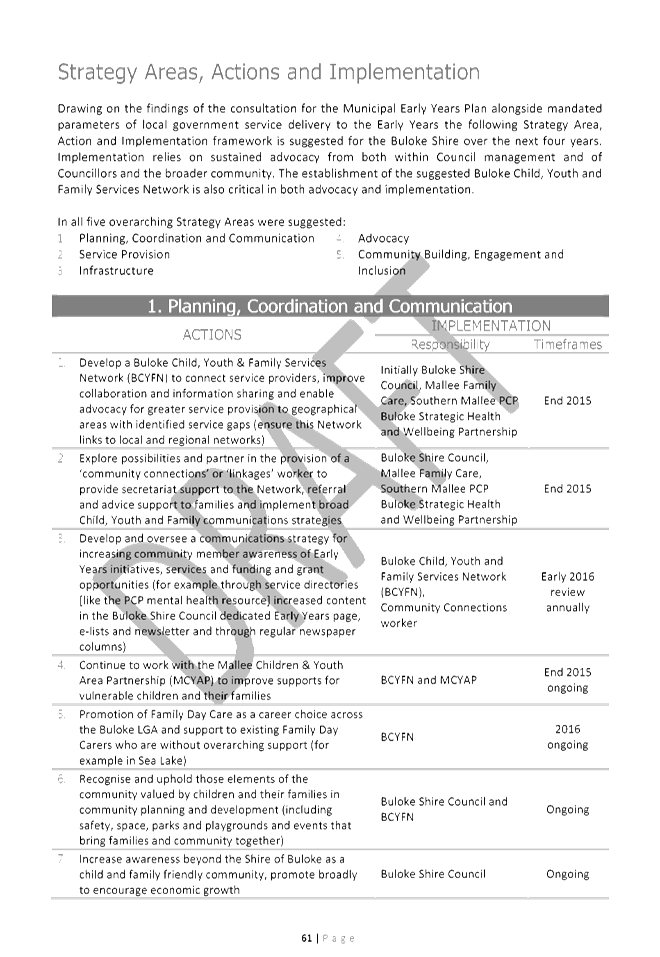
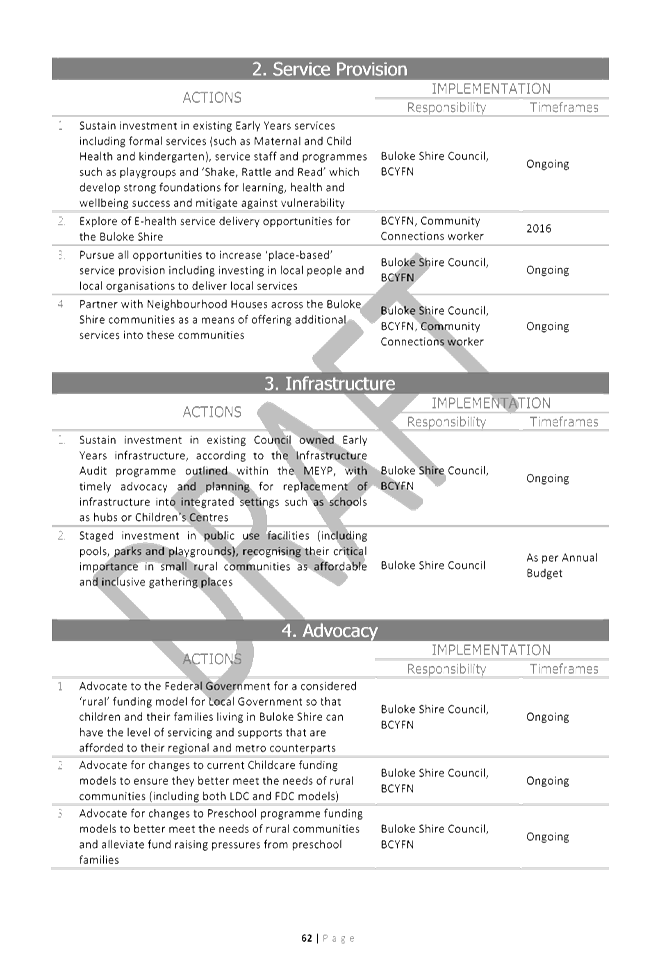
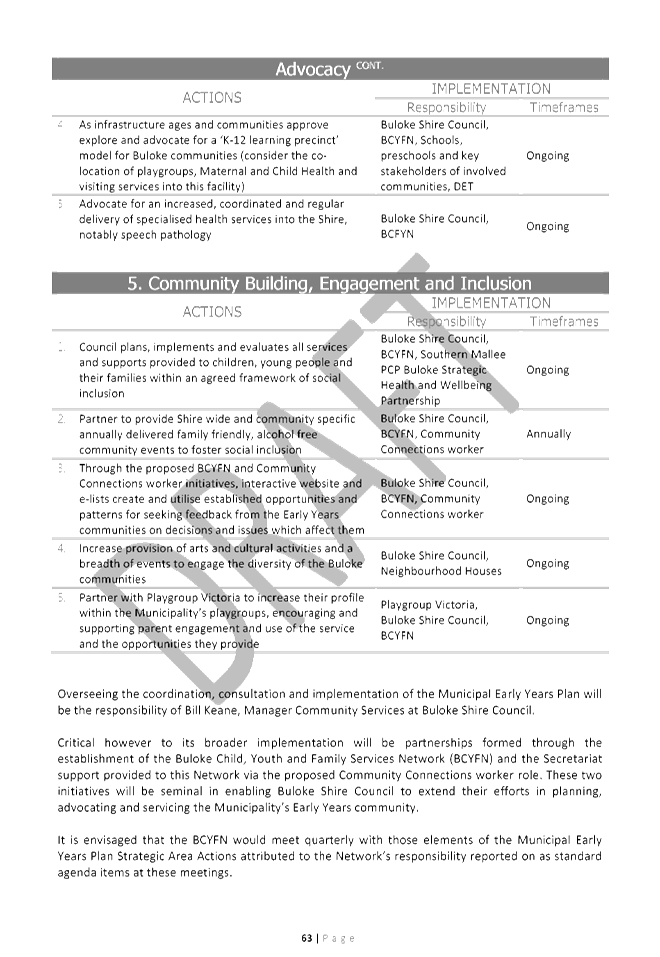
The draft Early Years Plan and the Children and Youth Strategy have been developed to provide strategic direction over the next four years for the Buloke Shire Council and its community.
It is recommended that the draft plans be placed on public exhibition to provide the community with further opportunity to comment on the proposed strategies.
2. Discussion
The draft Early Years Plan and the Children and Youth Strategy have been developed concurrently to ensure that there is consistency and synergy between the documents.
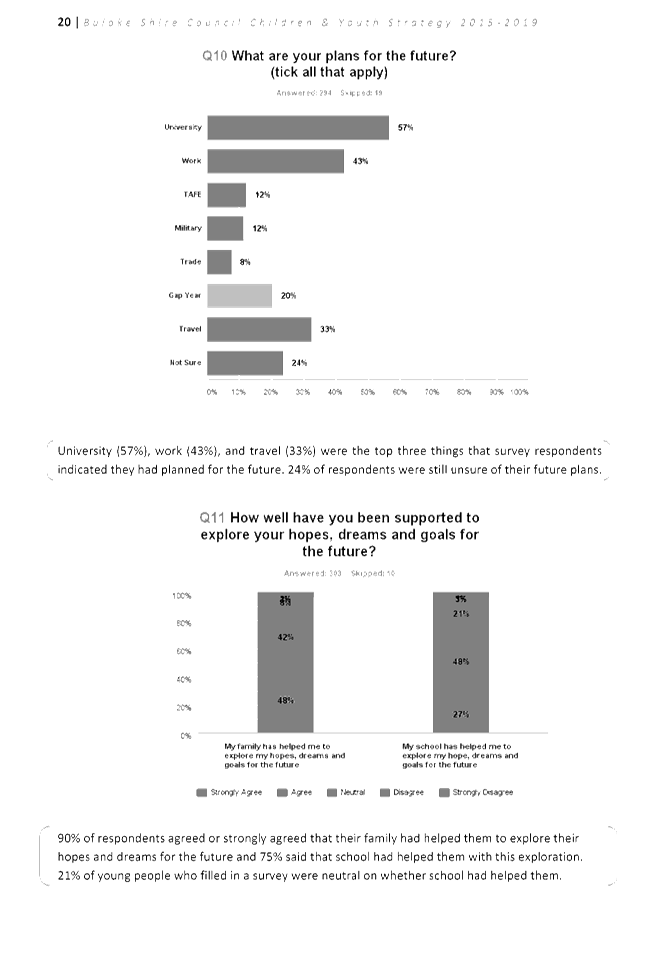
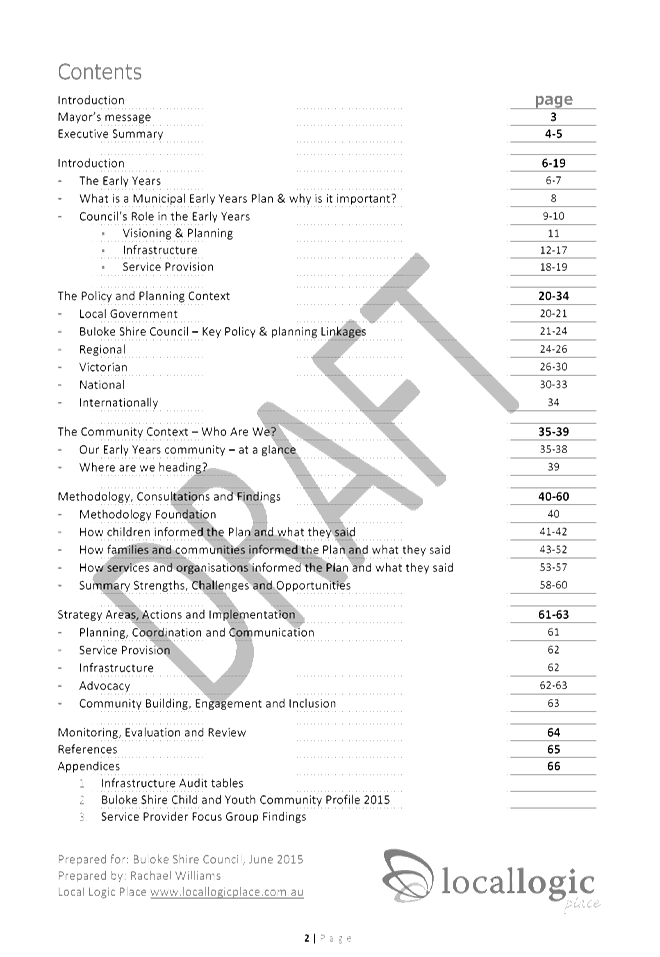
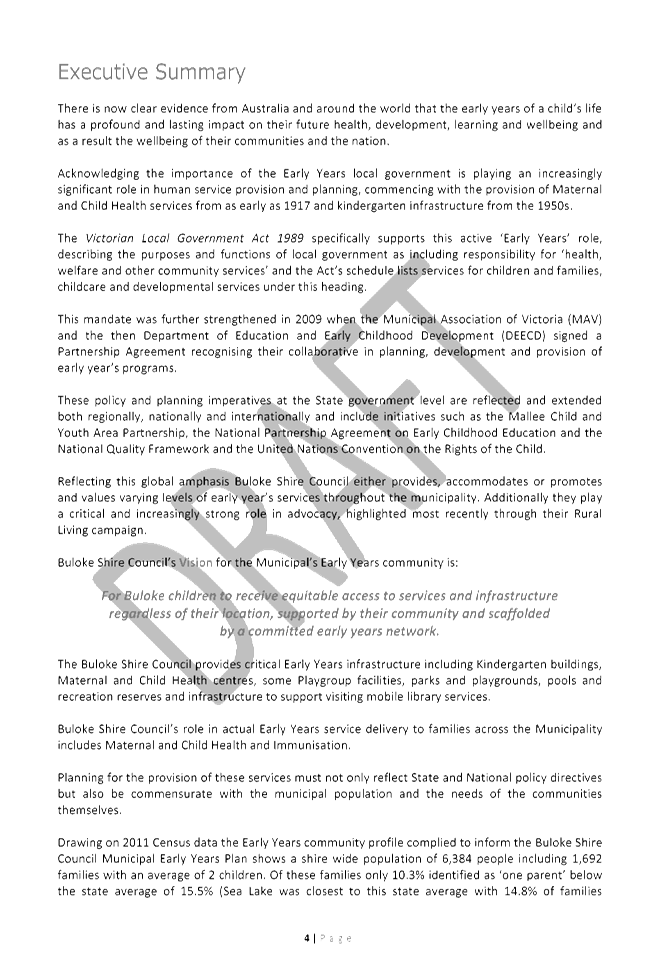
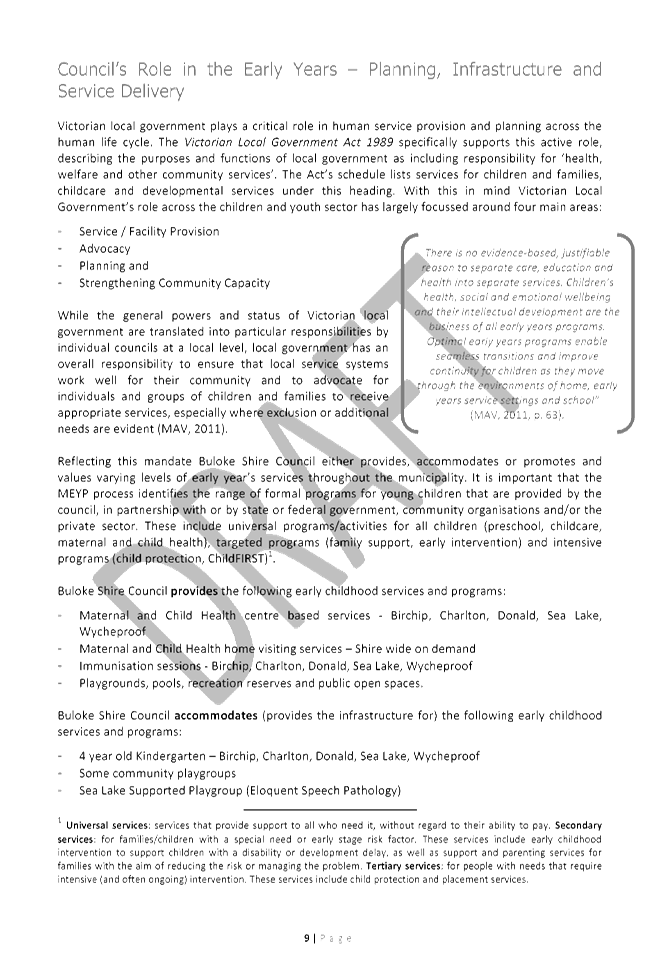
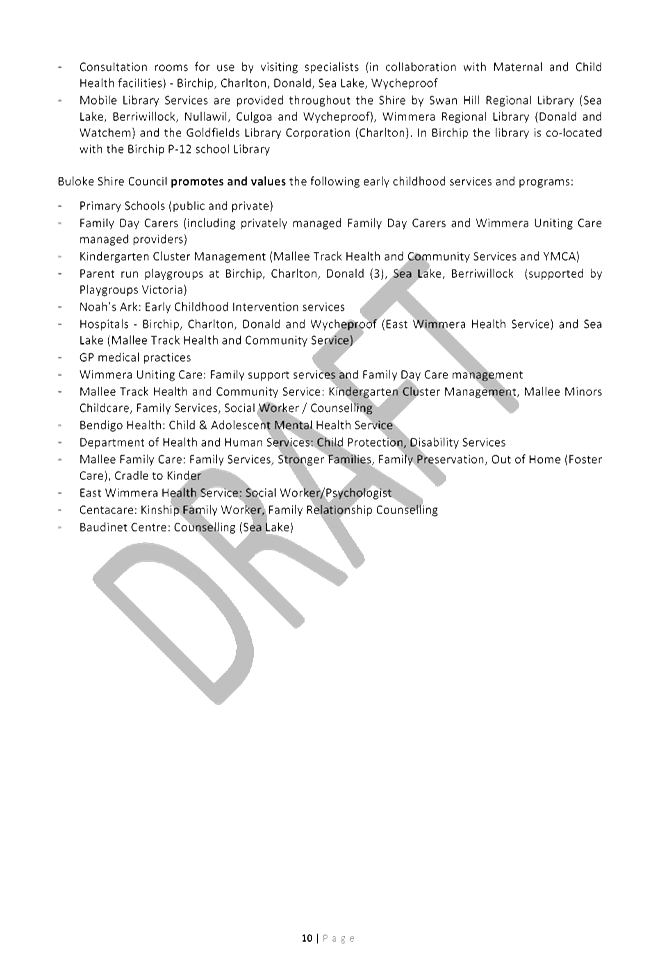
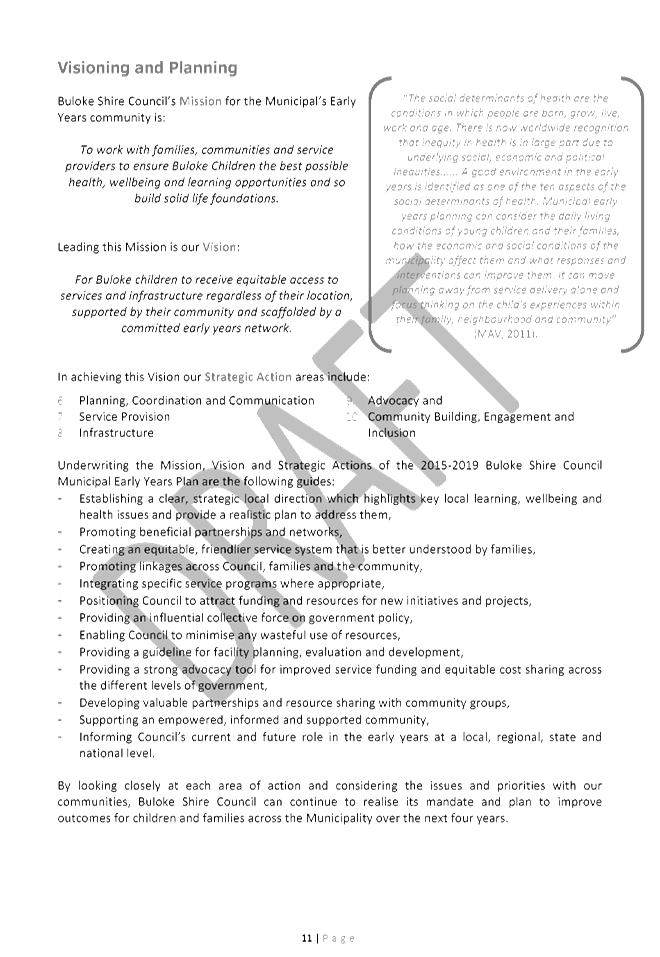
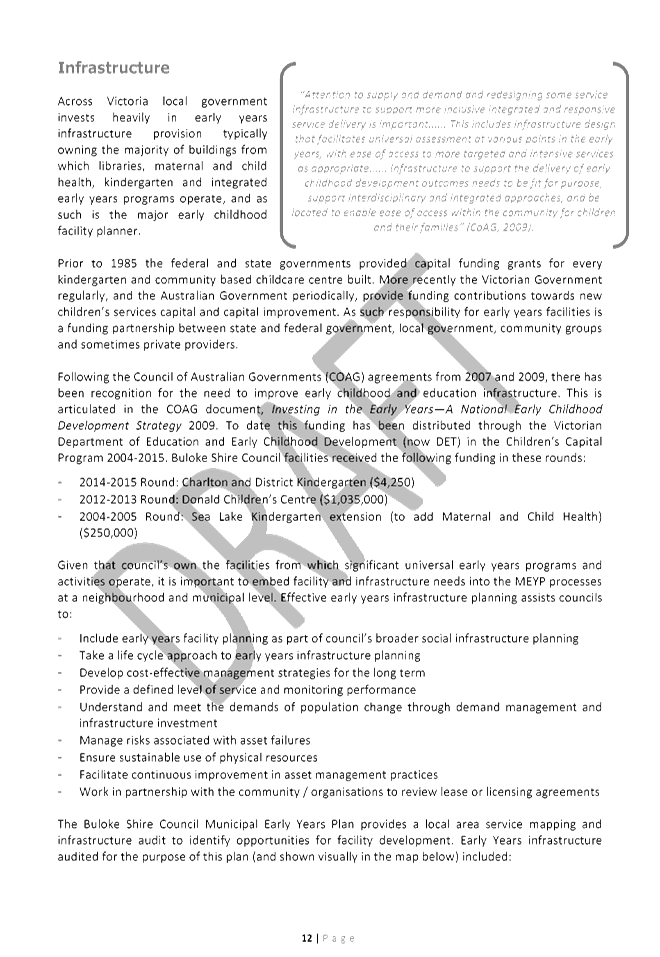
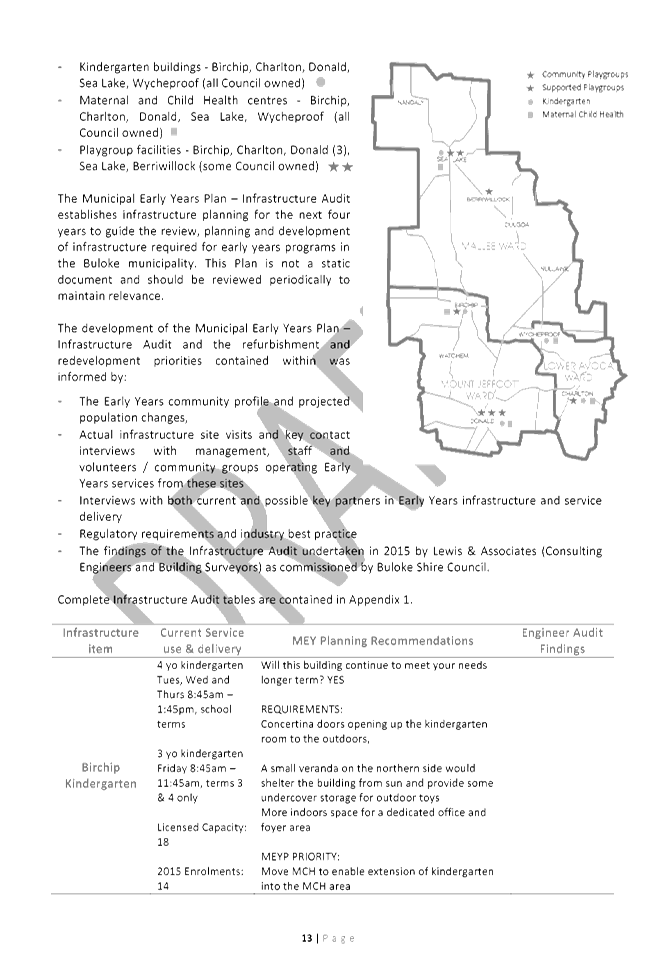
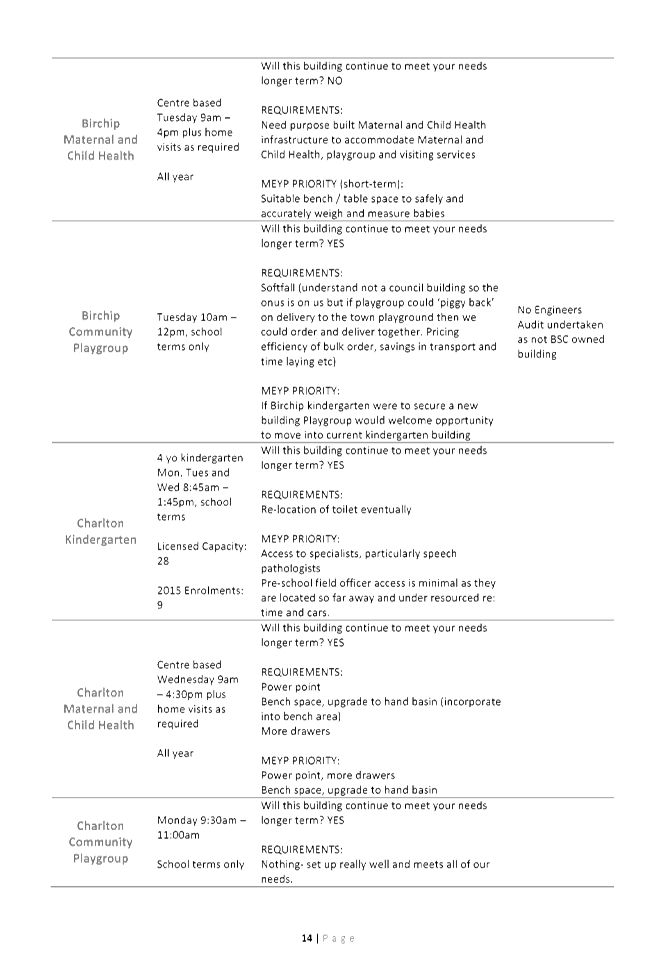
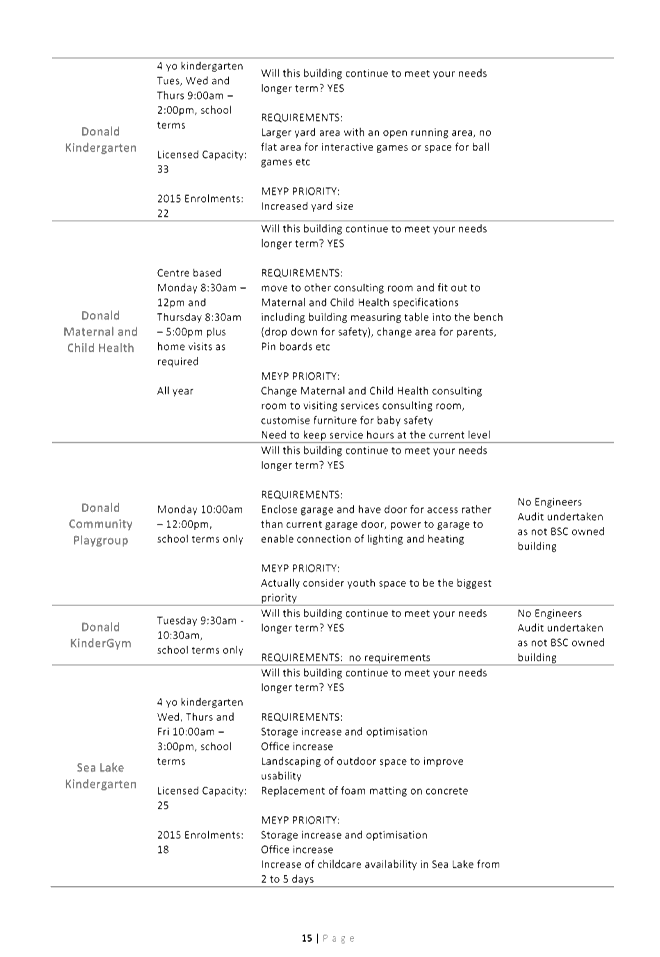
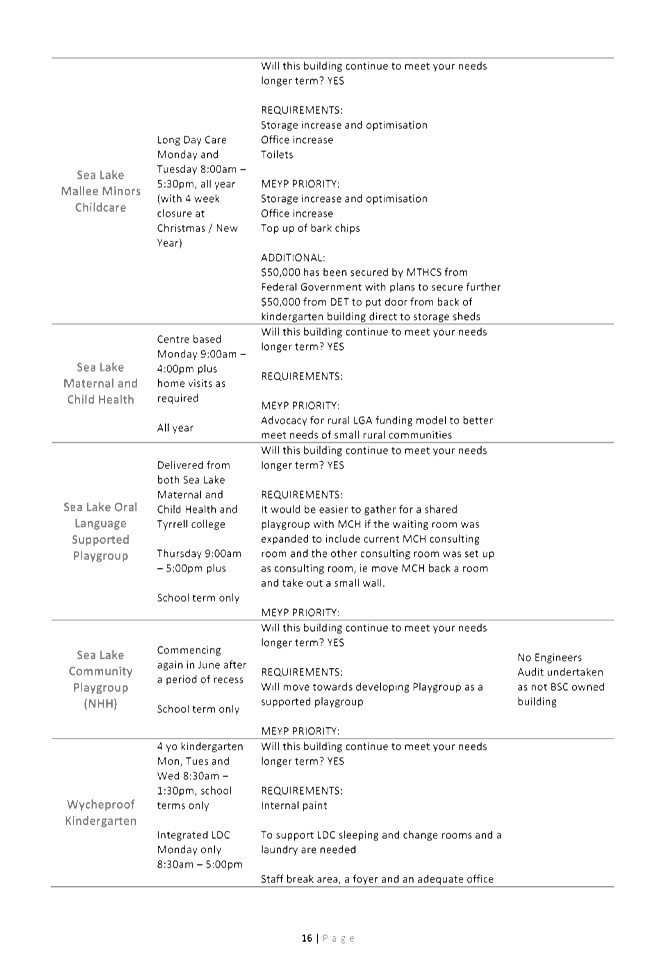
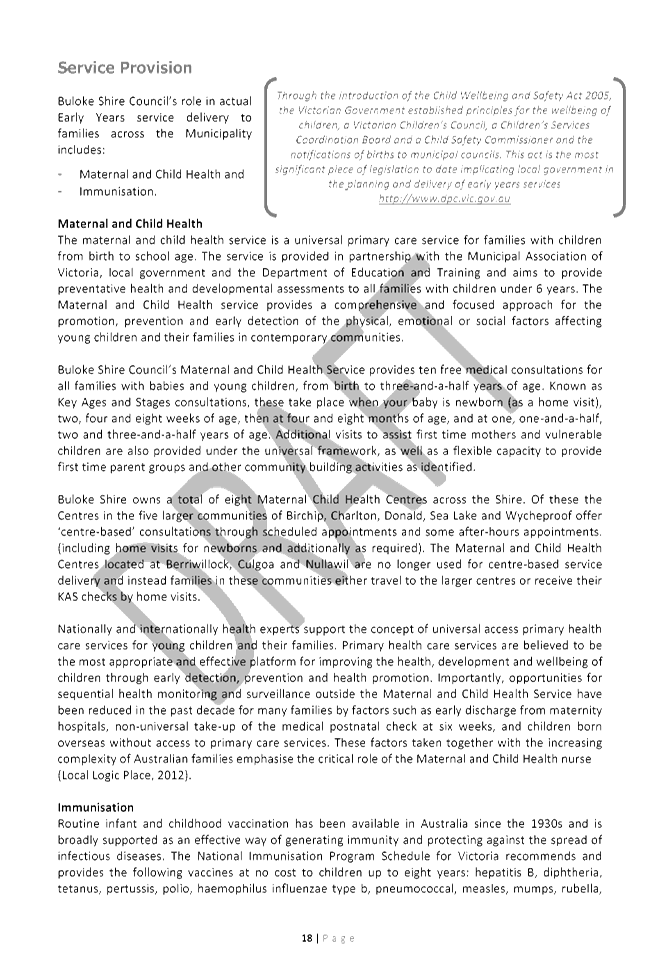
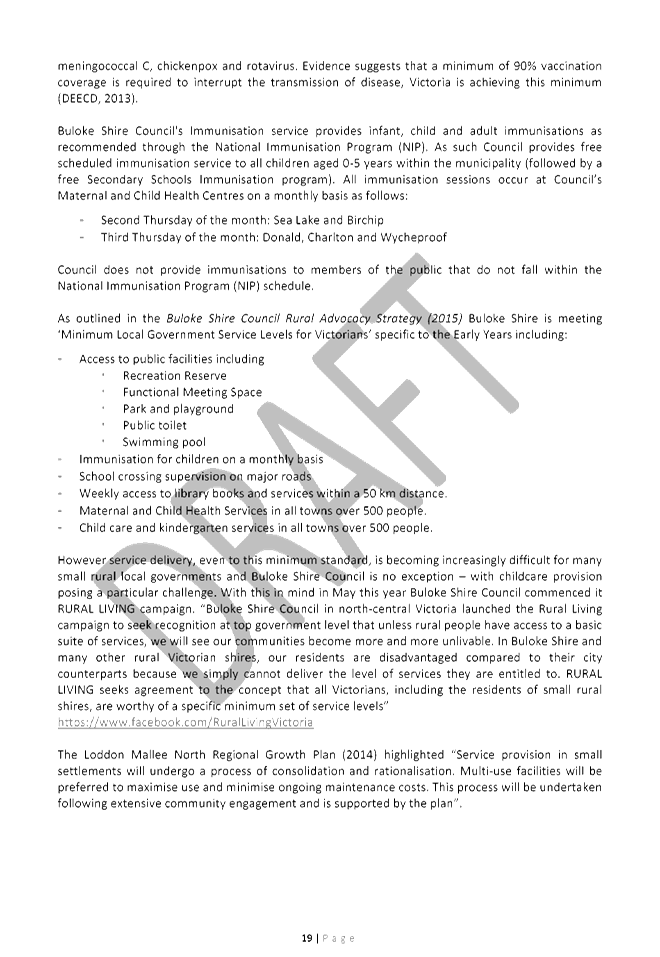
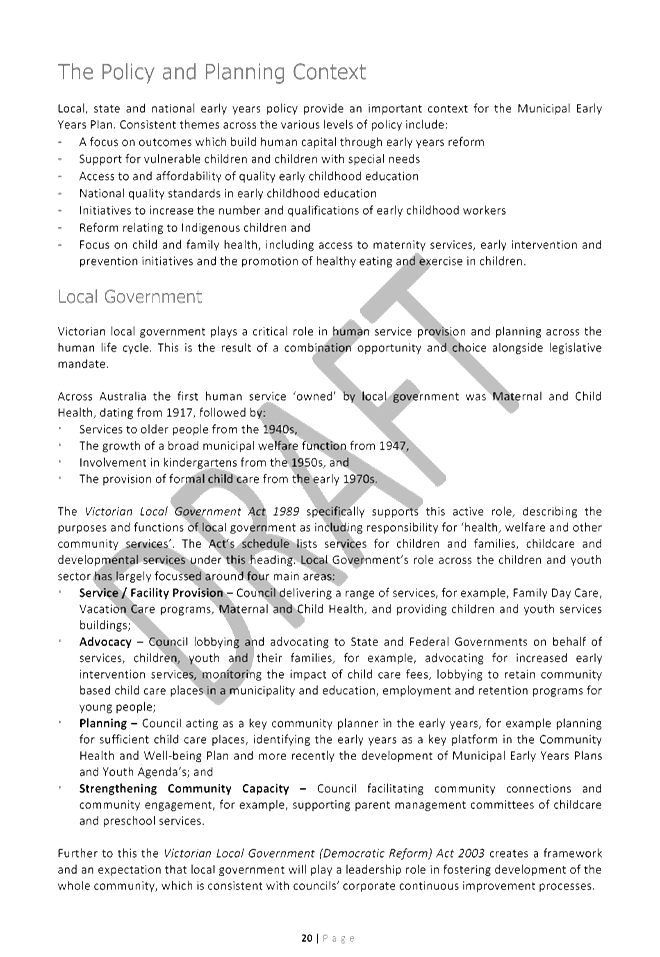
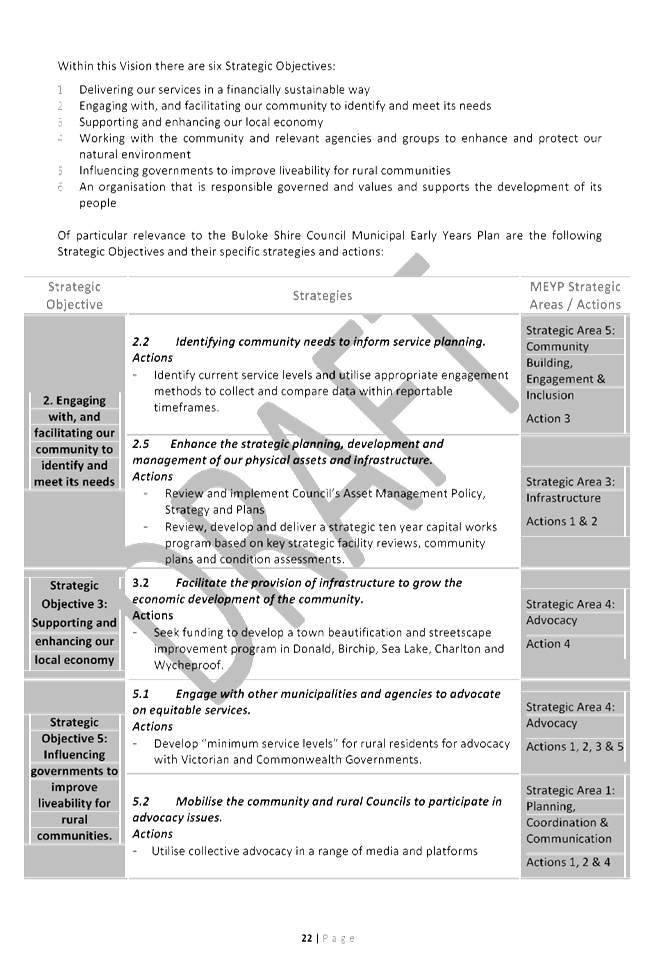
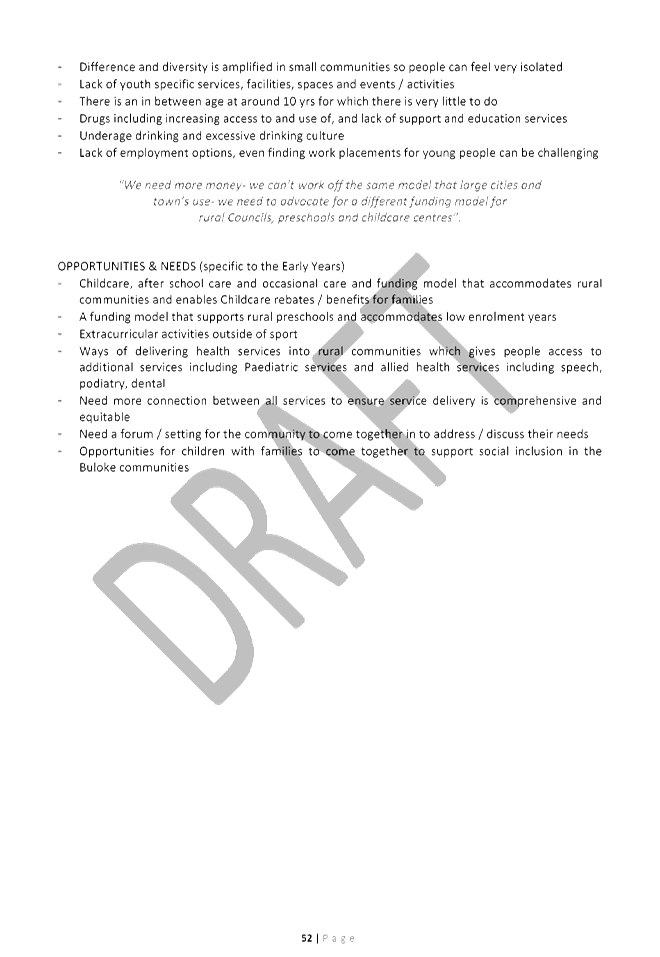
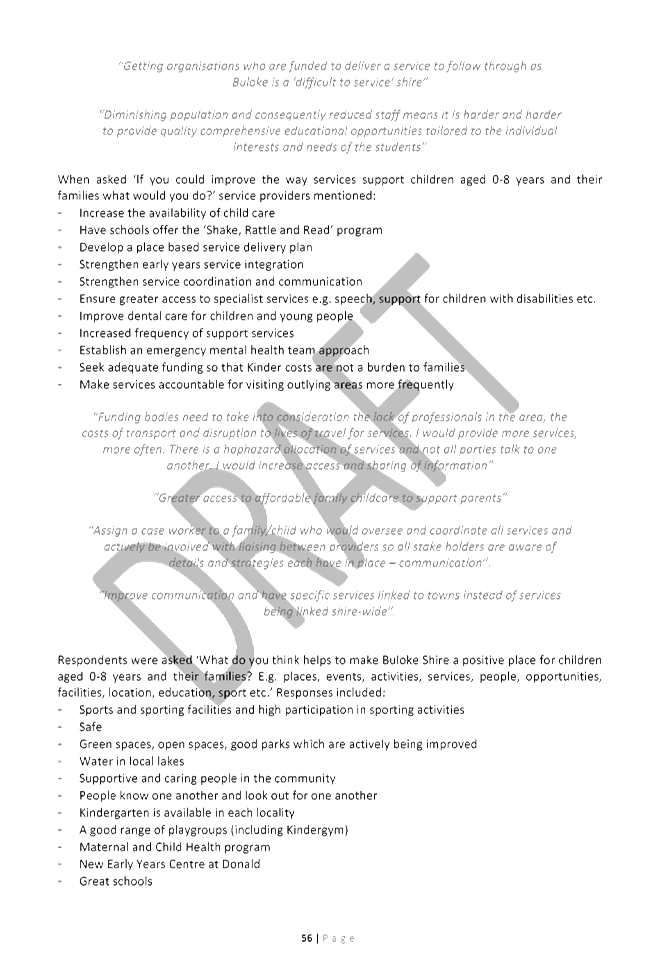
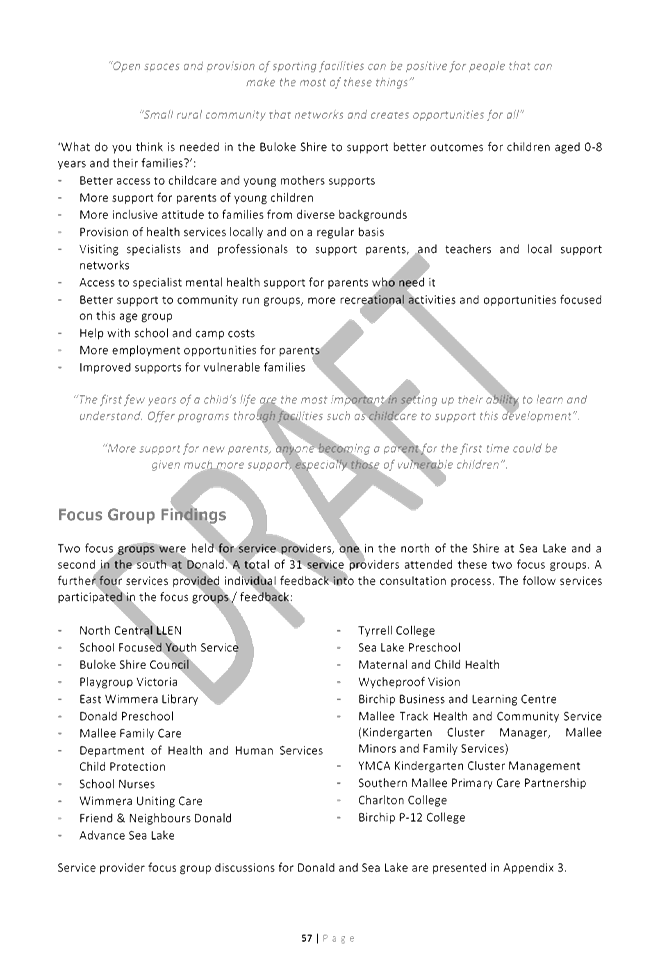
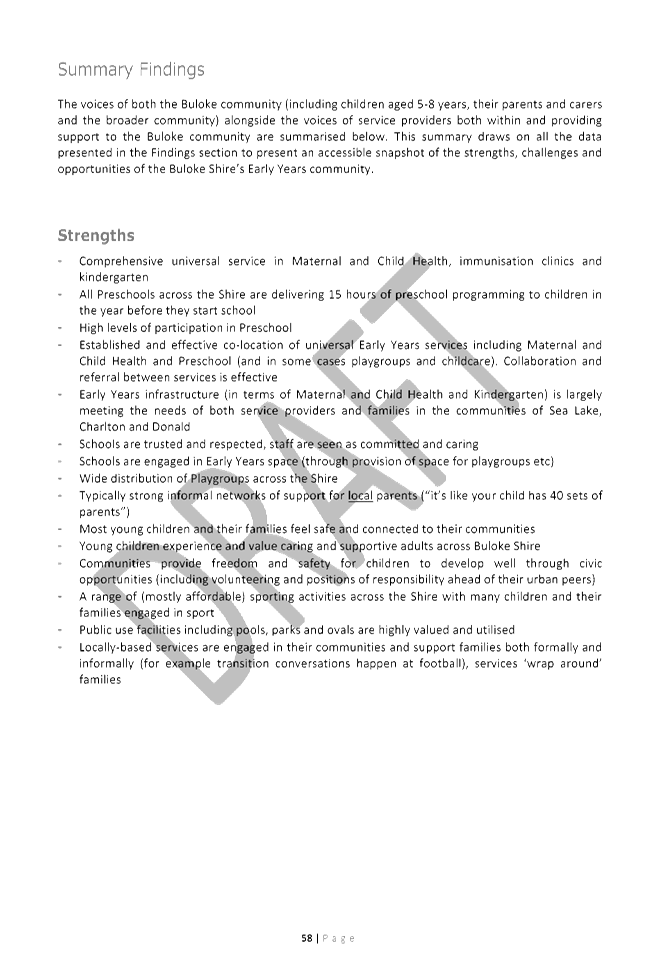
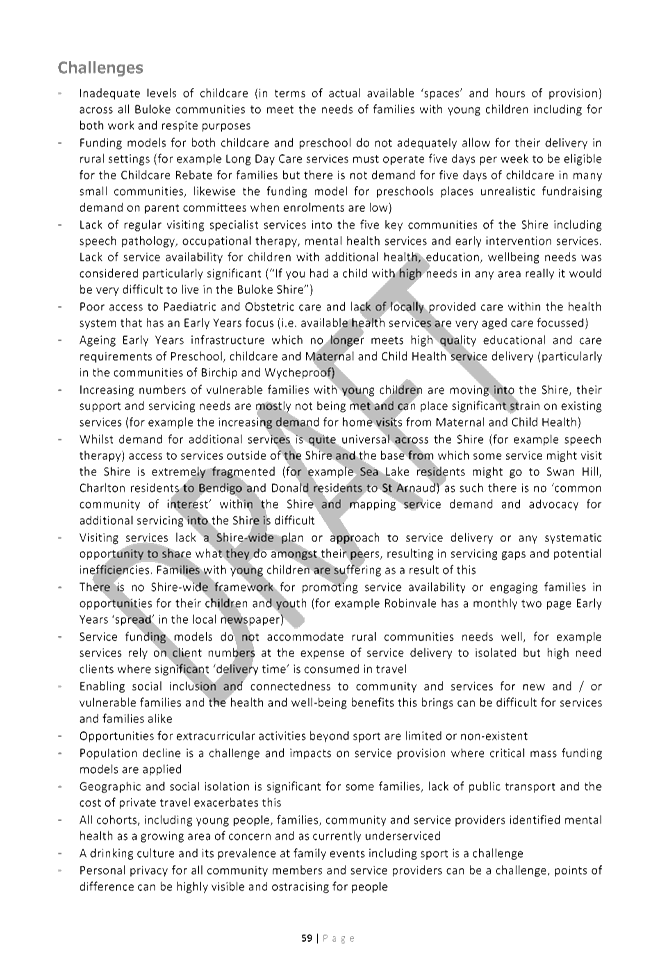
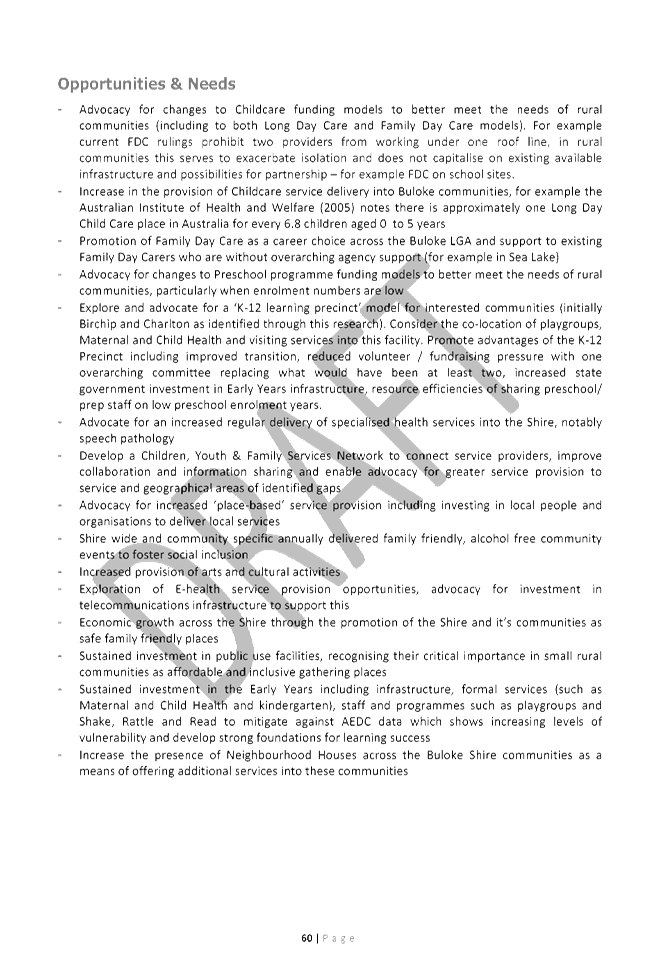
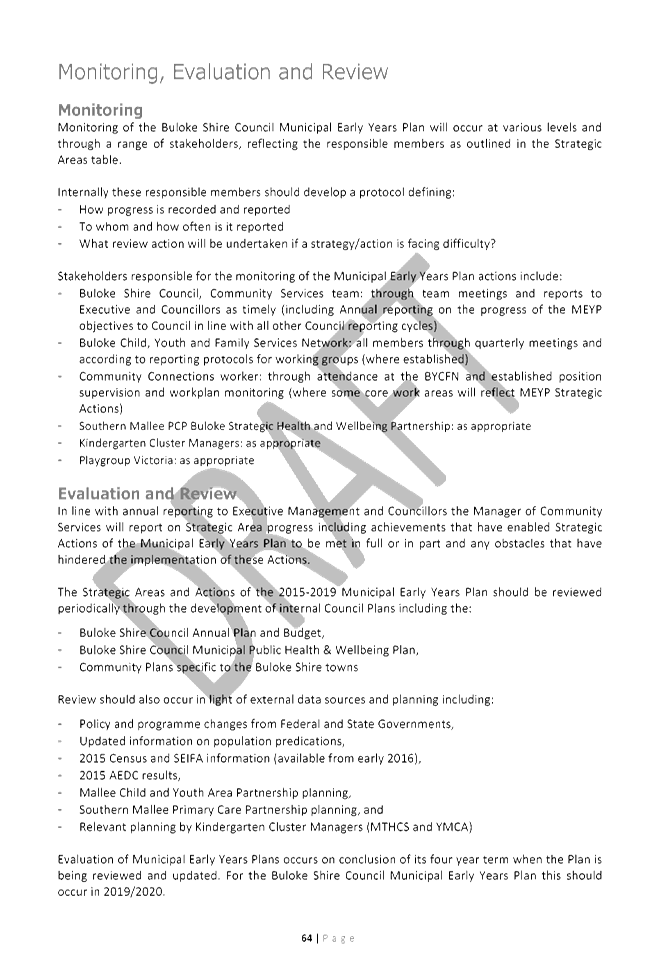
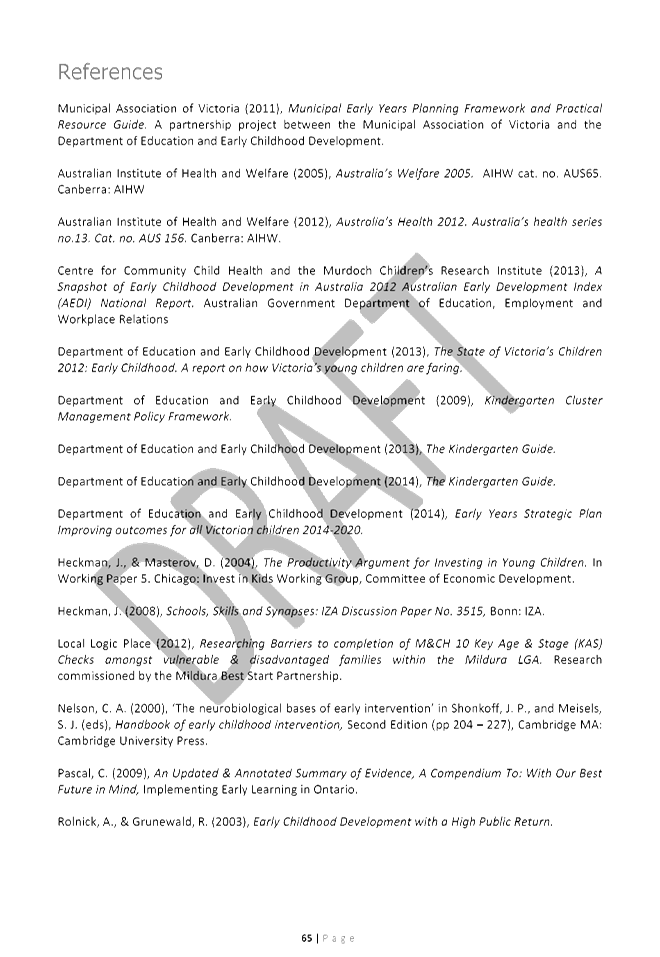
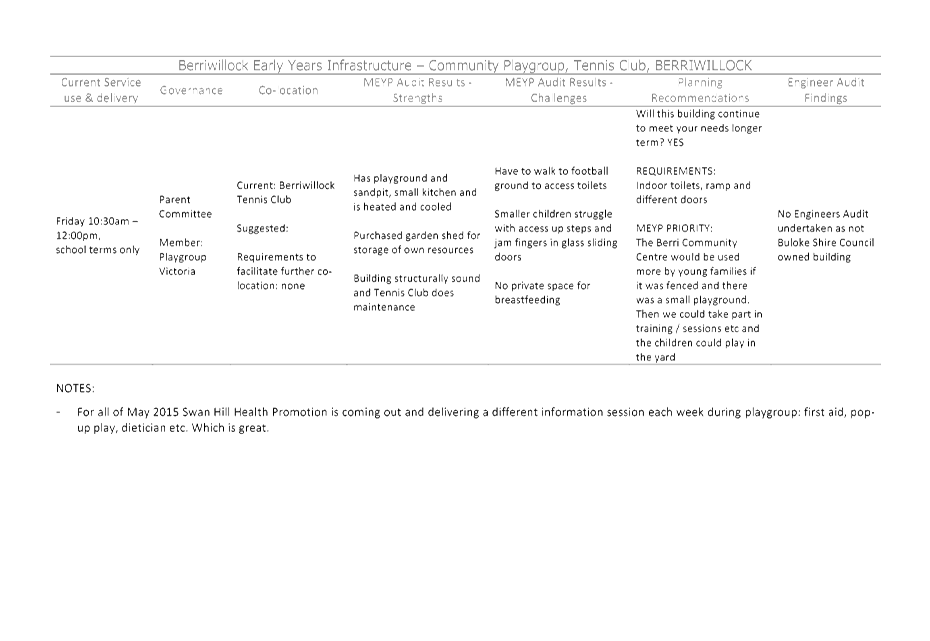
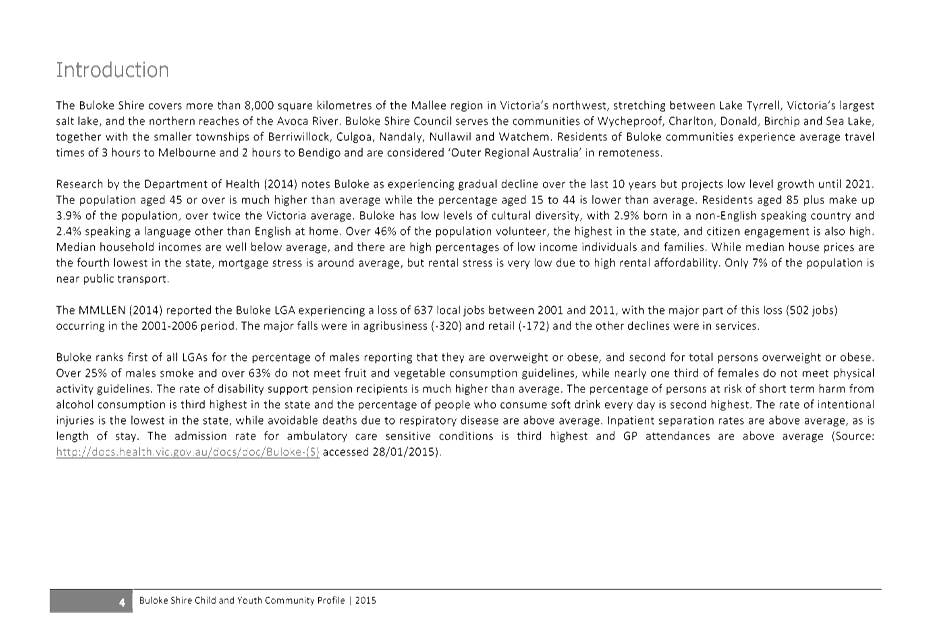
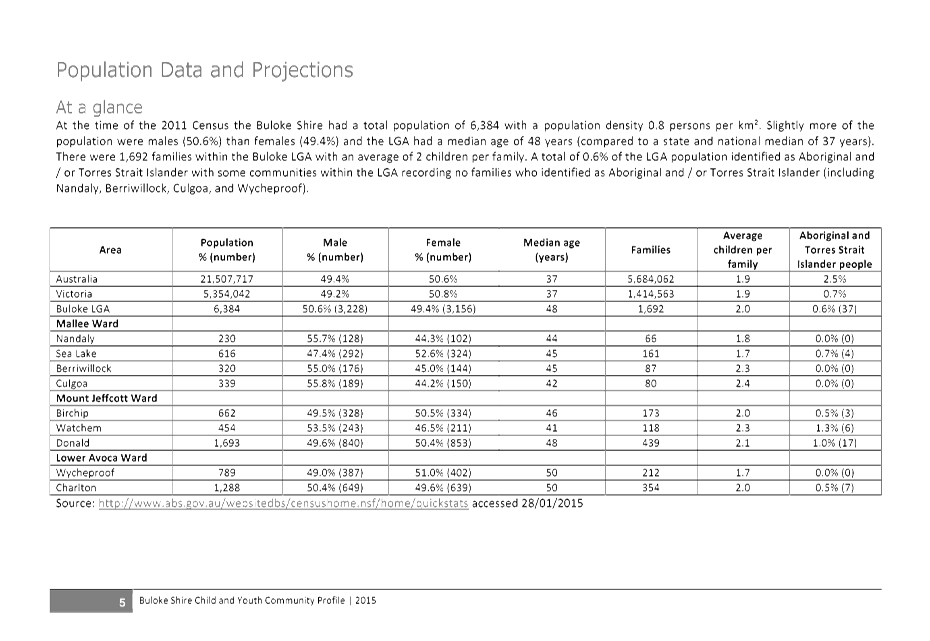
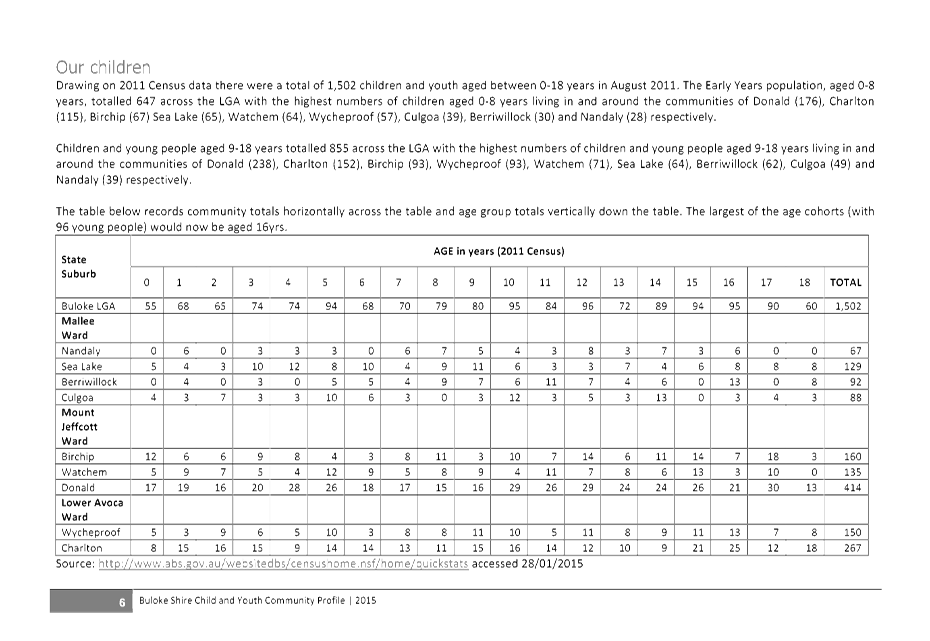
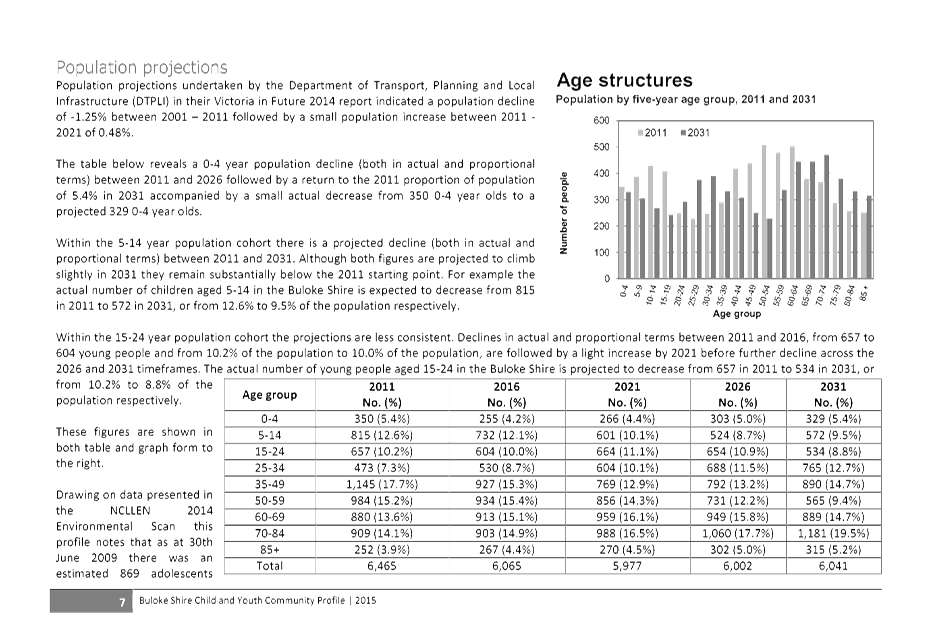
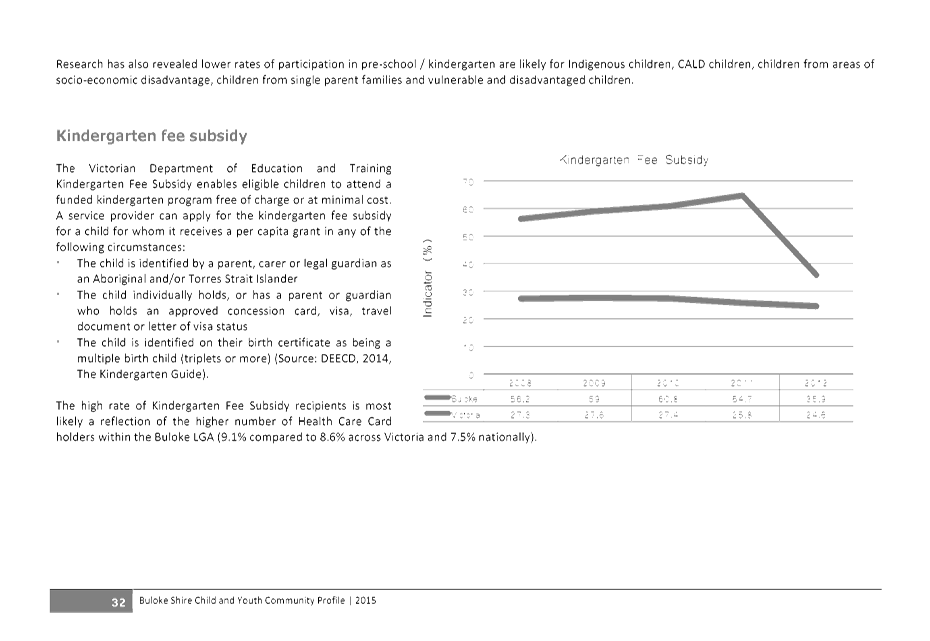
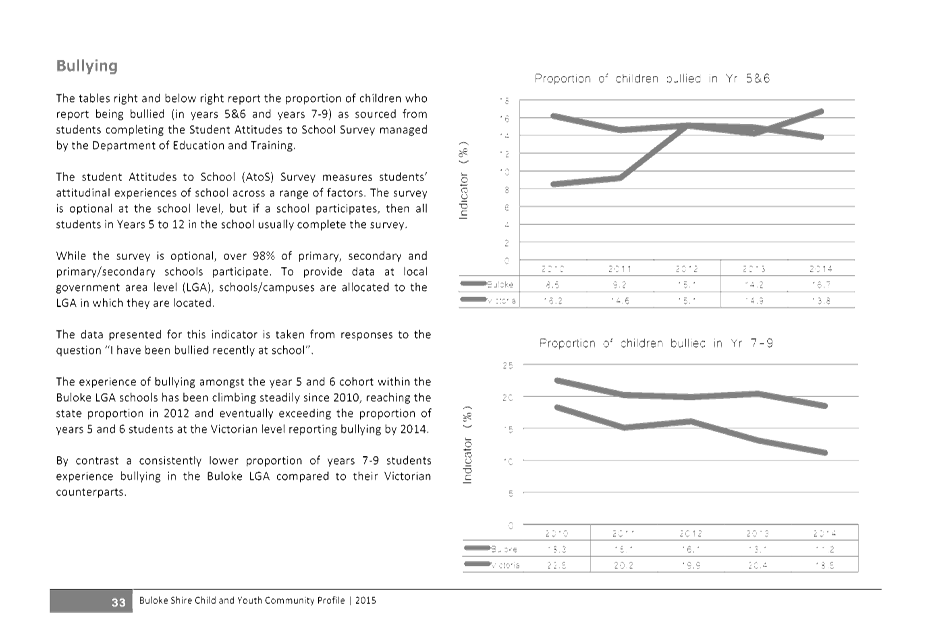
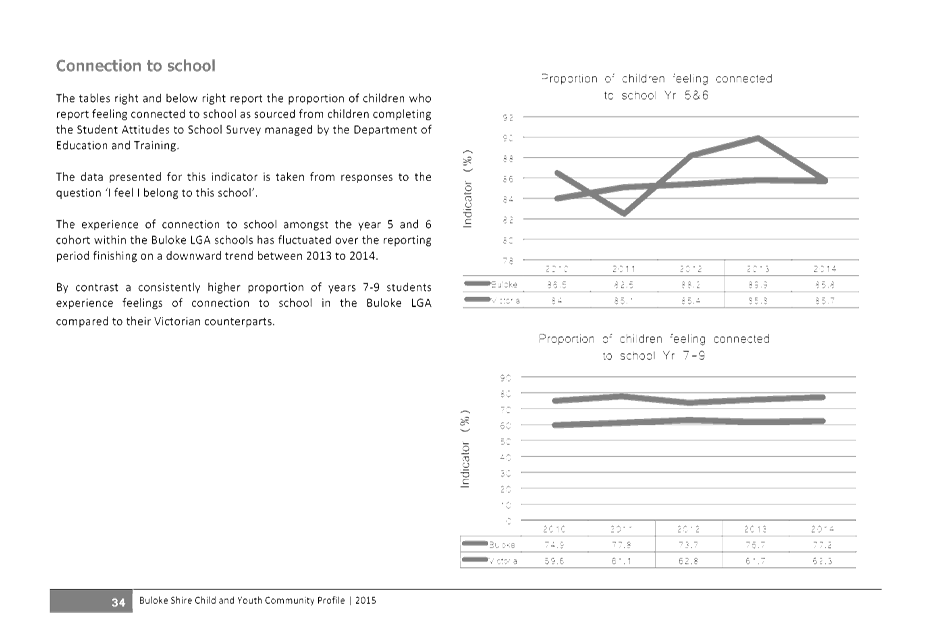
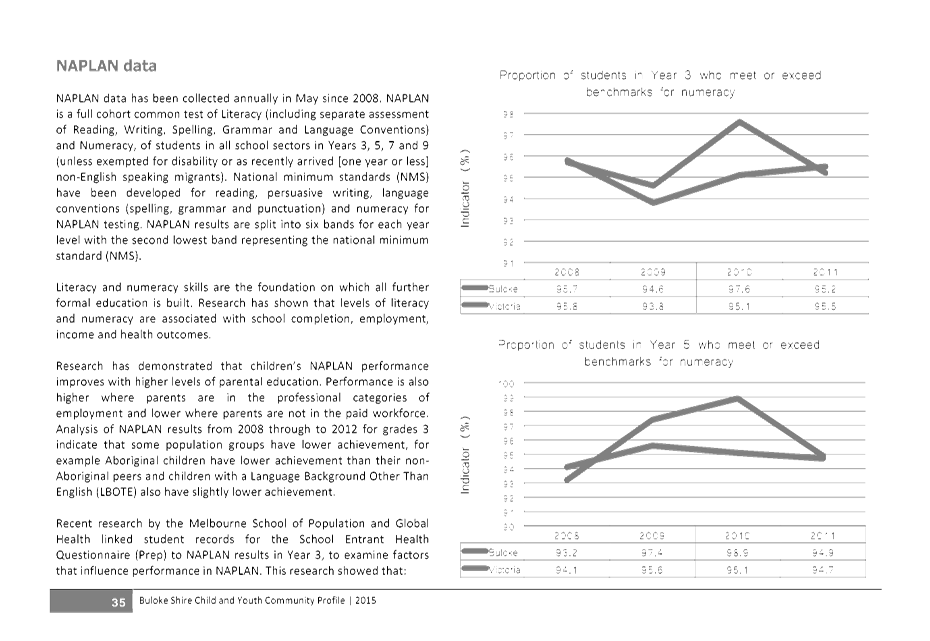
The draft Municipal Early Years Plan articulates local government’s role in early years services and it provides strategic direction for the development and coordination of early education, care and health programs, activities and other local developments that impact on children from birth to eight years. It is a universal document, not limited to Council’s statutory considerations.
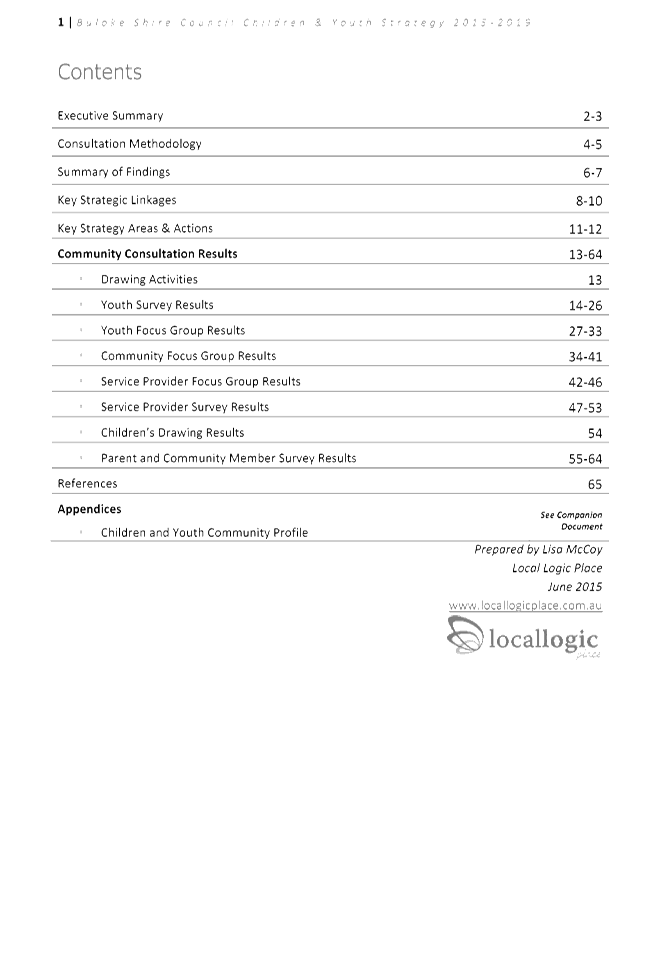
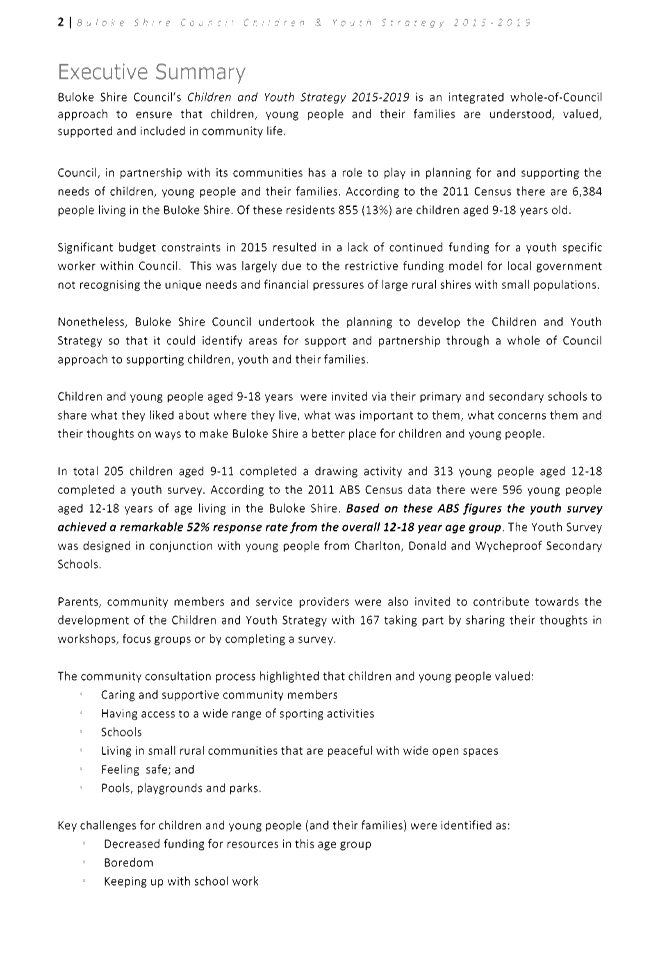
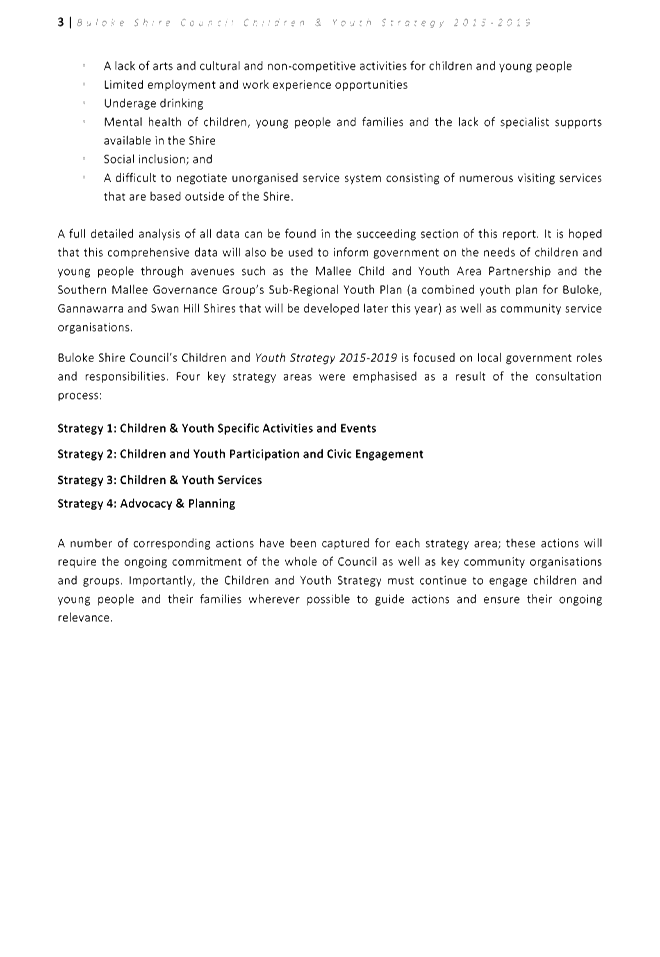
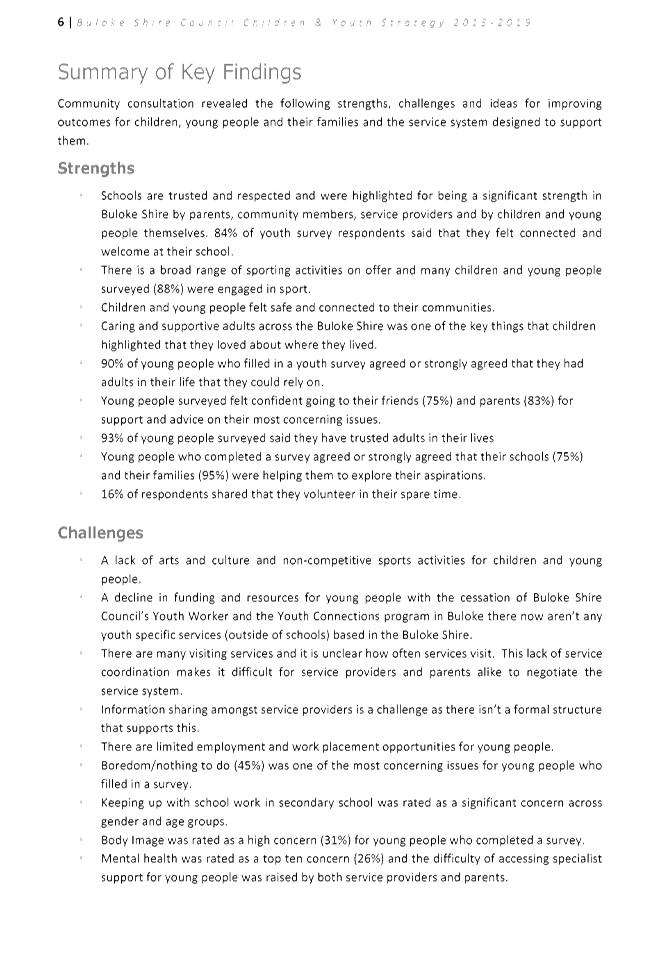
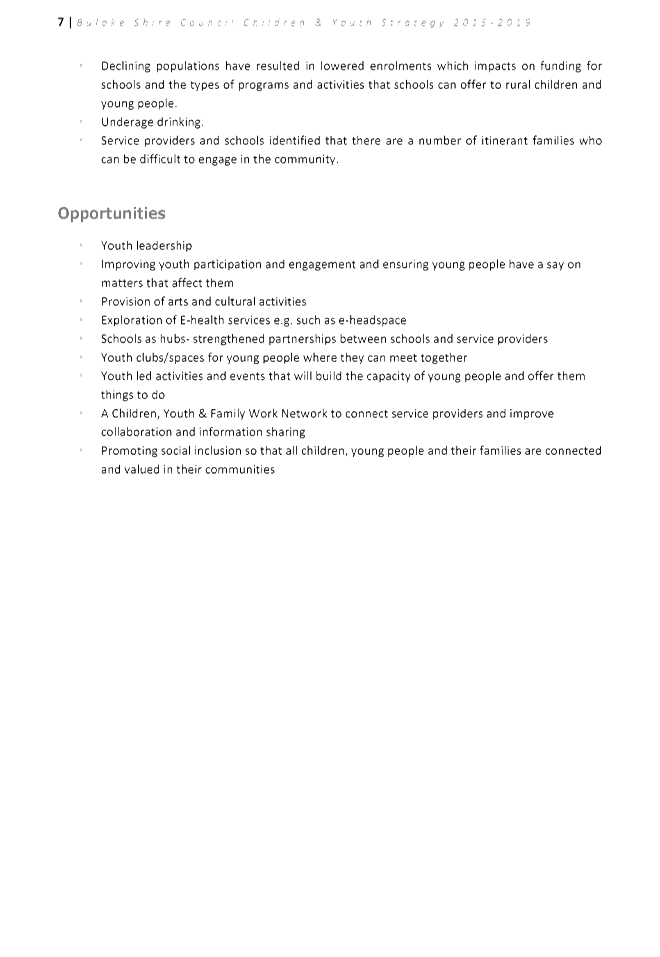
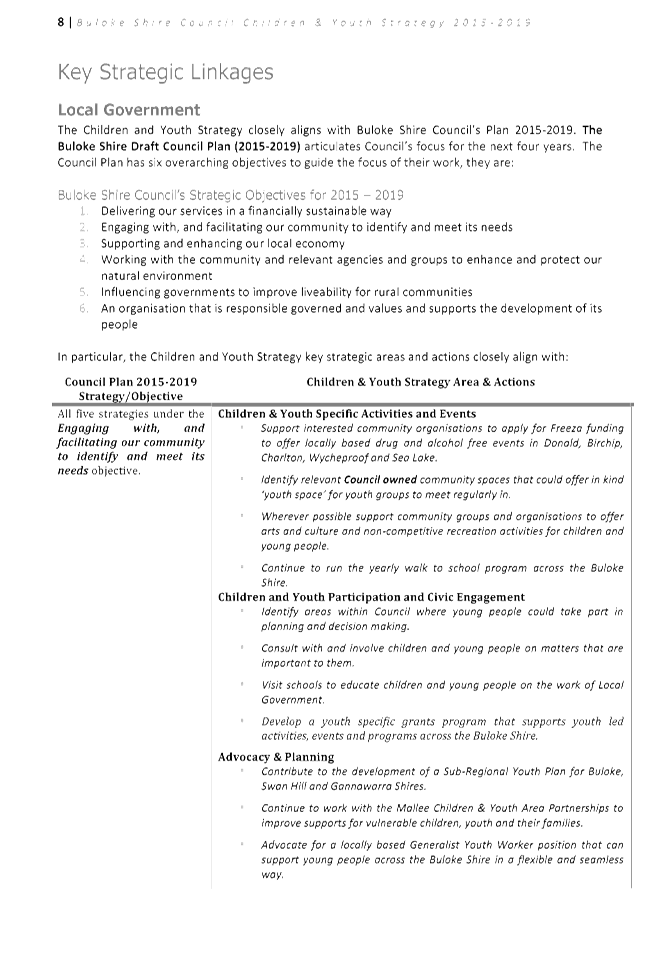
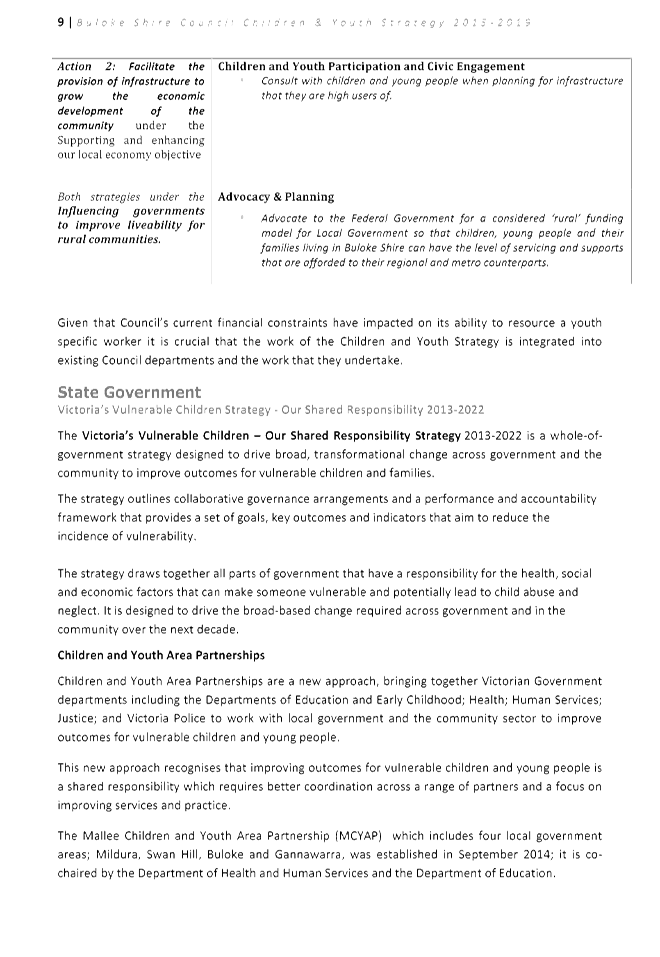
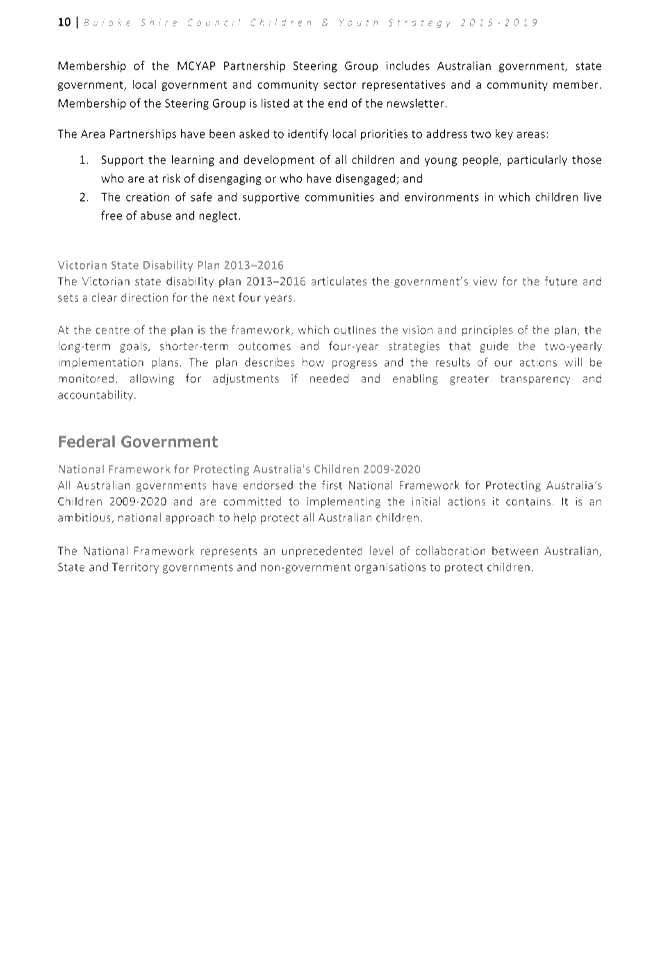
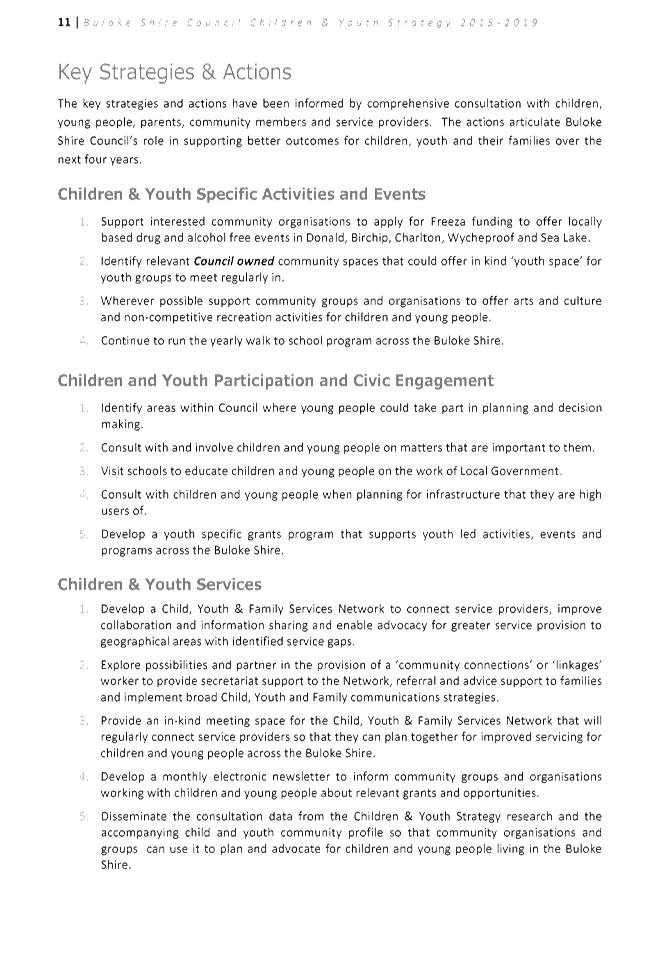
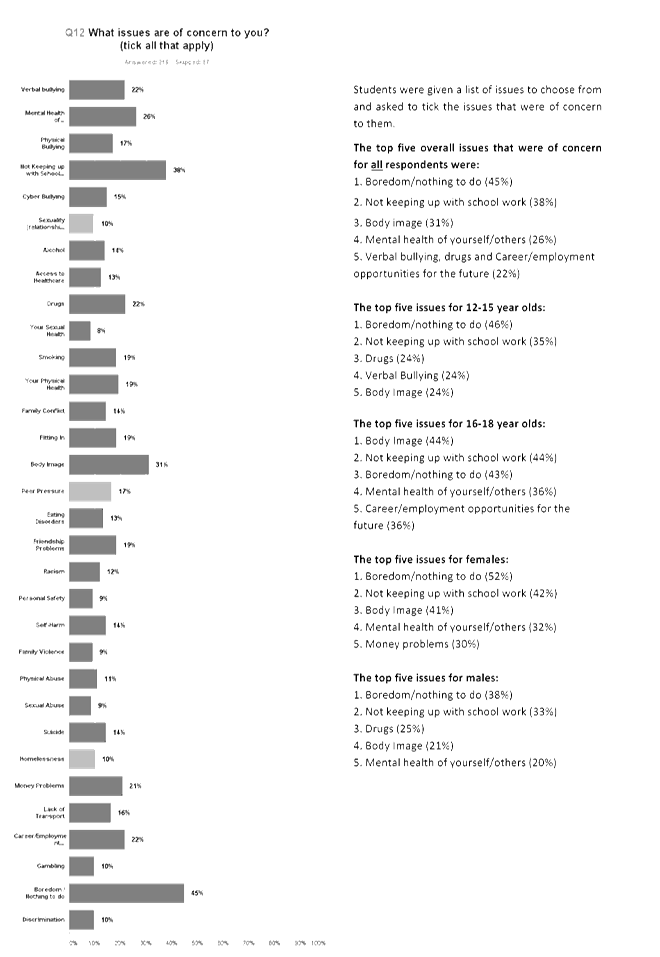
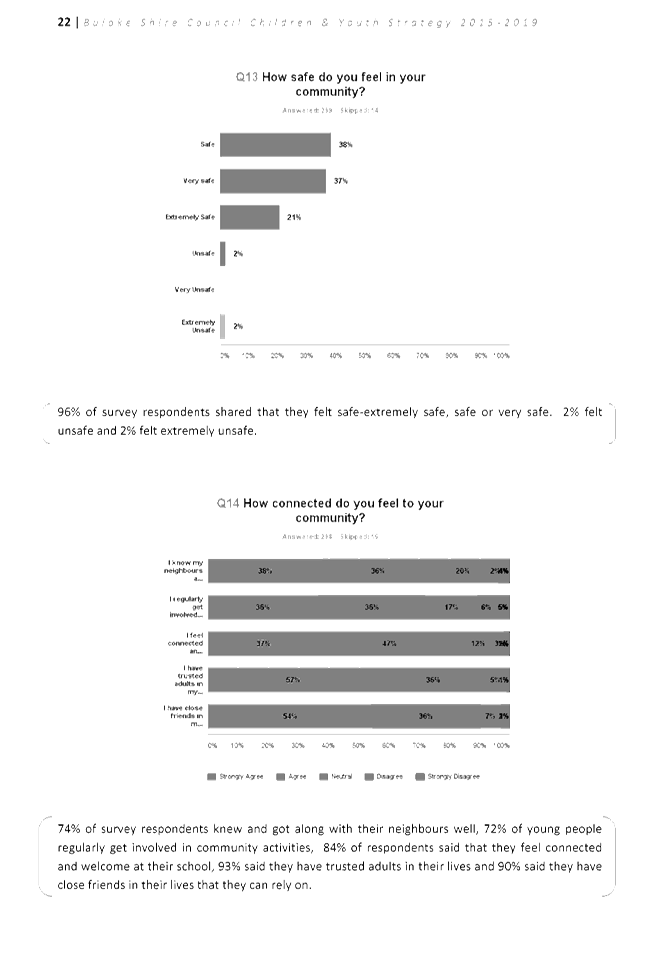
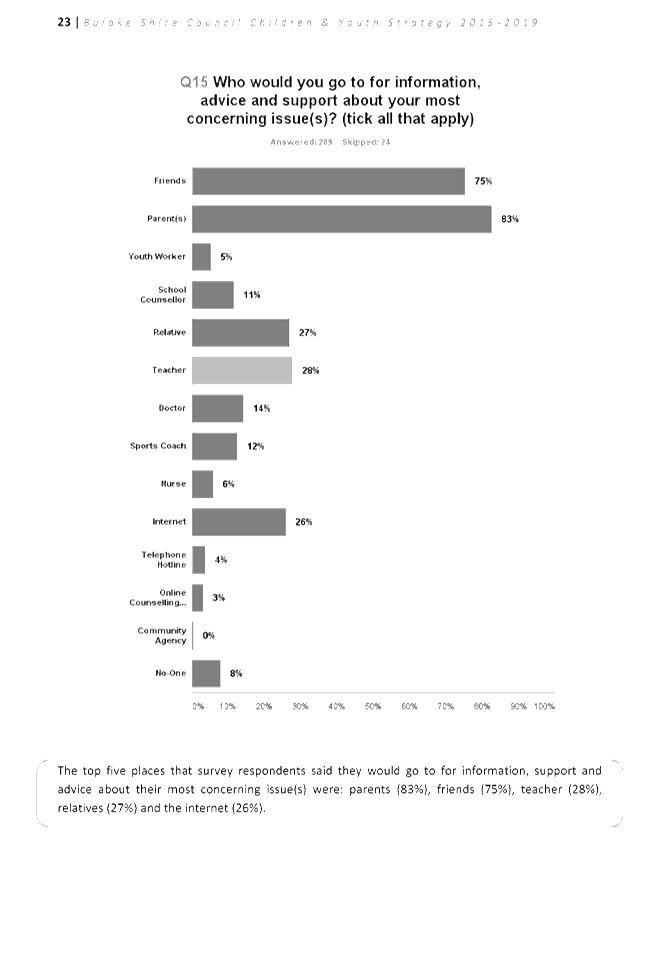
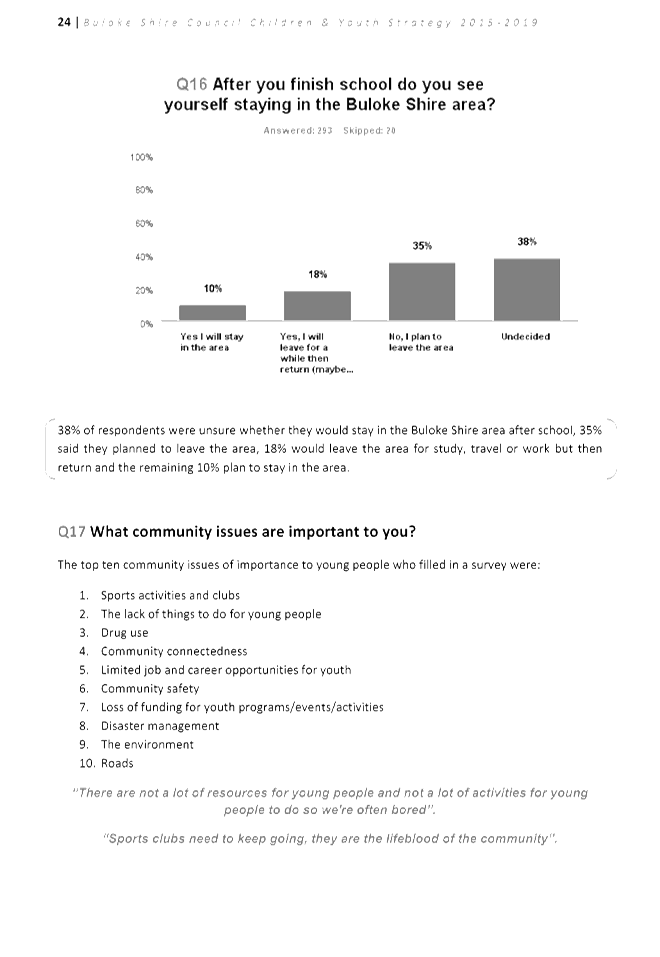
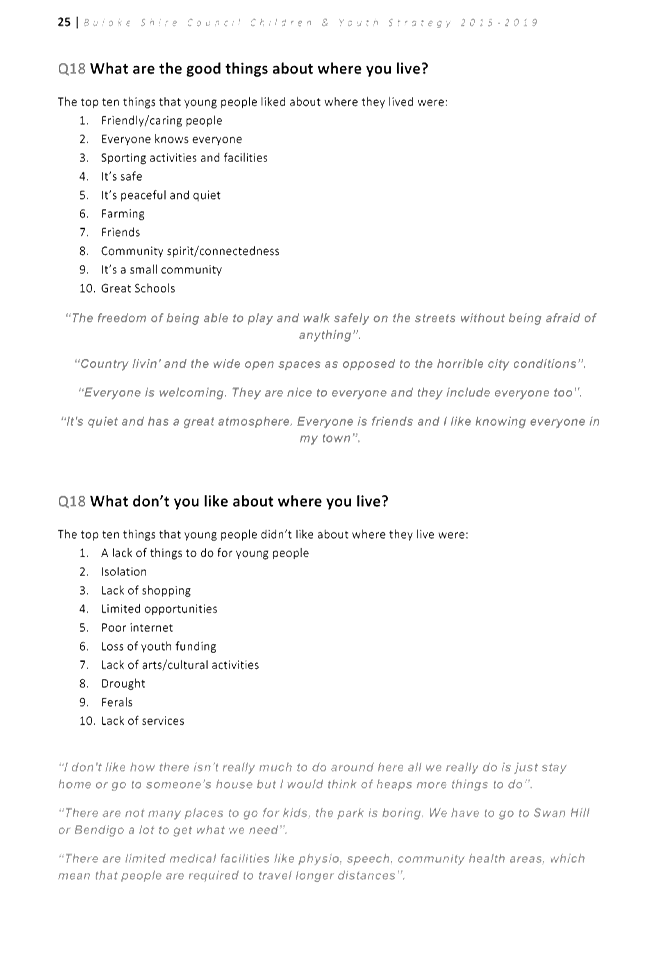
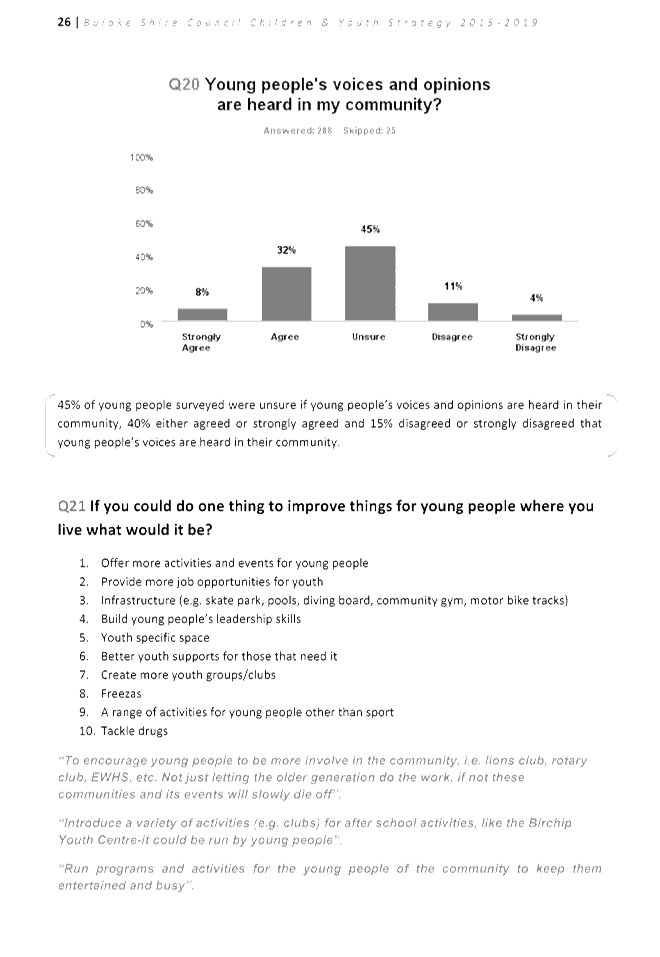
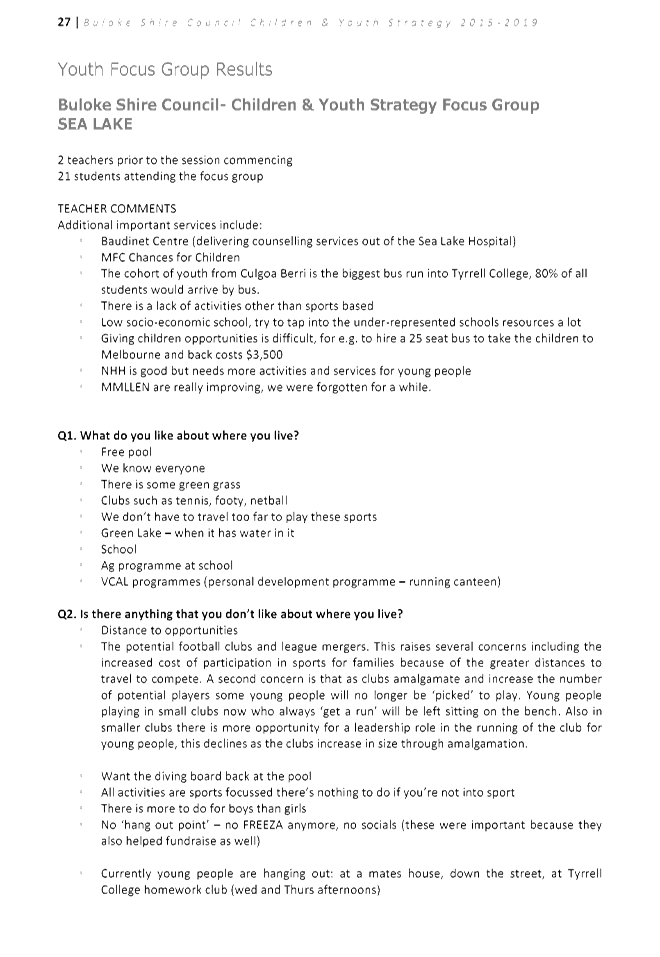
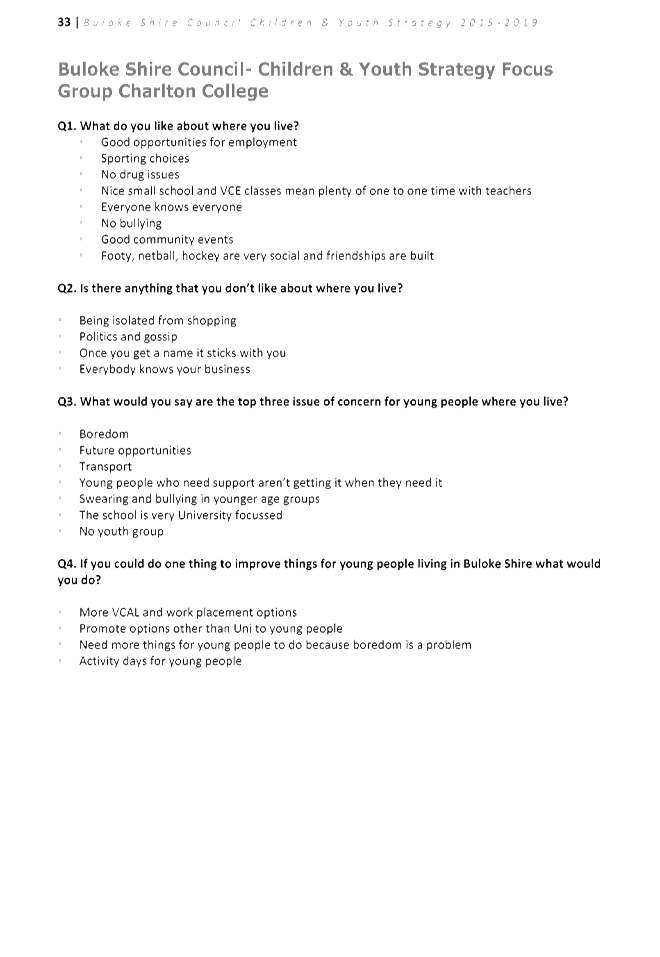
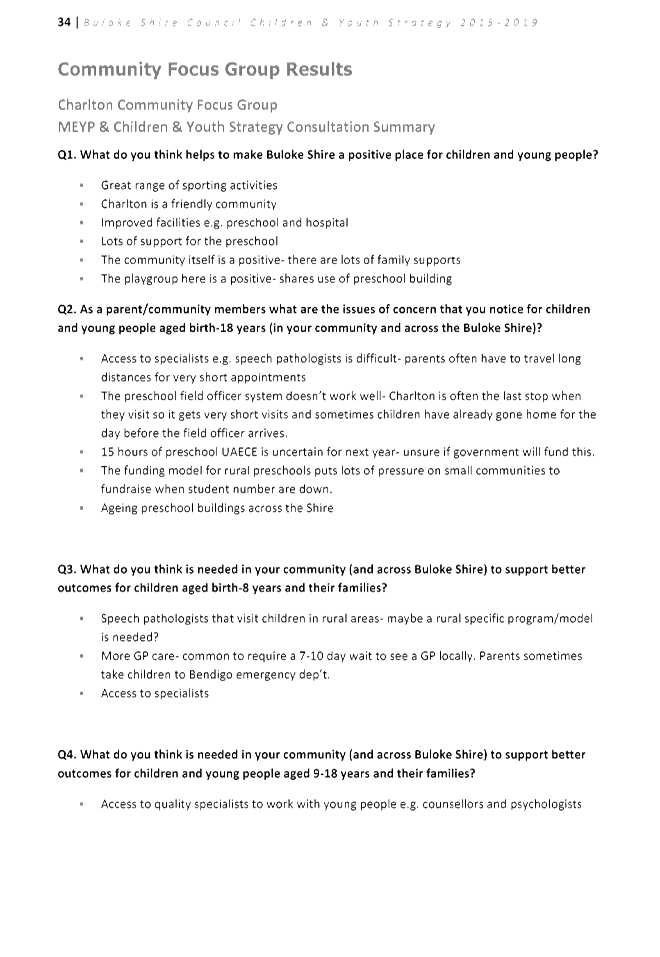
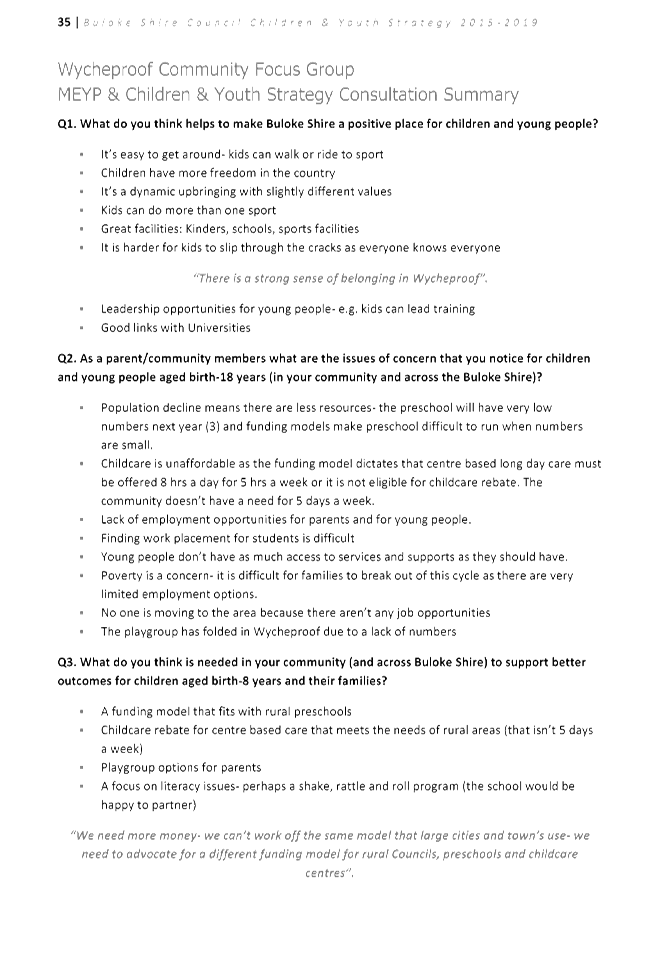
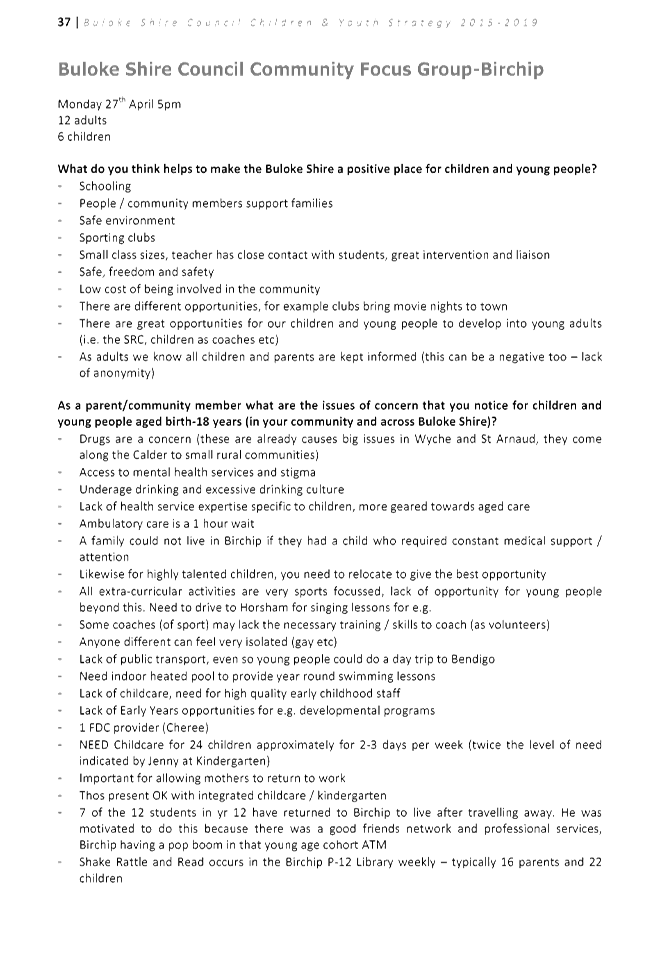
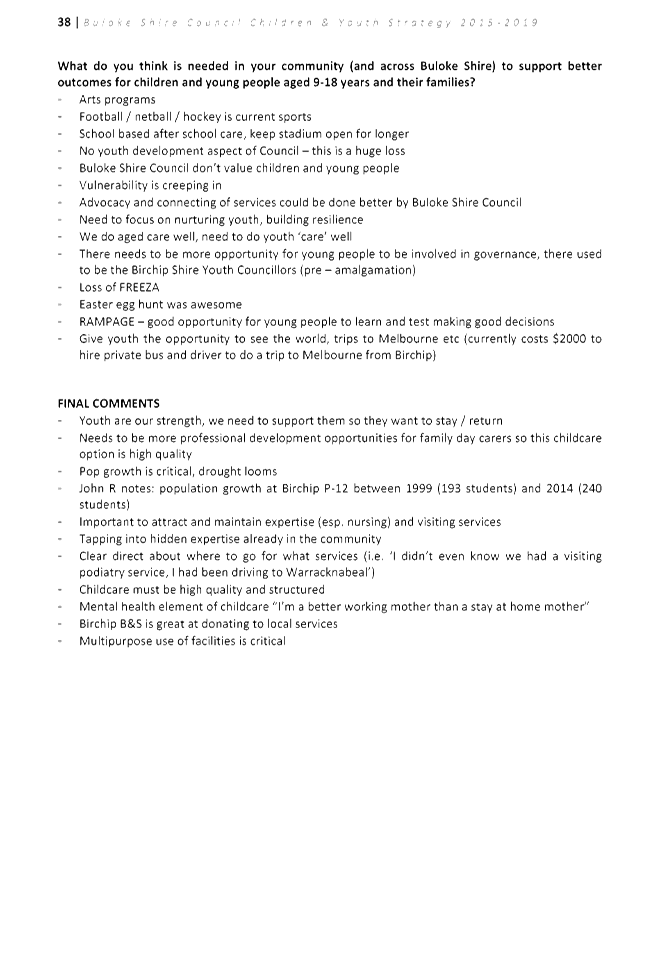
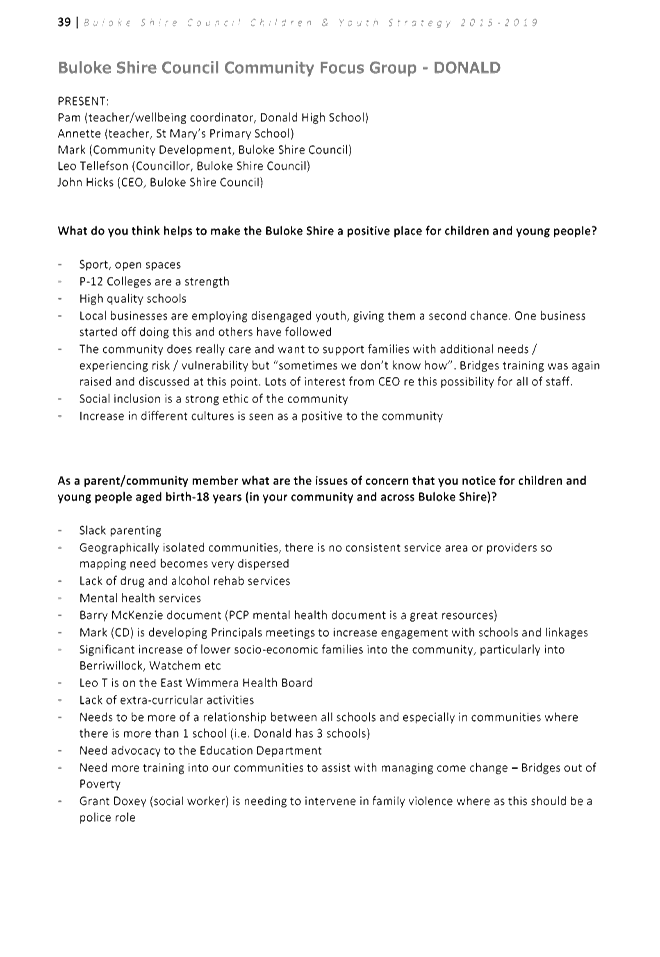
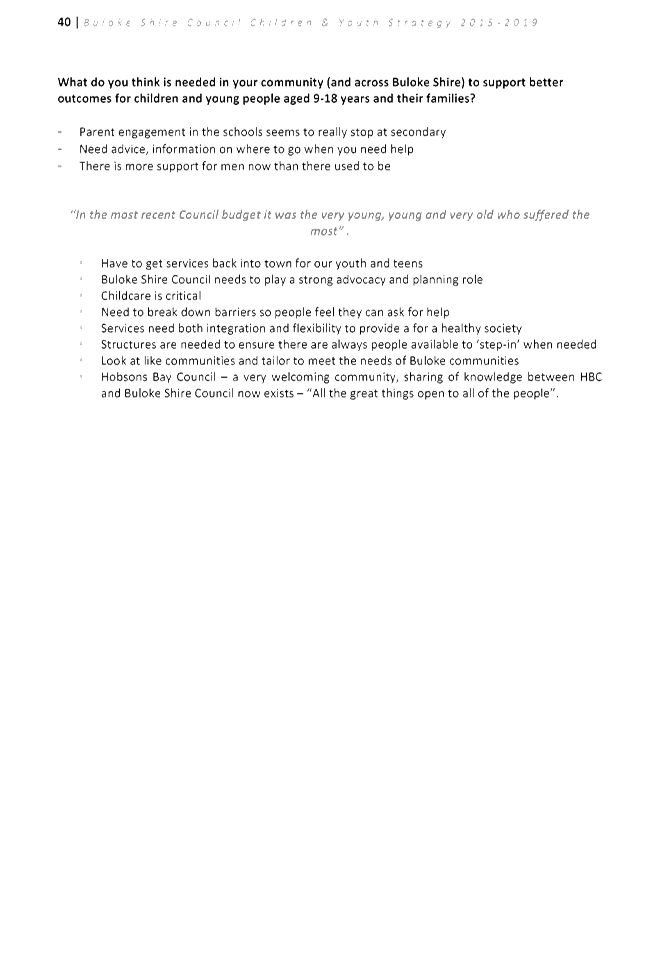
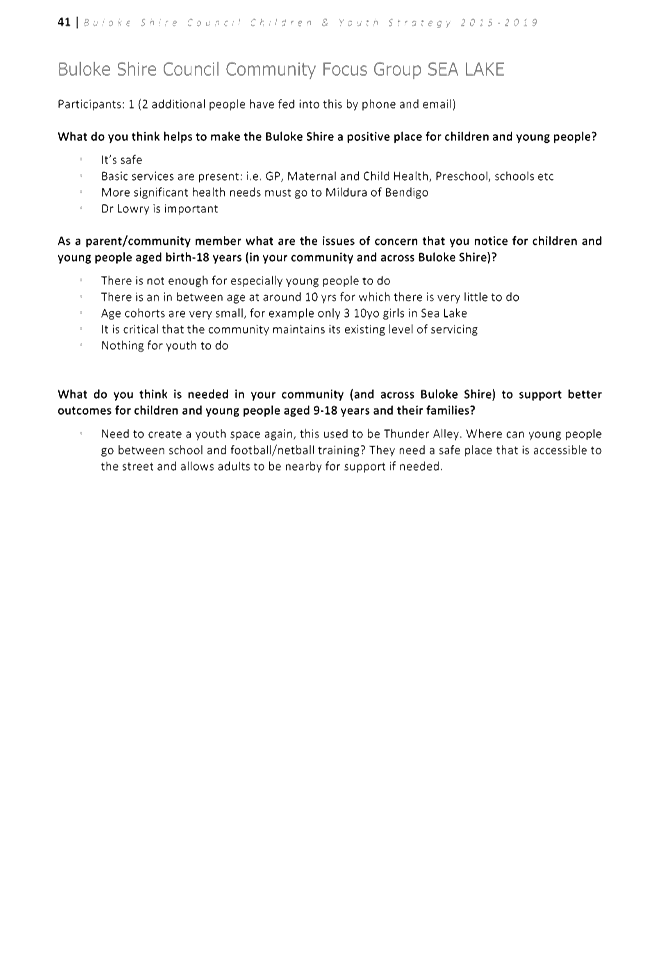
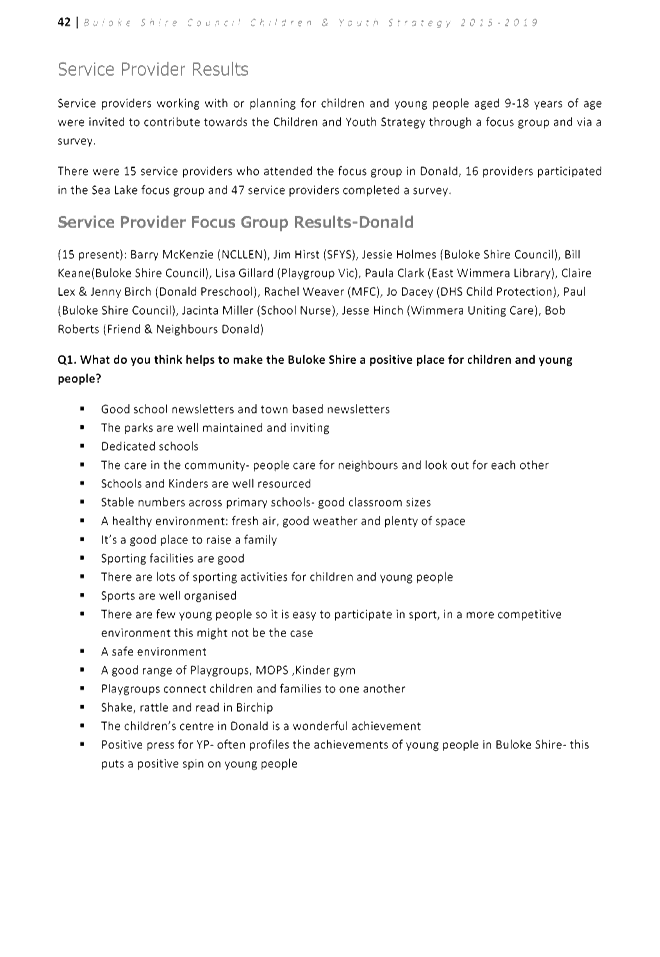
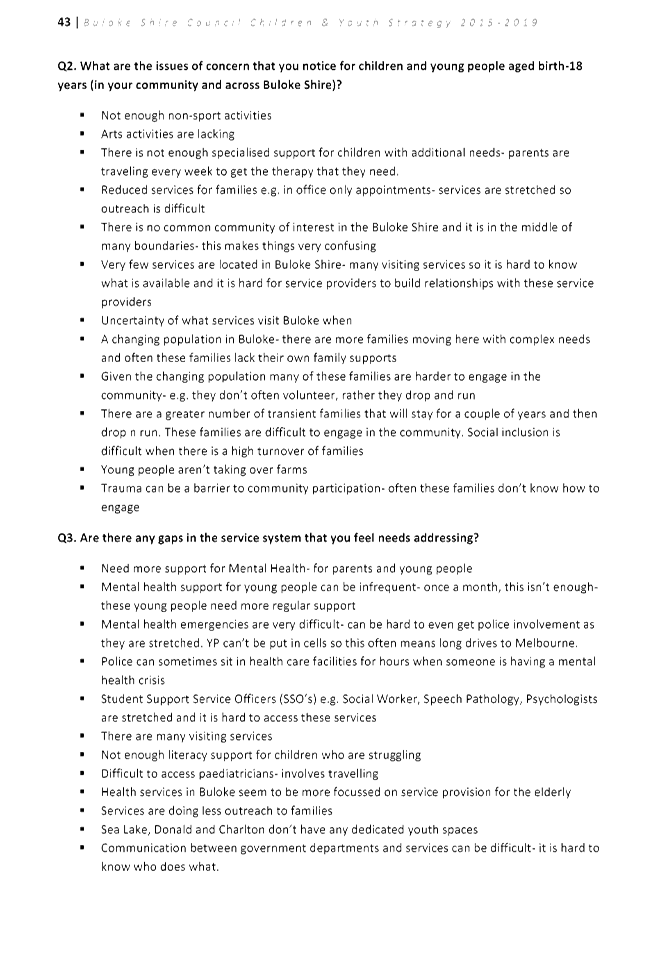
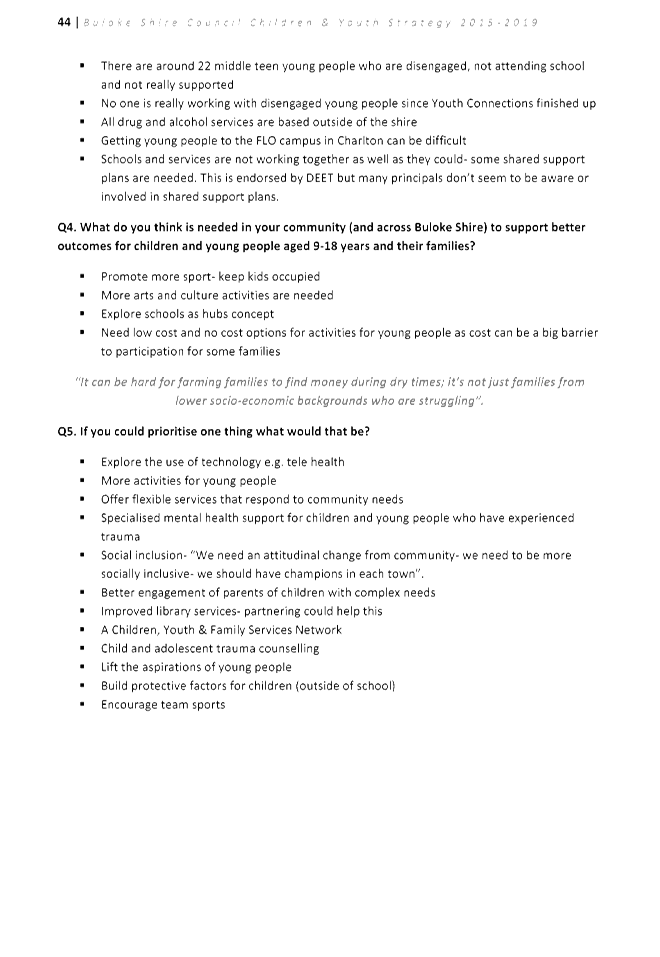
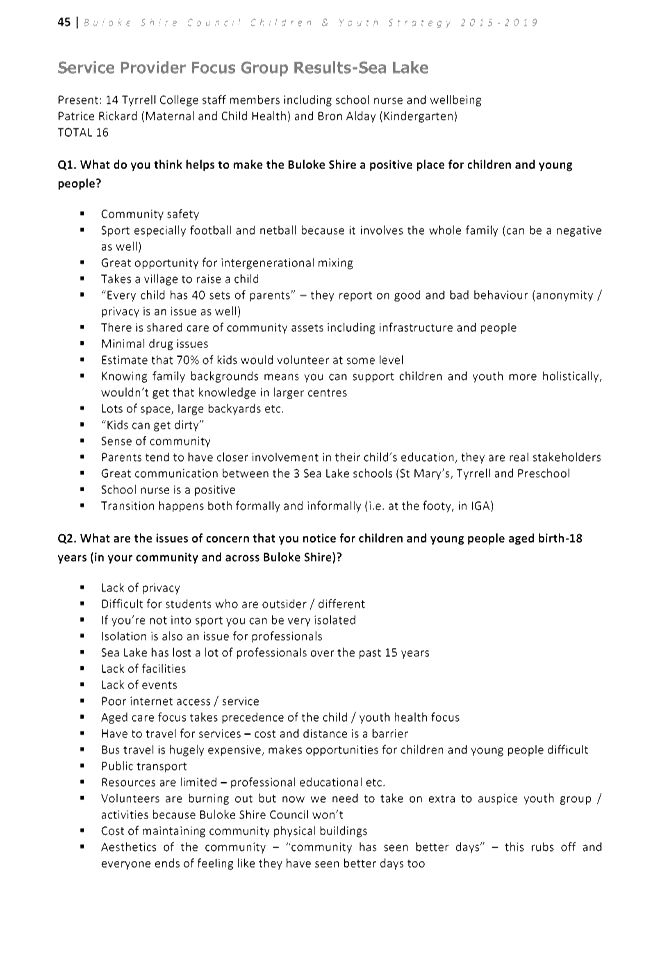
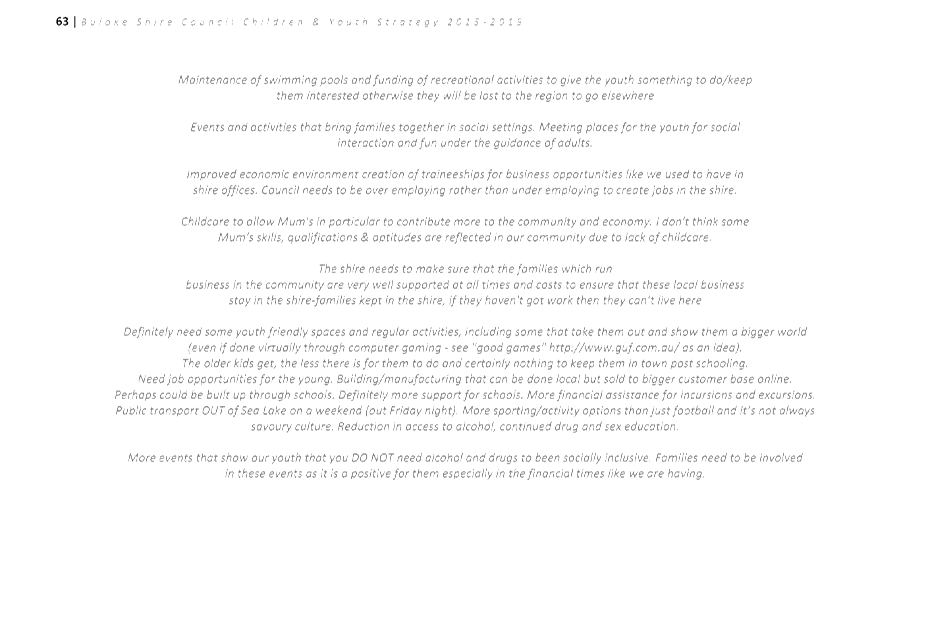
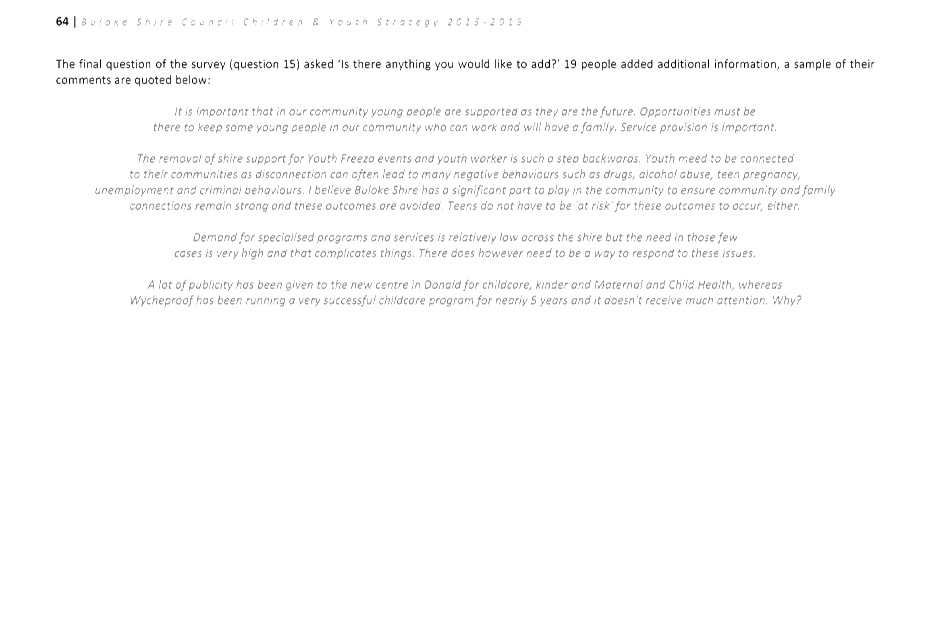
The draft Children and Youth Strategy 2015-2019 is an integrated whole-of-Council approach to ensure that children, young people and their families are understood, valued, supported and included in community life in Buloke.
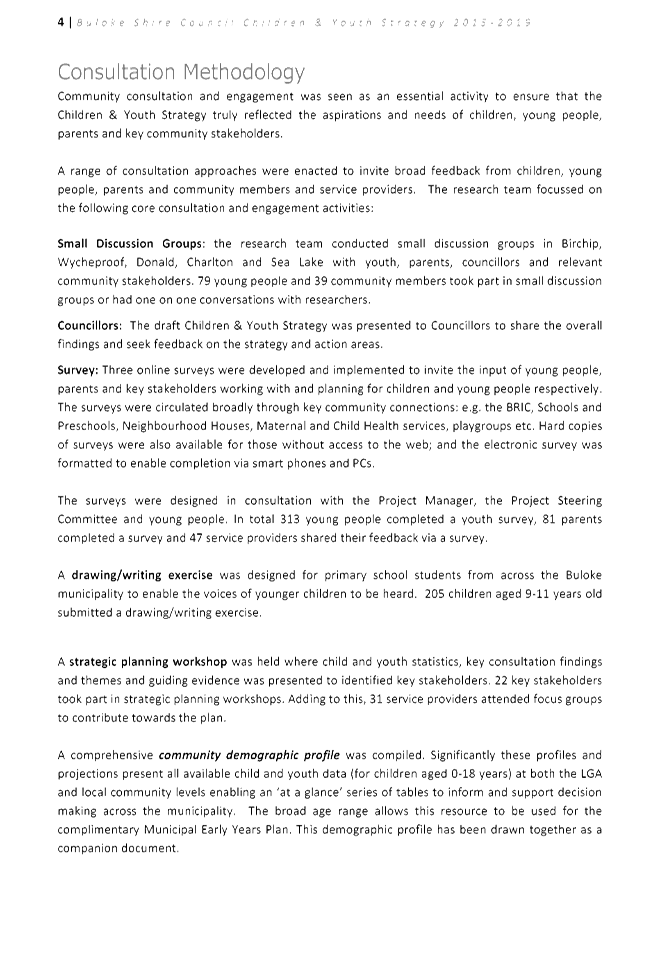
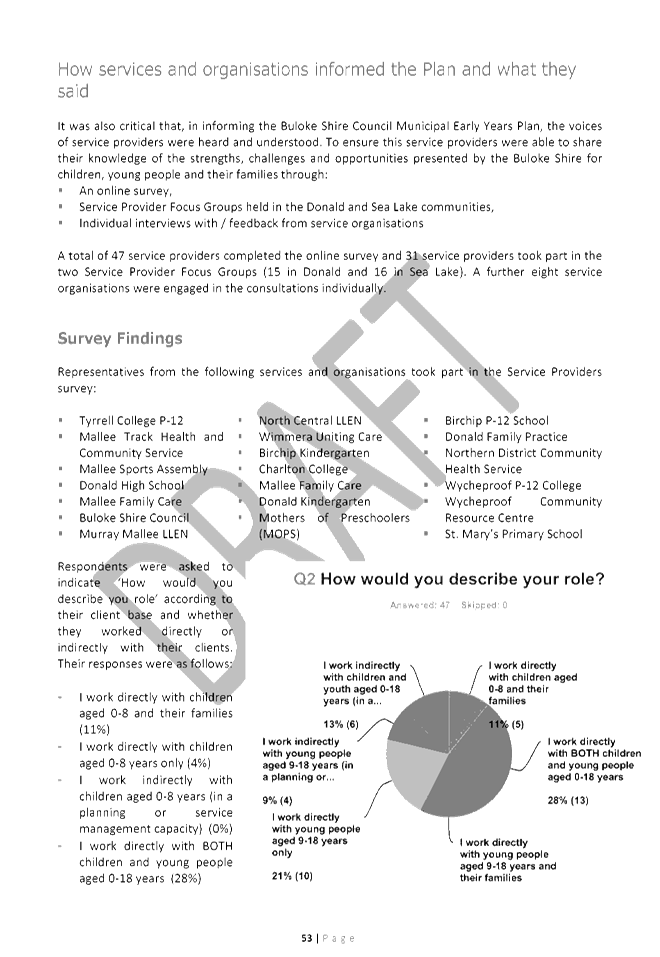
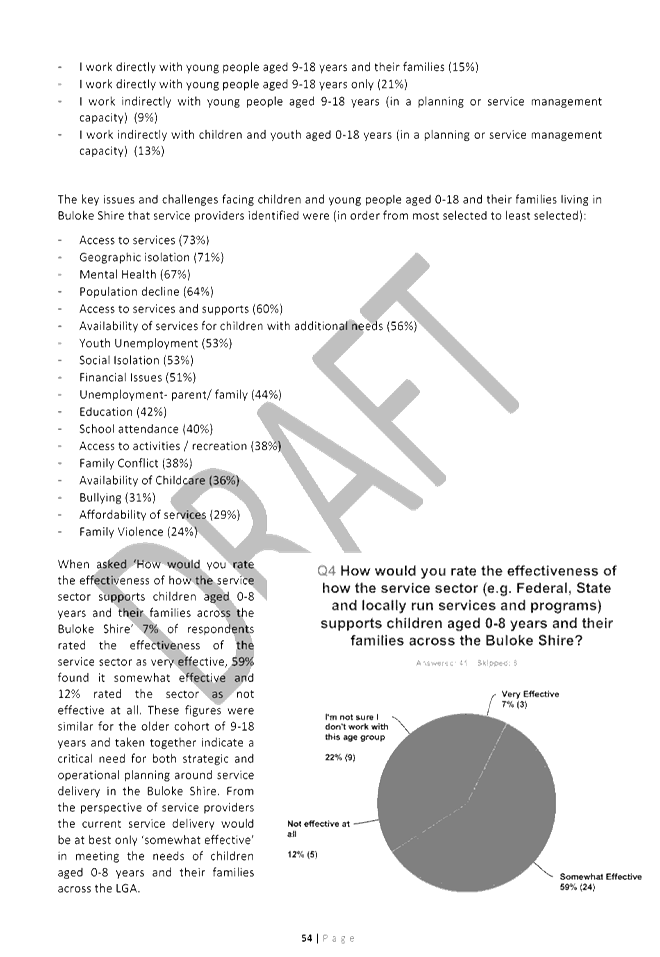
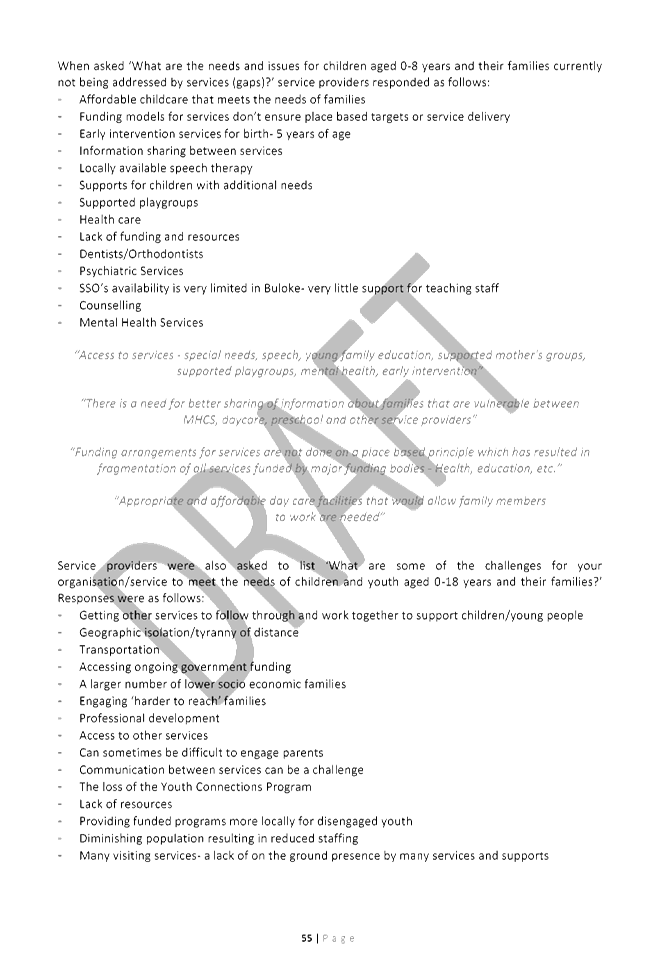
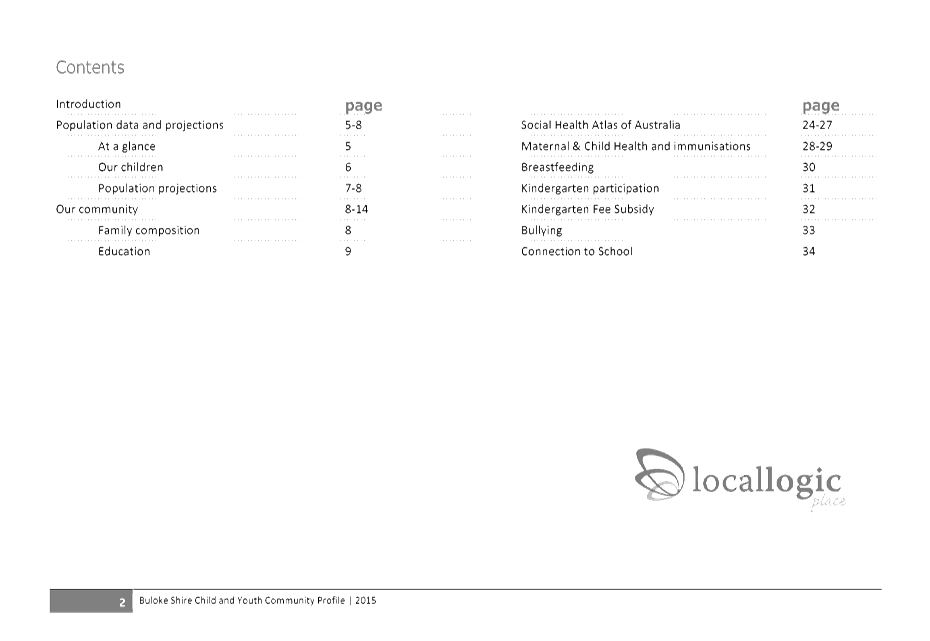
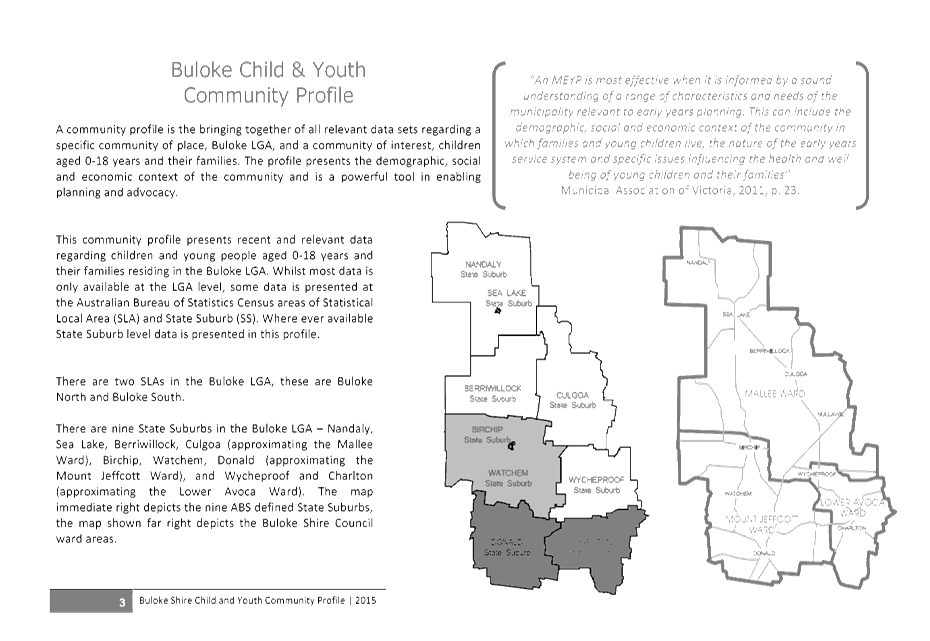
The draft plan and strategy have been developed through the collation of available statistical data and extensive consultation with a range of community members across the shire, as well as stakeholders involved in service delivery to the age groups concerned.
The draft plan and strategy make a number of recommendations around the themes of:
- Activities and events
- Participation and civic engagement
- Services
- Advocacy, planning and coordination
3. Financial Implications
The draft plan and strategy have given strong considerations to Council’s financial position and the level of resources available when making recommendations.
4. Cost Shift Considerations
The draft plan and strategy take in to account Councils financial position but the recommendations are also a result of changes to state and federal funding arrangements for the provision of a range of early years, children and youth services including;
- Declining birth rates across Buloke Shire but higher complex need case loads
- Difficulty in accessing grants that allow for staff resources to deliver projects
- Funding models for universal kindergarten access
- Funding models for childcare access and provision in rural areas.
These funding challenges have meant that Council is required to prioritise its service delivery model and that the standard of delivery is below that expected by the community.
5. Community Consultation
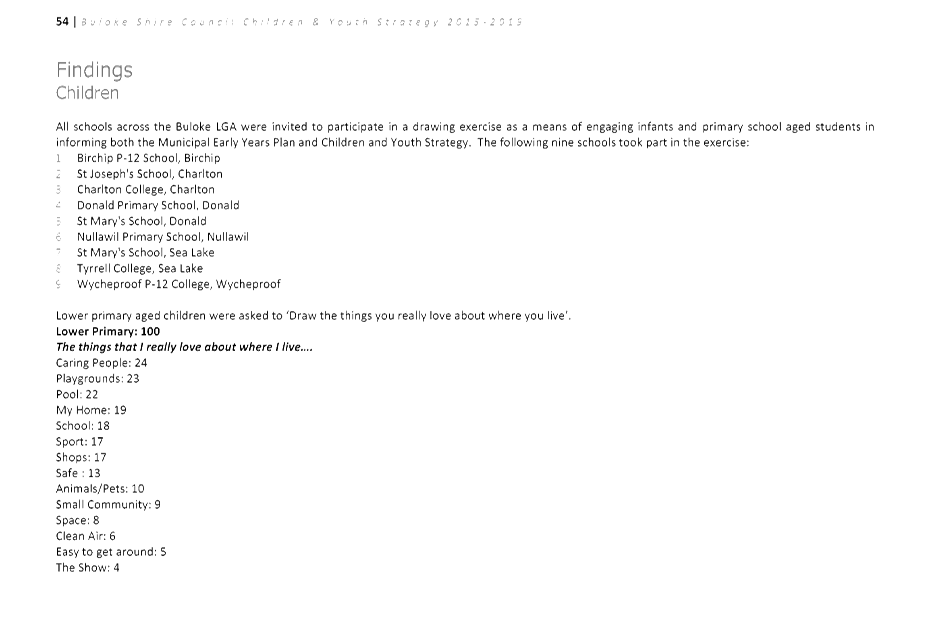
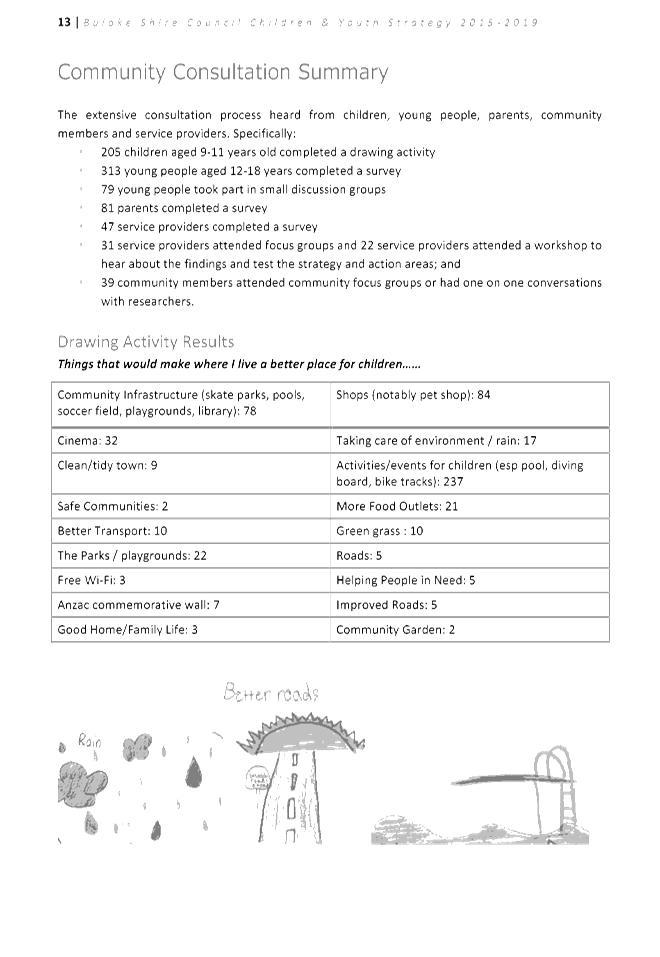
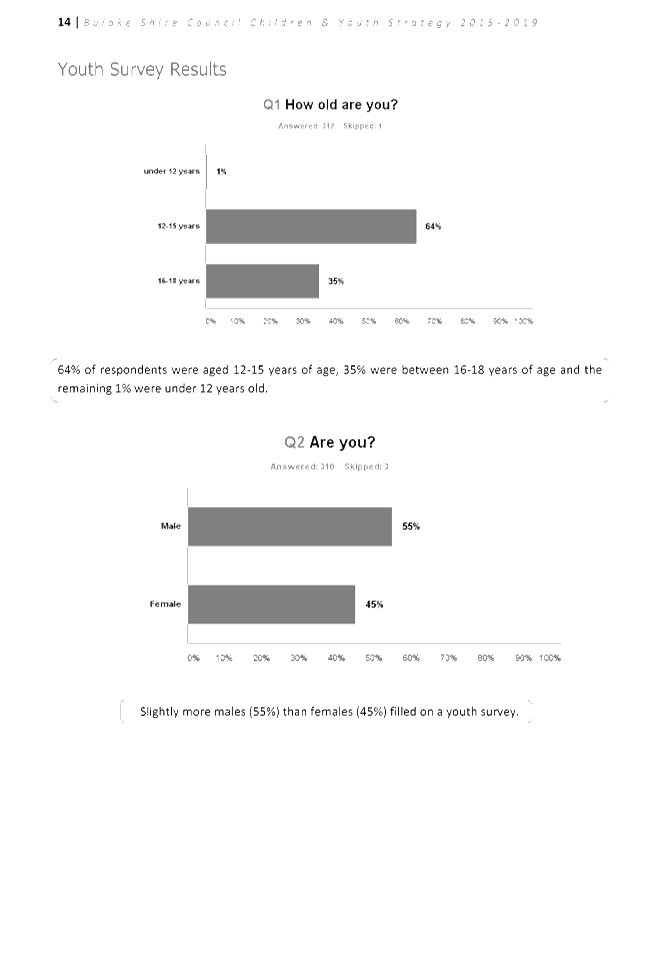
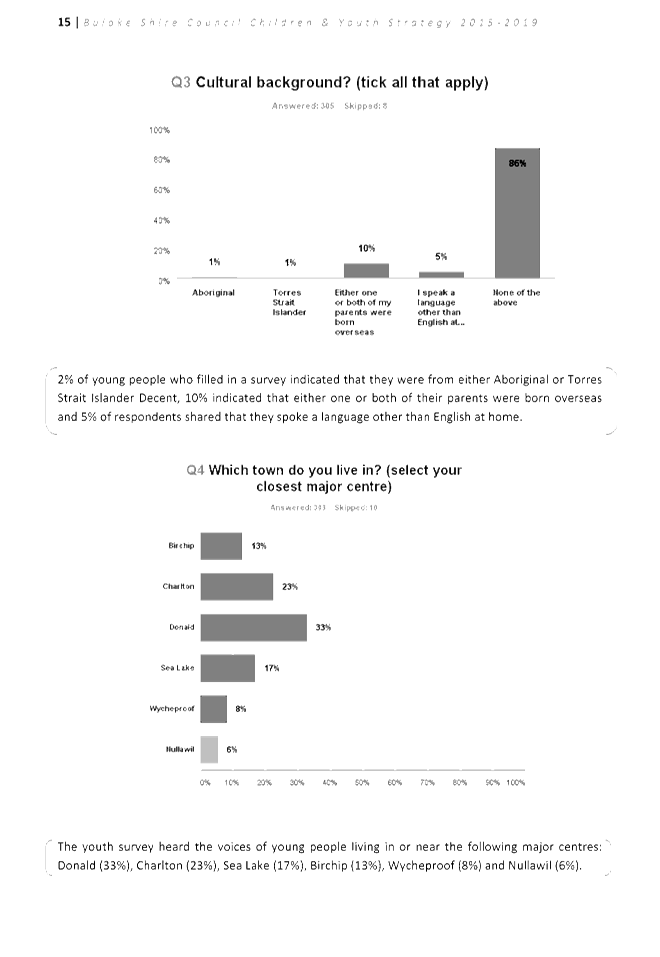
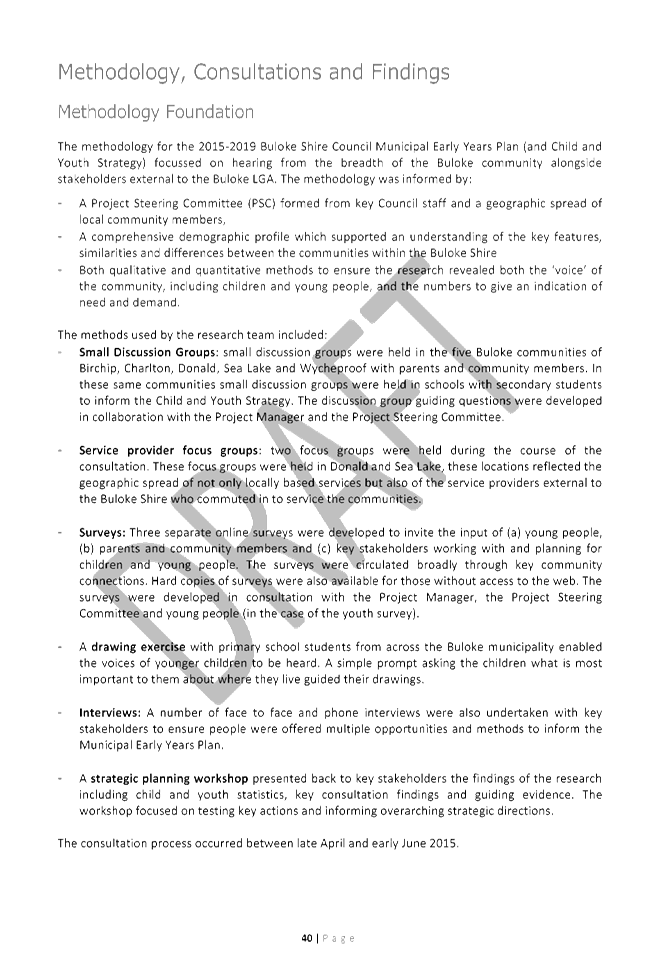
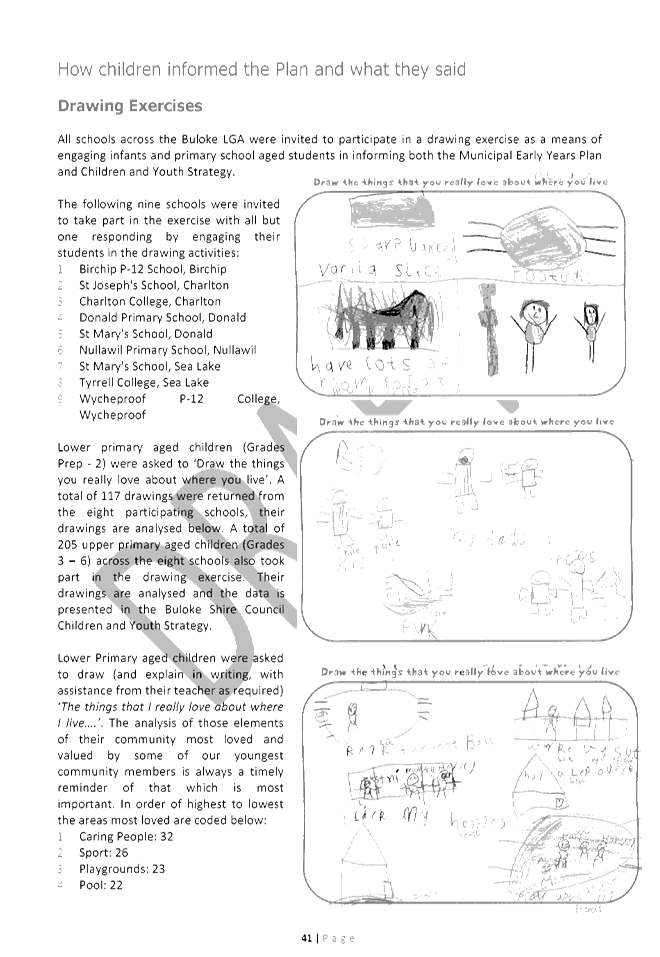
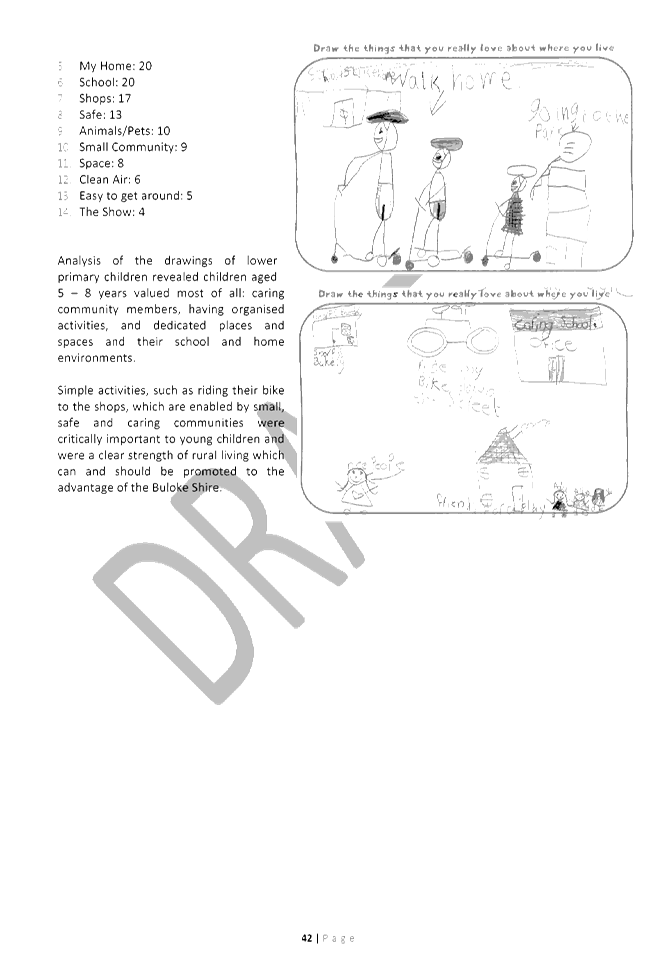
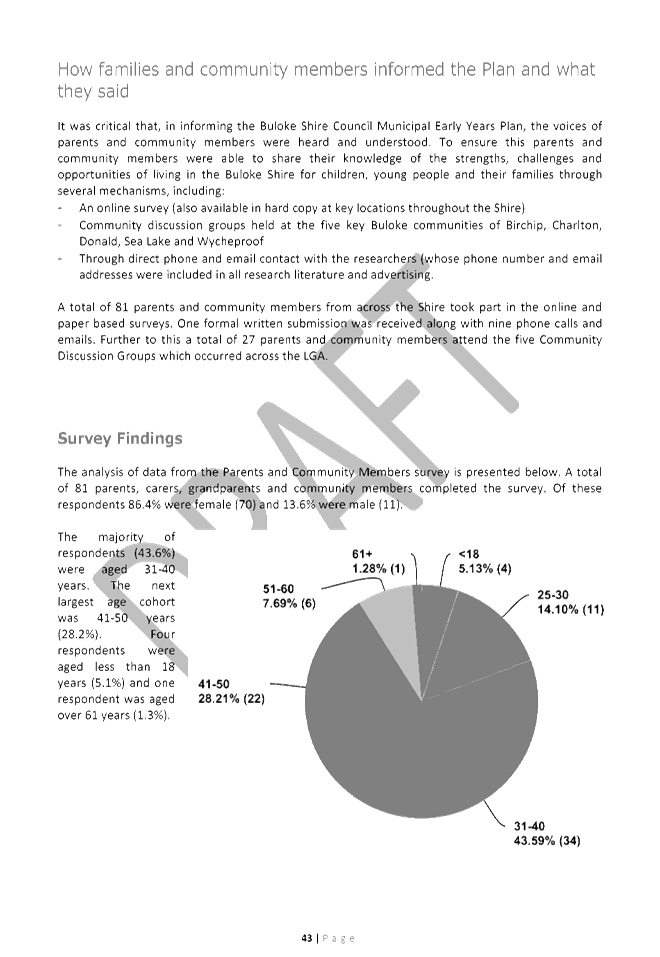
The draft plan and strategy involved extensive community consultation through a range of mediums including one-on-one discussions, small workshops, surveys, drawing exercises and the involvement of a project steering committee.
6. Internal Consultation
The draft plan and strategy have been developed in consultation with a number of Council staff members including the Manager of Community Services, Manager of Planning and Community Support, Maternal Child Health Nurses, Community Development Officer and Facilities Co-ordinator.
7. Legislative / Policy Implications
Nil
8. Environmental Sustainability
Nil
9. Conflict of Interest Considerations
No officer involved in the writing of this report has a conflict of interest.
10. Conclusion
It is recommended that Council adopts the draft Municipal Early Years Plan and the Children and Youth Strategy and consents to place them on exhibition for public comment.
Buloke Shire Council Ordinary Meeting Agenda Wednesday, 8 July 2015
7.2.5 Adoption of draft Municipal Early Years Plan and Children & Youth Strategy for public exhibiiton
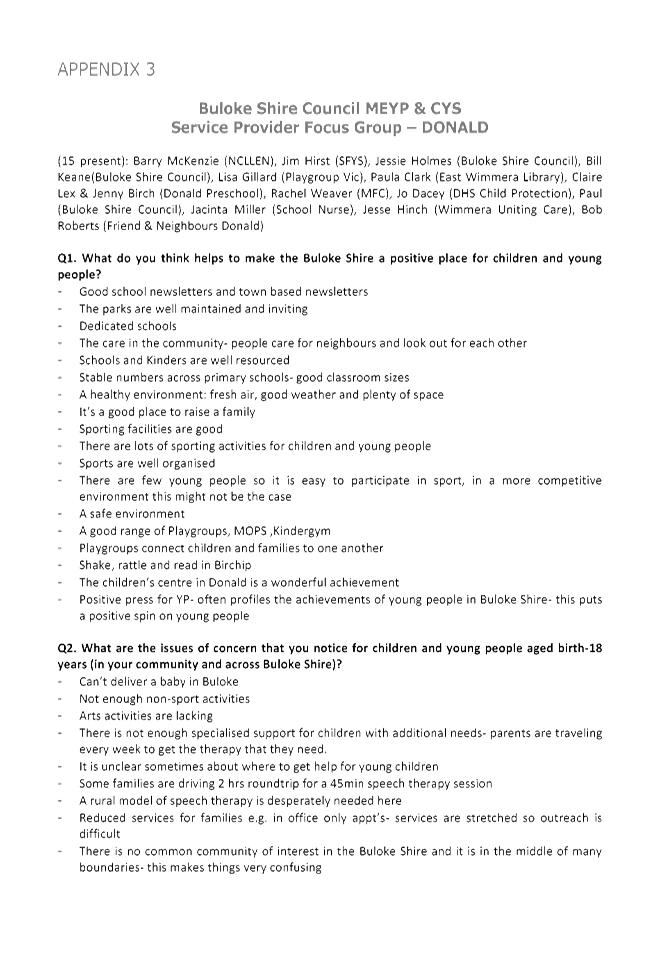
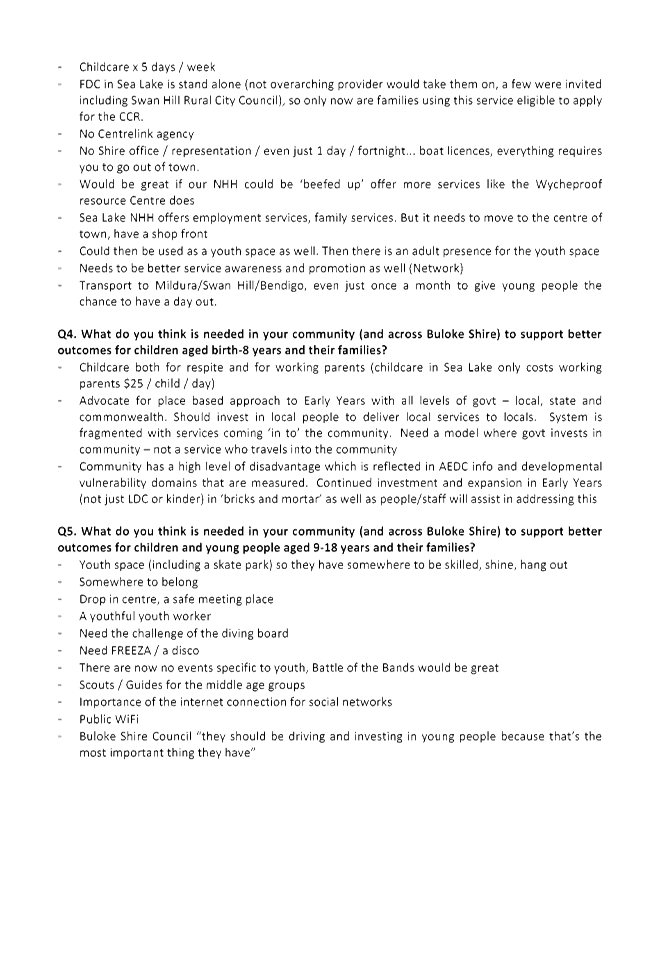
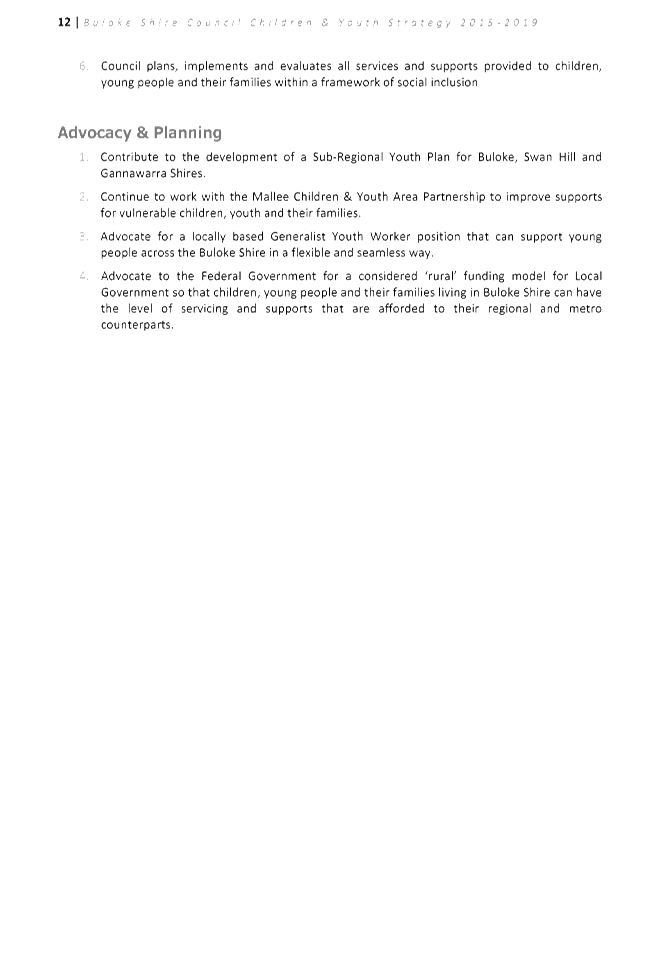
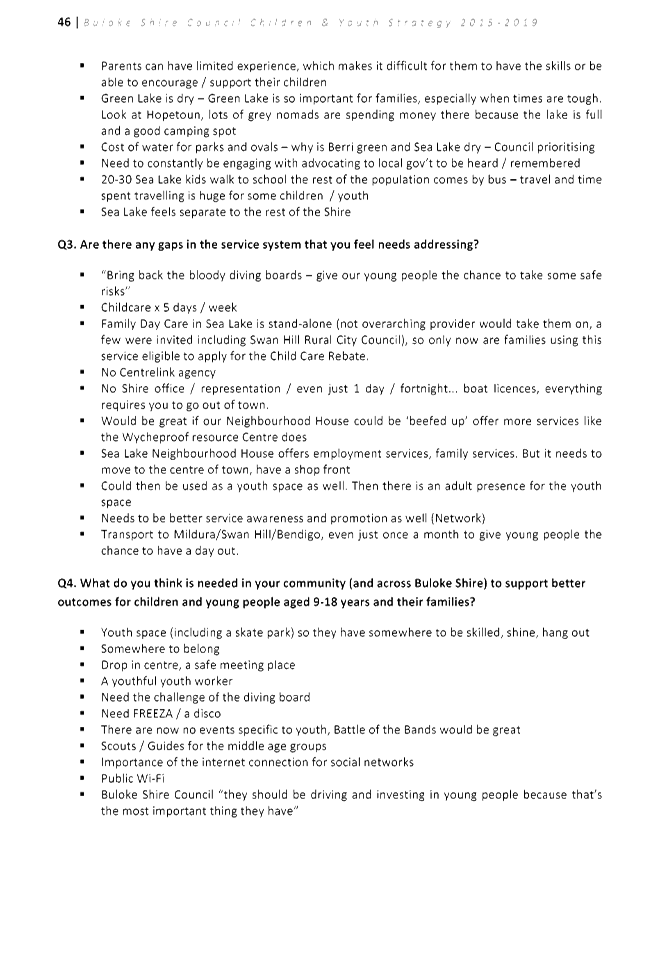
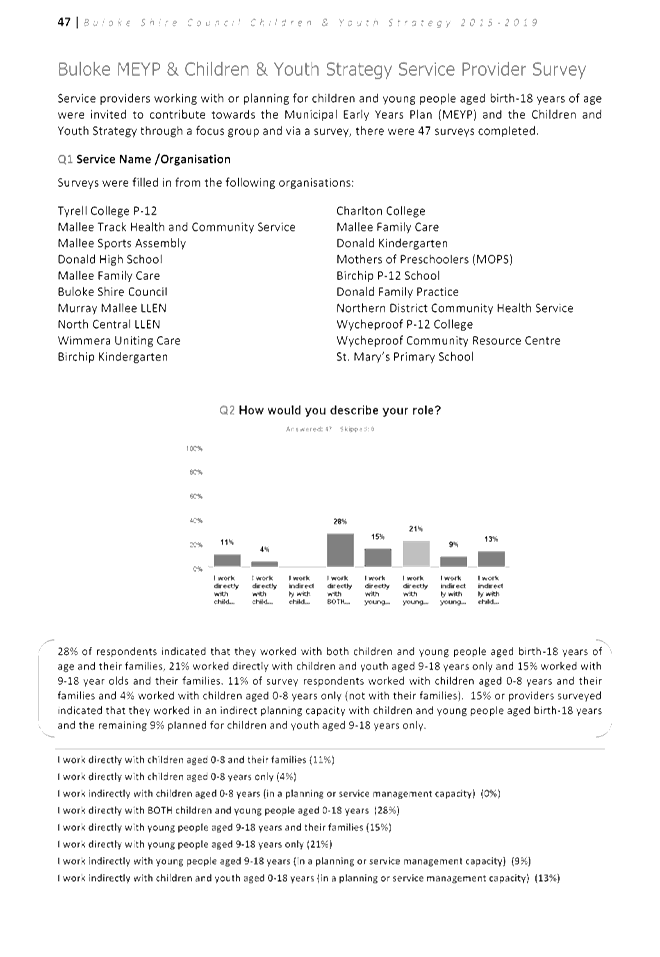
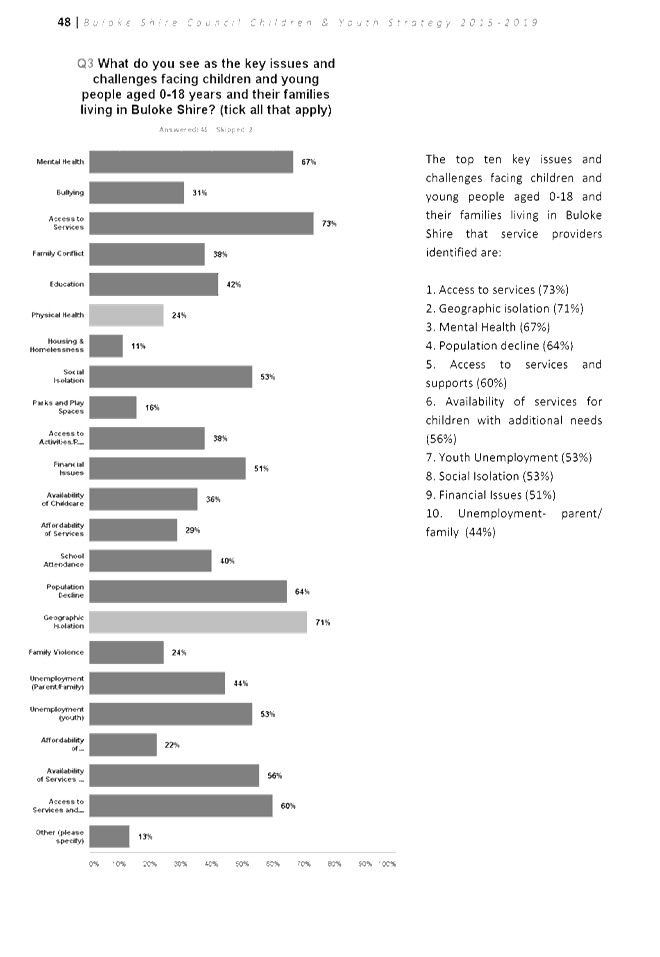
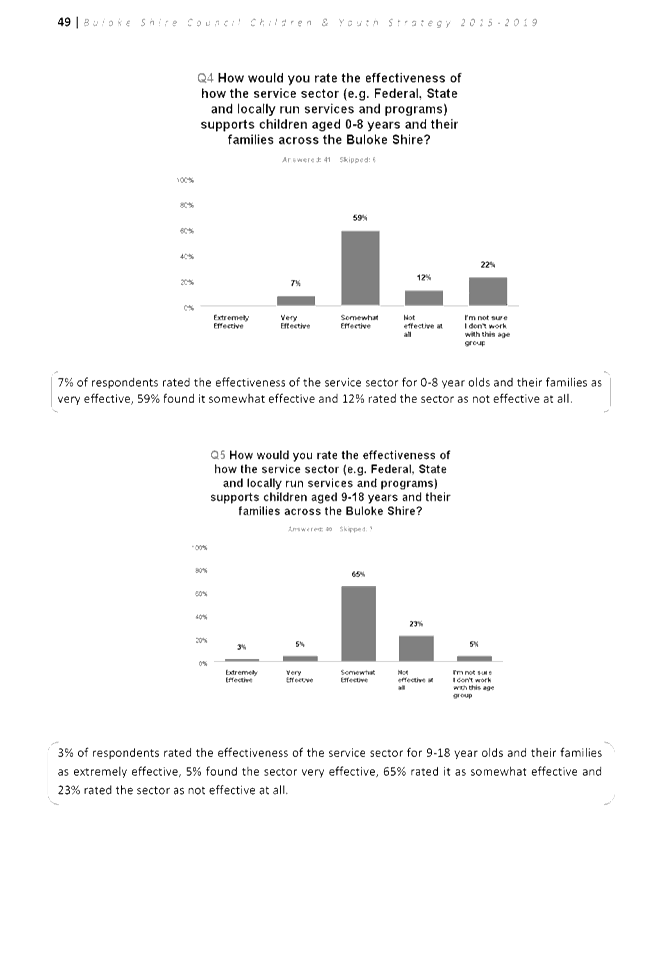
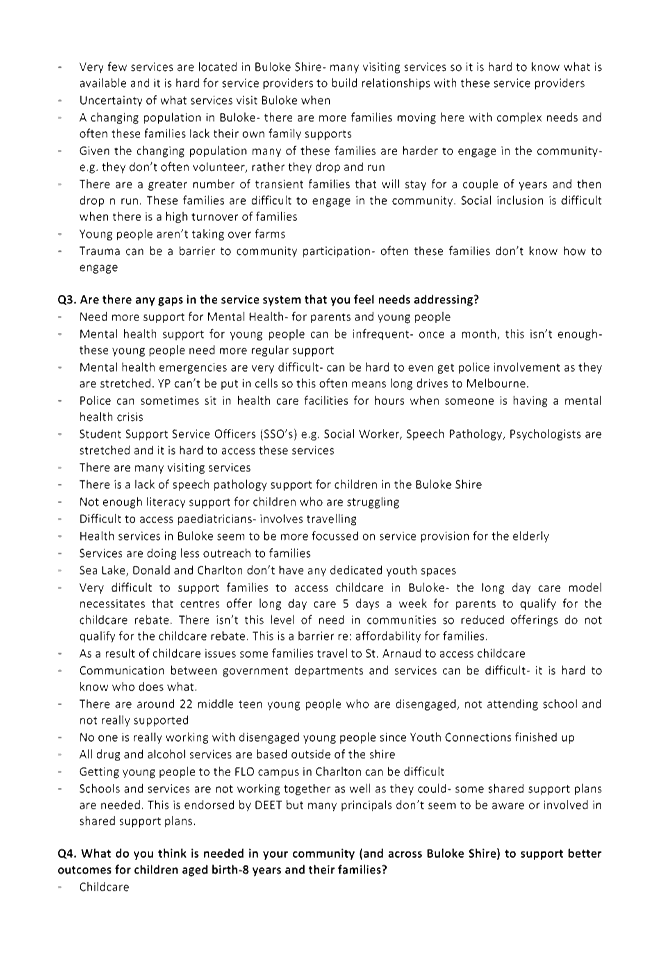
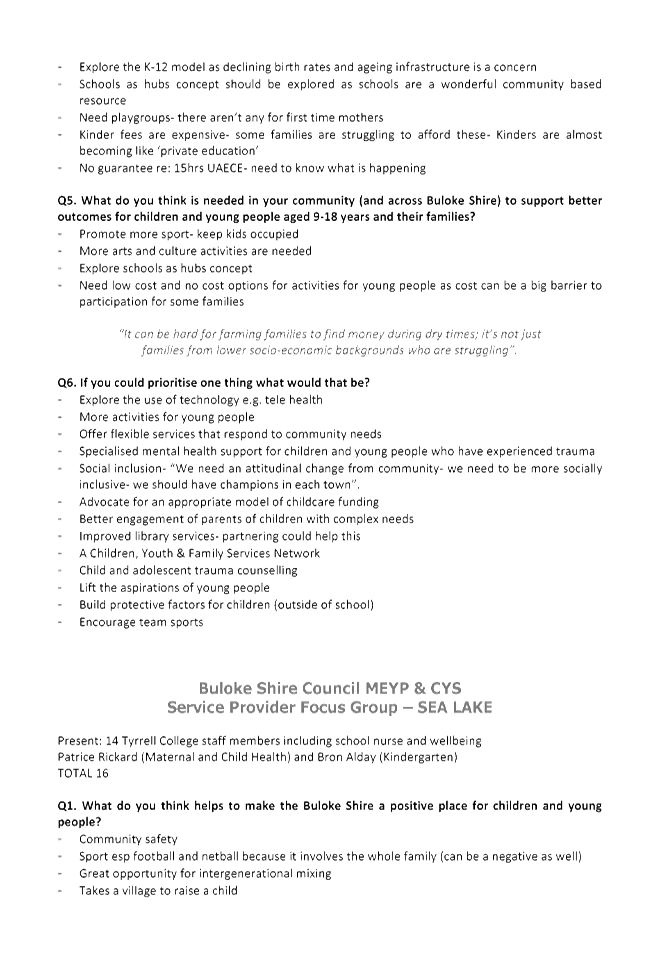
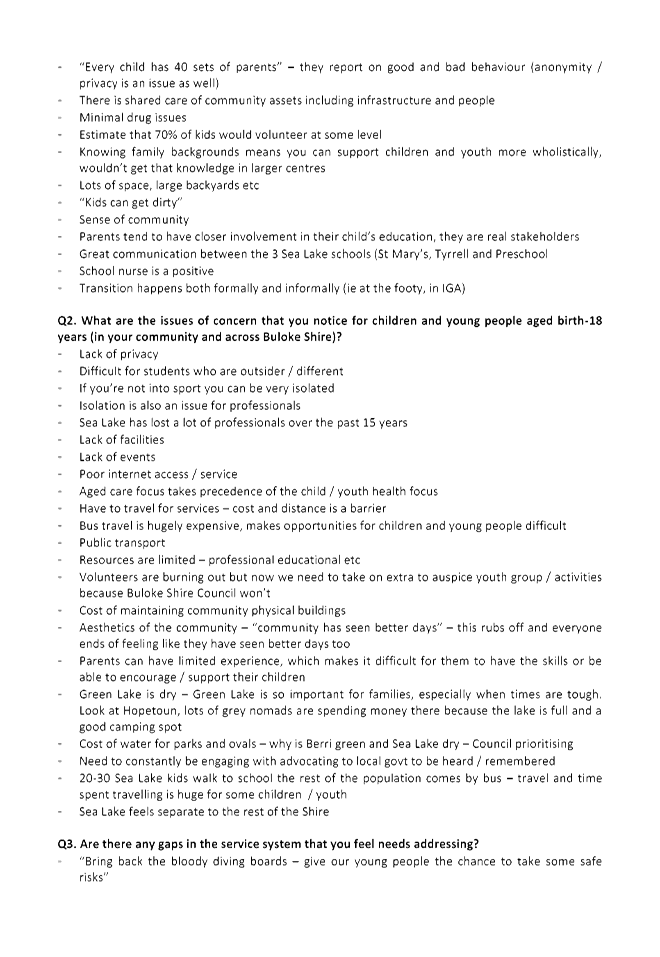
Attachment 1 Draft Buloke Children & Youth Strategy

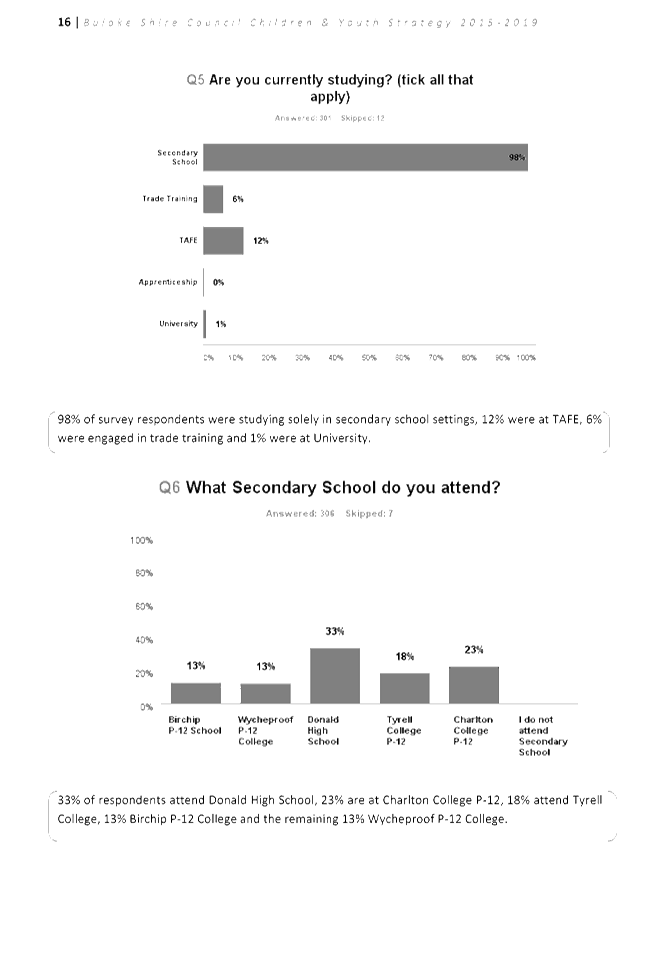
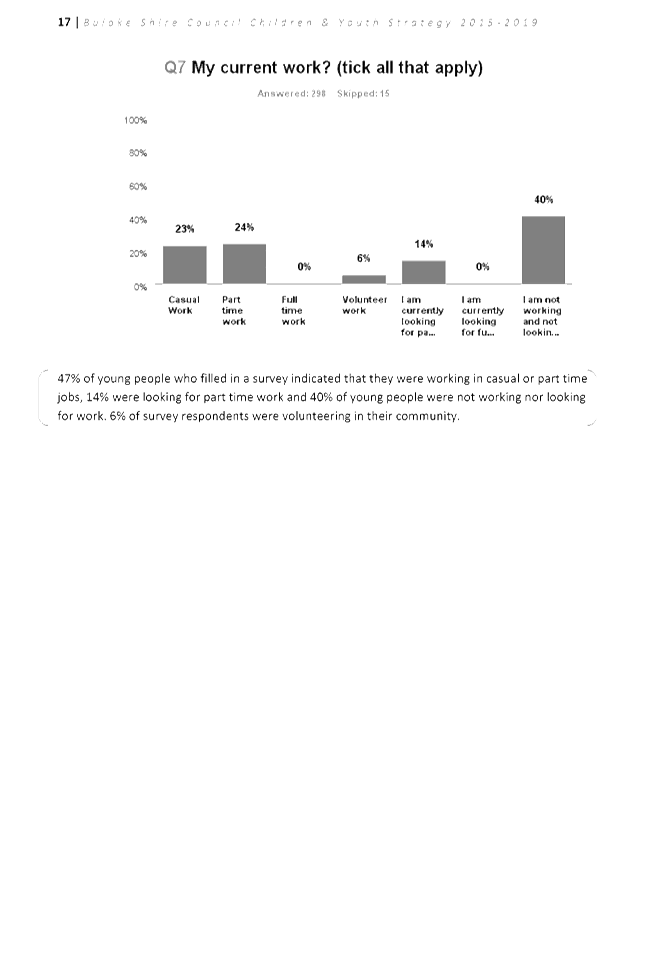
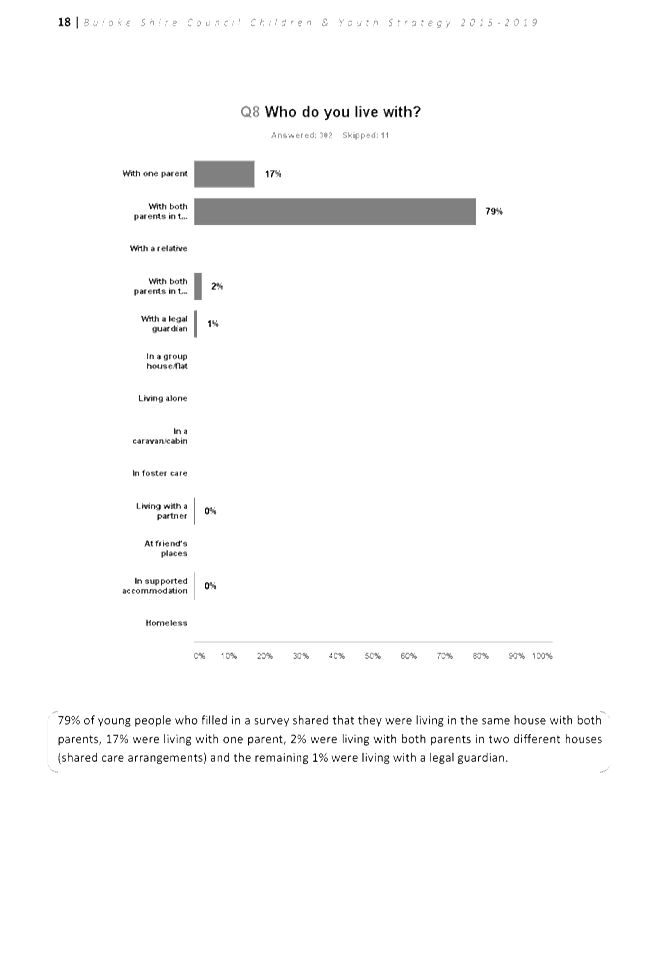
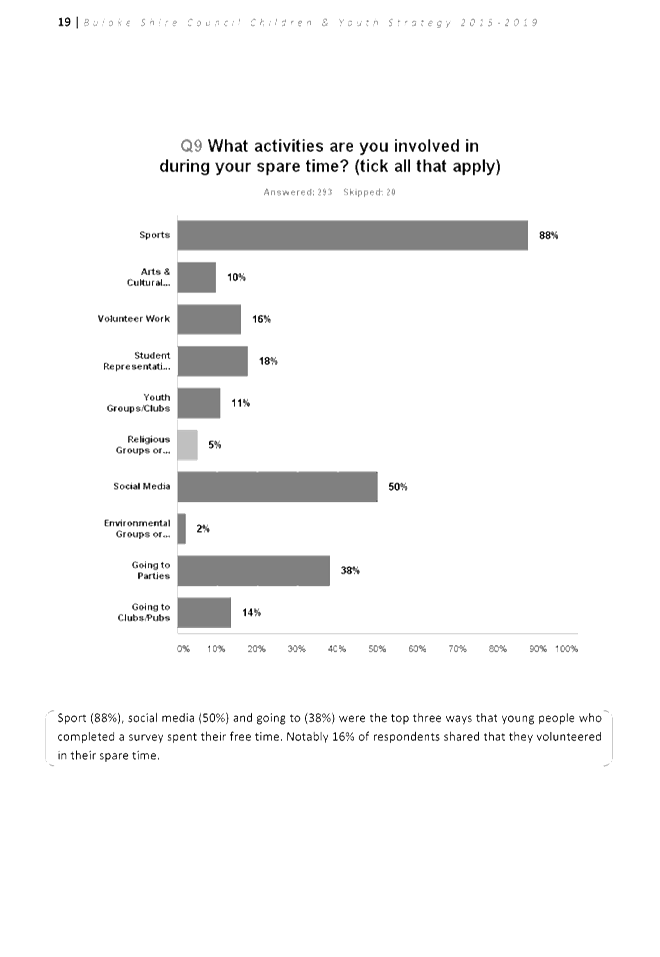
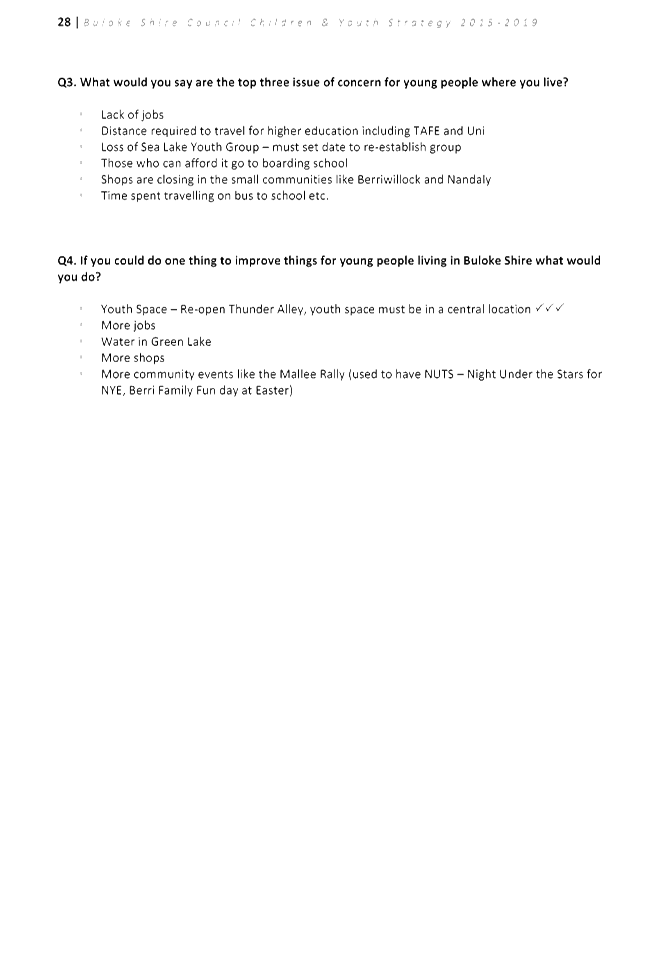
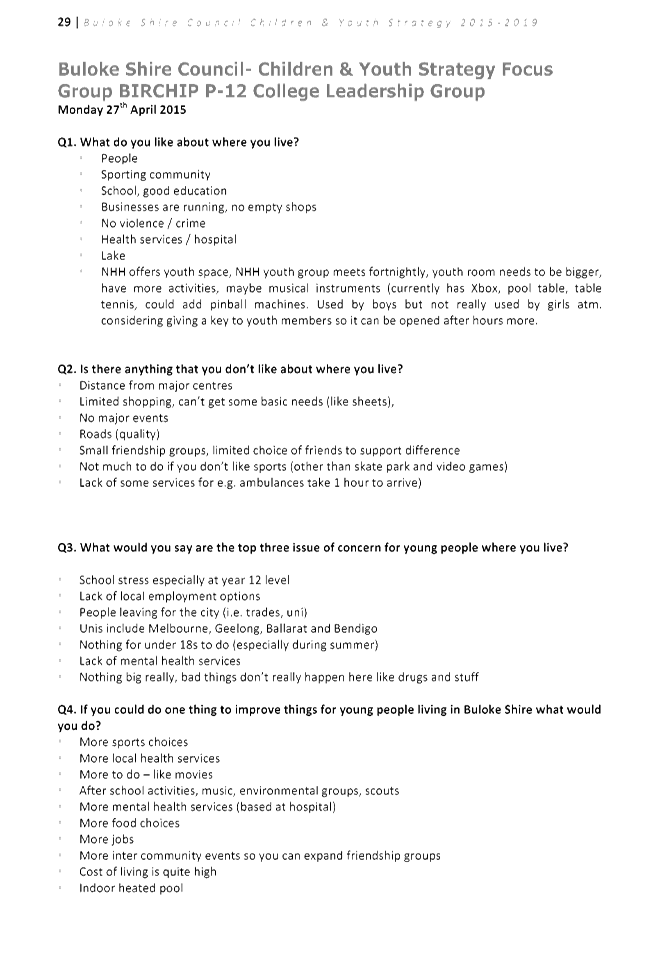

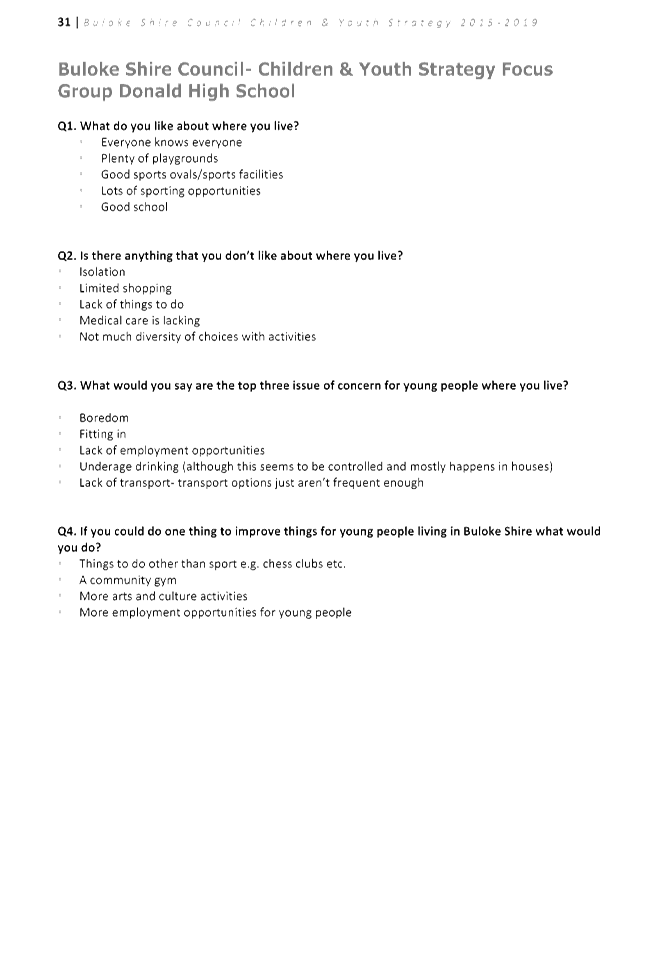
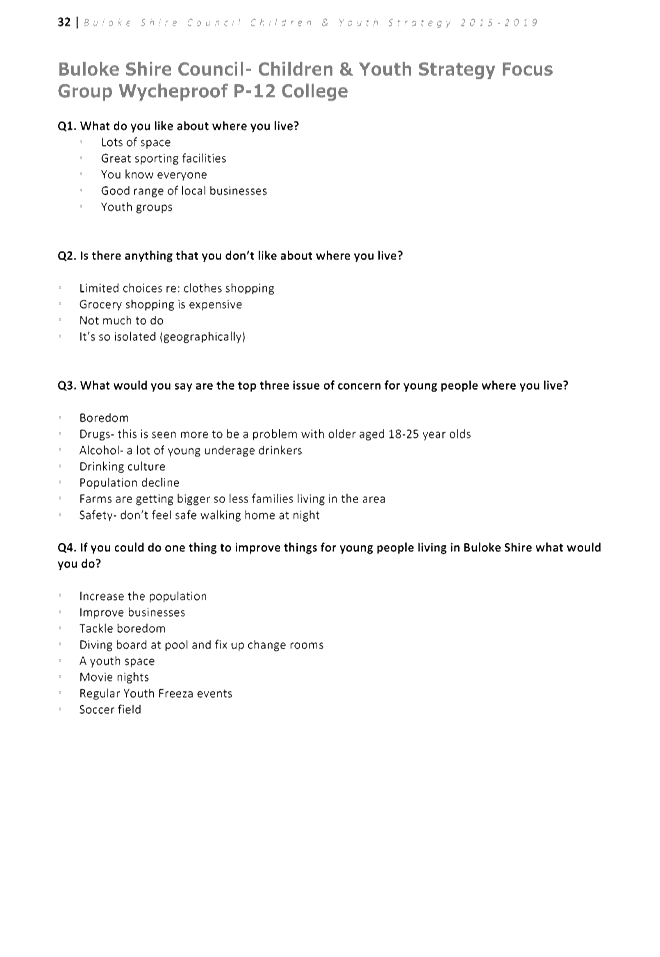

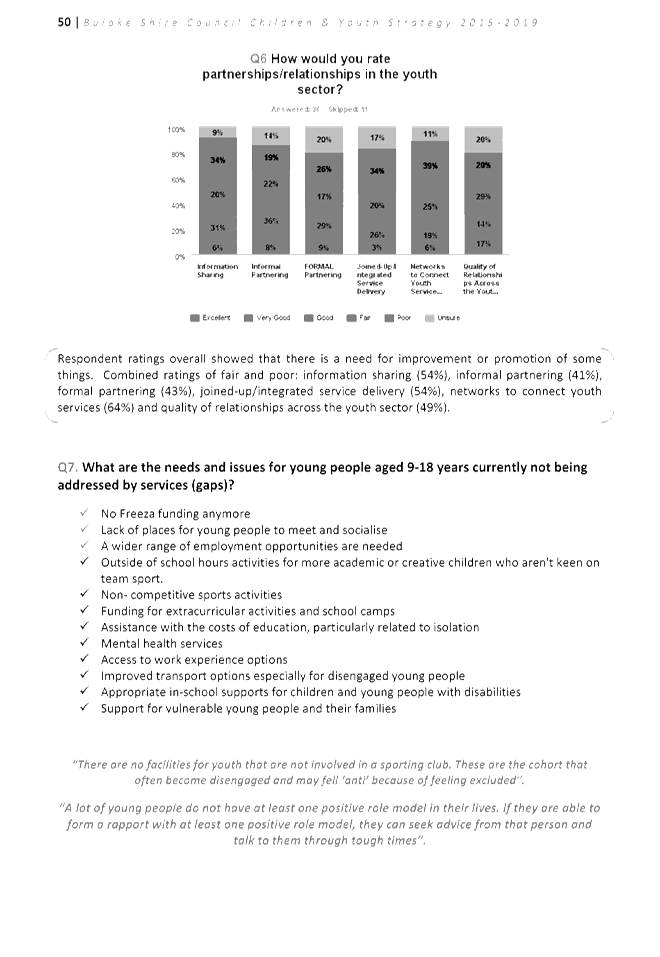
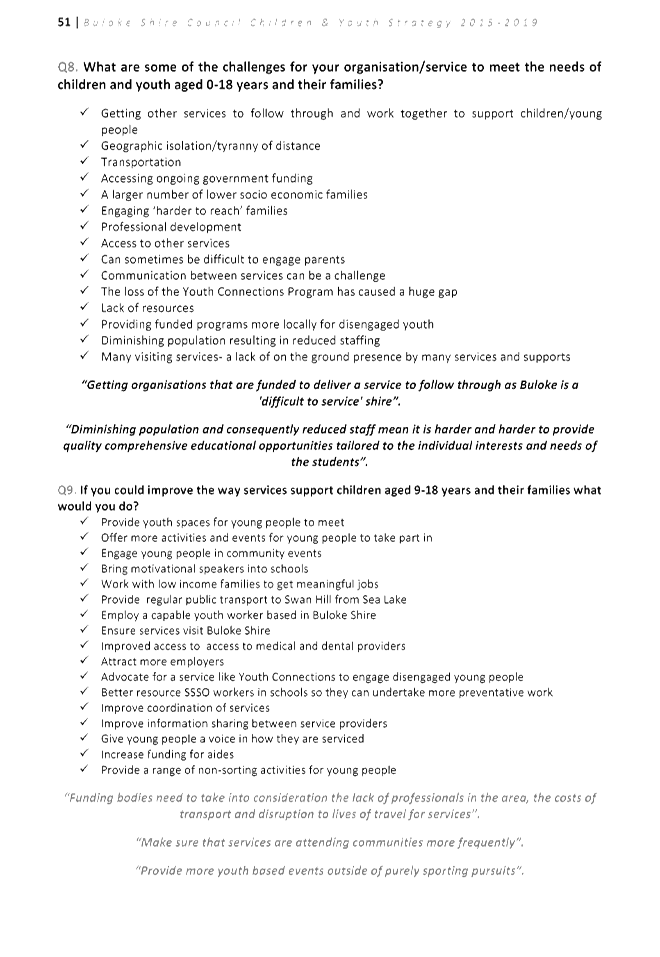
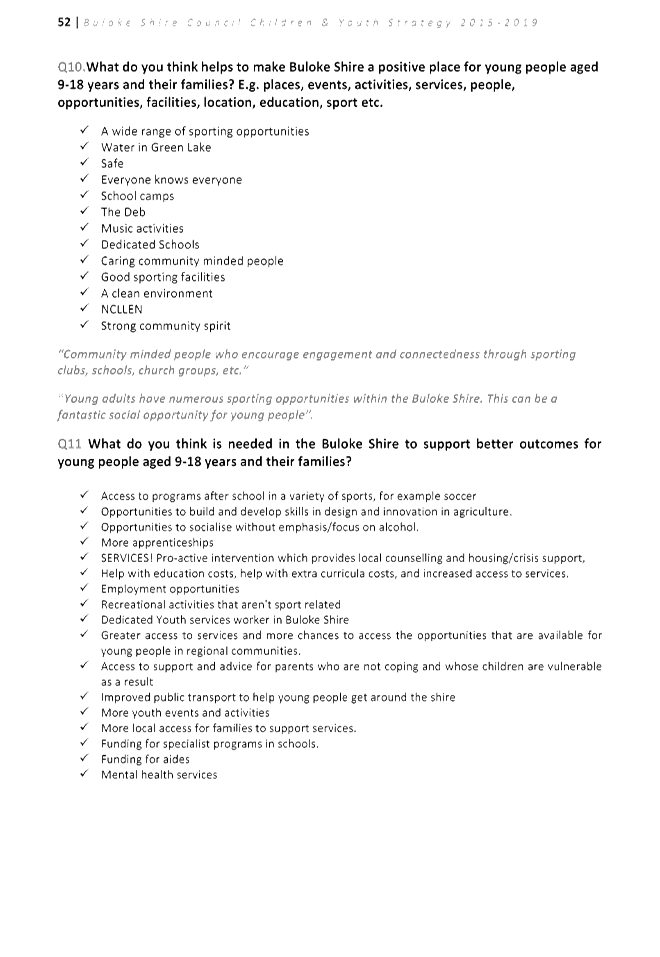
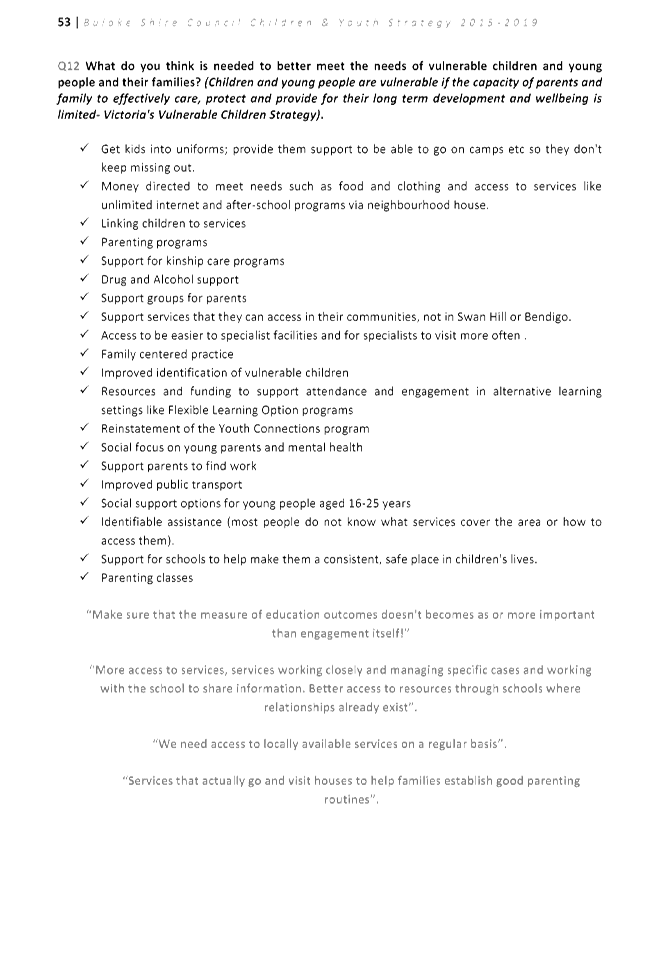
Buloke Shire Council Ordinary Meeting Wednesday, 8 July 2015
7.2.5 Adoption of draft Municipal Early Years Plan and Children & Youth Strategy for public exhibiiton
Attachment 1 Draft Buloke Children & Youth Strategy
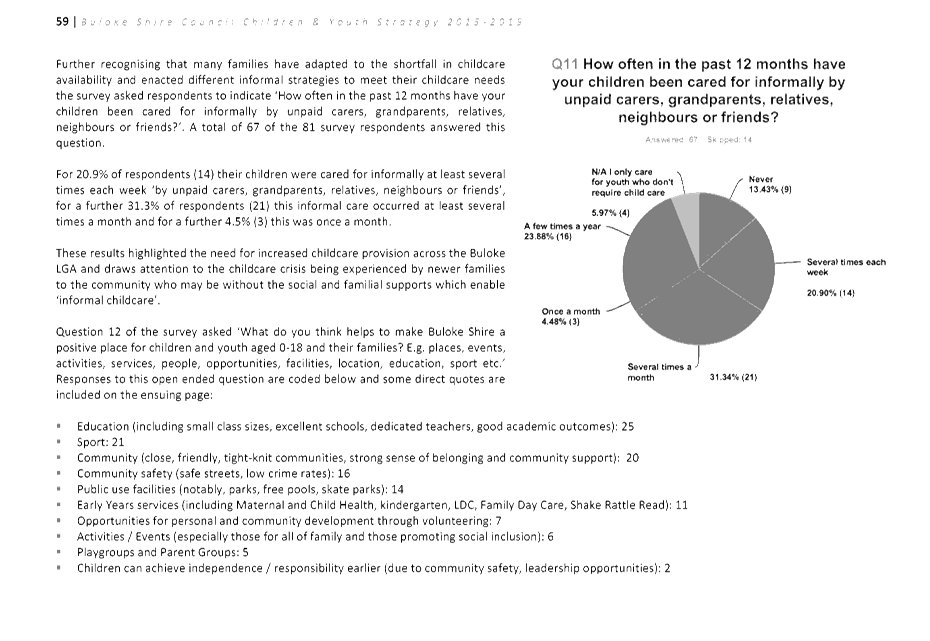
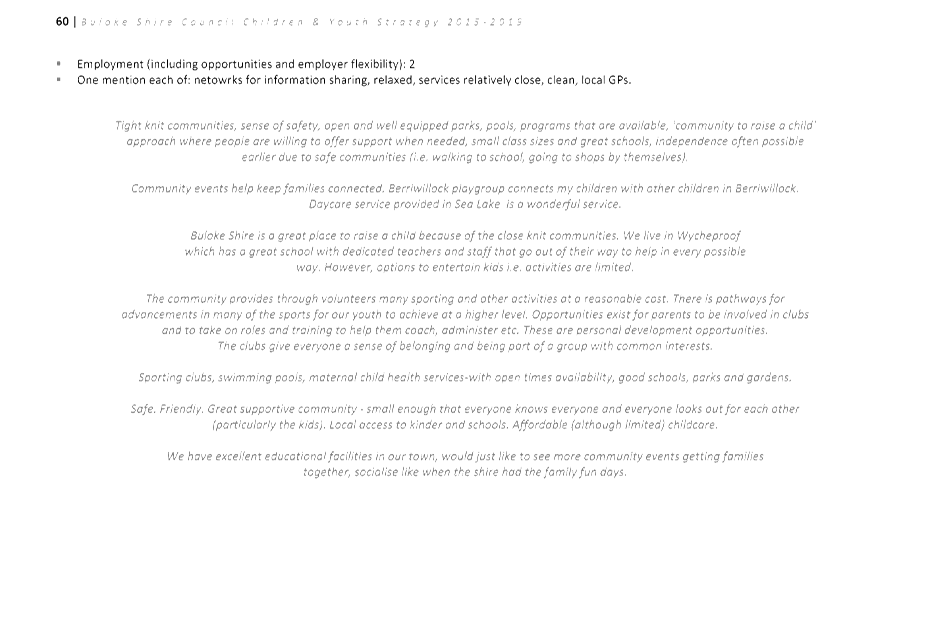
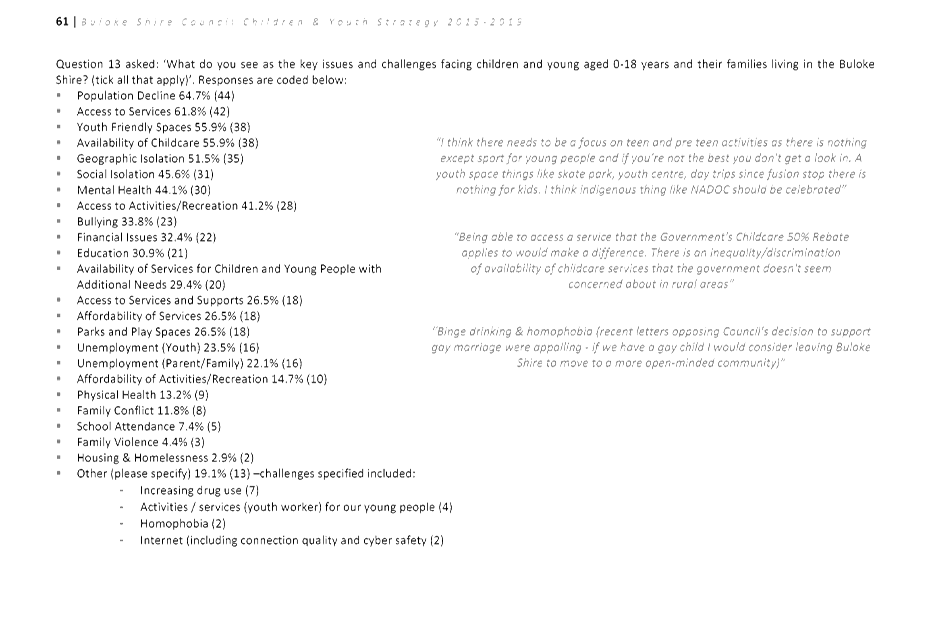
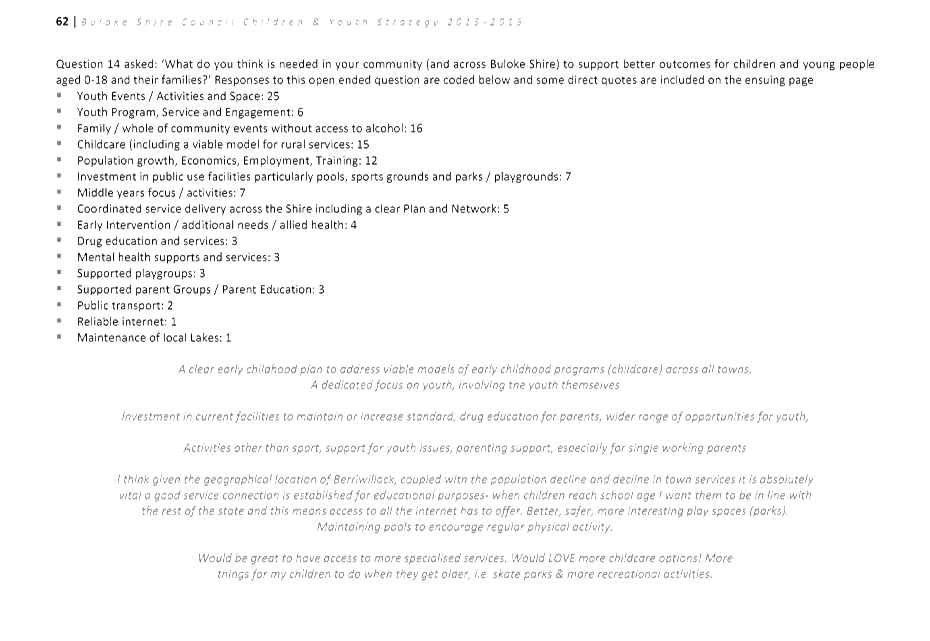
Buloke Shire Council Ordinary Meeting Wednesday, 8 July 2015
7.2.5 Adoption of draft Municipal Early Years Plan and Children & Youth Strategy for public exhibiiton
Attachment 1 Draft Buloke Children & Youth Strategy
Buloke Shire Council Ordinary Meeting Agenda Wednesday, 8 July 2015
7.2.5 Adoption of draft Municipal Early Years Plan and Children & Youth Strategy for public exhibiiton
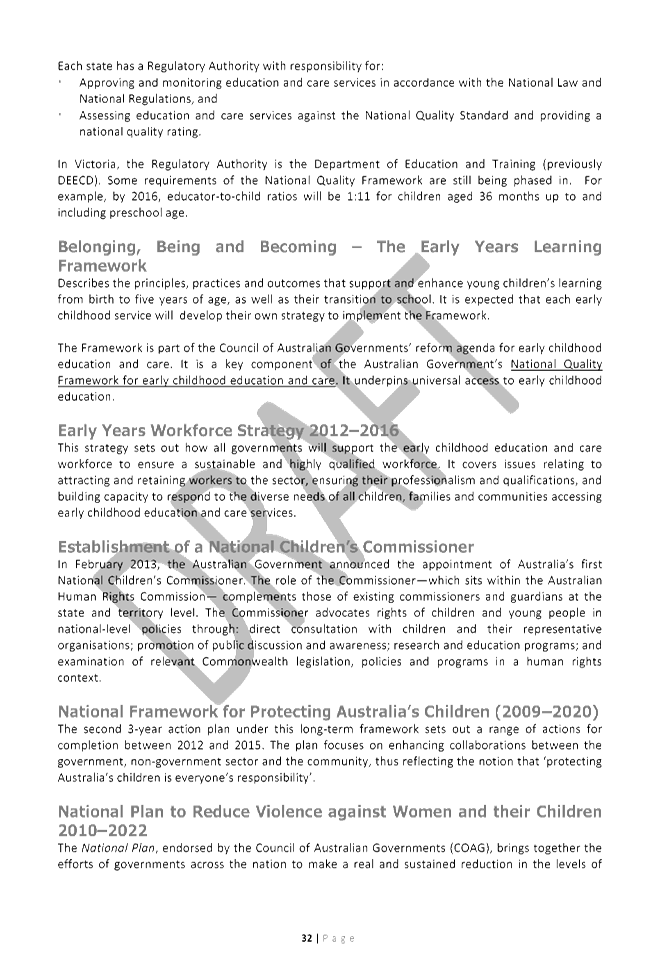
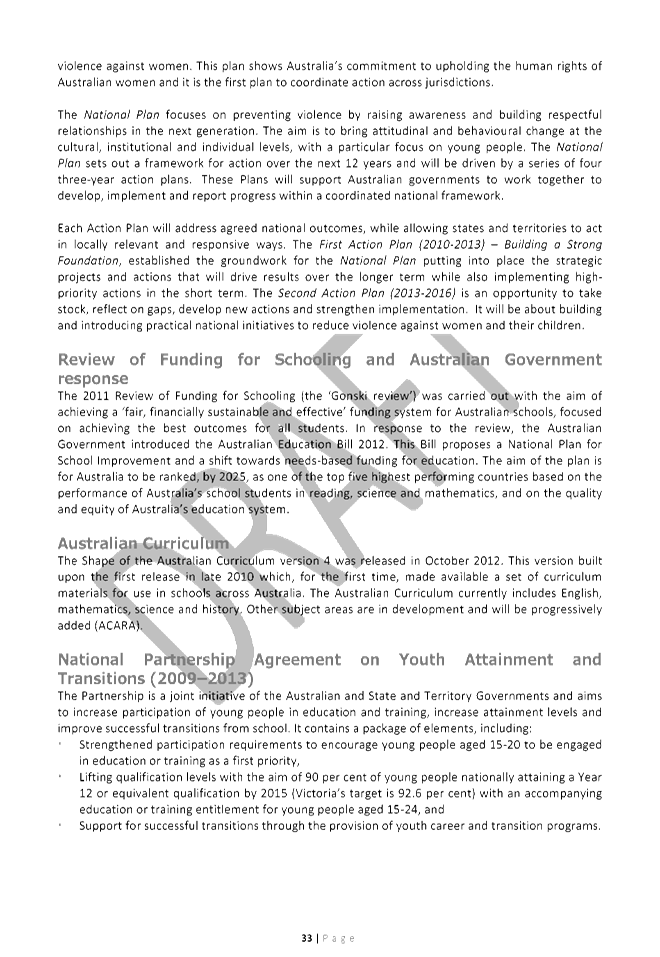
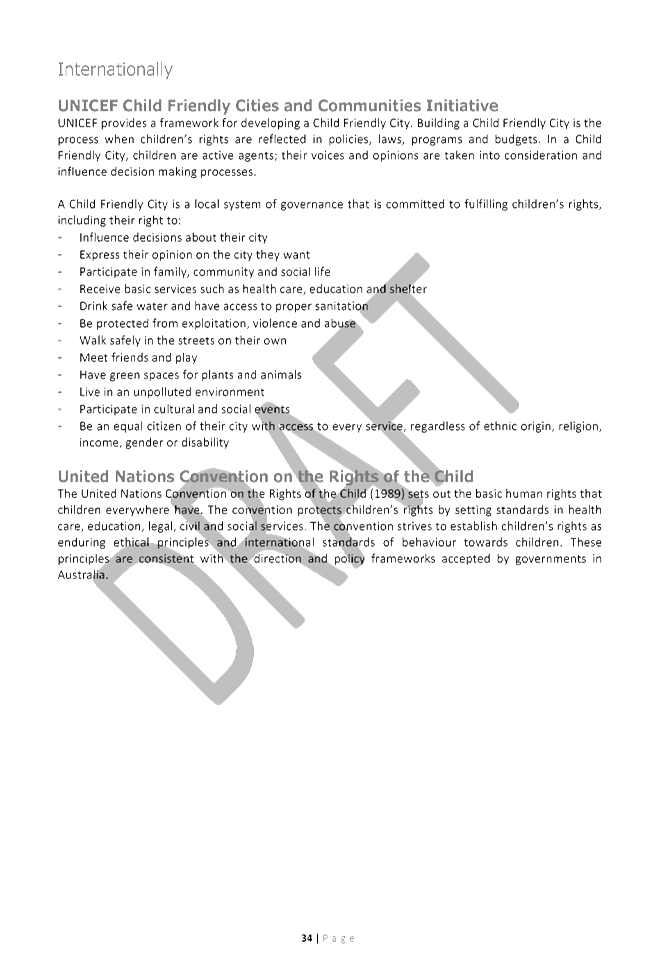
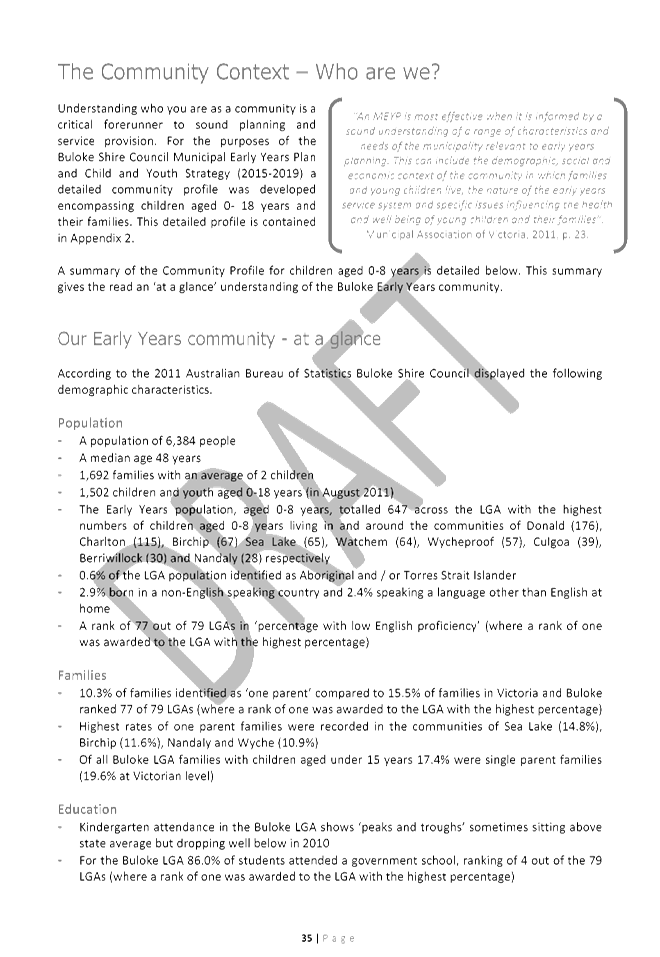
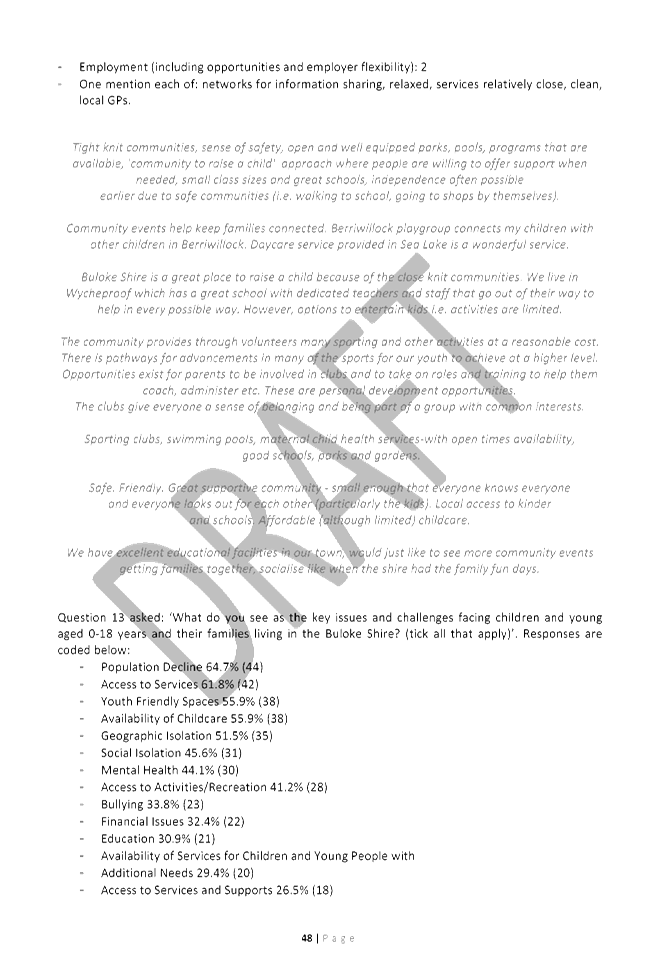
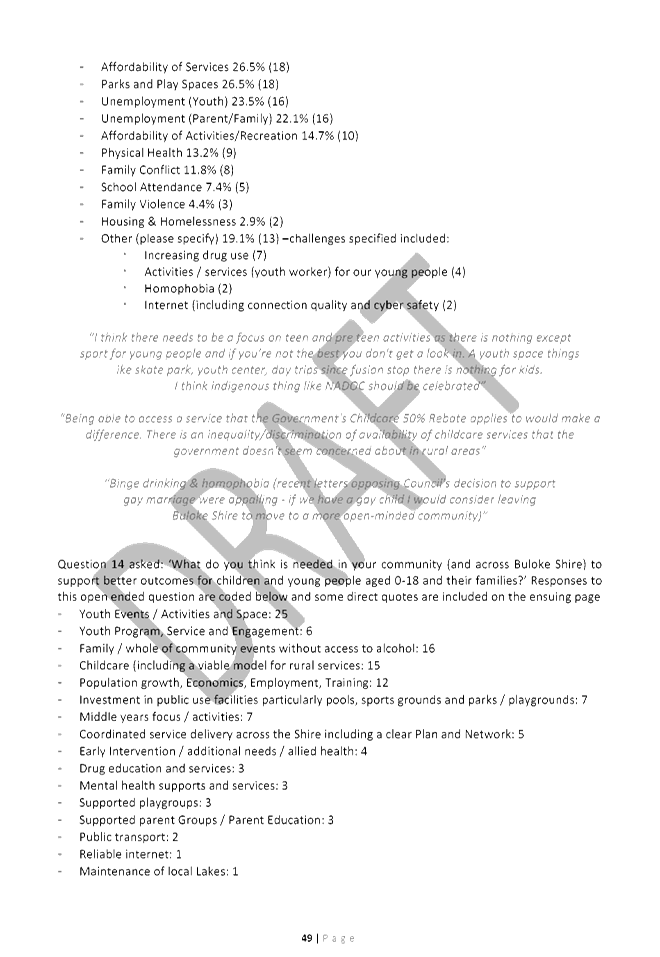
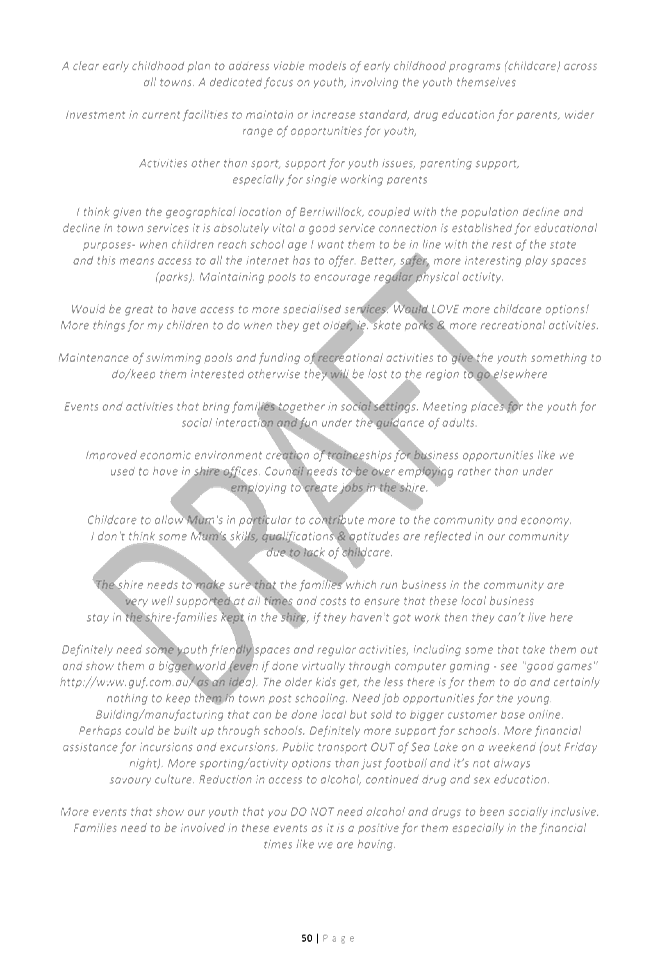
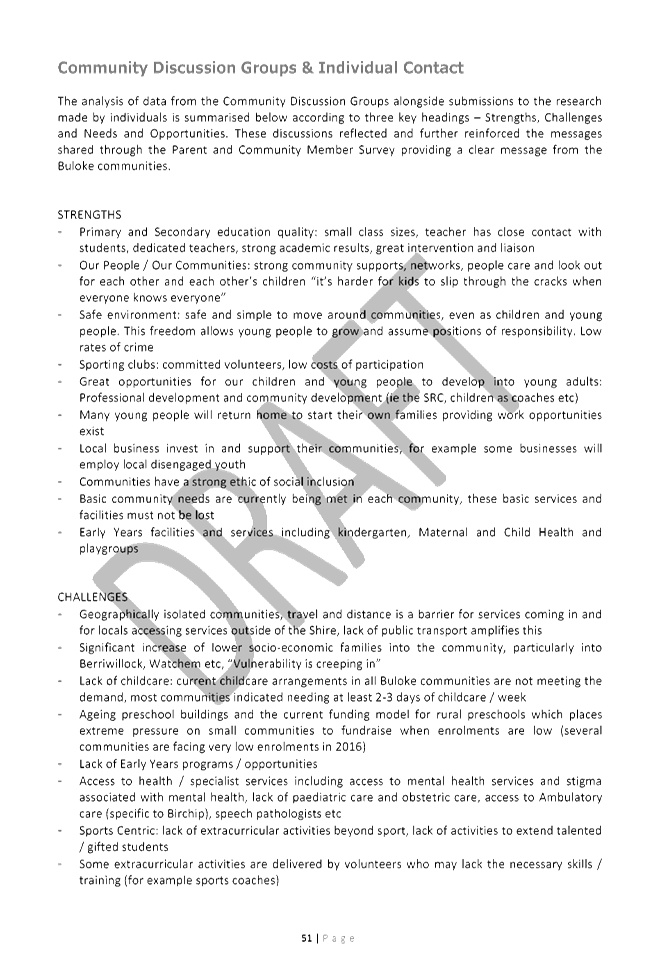
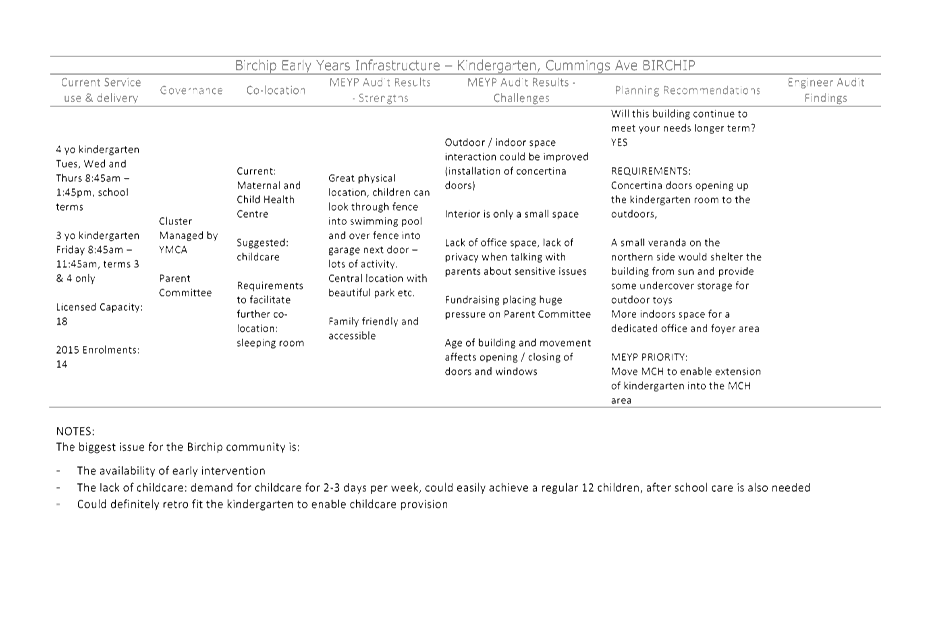
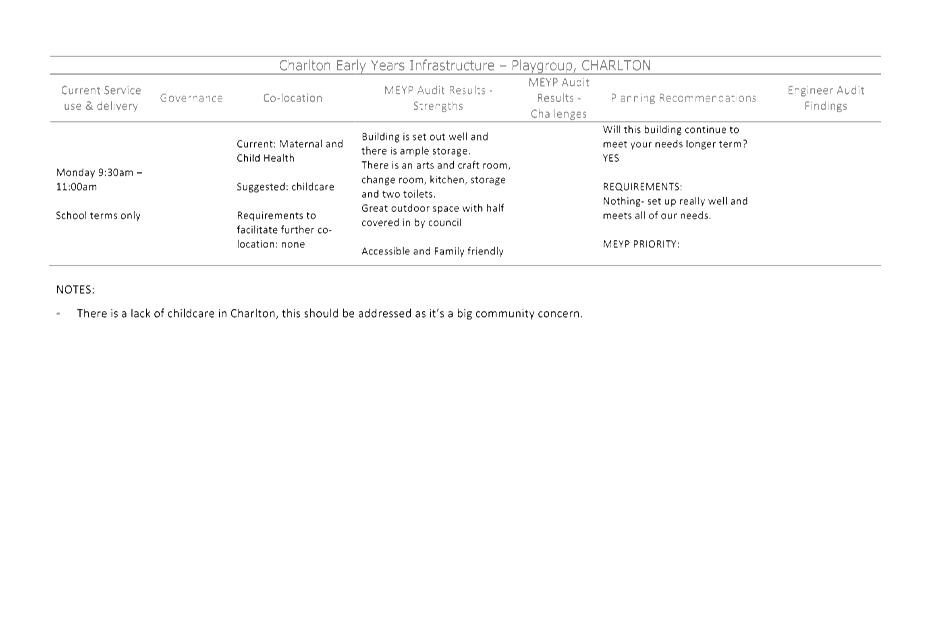
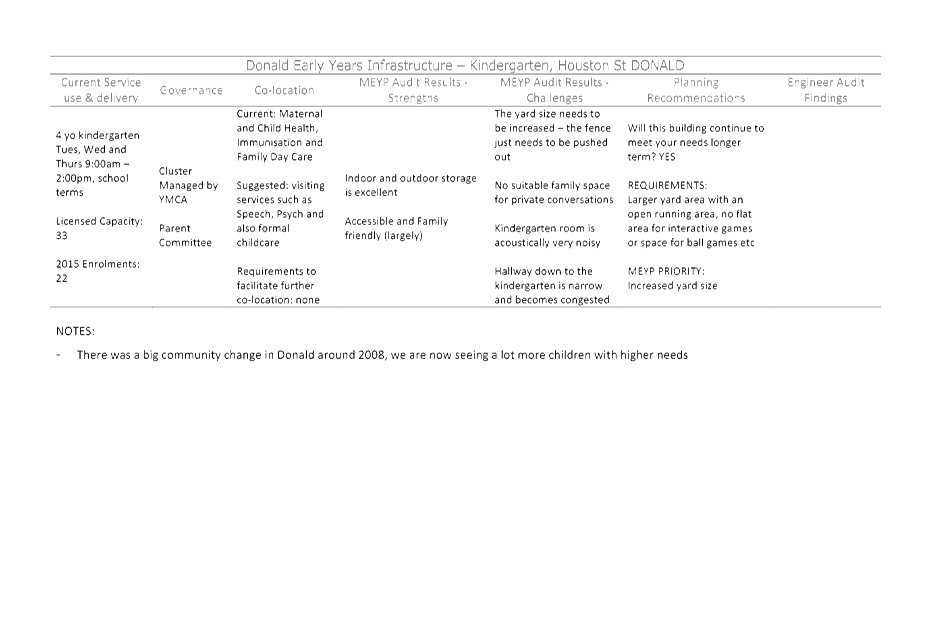
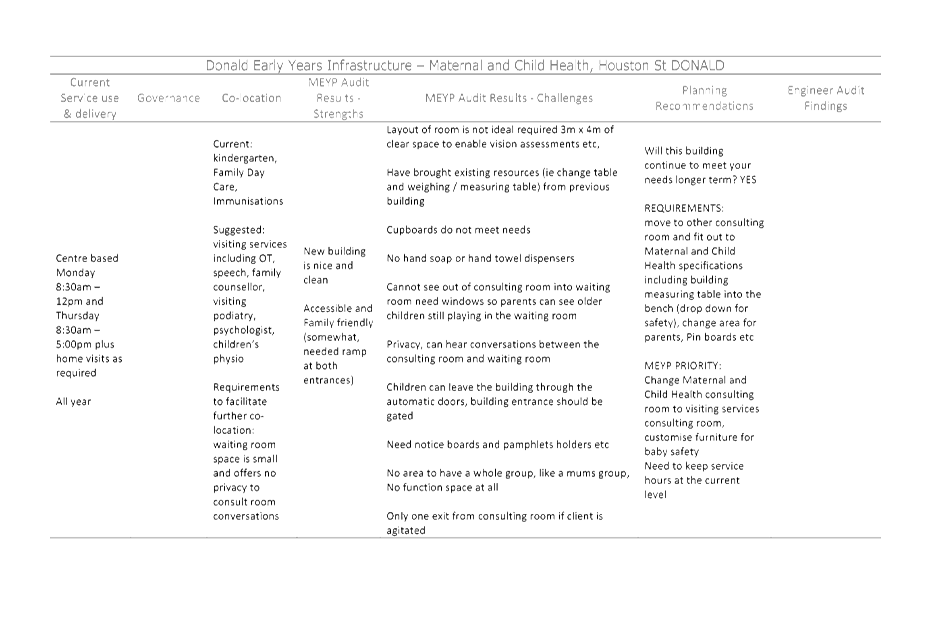
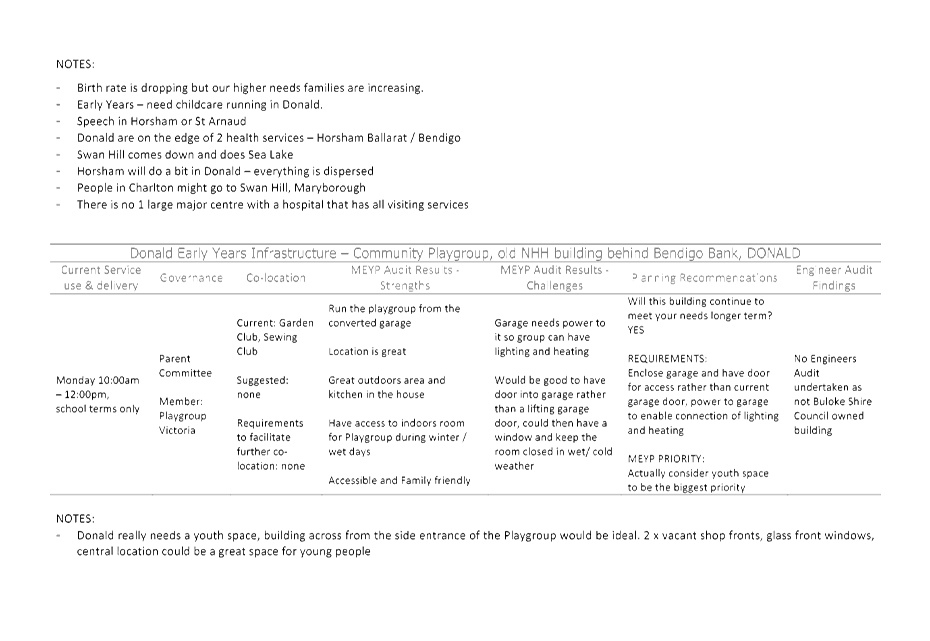
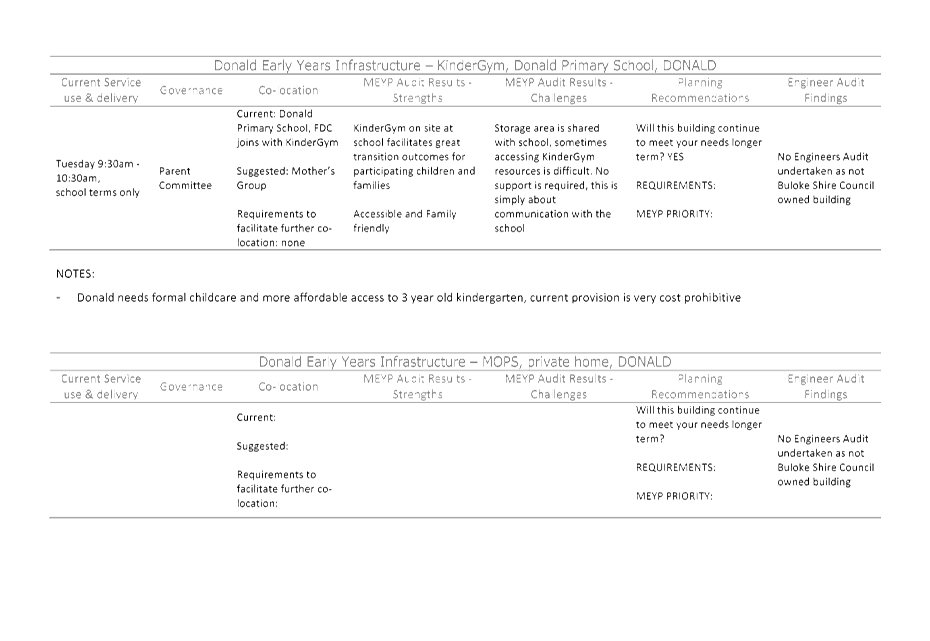
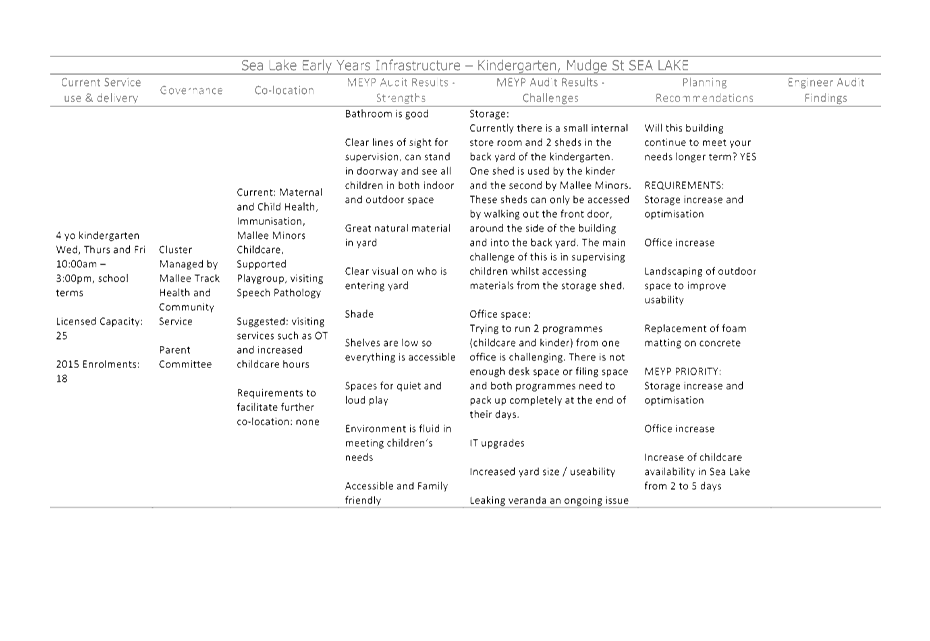
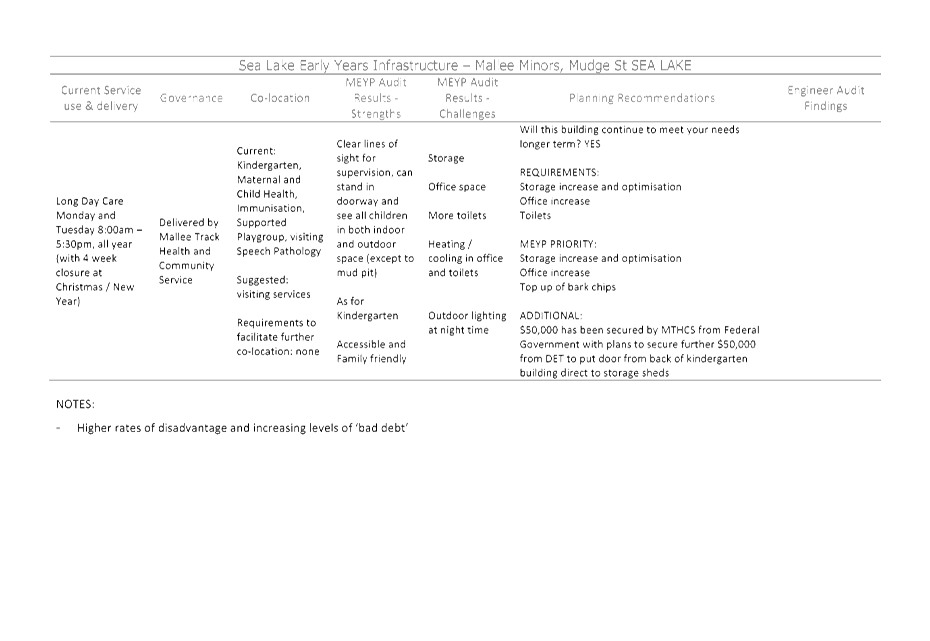
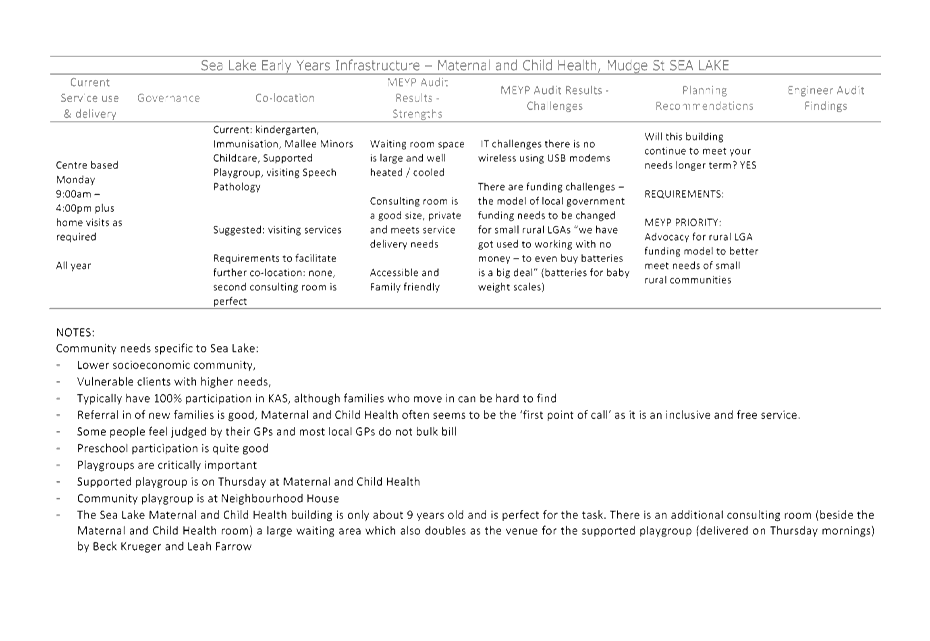
Attachment 2 Draft Buloke Municipal Early Years Plan




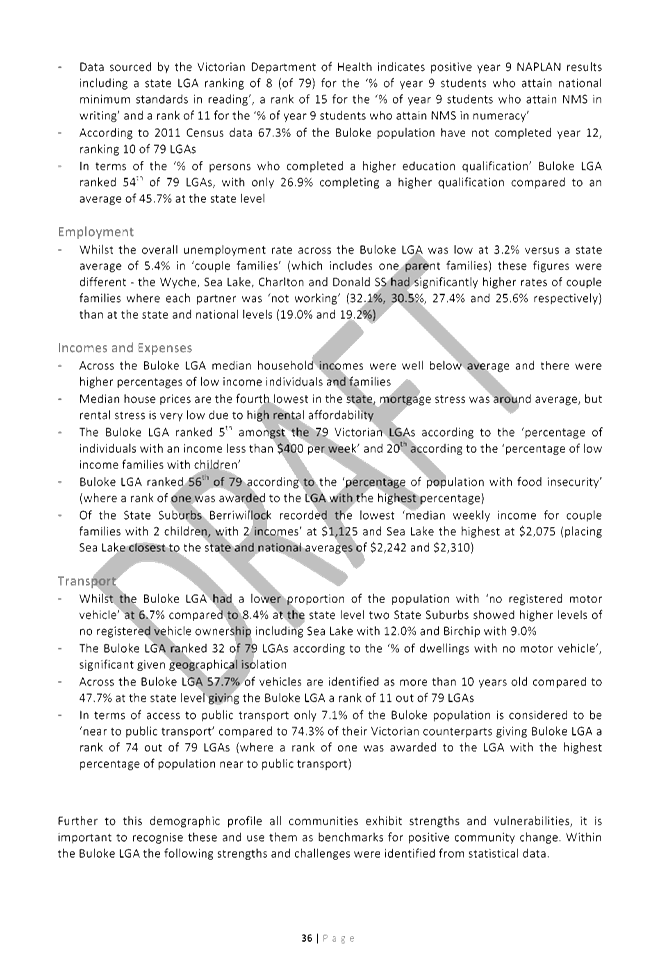
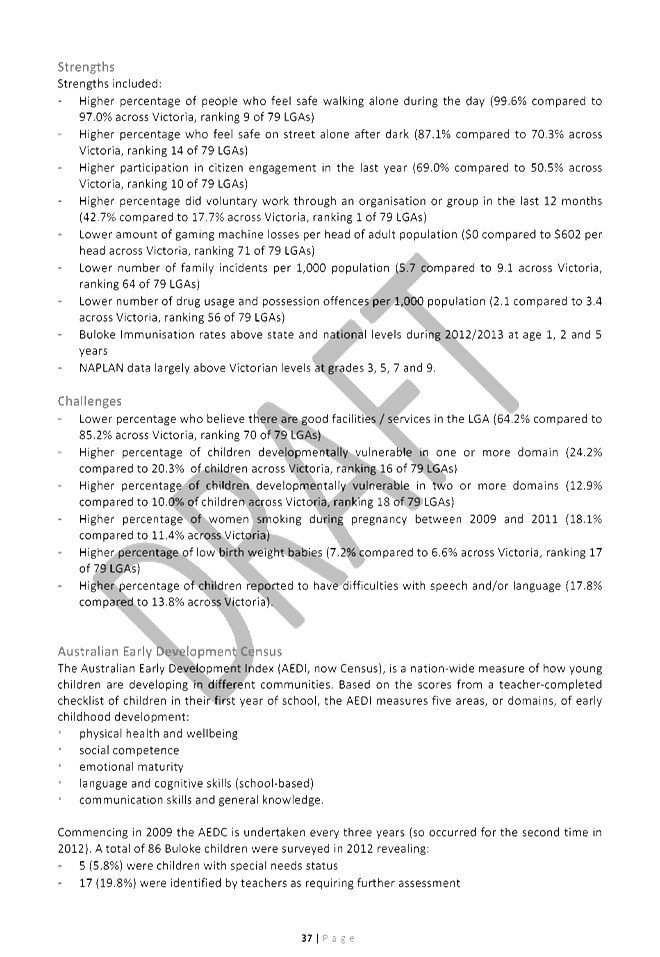
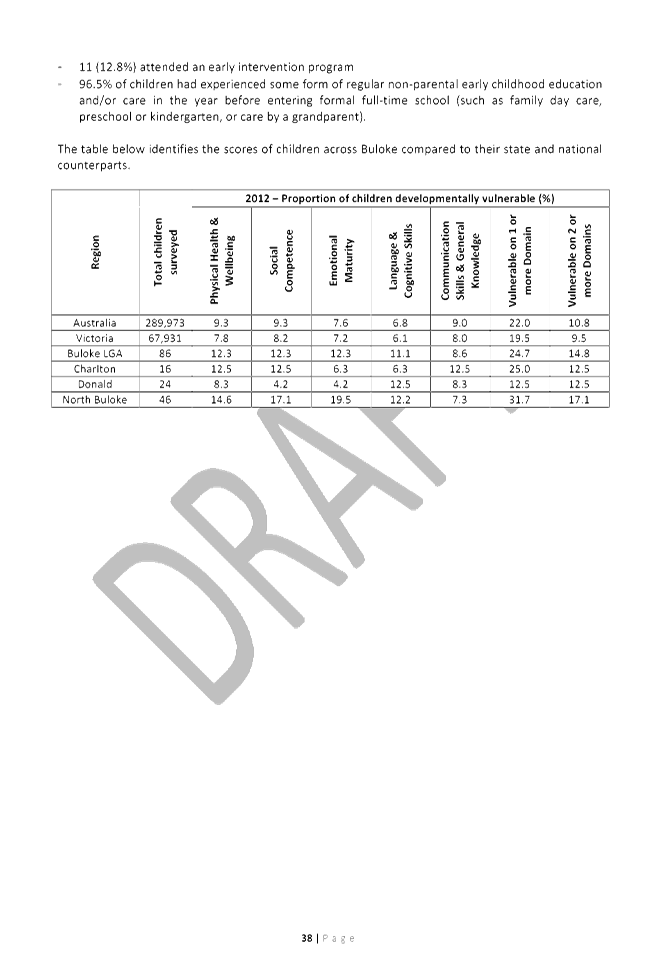
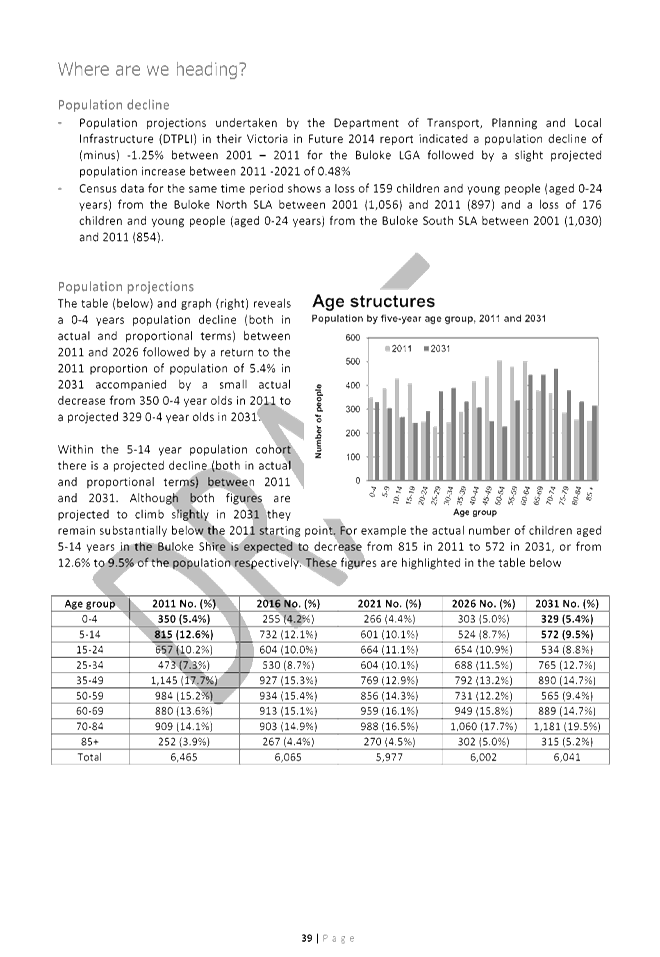
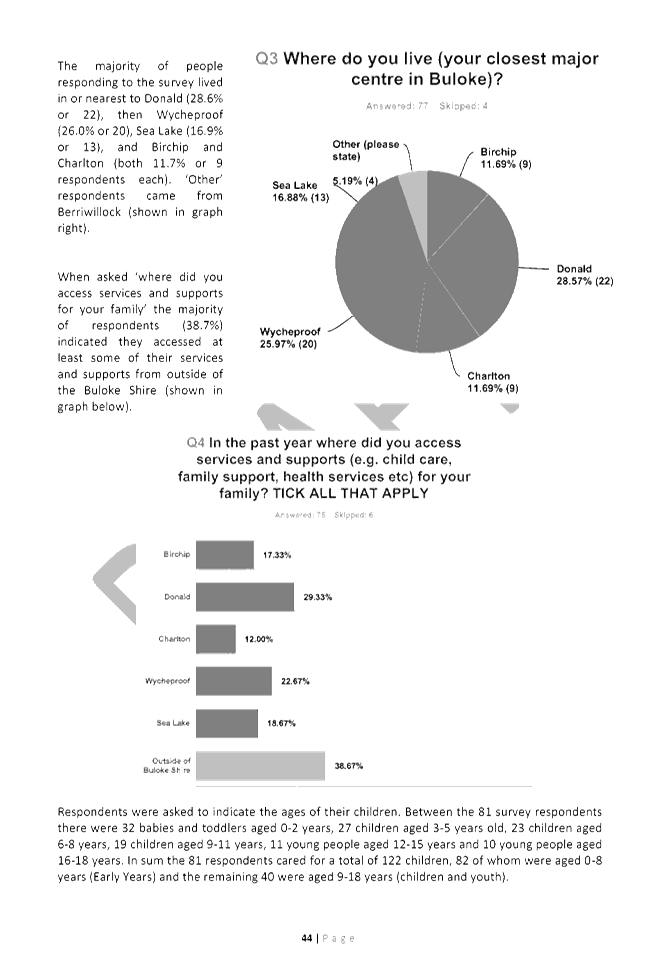
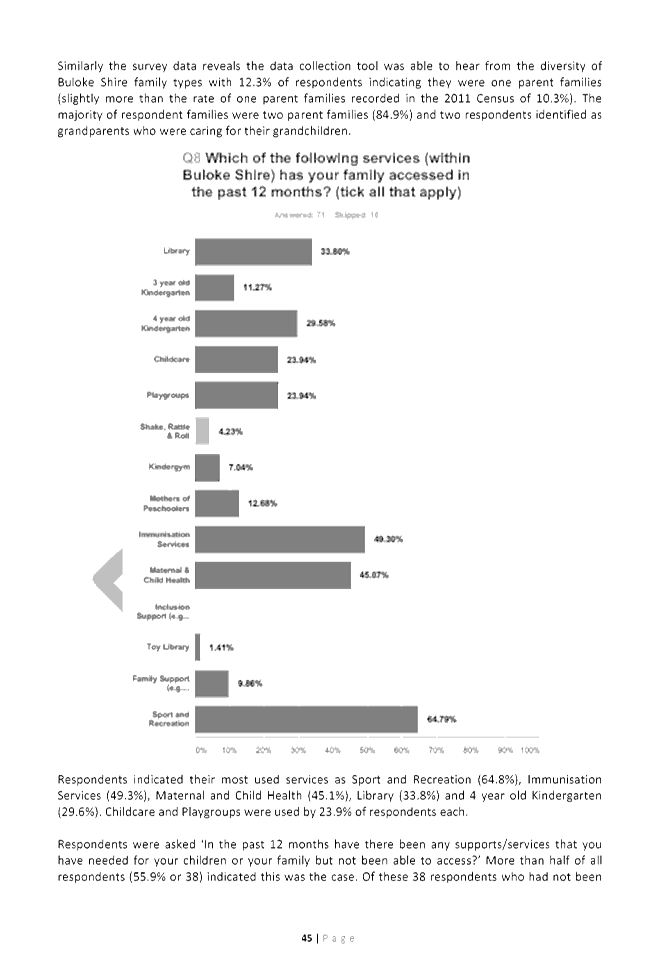
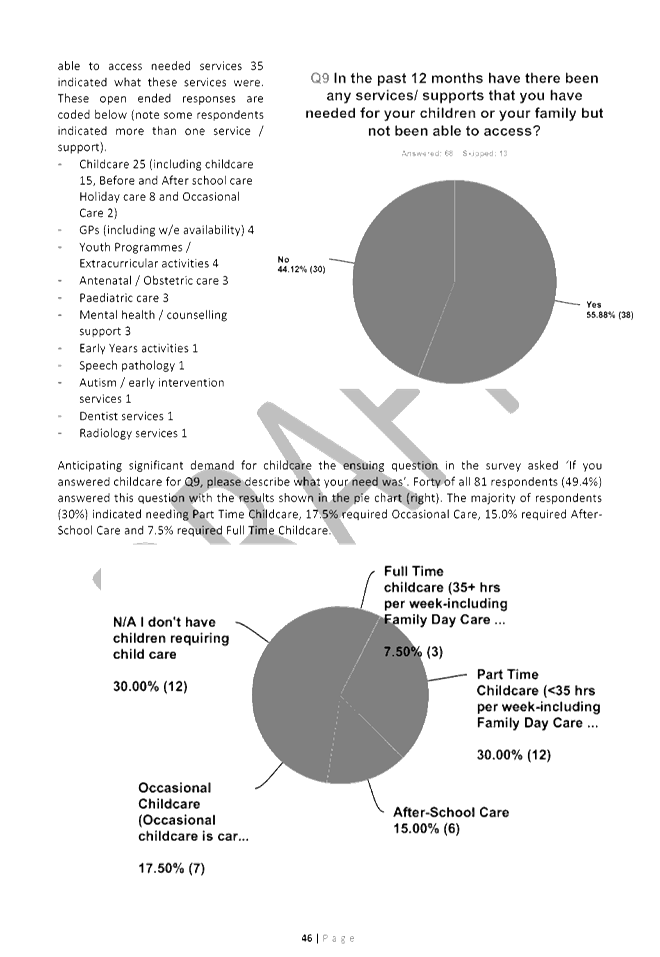
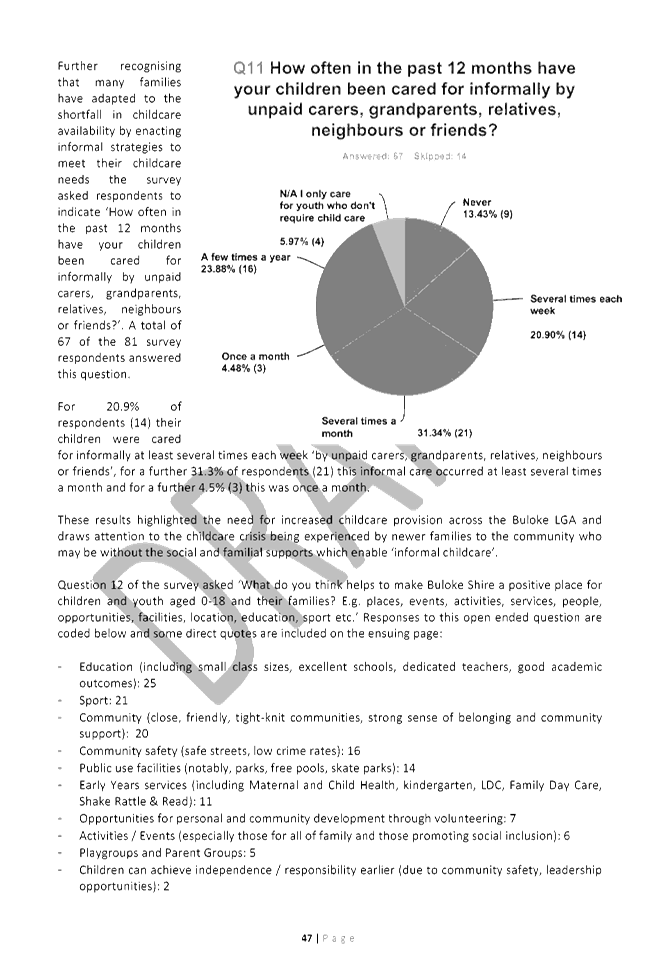
Buloke Shire Council Ordinary Meeting Wednesday, 8 July 2015
7.2.5 Adoption of draft Municipal Early Years Plan and Children & Youth Strategy for public exhibiiton
Attachment 2 Draft Buloke Municipal Early Years Plan
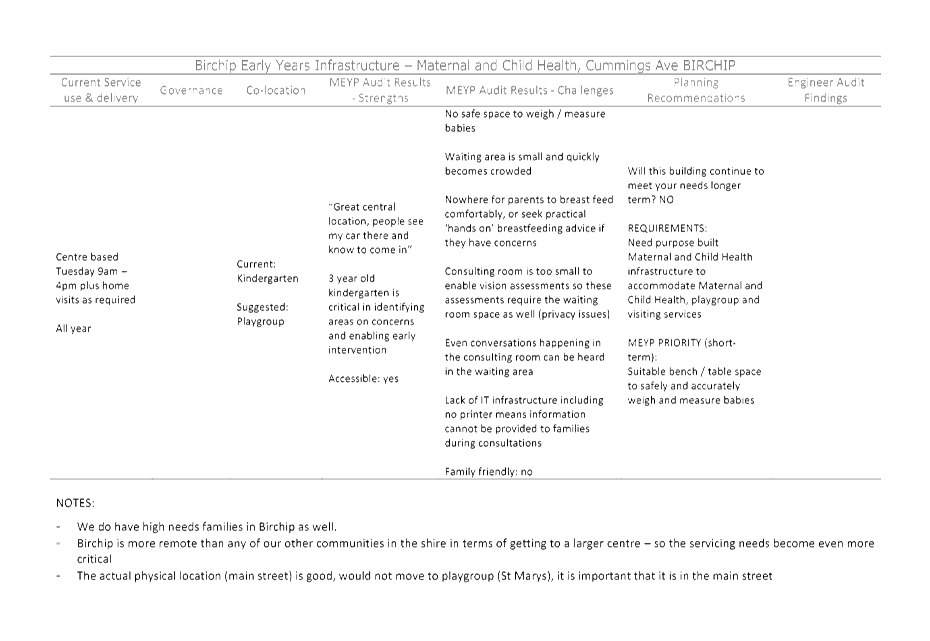
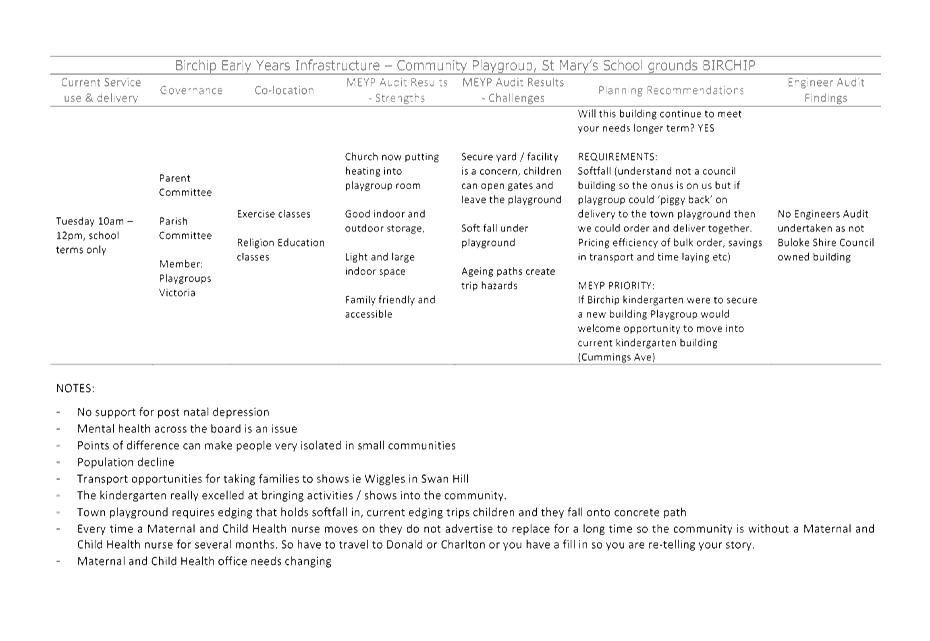
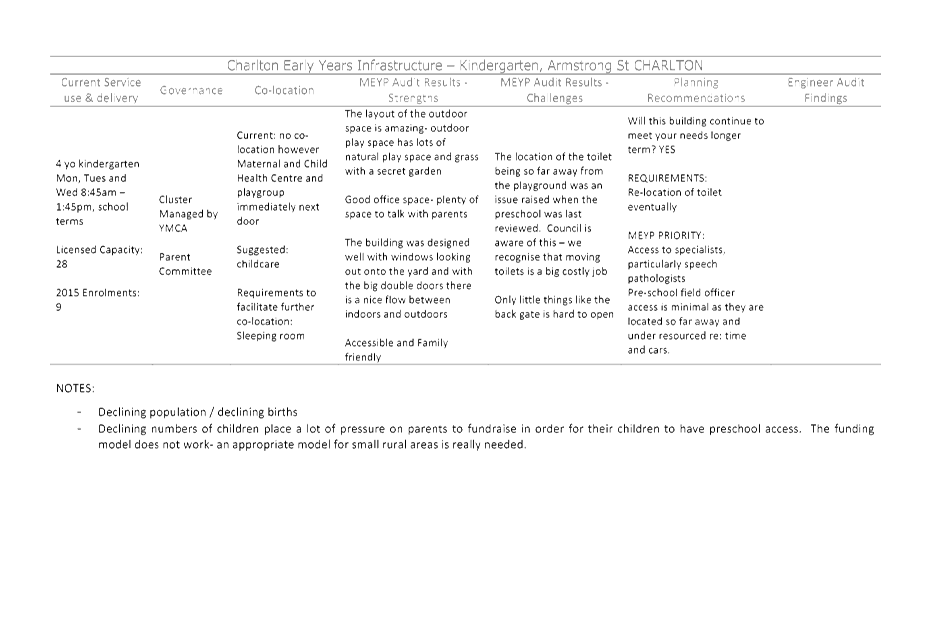
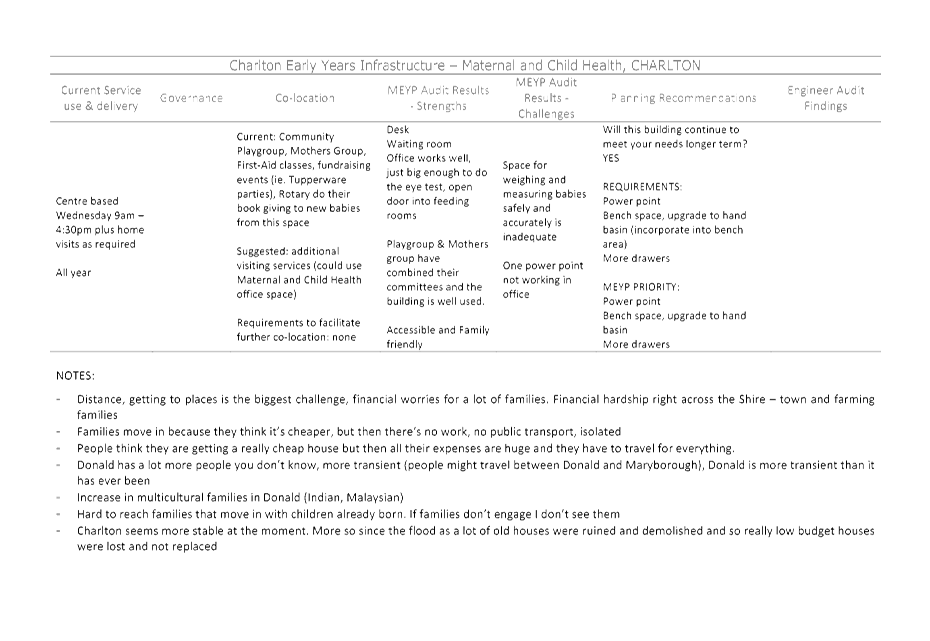

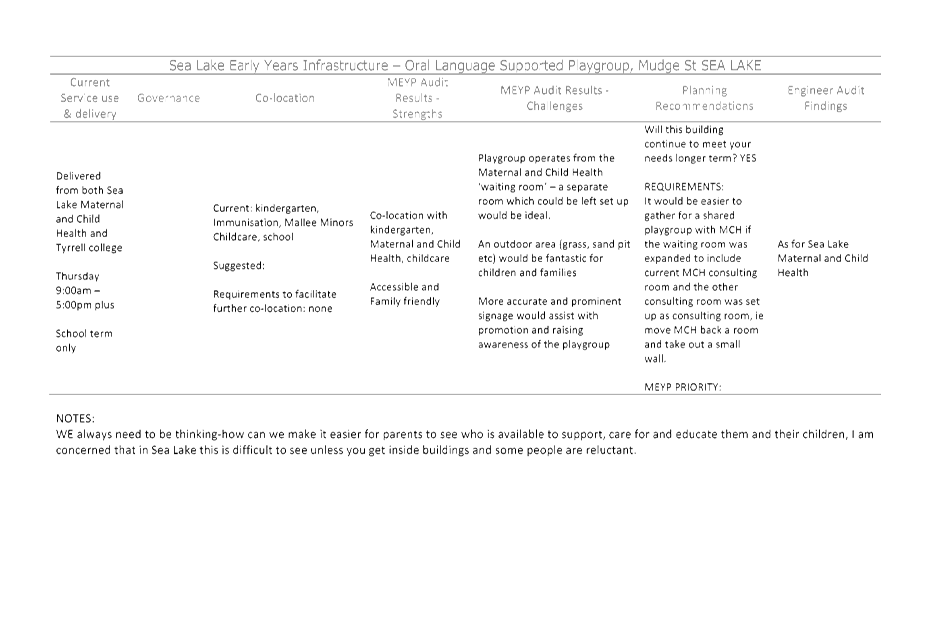
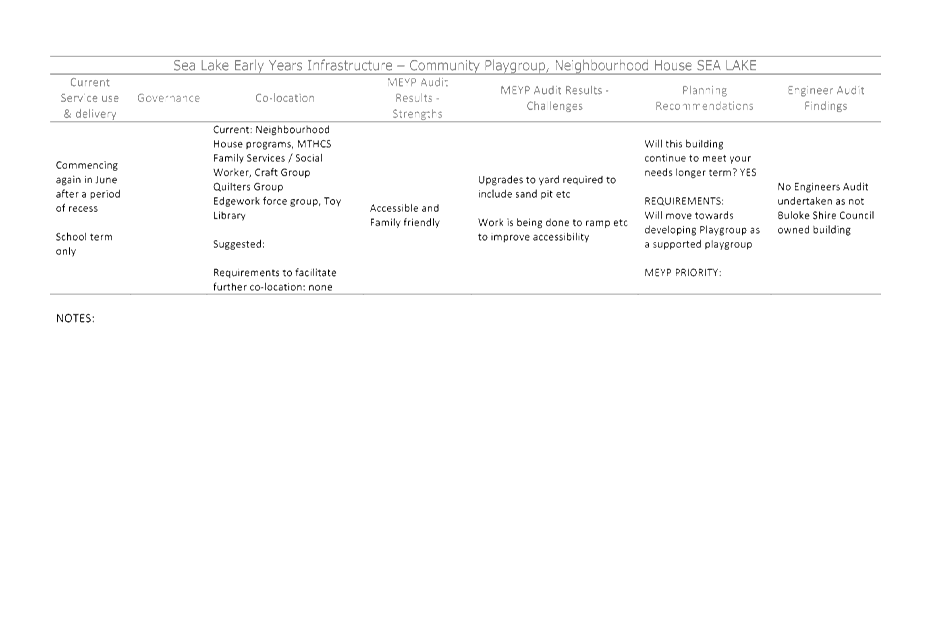
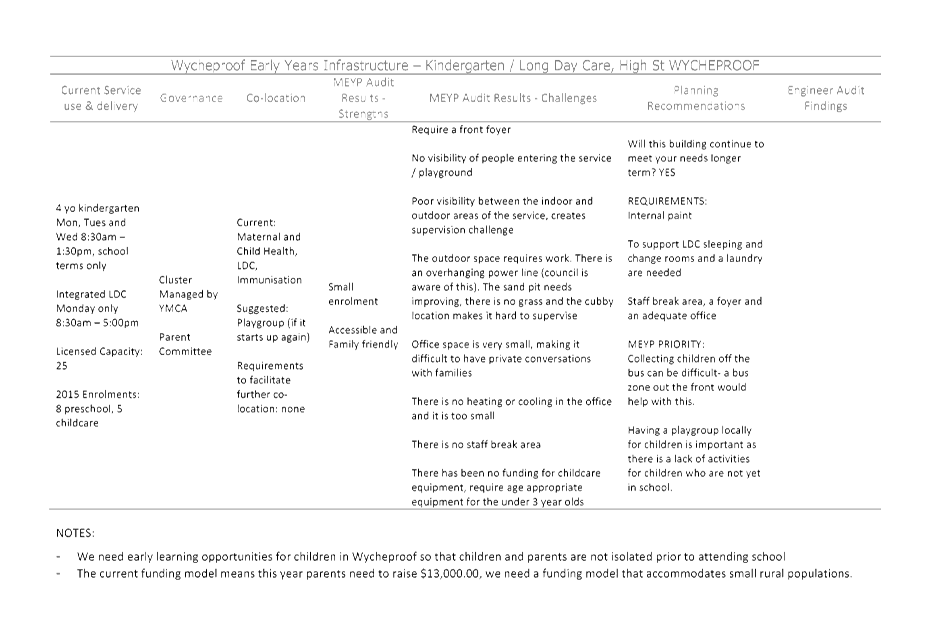
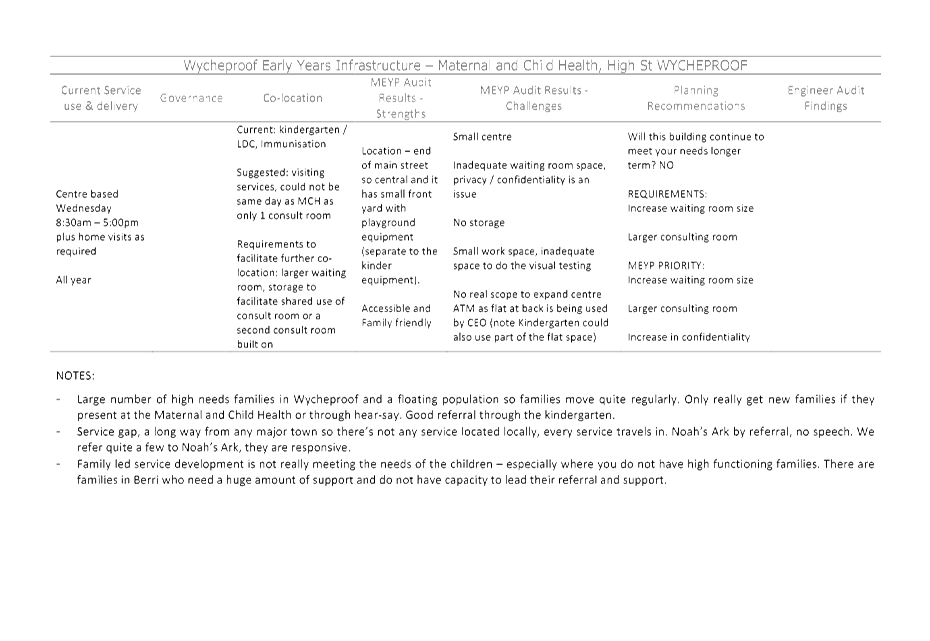
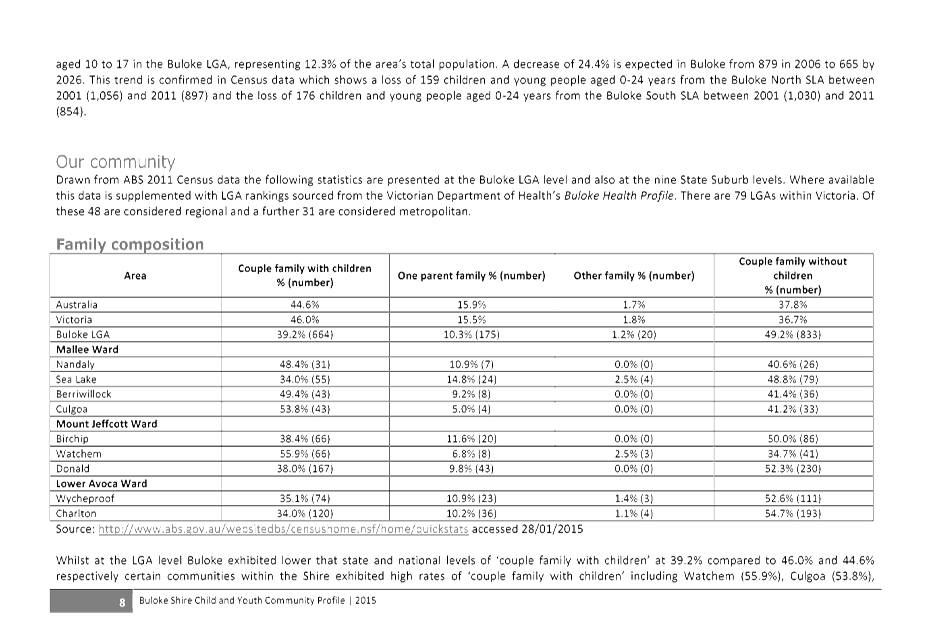
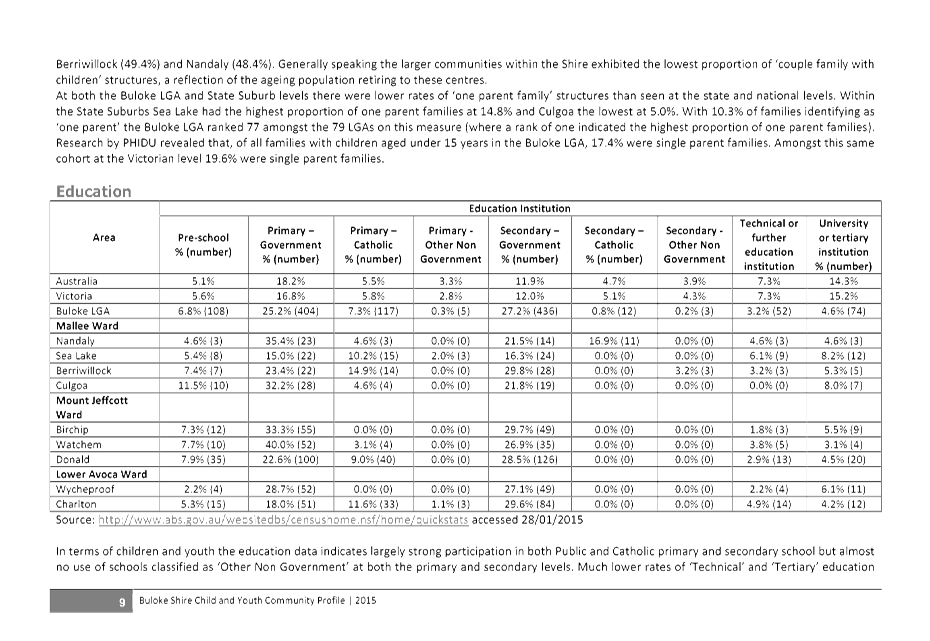
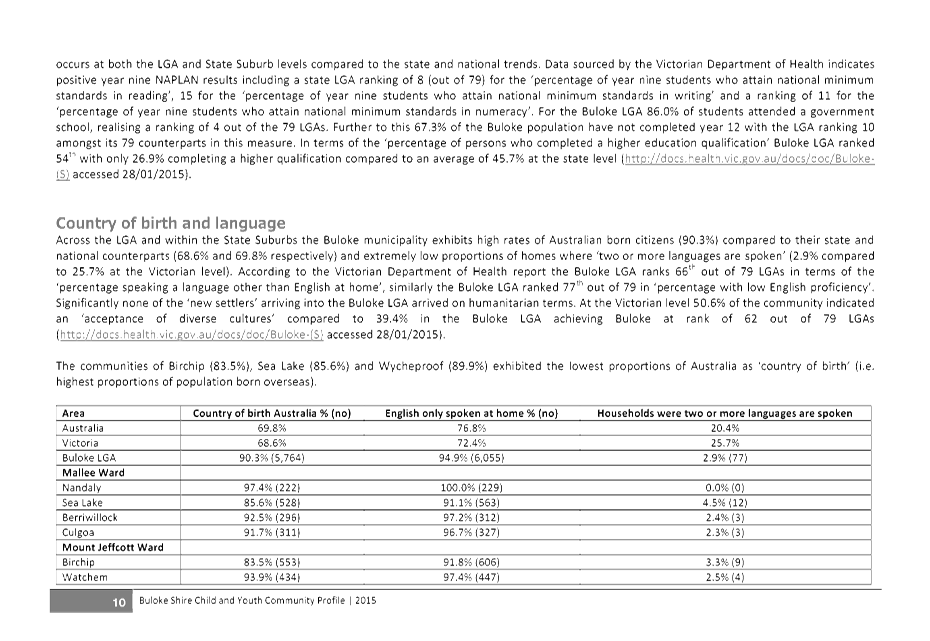
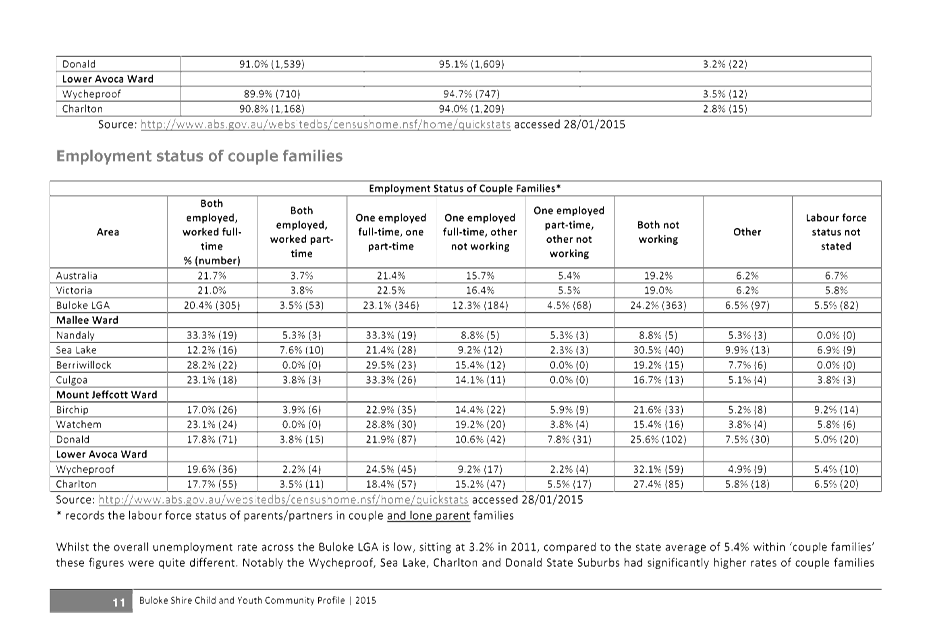
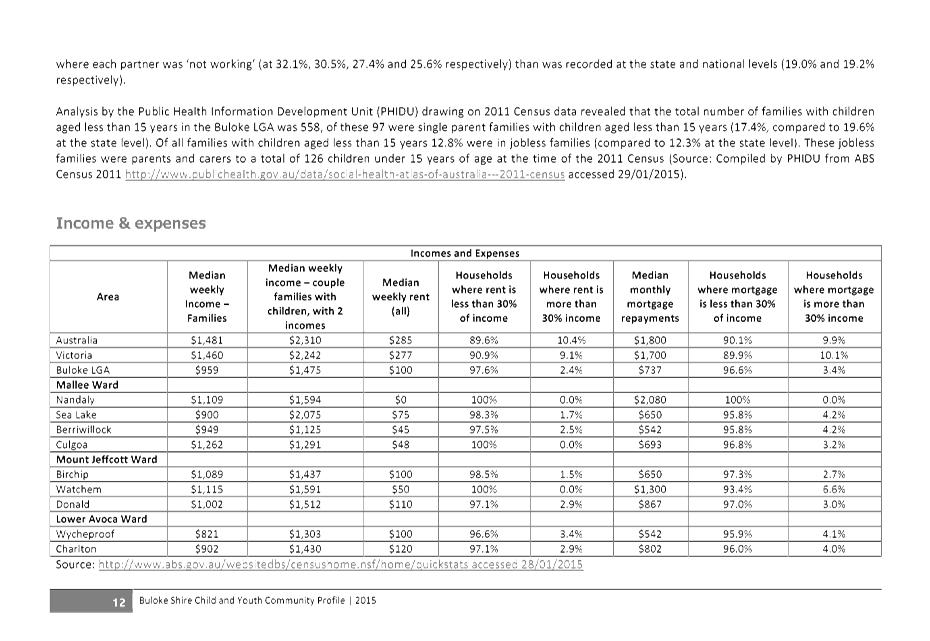
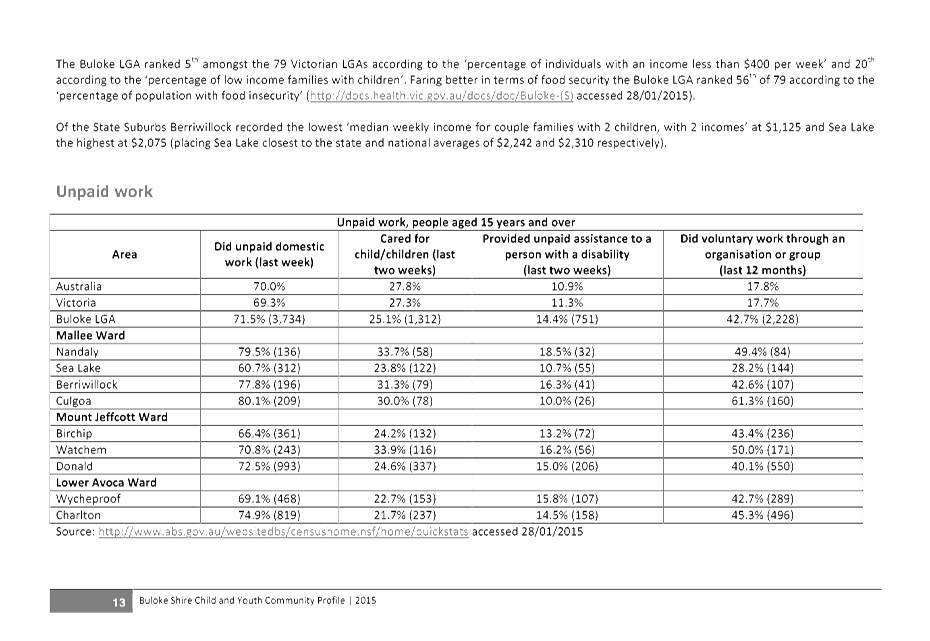
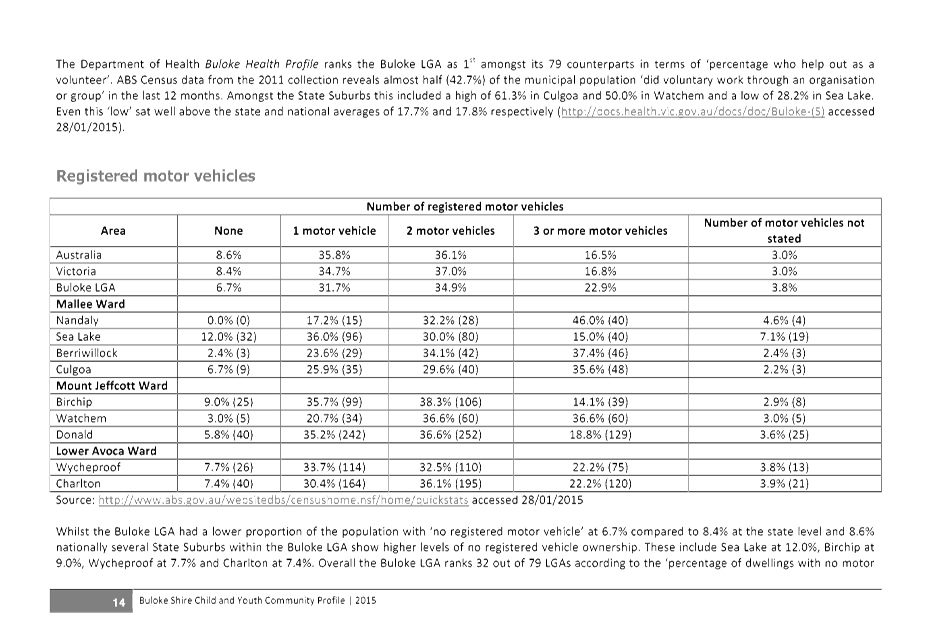
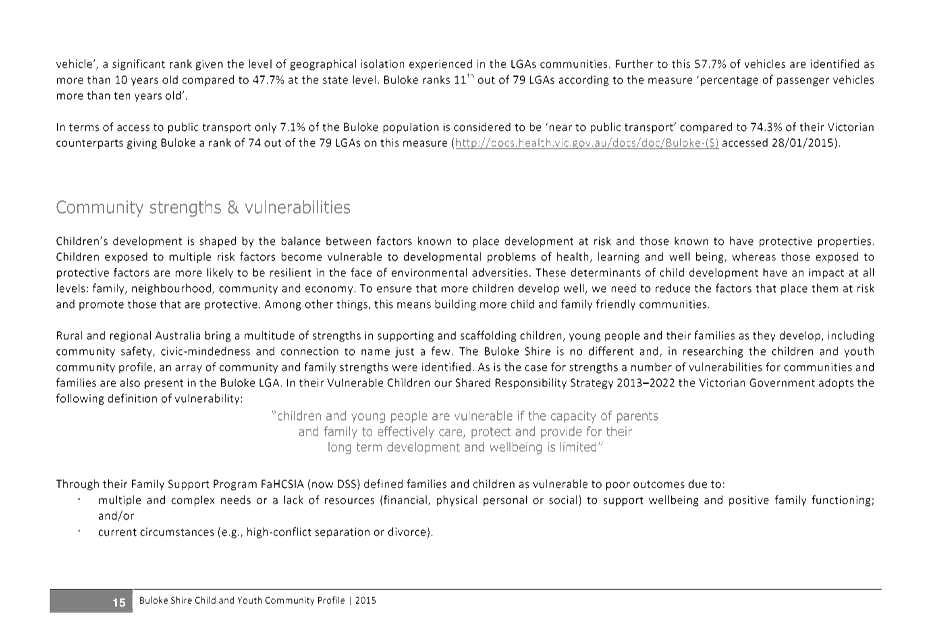
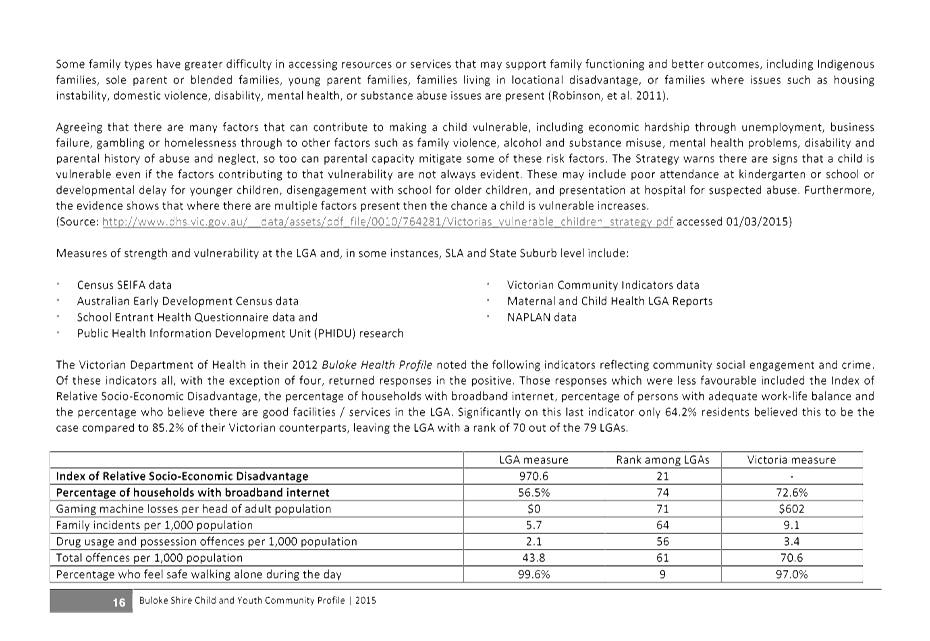
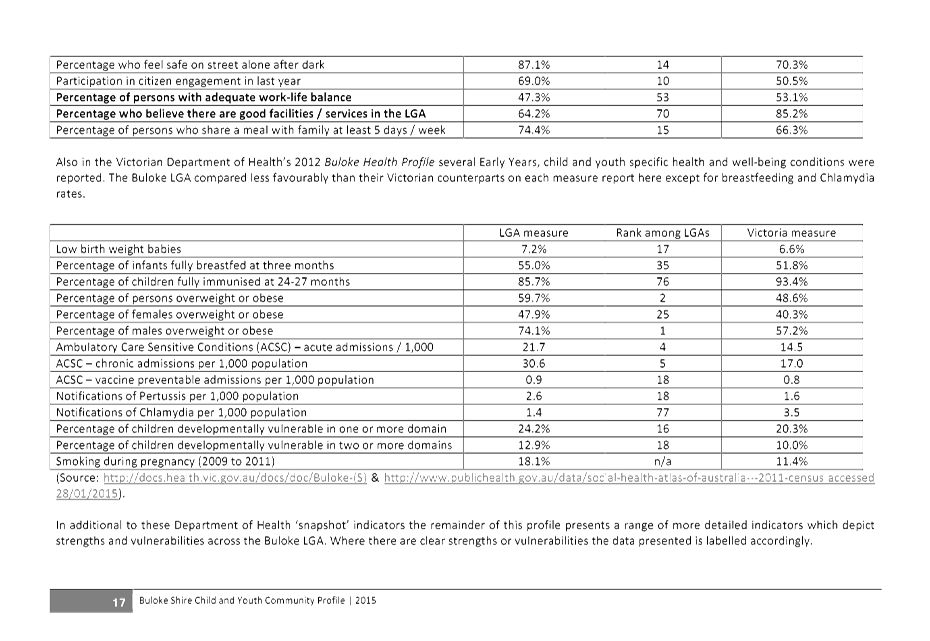
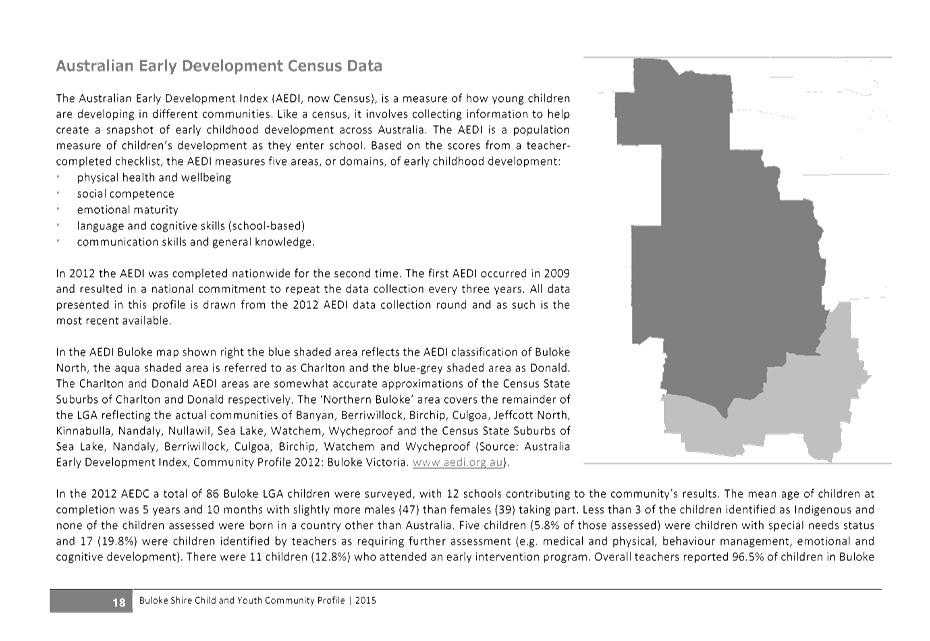
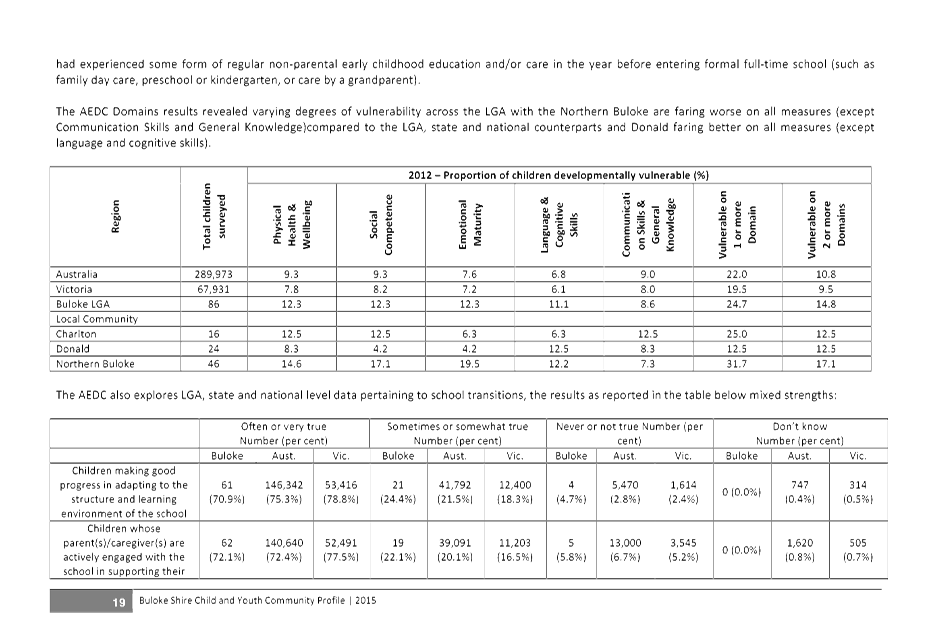
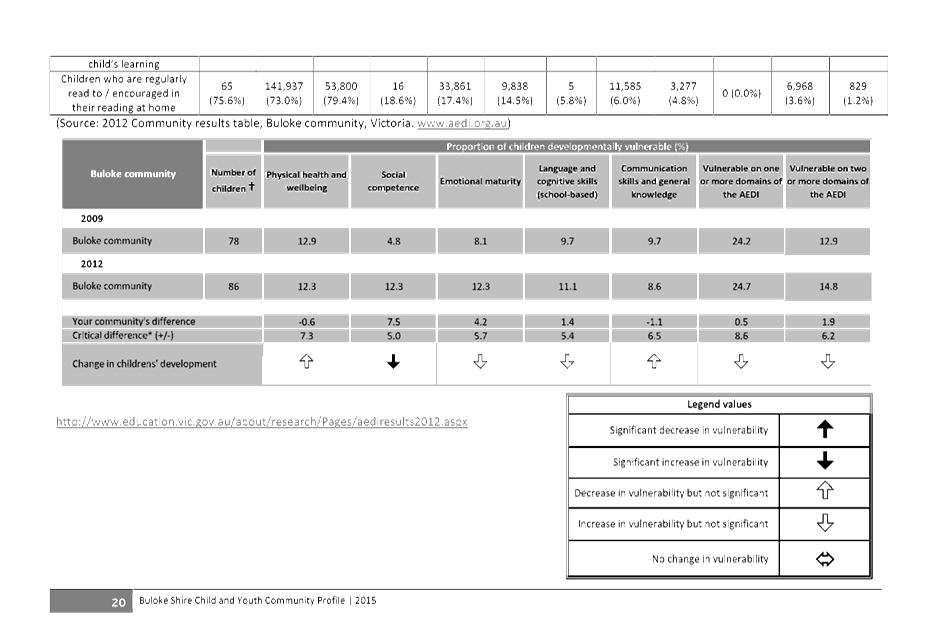
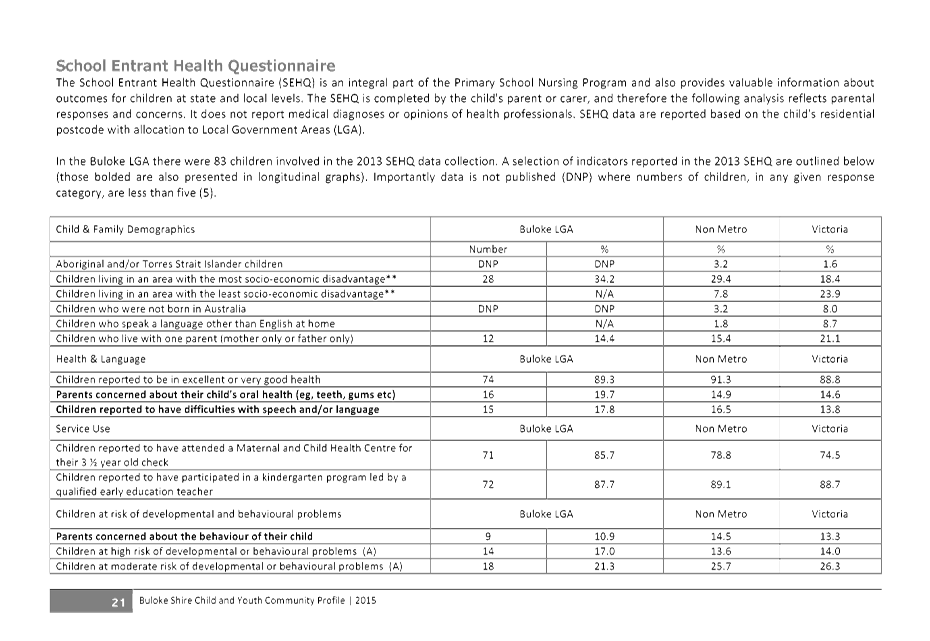
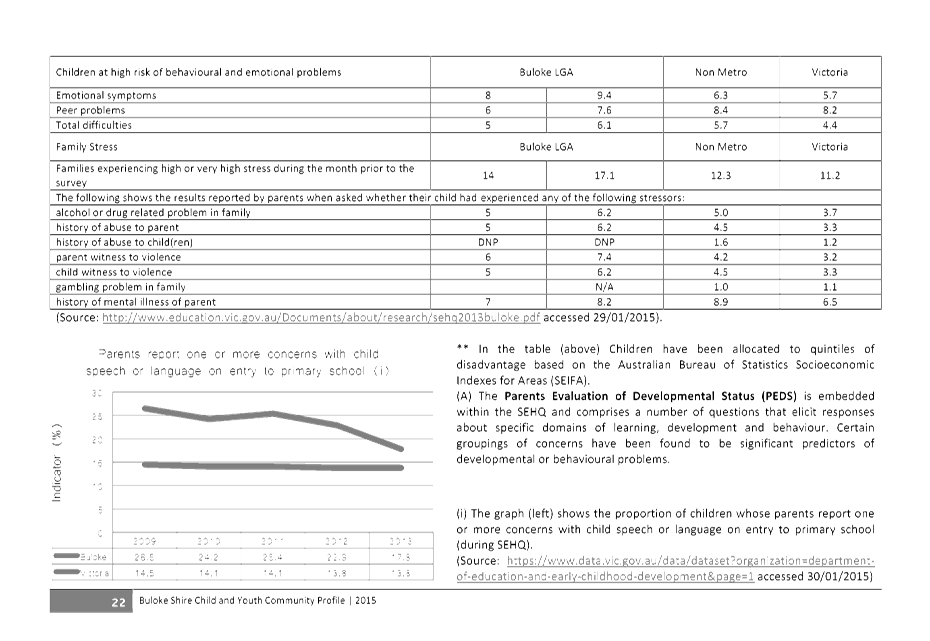
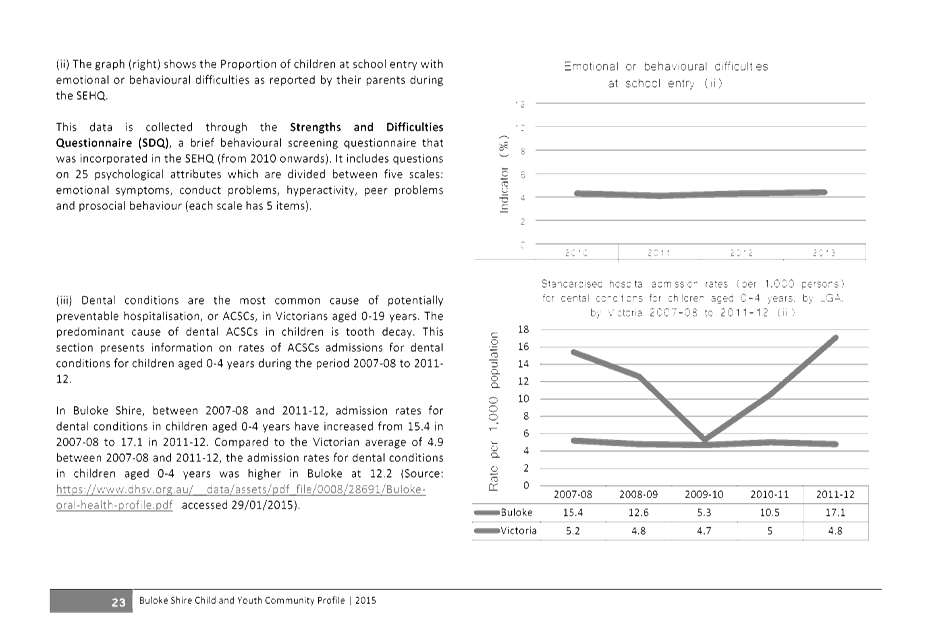
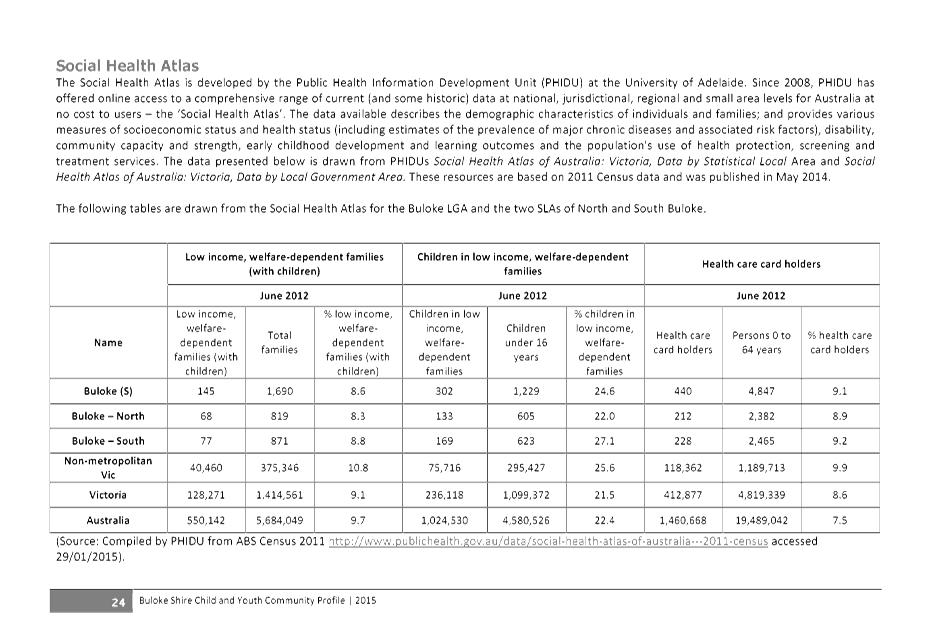
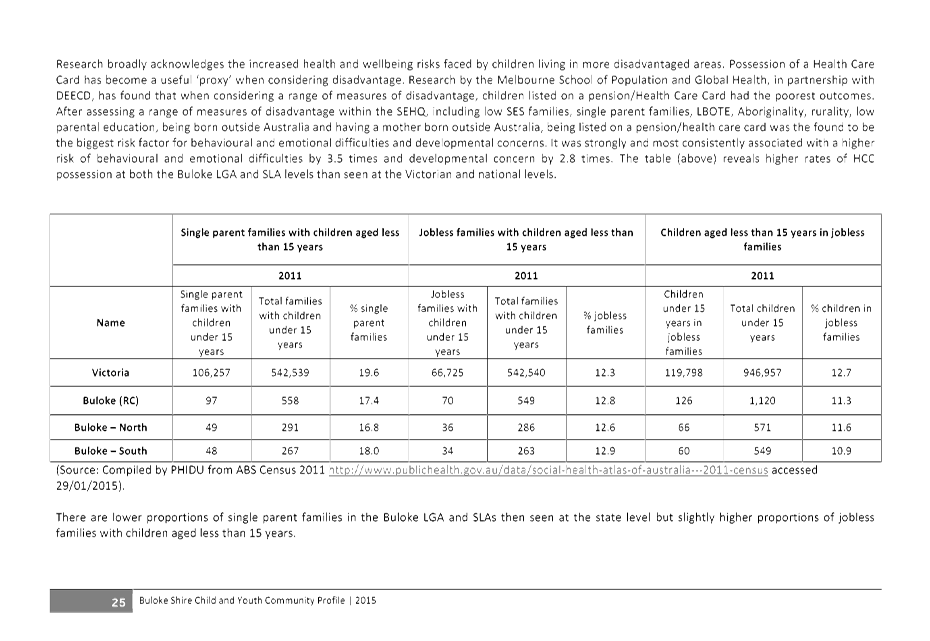
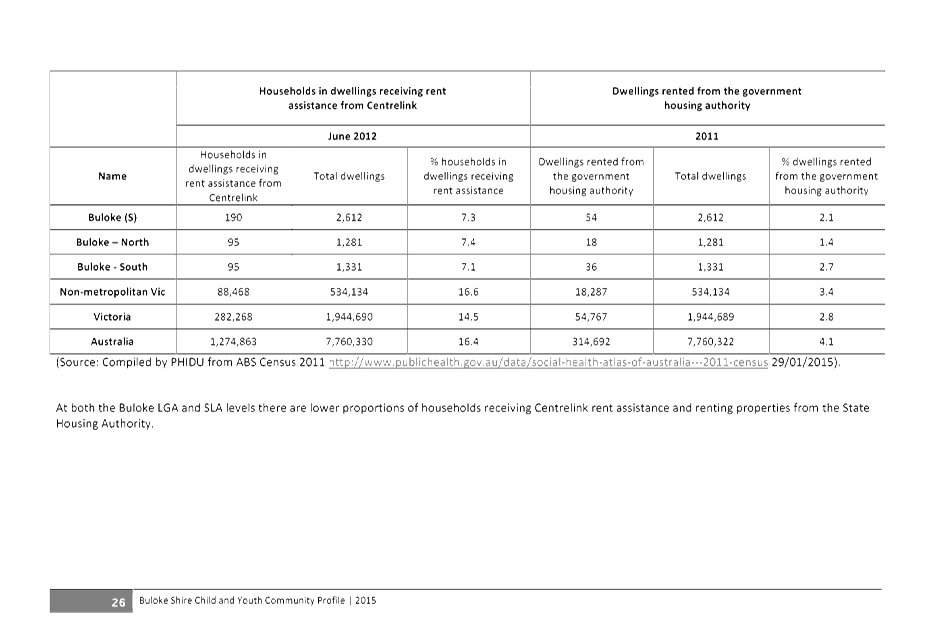
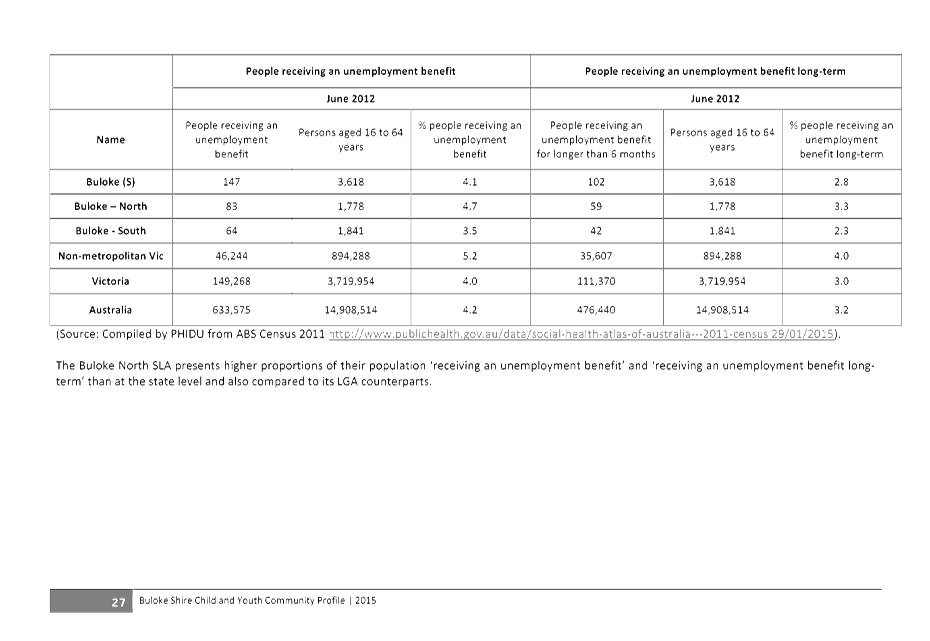
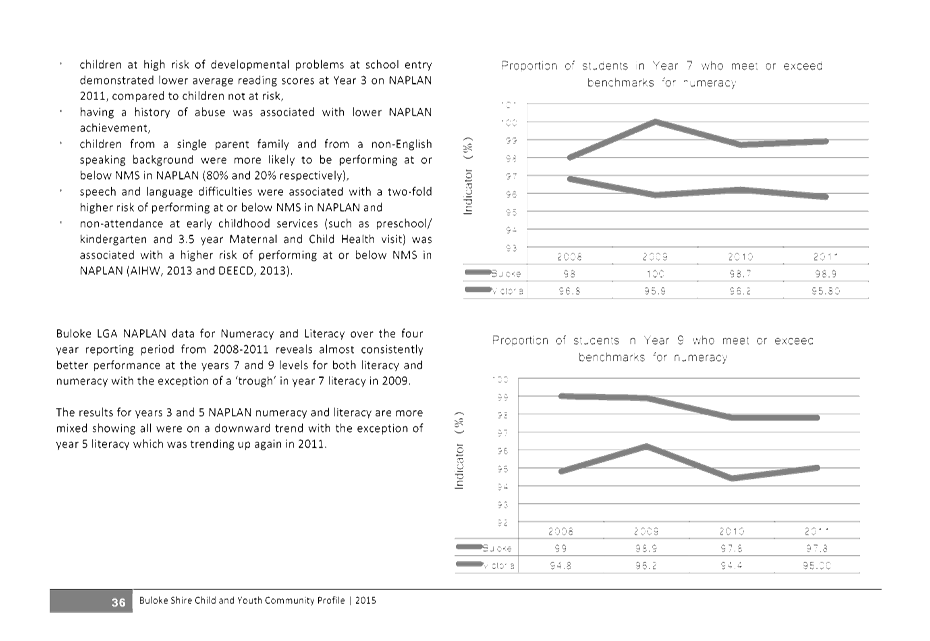
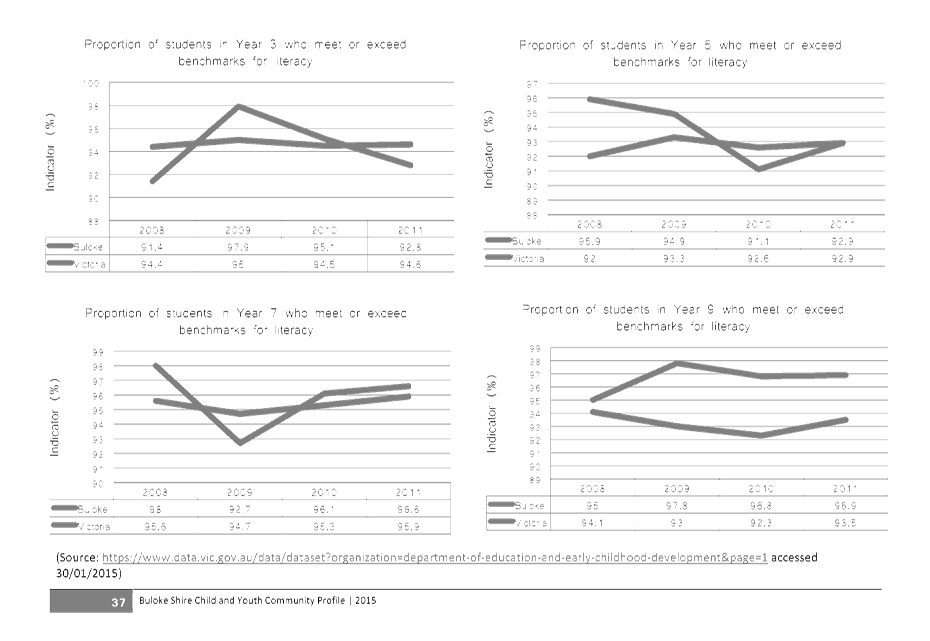
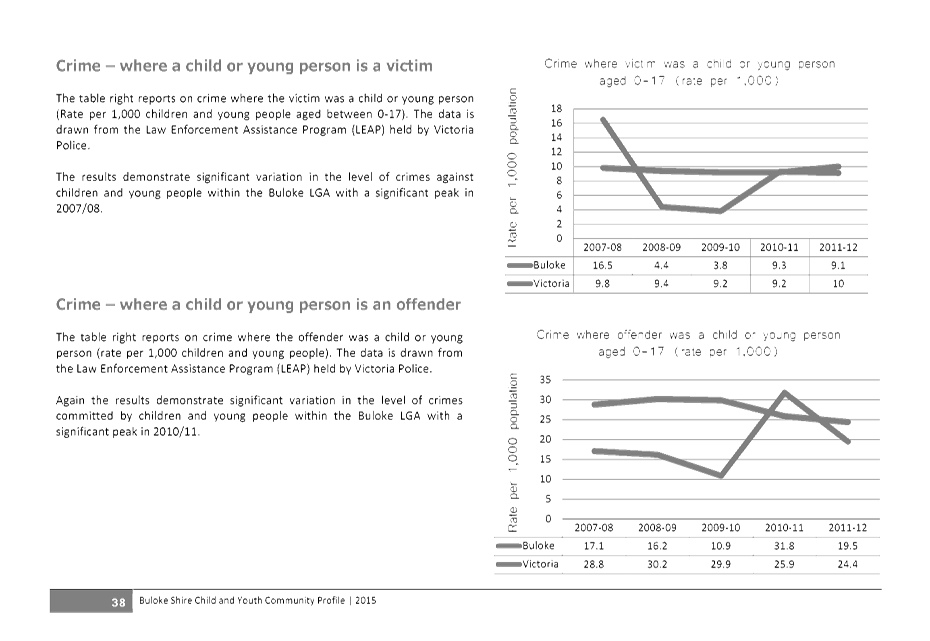
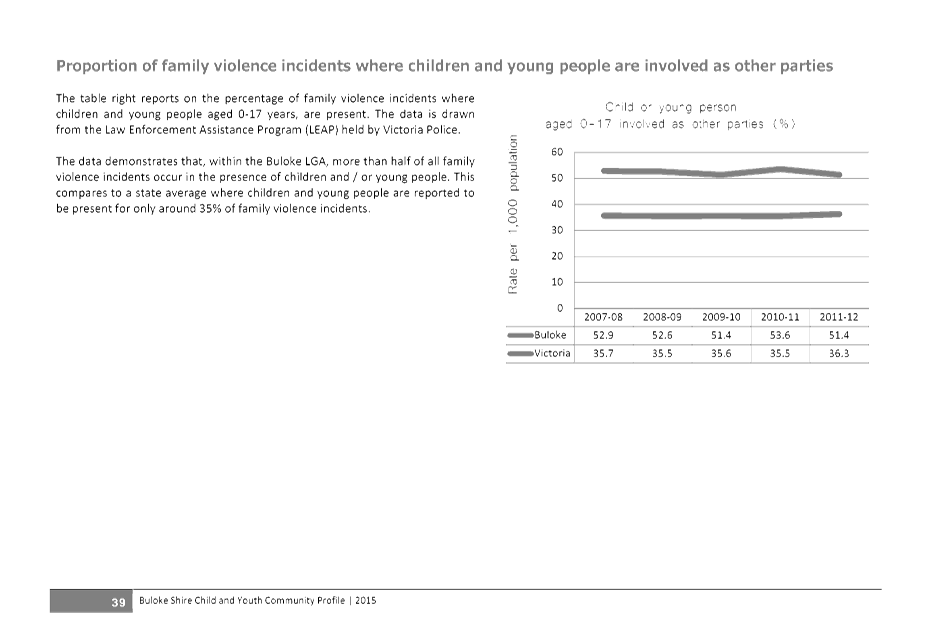
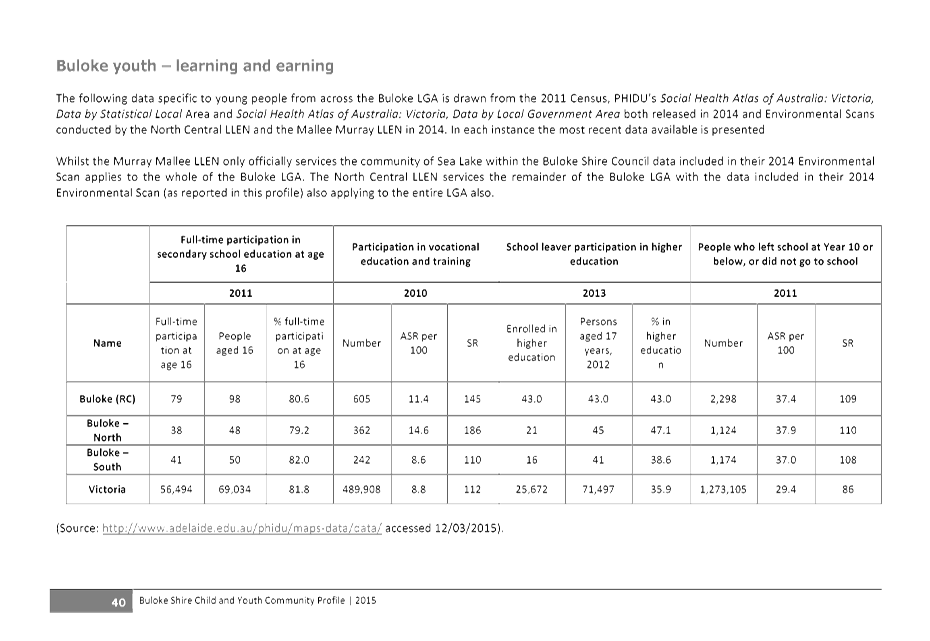
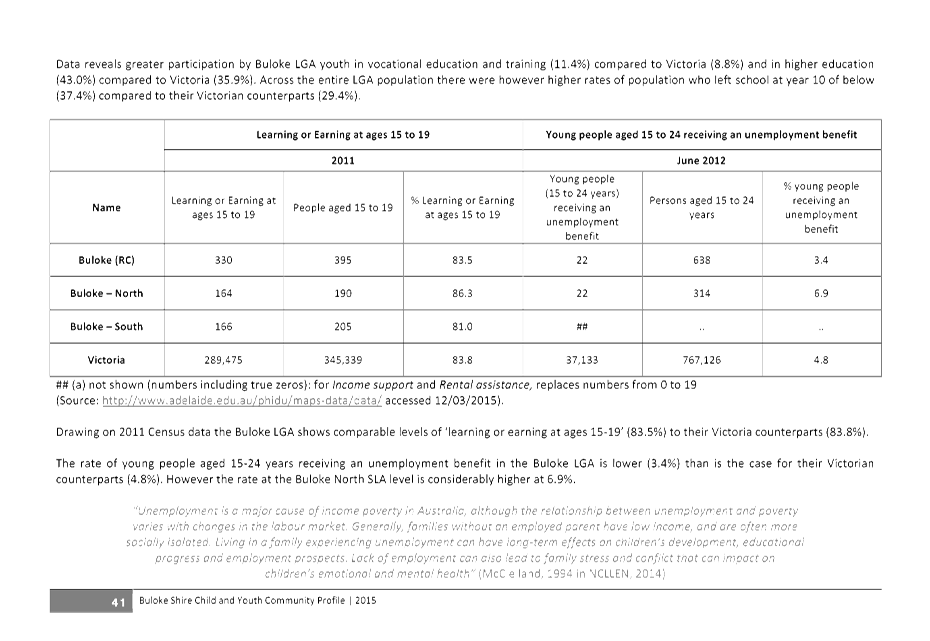
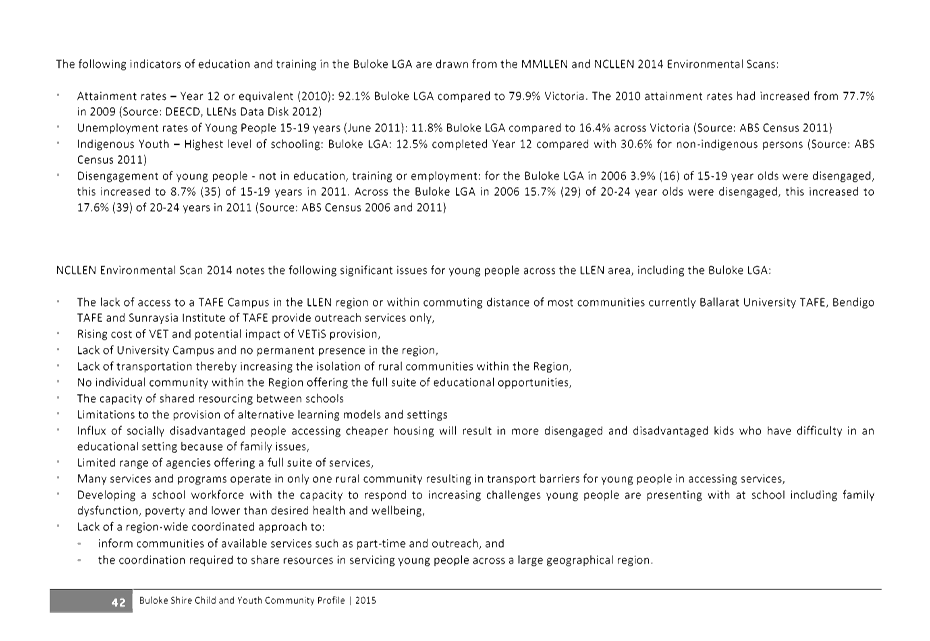
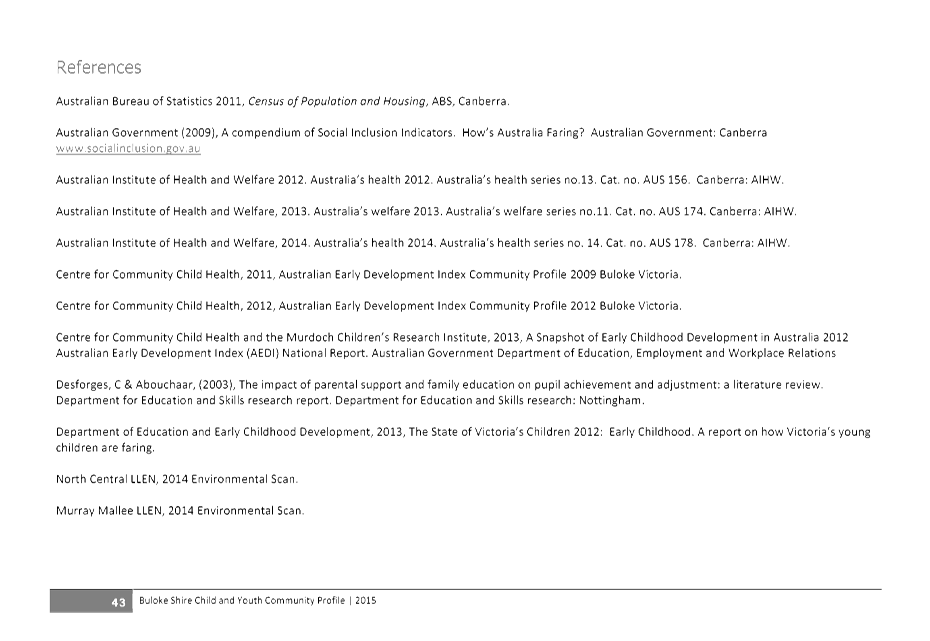
Buloke Shire Council Ordinary Meeting Wednesday, 8 July 2015
7.2.5 Adoption of draft Municipal Early Years Plan and Children & Youth Strategy for public exhibiiton
Attachment 2 Draft Buloke Municipal Early Years Plan
7.2.6 Community Grants and Sponsorship
Author’s Title: Community Development Officer
Department: Planning and Community Support File No: 0001
|
Nil |
Relevance to Council Plan 2015 - 2019
Strategic Objective: Engaging with, and facilitatiing our community to identify and meet its needs
|
That Council endorses the allocation of $1,000 Project Support Grant to the Watchem Panthers Cricket Club, $1000 Nullawil Netball Club, $2000 Birchip Senior Citizens Club, a total of $4,000 in accordance with the Community Grants and Sponsorship guidelines. |
1. Executive Summary
The purpose of this report is to recommend that Council endorse the allocation of funds from the Community Grants and Sponsorship Program to the Watchem Panthers for assistance in the set-up of the Club, to the Nullawil Netball Club for design plans of verandah for netball clubrooms and to the Birchip Senior Citizens for the upgrade of concrete entry ramp at the senior Citizens rooms .
2. Discussion
The Community Grants and Sponsorship program provides a vehicle for Council to support events that demonstrate that living in rural Victoria does not mean missing out on the community benefits the social connectedness associated with active sporting groups and support for older residents in our rural communities. The contributions these groups make to their communities is the result of positive community collaboration and promote Buloke as a community with strong local connections, where people with a broad range of interests participate in community life.
3. Financial Implications
Grants allocations were considered in light of Council’s overall budget position. The total allocation in line with this report is $4,000 and was within the budget allocation for the program in the 2014/15 budget.
4. Cost Shift Considerations
There are no cost shifting implications in regard to this report.
5. Community Consultation
Council officers have consulted with the applicants and reviewed all documentation associated with the sponsorship applications.
6. Internal Consultation
Appropriate internal consultation has taken place between the Planning and Community
Support and Works and Technical Services managers and officers
7. Legislative / Policy Implications
The community grants and sponsorship program has been developed in response to the Local Government Investigations and Compliance Inspectorate guidelines
8. Environmental Sustainability
No implications
9. Conflict of Interest Considerations
No Officer involved in the preparation of this report has a conflict of interest.
10. Conclusion
It is recommended that Council endorses the allocation of funds to the applicants.
7.2.7 Birchip Community Housing Committee
Author’s Title: Director Works and Technical Services
Department: Works and Technical Services File No: CP/02/15
Relevance to Council Plan 2015 - 2019
Strategic Objective: An organisation that is responsive to the evolving needs of the community.
|
That Council: 1. Gives approval to the Birchip Community Housing Committee to seek a bank loan of up to $150,000 to construct additional community housing at 4 Morrison Street, Birchip.
2. Agrees to act as guarantor for a ten-year loan up to a maximum of $150,000.
|
1. Executive Summary
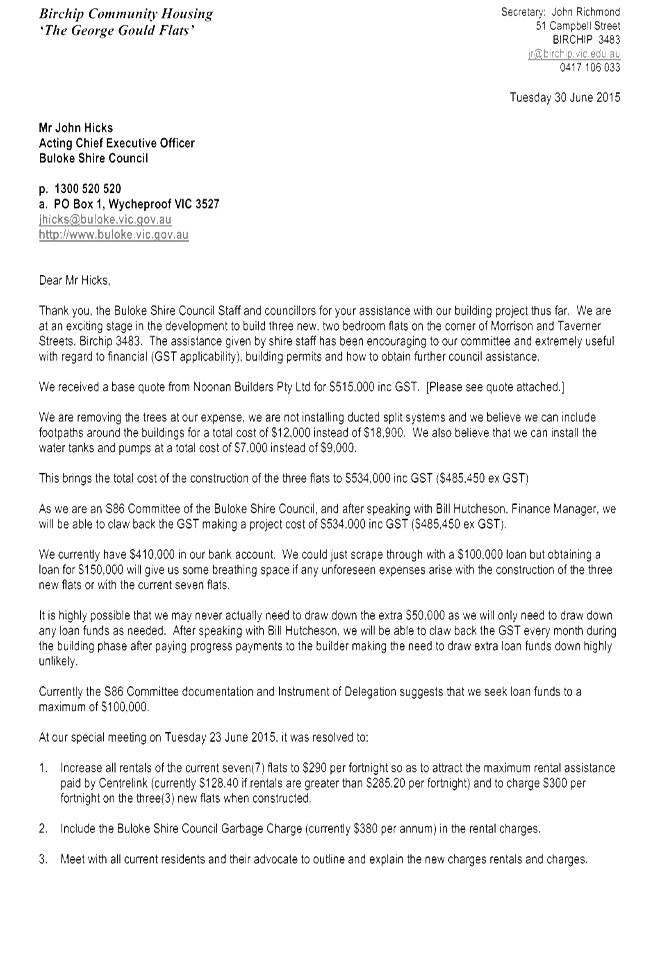
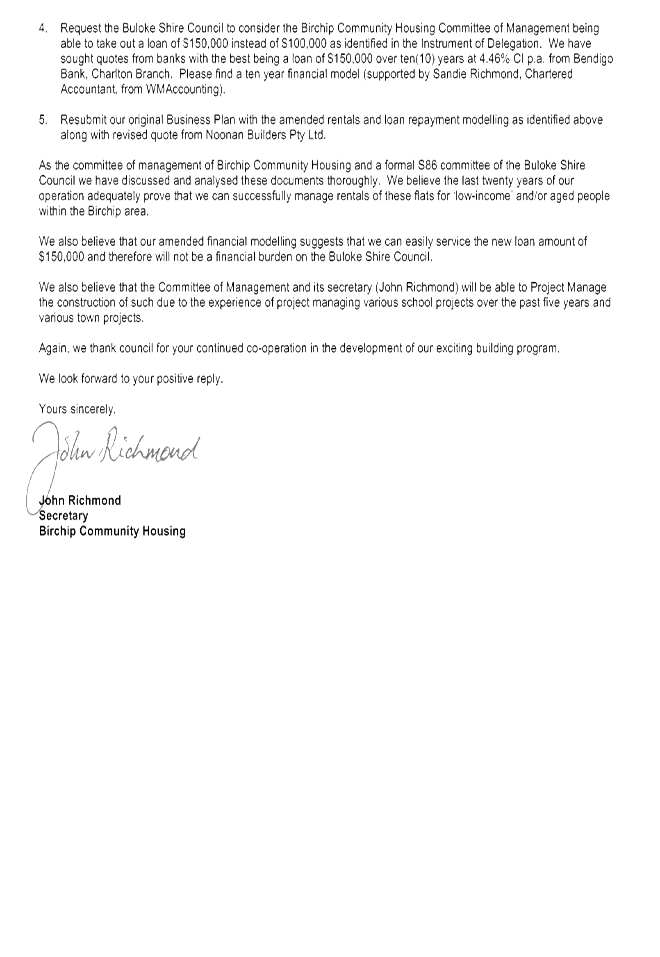
The Birchip Community Housing Committee has formally requested that Council (as the owner of the land) act as the guarantor for a ten-year loan up to a maximum of $150,000. In addition, the Instrument of delegation for the Committee establishes that Council needs to approve any loan borrowings over $50,000.
2. Discussion
In May 2014, Council passed a resolution to make the Birchip Community Housing Committee as a Special Committee of Council in accordance with Section 86 of the Local Government Act 1989. The instrument of delegation states that the Committee shall not enter into contracts or incur expenditure exceeding $50,000 or borrow money without approval of Council.
In June 2014, the Council resolved to give approval to the Birchip Community Housing Committee to borrow $100,000 for the construction of three additional residences on Council-owned land at 4 Morrison Street, Birchip.
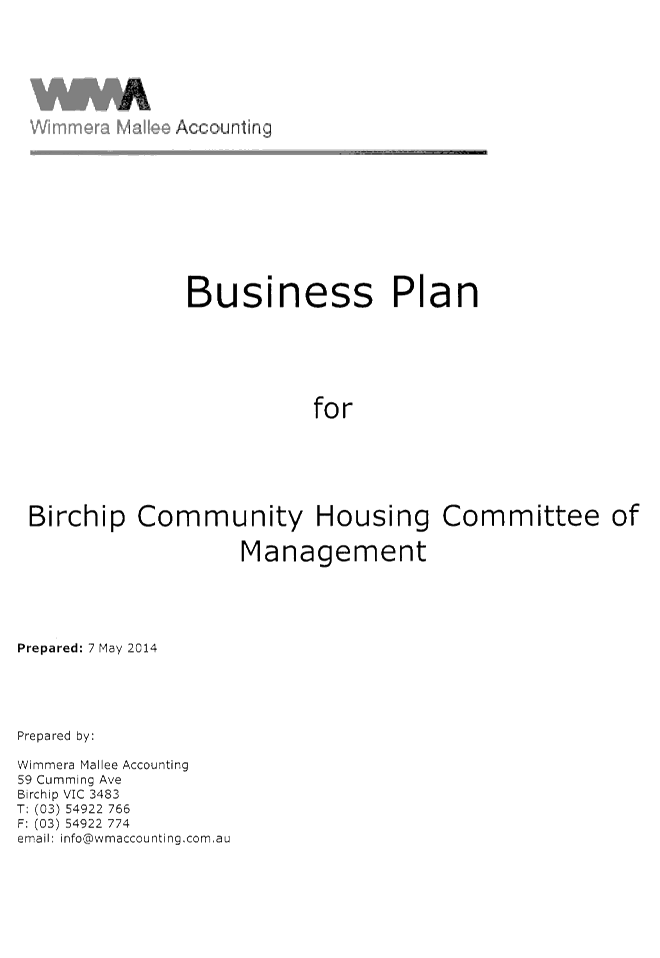
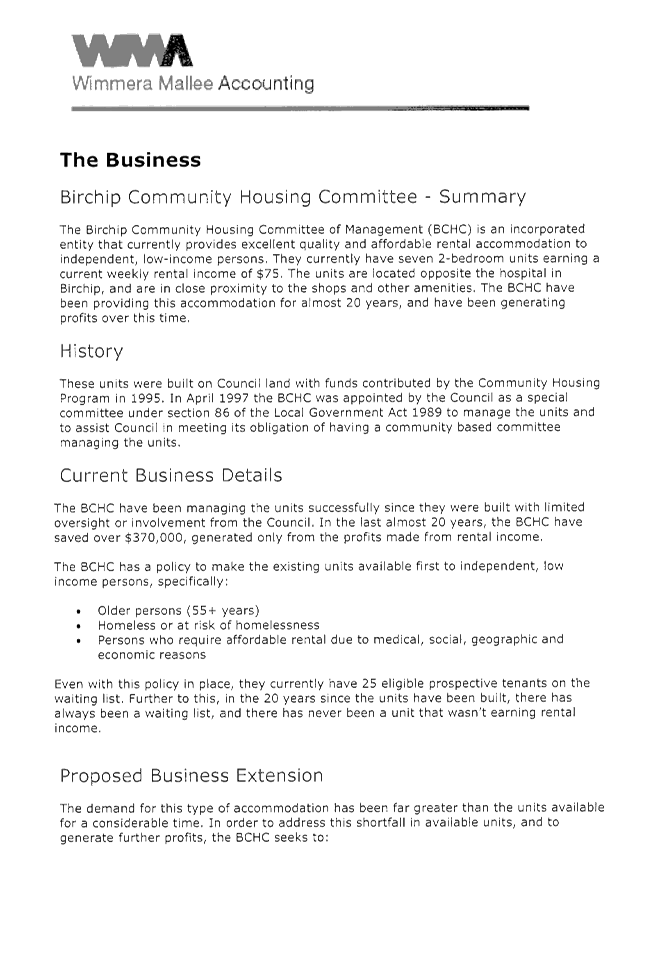
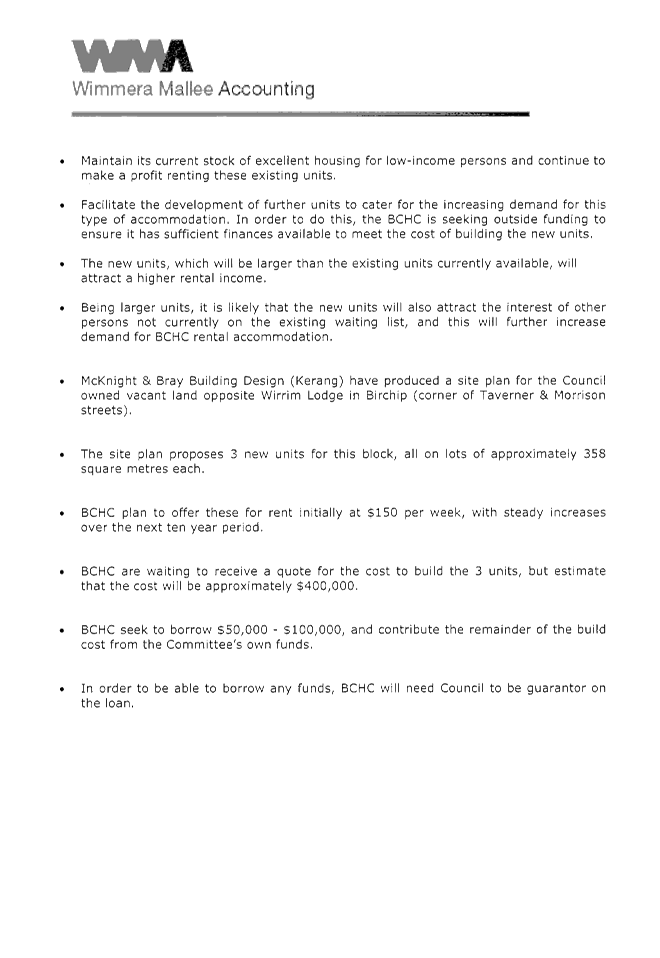
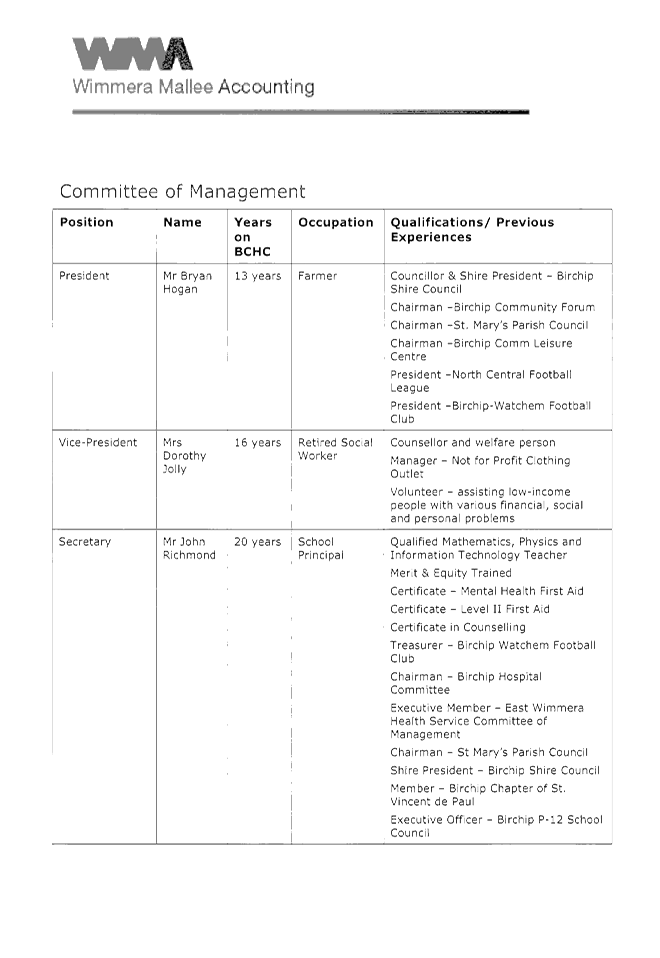
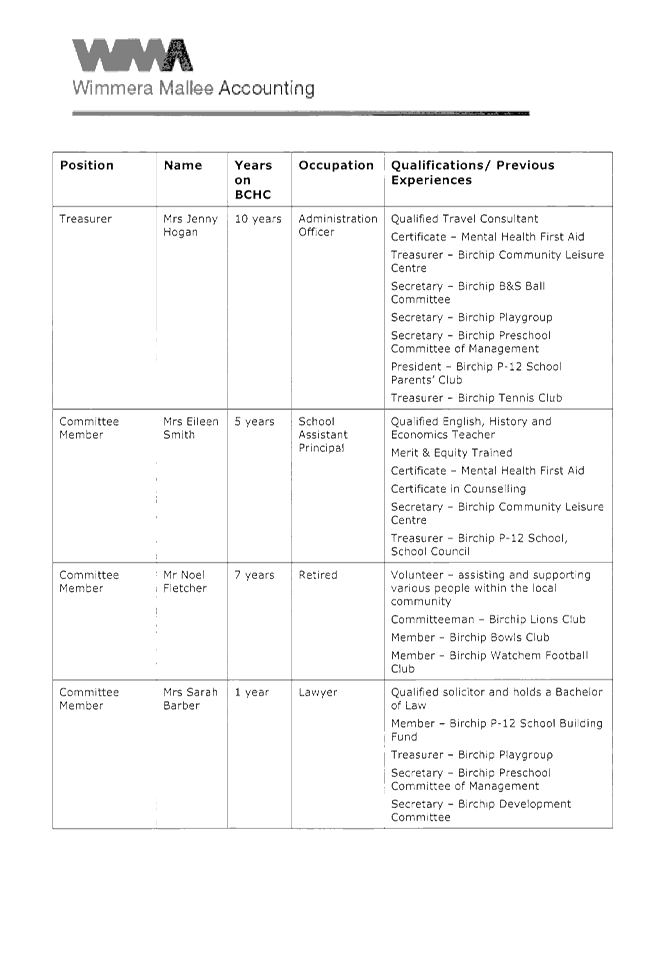
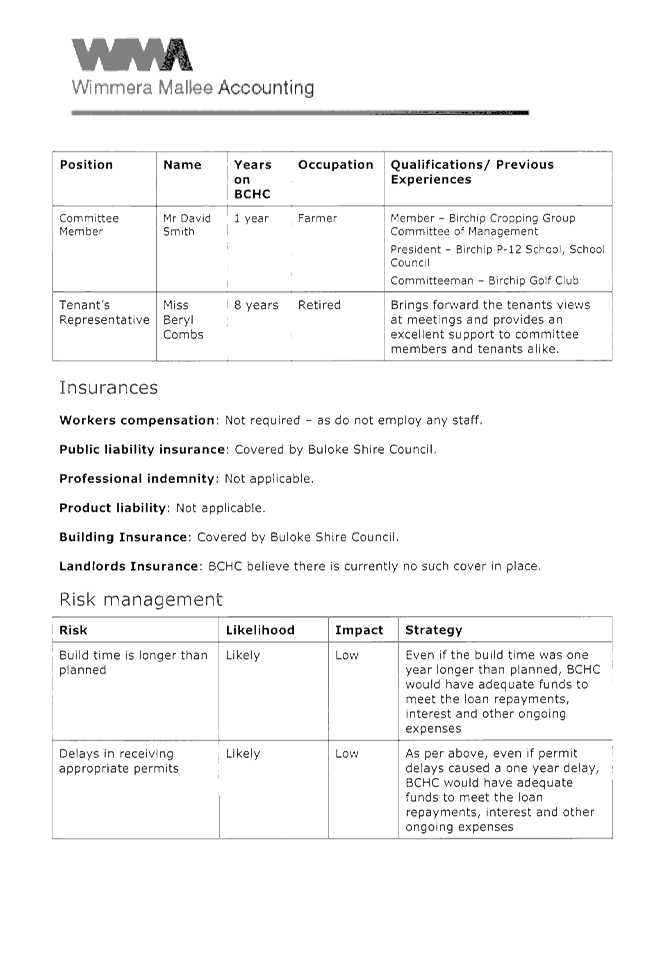
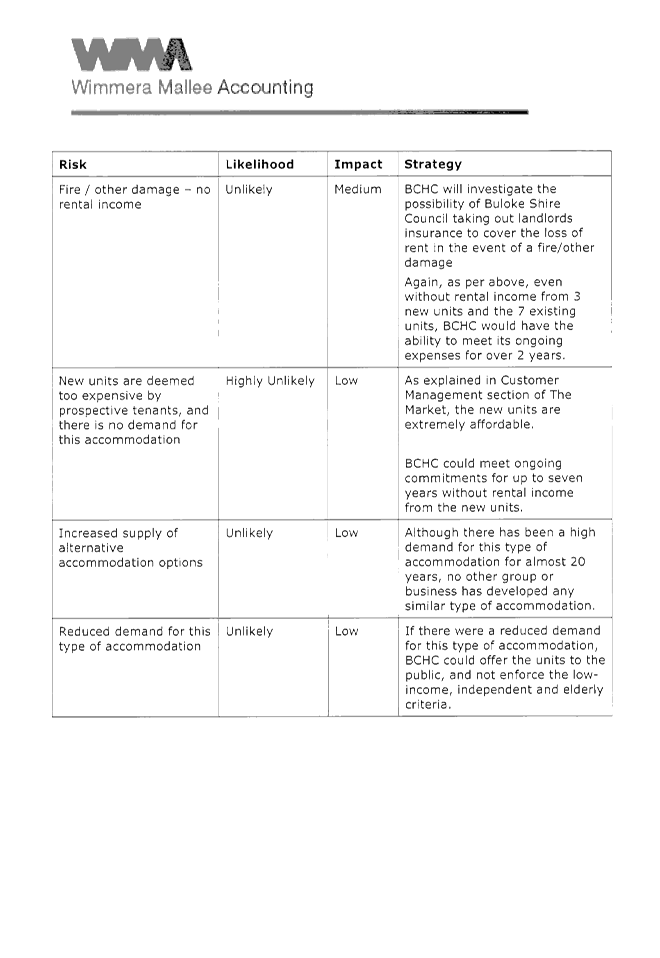
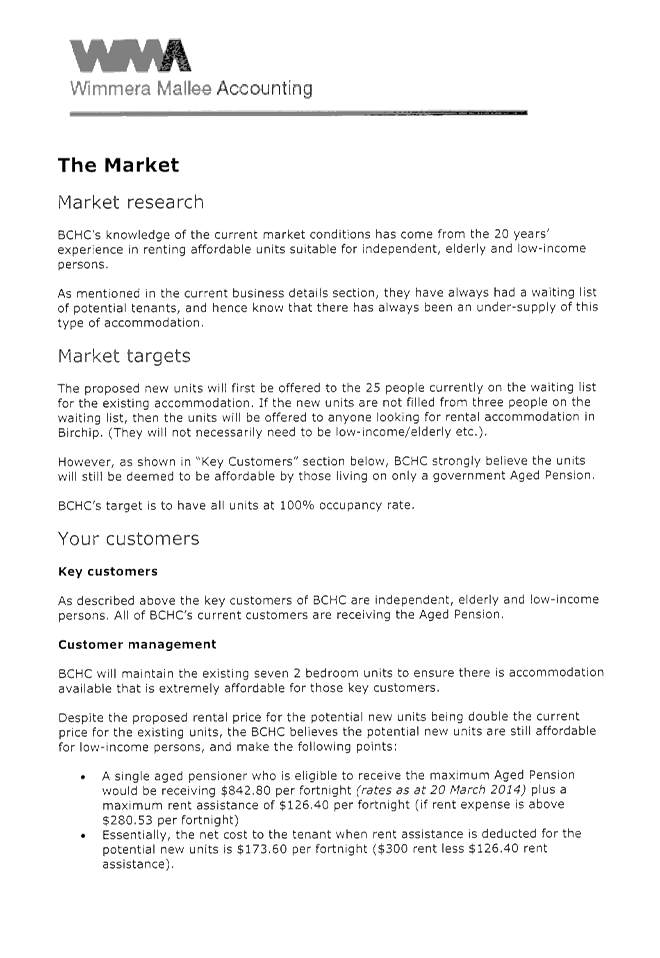
Since this time, the Committee has firmed up plans and quotes and reviewed its business plan for the development. The business plan, which has been completed with the appropriate amount of rigour, outlines:
· The Committee has available funds to expand the operation provided Council supports allowing the development to occur on the land.
· The development is able to be funded without impacting other Council funding sources.
· The Committee has developed full construction plans and obtained firm quotes for the project, with an estimated total cost of $485,000 ex GST.
· The Committee has $410,000 in savings and would require a loan of up to $150,000 to construct the three units.
In submitting the business plan to Council, the Committee has formally requested that Council (as the owner of the land) act as the guarantor for the loan. In addition, the Instrument of delegation for the Committee establishes that Council needs to approve any loan borrowings over $50,000.
The Committee proposes to take out a ten year loan and has completed a projected cash flow statement for repayment of the loan. The full financial projections and details of the project are set out in the business plan.
3. Financial Implications
As guarantor of the $150,000, Council has a financial risk exposure if the Committee defaulted on the loan. In addition, Council has ultimate responsibility for the operations of all section 86 committees, which includes the construction of the units.
Operational and maintenance costs associated with the proposed developments will be the full responsibility of the Birchip Community Housing Committee.
4. Cost Shift Considerations
There are no cost shift considerations associated with this report.
5. Community Consultation
Councillors and staff have attended meetings with the Birchip Community Housing Committee throughout over the past 18 months to progress their proposed development.
6. Internal Consultation
Members of the Senior Management Team have reviewed the proposal and Business Plan.
7. Legislative / Policy Implications
Section 86 Committees are provided for under the Local Government Act as a Special Committee of Council. Council can delegate certain powers to a special committee.
8. Environmental Sustainability
The building works will have all the necessary approvals, including incorporated environmentally sustainable design principals.
9. Conflict of Interest Considerations
Members of a special committee are required to make disclosures in the Council’s register of interests. No staff involved in the preparation of this report have a conflict of interest.
10. Conclusion
It is recommended that Council write to the Committee to approve the request to seek a bank loan for the proposal and agree to act as the guarantor of the loan to a maximum of $150,000.
Buloke Shire Council Ordinary Meeting Agenda Wednesday, 8 July 2015
7.2.7 Birchip Community Housing Committee
Attachment 1 Letter of request
Buloke Shire Council Ordinary Meeting Agenda Wednesday, 8 July 2015
7.2.7 Birchip Community Housing Committee
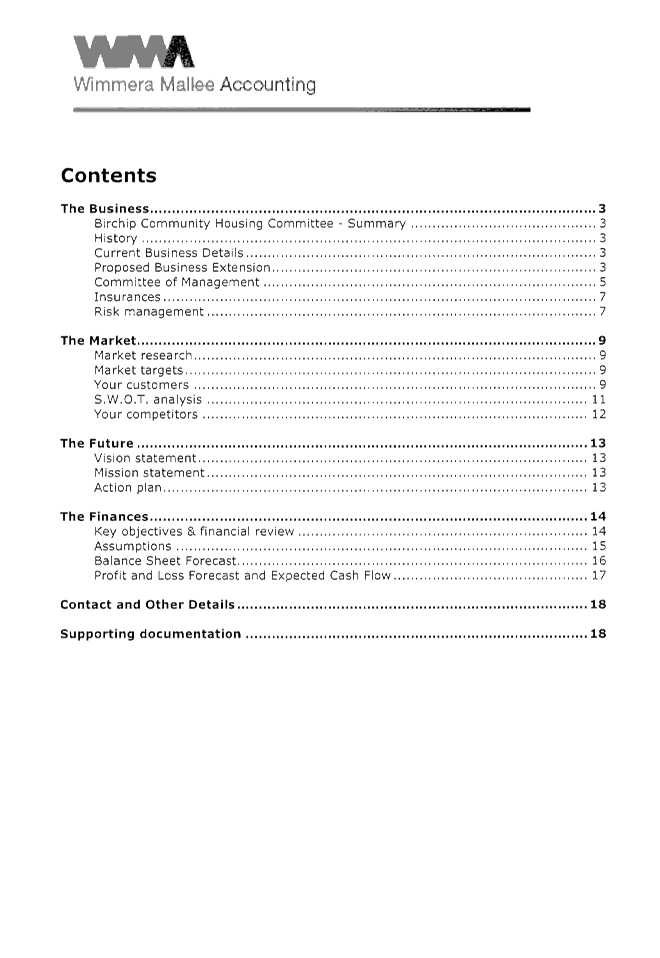
Attachment 2 Business plan








Buloke Shire Council Ordinary Meeting Agenda Wednesday, 8 July 2015
7.3 Financial Reports
7.3.1 Financial Performance As At 31 May 2015
Author’s Title: Finance Manager
Department: Finance File No: 0615
|
4 Cash Flow Projections May 2015 |
Relevance to Council Plan 2015 - 2019
Strategic Objective: Delivering our services in a financially sustainable way
|
That Council receives and notes the Financial Performance Report for the period ending 31 May 2015.
|
1. Purpose
The purpose of this report is for Council to assess its year-to-date financial performance as at 31 May 2015. In addition, the mid-year review of the Council’s financial performance including forecast projections to 30 June 2015 is included in the reports, along with the original adopted 2014-15 Budget.
2. Discussion
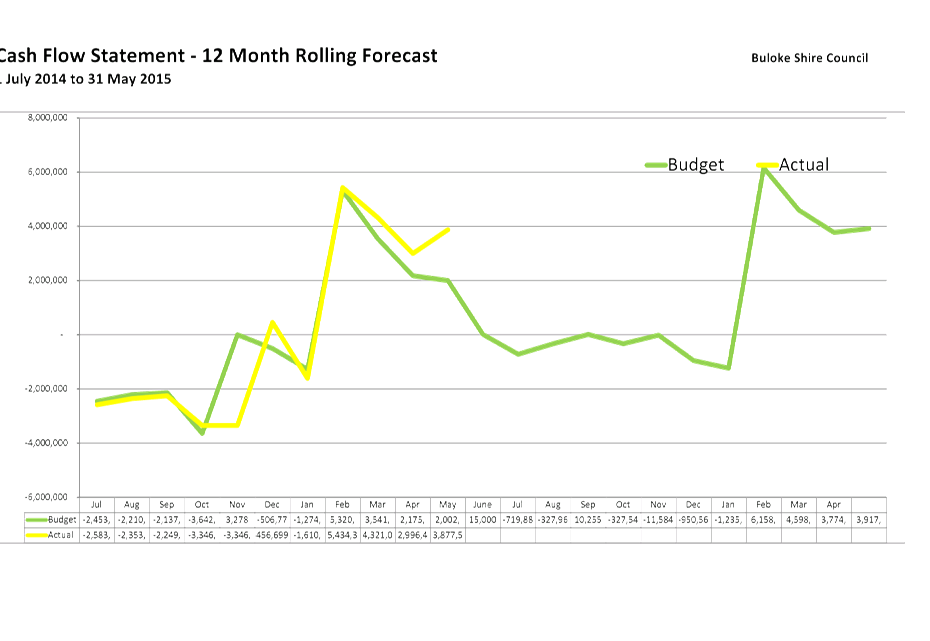
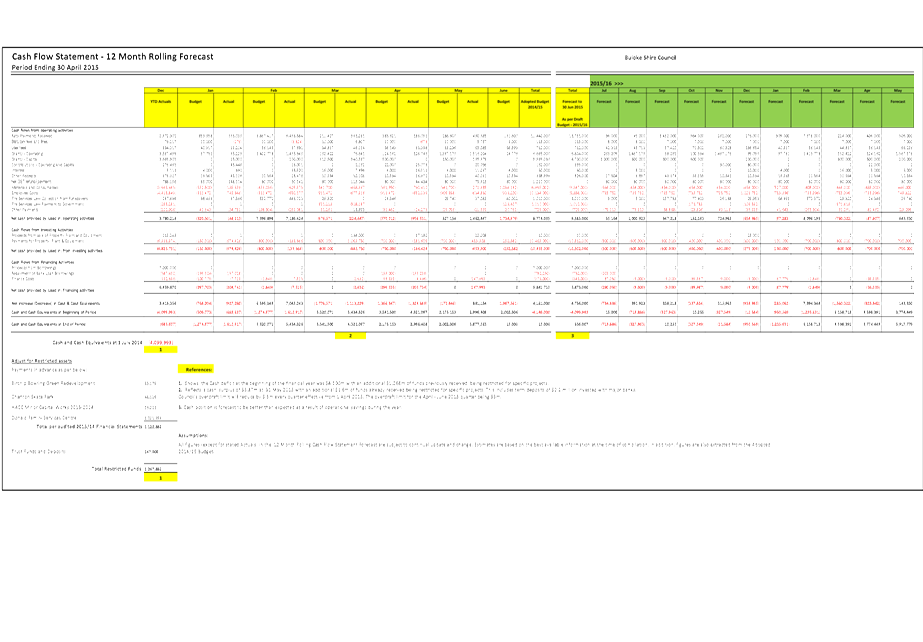
As at the end of May 2015 one of the most obvious and positive things evident in the attachments is the current cash flow. When compared to the projected cash flow Council continues to achieve a result better than the projected position. Not only does this put Council in a strong position but it also saves Council many thousands of dollars previously incurred as overdraft interest.
The budget is travelling better than expected and will see Council in a stronger cash position at the end of the year. This position will then become a strong platform on which the 2015/16 budget will be based. The following is an explanation of the various financial statements.
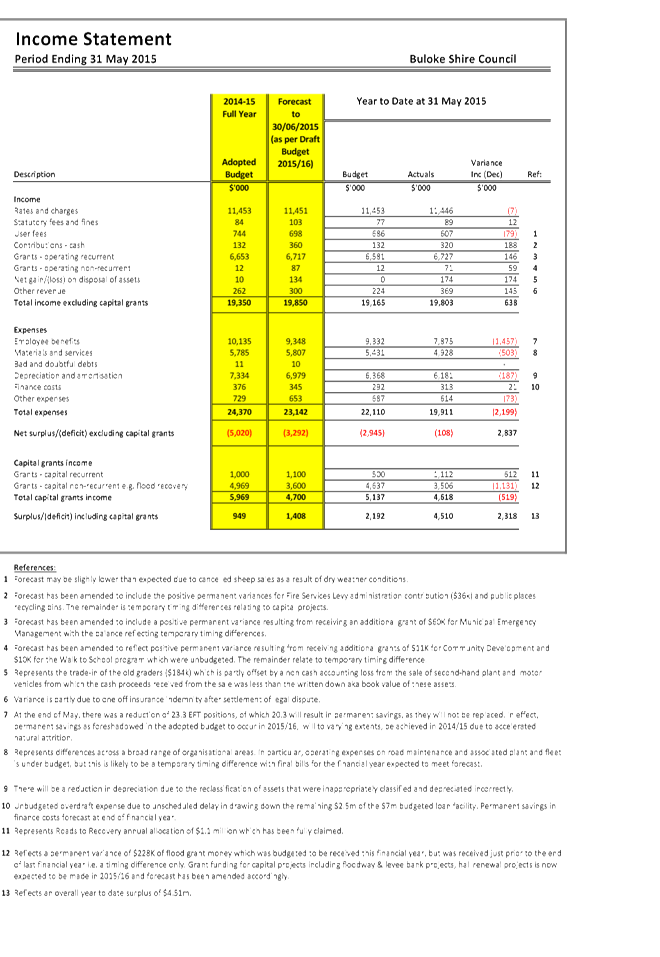
The Income Statement (Attachment 1) provides a summary of the total income and total expenditure relating to the Council’s annual recurrent operations. It also specifically includes capital income e.g. flood grants, but never includes capital works expenditure.
For the period ending 31 May 2015, the year to date (YTD) actual surplus is $4.5M compared with a forecast surplus of $1.40M at 30 June 2015. Total YTD income excluding capital grants is $19.81M which is in line with the forecast income of $19.85M at end of the financial year. The final instalment of the Victoria Grants Commission allocation was received during May. Operating YTD expenditure is $19.91M with a forecast expenditure of $23.14M at end of year. Generally June will be a time when creditors will be finalised so while it is expected this figure will increase it should still remain below the forecast expenditure.
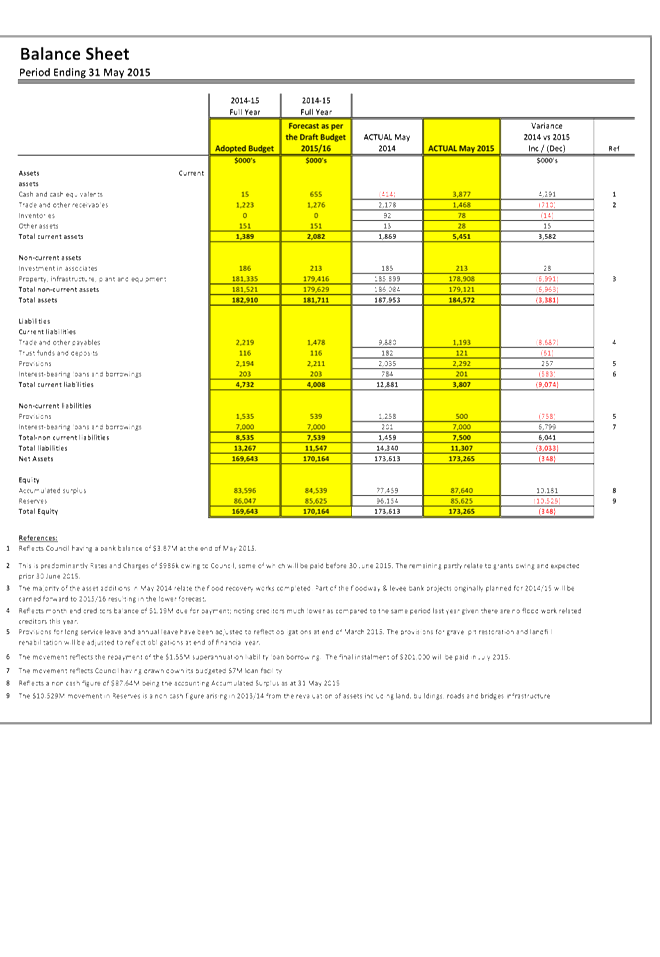
The Balance Sheet (Attachment 2) effectively shows a summary of the value of Assets (what we own) and our Liabilities (what we owe), both of which balance off against each other to show Equity (our net worth).
At the 31 May 2015, the Balance Sheet shows Council’s bank balance at $3.87M which is an increase from the April balance of $2.99M. This increase was due to Council receiving the final Grants Commission payment and the payment of the 4th rates instalment.
As mentioned the Cash Flow Statement shows Council in a much stronger position than anticipated. It should however be noted that this doesn’t mean that these funds are available as Council must ensure it has funds available to payout the $7M loan.
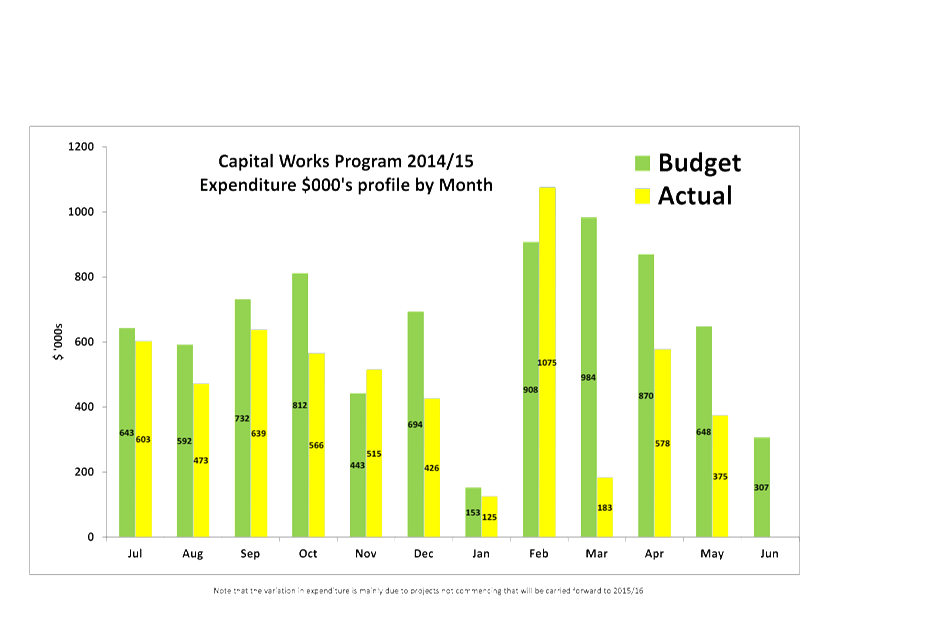
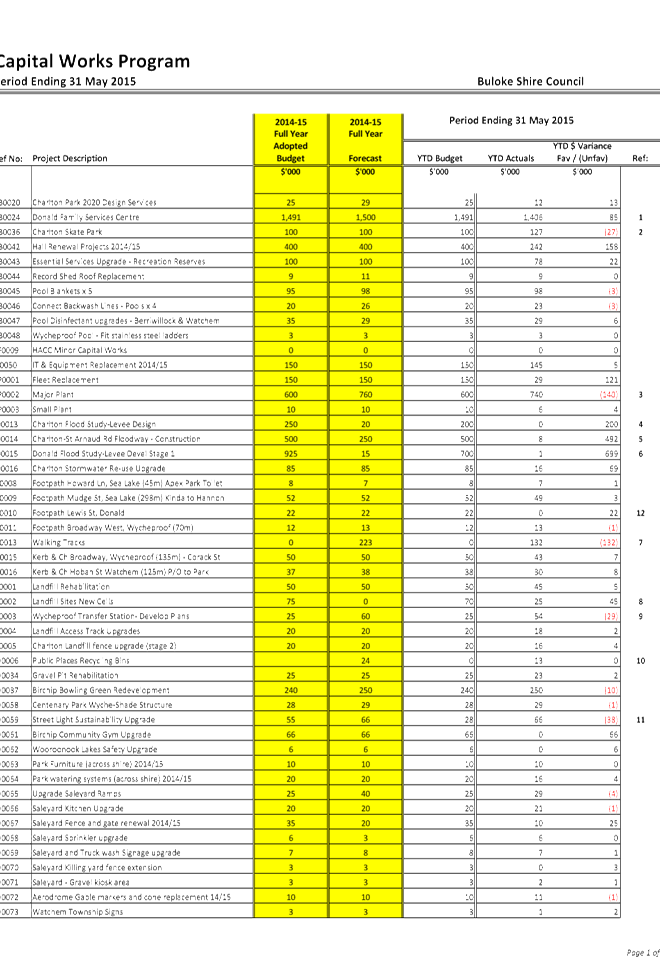
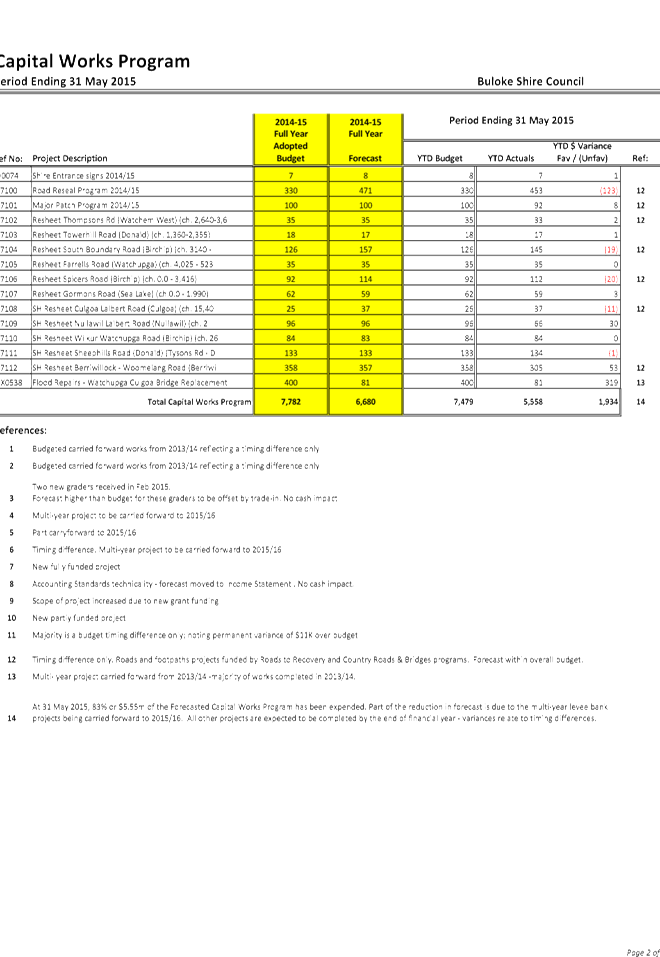
The Capital Works Program report again reflects that Council is making excellent progress in delivering the 2014/15 program. There are however a couple of major projects which will be carried forward into the 2015/16 year.
3. Financial Implications
This report continues to show that Council’s tight financial management is placing it in a sounder position. It is critical that Council continues to have a positive cash flow and at present it is ahead of budget.
4. Community Consultation
No consultation with the community was required for the production of this report.
5. Internal Consultation
The reports have been prepared in consultation with Budget Managers directly responsible for Council budgets.
6. Legislative / Policy Implications
The report is consistent with the requirements of the Local Government Act 1989.
7. Environmental Sustainability
This report has no direct impact on environmental sustainability.
8. Conflict of Interest Considerations
Nil
9. Conclusion
The Financial Performance Report reinforces that Council is successfully managing its challenging financial position and is well positioned to both achieve and positively exceed its 2014-15 adopted budget. Council has a clear understanding of its finances and has implemented its adopted borrowing strategy, allowing it to prudently manage its finances into the future.
Buloke Shire Council Ordinary Meeting Agenda Wednesday, 8 July 2015
7.3.1 Financial Performance As At 31 May 2015
Attachment 1 Income Statement May 2015
Buloke Shire Council Ordinary Meeting Agenda Wednesday, 8 July 2015
7.3.1 Financial Performance As At 31 May 2015
Attachment 2 Balance Statement May 2015
Buloke Shire Council Ordinary Meeting Agenda Wednesday, 8 July 2015
7.3.1 Financial Performance As At 31 May 2015
Attachment 3 Cash Flow Graph May 2015
Buloke Shire Council Ordinary Meeting Agenda Wednesday, 8 July 2015
7.3.1 Financial Performance As At 31 May 2015
Attachment 4 Cash Flow Projections May 2015
Buloke Shire Council Ordinary Meeting Agenda Wednesday, 8 July 2015
7.3.1 Financial Performance As At 31 May 2015
Attachment 5 Capitial Works Progress May 2015
Buloke Shire Council Ordinary Meeting Agenda Wednesday, 8 July 2015
7.3.1 Financial Performance As At 31 May 2015
Attachment 6 Capital Works Expenditure May 2015
Buloke Shire Council Ordinary Meeting Agenda Wednesday, 8 July 2015
9. OTHER BUSINESS
9.3 Questions from Councillors
9.5 Any Other Procedural Matter
10. MATTERS THAT MAY EXCLUDE THE PUBLIC
RECOMMENDATION:
That the Council reopen the meeting to the public pursuant to Section 89(2) of the Local Government Act 1989