Ordinary Council Meeting
Agenda
Wednesday 13 May 2015
Commencing at 7.00pm
Wycheproof Supper Room
367 Broadway, Wycheproof
John Hicks
Chief Executive Officer
Buloke Shire Council
Ordinary Council Meeting
Agenda
Wednesday 13 May 2015
Commencing at 7.00pm
Wycheproof Supper Room
367 Broadway, Wycheproof
John Hicks
Chief Executive Officer
Buloke Shire Council
Buloke Shire Council Ordinary Meeting Agenda Wednesday, 13 May 2015
1. COUNCIL WELCOME and statement of acknowledgement
WELCOME
The Mayor Cr Reid Mather will welcome all in attendance.
STATEMENT OF ACKNOWLEDGEMENT
The Mayor Cr Reid Mather will acknowledge the traditional owners of the land on which we are meeting and pay our respects to their Elders and to the Elders from other communities who maybe here today.
2. RECEIPT OF APOLOGIES
3. CONFIRMATION OF MINUTES OF PREVIOUS MEETING
|
Recommendation: That Council adopt the Minutes of the Ordinary Meeting held on Wednesday, 8 April 2015 and Council adopt the Minutes of the Special Meeting held on Wednesday, 6 May 2015. |
4. REQUESTS FOR LEAVE OF ABSENCE
5. DECLARATION of PECUNIARY AND conflictS of interest
In accordance with Sections 77A, 77B and 78 of the Local Government Act Councillors are required to disclose an "interest" in a decision if they would receive, or could be reasonably perceived as receiving a direct or indirect financial or non-financial benefit or detriment (other than as a voter, resident or ratepayer) from the decision.
Disclosure must occur immediately before the matter is considered or discussed.
6.1 Building Permits - Monthly Update
6.2 Report on Assemblies of Councillors
6.3 Planning Applications Approved By Chief Executive Officer
6.4 Planning Applications Received - Monthly Update
6.5 Letters of Congratulations and Recognition of Achievement/Awards
7.2.1 Rural Living - Rural People, Equal Services
7.2.3 Request To Rename a Section of Scrubbery Lane, Litchfield to McGrath Road
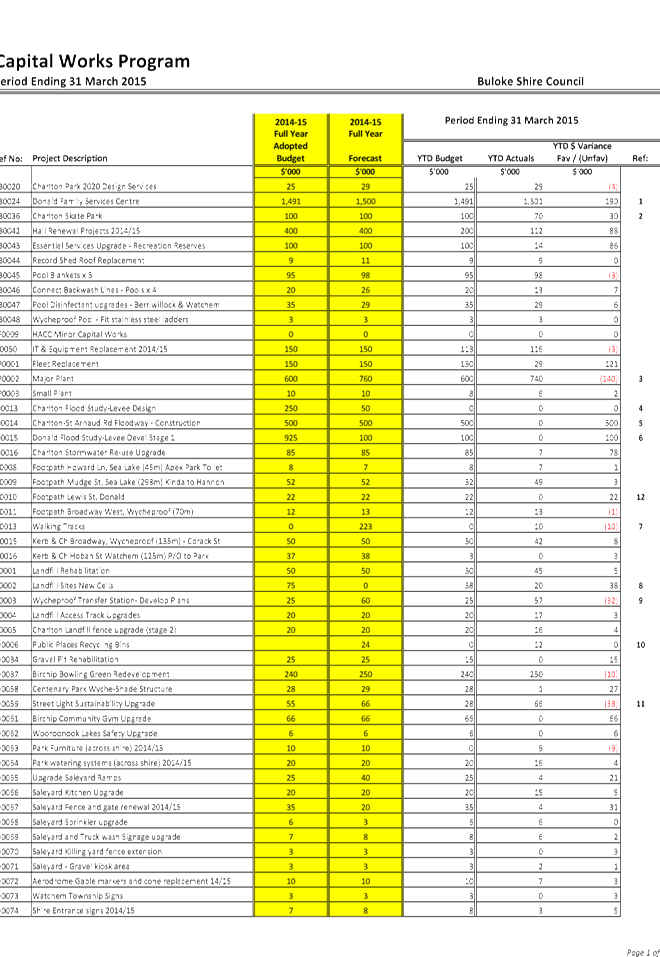
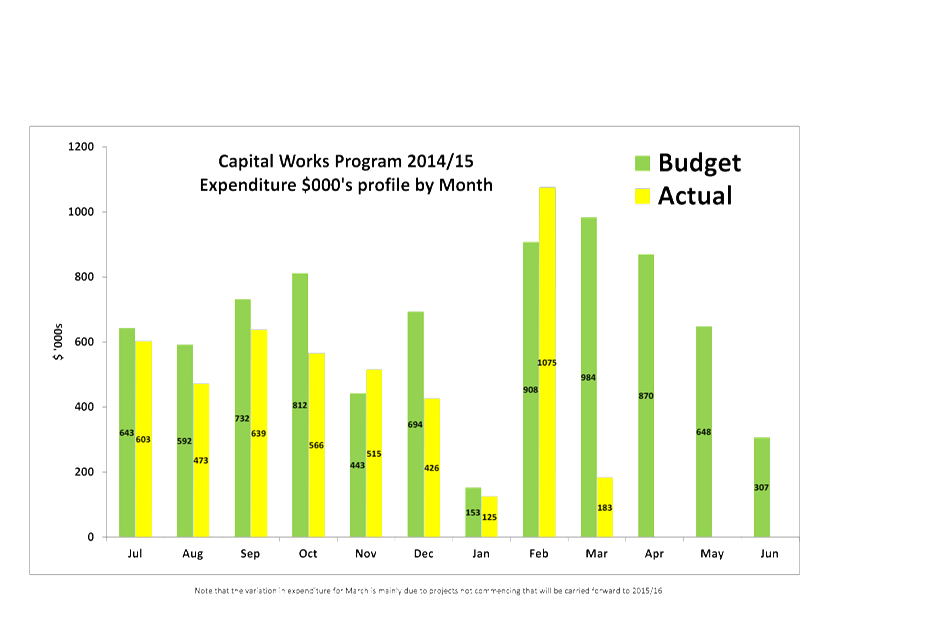
7.2.4 2014/15 Capital Works Program Report
7.2.7 Submission to the Review on Local Government Rate Capping
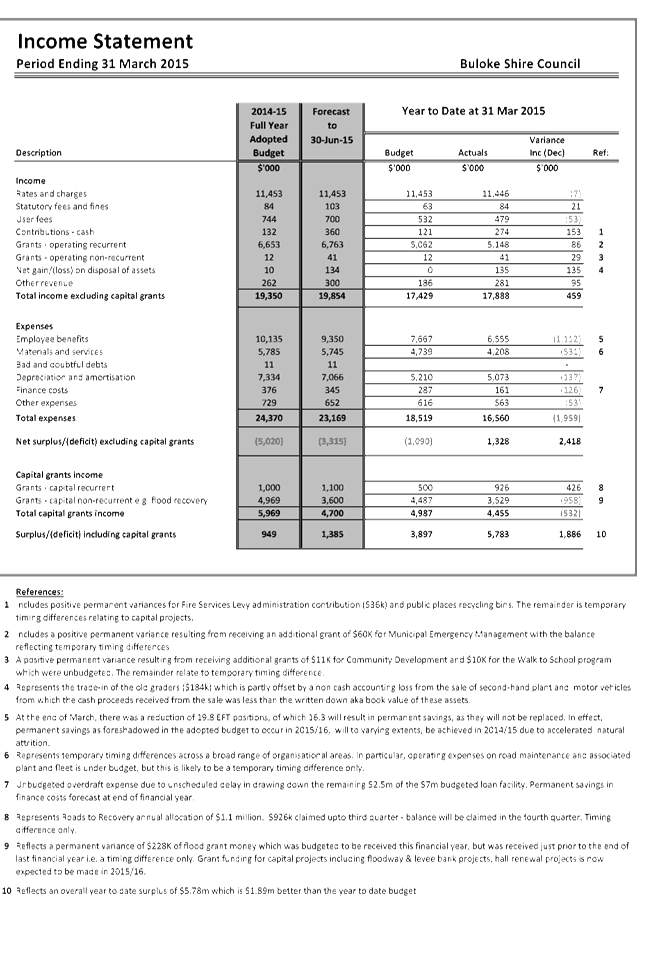
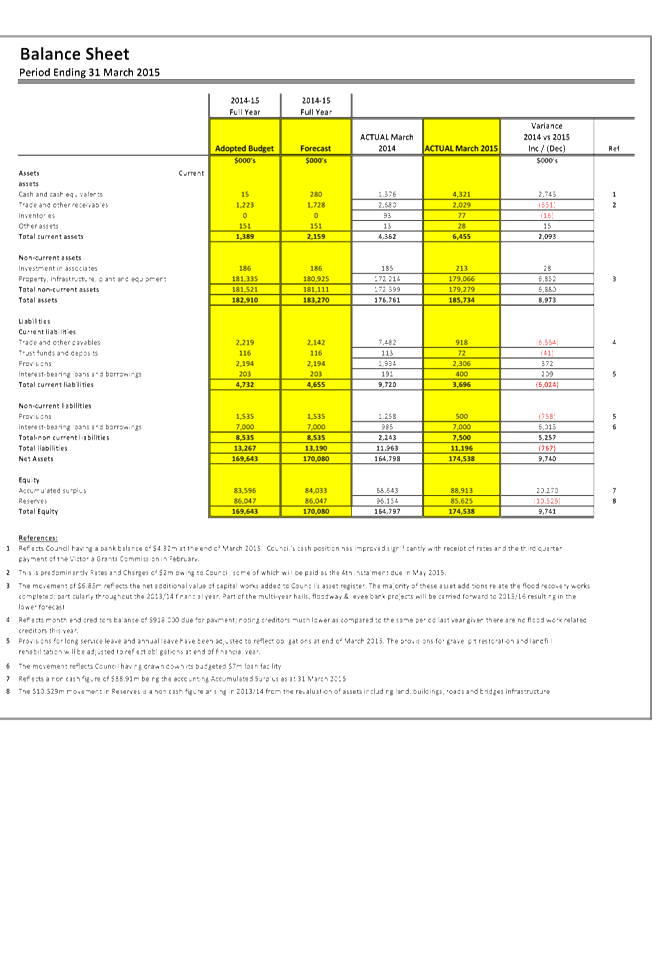
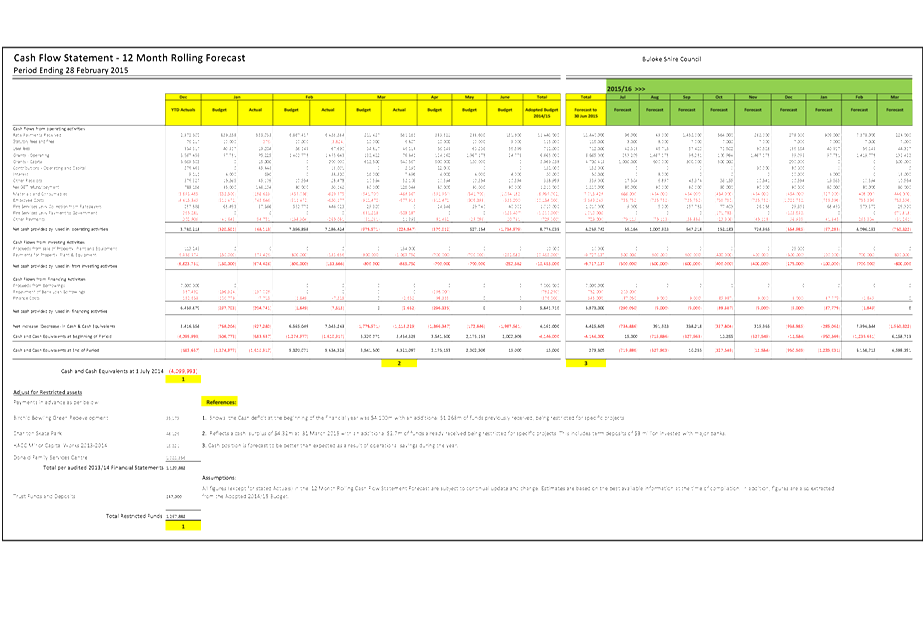
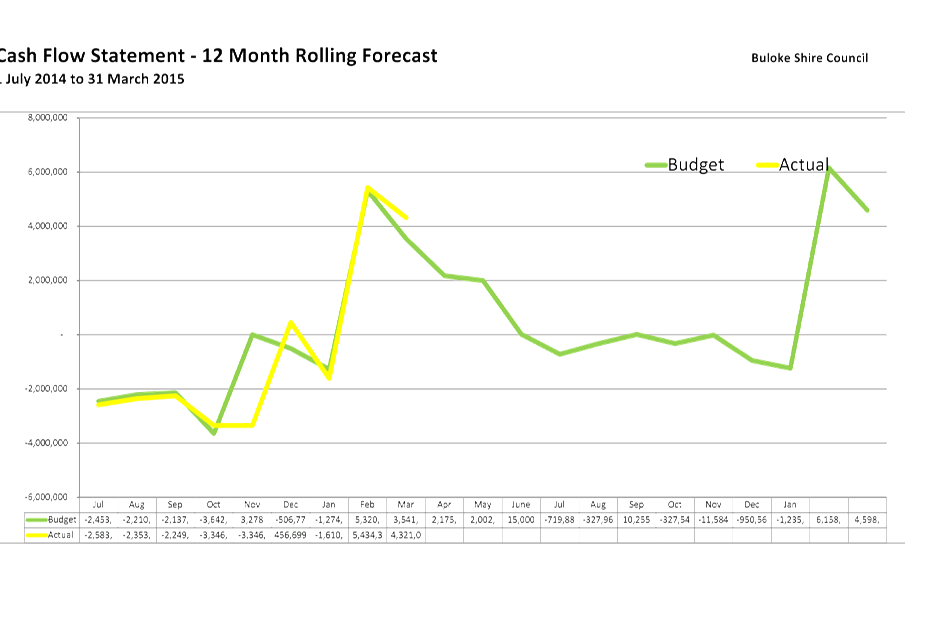
7.3.1 Financial Performance As At 31 March 2015
8....... REPORTS FROM COUNCILLORS
9.2.1 Notice of Motion - Cr Milne - Victoria Police Stations
9.3 Questions from Councillors
9.5 Any Other Procedural Matter
10..... MATTERS THAT MAY EXCLUDE THE PUBLIC
Nil 124
NEXT MEETING
The next Ordinary Meeting of Council will be held in Wycheproof Supper Room, 367 Broadway, Wycheproof on Wednesday, 10 June 2015 at 7.00pm.
JOHN HICKS
CHIEF EXECUTIVE OFFICER
6. Procedural Items
6.1 Building Permits - Monthly Update
Author’s Title: Compliance Administration Officer
Department: Planning and Community Support File No: DB/14/02
|
Nil |
|
That the Council note information contained in the report on Building Permits approved by staff from 1 April 2015 to 30 April 2015.
|
1. Executive Summary
This report provides information on Building Permits approved by staff from 1 April 2015 to 30 April 2015.
2. List of Building Permits Approved by Council Surveyor
|
Permit No. |
Address |
Project Description |
Value |
Date Approved |
|
20150026 |
43-47 Campbell Street, BIRCHIP |
Alterations: Alterations & Extension to existing Gymnasium |
$65,000 |
17/04//2015 |
|
20150027 |
317 Broadway, WYCHEPROOF |
Extension: Open Alfresco Area |
$25,000 |
17/04/2015 |
|
20150029 |
42-44 Calder Highway, Nullawil |
New building: Amenities & Office |
$45,000 |
24/04/2015 |
3. List of Building Permits Approved by Private Surveyors
|
Permit No. |
Address |
Project Description |
Value |
Date Approved |
|
20150028 |
16 Watson Street, BIRCHIP |
Restump Dwelling |
$49,439 |
17/04/2015 |
6.2 Report on Assemblies of Councillors
Author’s Title: Executive Assistant
Department: Office of the CEO File No: GO/05/04
|
1 Councillor Briefing - 1 April 2015 2 Councillor Briefing - 8 April 2015 |
|
That the Council notes the records of the Councillor Briefings held 1, 8 and 15 April 2015 and the Assembly of Councillors held 15 April 2015. |
1. Key Points/Issues
The Local Government Act 1989 (the Act) provides that a record must be kept of any meeting of Councillors and staff deemed to be an Assembly of Councillors as defined in the Act.
The Act also provides that the record of any Assembly of Councillors is to be reported to the next practicable Ordinary Meeting of Council and recorded in the Minutes.
A Record of the Councillor Briefings held 1, 8 and 15 April 2015 and the Assembly of Councillors held 15 April 2015 is attached.
Buloke Shire Council Ordinary Meeting Agenda Wednesday, 13 May 2015
6.2 Report on Assemblies of Councillors
Attachment 1 Councillor Briefing - 1 April 2015
RECORD
Councillor Briefing
|
Date and Time: |
1 April 2015 |
Time: 5.00pm to 8.00pm |
|
Location: |
Charlton District Office (High Street, Charlton) |
|
Attendees: |
Cr Reid Mather – Mayor Cr Ellen White Cr David Pollard Cr Gail Sharp Cr Graeme Milne
John Hicks –Chief Executive Officer Bill Hutcheson – Finance Manager Glenn Berry – Acting Director of Works and Technical Services Ann Twyford –Manager Corporate Systems Bill Keane – Manager Community Services Jessie Holmes – Manager Planning and Community Support |
|
Apologies: |
Cr Stuart McLean and Cr Leo Tellefson |
ITEMS
|
NO. |
TOPIC |
PURPOSE |
|
|
1. |
Declarations of Conflicts of Interest |
Nil |
|
|
2. |
Councillor Only Session (5.00pm) |
|
|
|
|
Councillors Only Session with CEO (5.15pm) |
|
|
|
3. |
Presentations |
|
|
|
|
3.1 |
Chris Kelly and Cr Rod Fyffe (CEO and Chair - Goldfields Library Corporation) (5.30pm) |
|
|
|
3.2 |
Melanie Tranter (Acting Executive Officer – Budget Item - Central Victorian Greenhouse Alliance) (6.00pm) |
|
|
|
|
Dinner (6.15pm to 6.45pm) |
|
|
4. |
Items for Discussion |
|
|
|
|
4.1 |
1st Councillor Review of Proposed Budget 2015/16 (6.45pm) |
|
|
|
4.2 |
Library Services – Briefing Paper (7.30pm) |
Attachment |
|
|
4.3 |
Ordinary Meeting 8 April 2015 Draft Agenda and Attachments (7.45pm) |
Attachment |
|
5. |
CEO Updates |
|
|
|
6. |
Councillor Matters |
|
|
|
|
6.1 |
Family Violence – (Cr E White) (8.05pm) |
|
Next Briefing:
|
Date and Time: |
8 April 2015 |
Time: 5.00pm to 6.00pm |
|
Location: |
Wycheproof Supper Room |
|
Buloke Shire Council Ordinary Meeting Agenda Wednesday, 13 May 2015
6.2 Report on Assemblies of Councillors
Attachment 2 Councillor Briefing - 8 April 2015
RECORD
Councillor Briefing
|
Date and Time: |
8 April 2015 |
Time: 5.00pm to 6.00pm |
|
Location: |
Wycheproof Supper Room (Broadway, Wycheproof) |
|
Attendees: |
Cr Reid Mather – Mayor Cr Ellen White Cr David Pollard Cr Stuart McLean Cr Gail Sharp Cr Graeme Milne Cr Leo Tellefson
John Hicks –Chief Executive Officer Bill Hutcheson – Finance Manager Glenn Berry – Acting Director of Works and Technical Services Ann Twyford –Manager Corporate Systems Bill Keane – Manager Community Services Jessie Holmes – Manager Planning and Community Support |
|
Apologies: |
|
ITEMS
|
NO. |
TOPIC |
|
|
|
1. |
Declarations of Conflicts of Interest |
Cr Tellefson declared an interest in works on Lewis Street in Donald and left the Council Chamber whilst these were discussed at 5.55pm and returned at 5.57pm. Cr Tellefson declared an interest in works related to aged care facilities i.e. Goodwin Homes and left the Chamber while these were discussed at 6.10pm and returned at 6.12pm. |
|
|
2. |
Items for Discussion |
|
|
|
|
2.1 |
2nd Councillor Review of Proposed Budget 2015/16 |
Manager Finance to provide a briefing on Conflicts of Interest.
Acting Director Works and Technical Services to check overflow at Watchem Pool. List of plant and Information Technology in Capital Budget to be provided at next Budget meeting.
Increased level of detail to be provided to next budget meeting after discussion with Cr Milne. |
|
3. |
CEO Updates |
|
|
|
4. |
Councillor Matters |
|
|
Next Briefing:
|
Date and Time: |
15 April 2015 |
Time: 5.00pm to 8.00pm |
|
Location: |
Nullawil Community Building |
|
Buloke Shire Council Ordinary Meeting Agenda Wednesday, 13 May 2015
6.2 Report on Assemblies of Councillors
Attachment 3 Councillor Briefing - 15 April 2015
RECORD
Councillor Briefing
|
Date and Time: |
15 April 2015 |
Time: 6.00pm to 9.00pm |
|
Location: |
Nullawil Community Building (Recreation Reserve, Nullawil) |
|
|
Attendees: |
Cr Reid Mather – Mayor Cr Ellen White Cr Gail Sharp Cr Graeme Milne
John Hicks –Chief Executive Officer Bill Hutcheson – Finance Manager Anthony Judd – Director of Works and Technical Services Ann Twyford –Manager Corporate Systems Bill Keane – Manager Community Services Jessie Holmes – Manager Planning and Community Support |
|
|
Apologies: |
Cr McLean, Cr Tellefson and Cr Pollard |
|
ITEMS
|
NO. |
TOPIC |
ACTIONS |
||
|
1. |
Declarations of Conflicts of Interest |
Nil |
||
|
2. |
Presentations |
|
||
|
|
2.1 |
Nullawil Progress Association representatives (6.00pm) |
CEO to distribute Nullawil Community Plan to Councillors when received. |
|
|
3. |
Items for Discussion |
|
||
|
|
3.1 |
Final Councillor Review of Proposed Budget 2015/16 (6.00pm) |
Draft Council Budget to be provided to Special Meeting of Council on 6 May 2015. |
|
|
4. |
Councillor Matters |
|
||
|
|
4.1 |
NWMA Strategic Planning Day Outcomes (Cr White) |
CEO to provide suggested dates and responsibilities for NWMA Strategic Priority 3 to Cr White on Thursday 16 April 2015. |
|
|
|
4.2 |
Water Issues (Cr Milne) |
|
|
|
5. |
CEO Updates |
|
||
|
|
5.1 |
Rate Capping |
|
|
|
|
5.2 |
Rural Living Logo |
Councillors to provide preference for Rural Living Logo by Friday 17 April 2015. |
|
Next Briefing:
|
Date and Time: |
6 May 2015 |
Time: 5.00pm to 8.00pm |
|
Location: |
Wycheproof Supper Room |
|
Buloke Shire Council Ordinary Meeting Agenda Wednesday, 13 May 2015
6.2 Report on Assemblies of Councillors
Attachment 4 Assembly of Councillors - 15 April 2015
RECORD
Assembly of Councillors
|
Date and Time: |
15 April 2015 |
Time: 4.00pm to 5.30pm |
|
Location: |
Wycheproof Supper Room (367 Broadway, Wycheproof) |
|
Attendees: |
Cr Reid Mather - Mayor Cr Leo Tellefson Cr Ellen White Cr David Pollard Cr Graeme Milne Cr Gail Sharp
John Hicks –Chief Executive Officer Bill Hutcheson – Finance Manager Anthony Judd –Director of Works and Technical Services Ann Twyford –Manager Corporate Systems Bill Keane – Manager Community Services Jessie Holmes – Manager Planning and Community Support |
|
Apologies: |
Cr McLean |
ITEMS
|
NO. |
TOPIC |
ACTIONS |
|
1. |
Meeting with Merv Whelan (Local Government Economic Consultant) – Financial Sustainability of Buloke Shire |
|
|
2. |
Conflicts of Interest |
|
6.3 Planning Applications Approved By Chief Executive Officer
Author’s Title: Executive Assistant
Department: Office of the CEO File No: LP/10/01
|
Nil |
|
That Council notes information contained in this report on planning permits that have been administered by the Planning Officer and approved by the Chief Executive Officer under Council’s delegated authority. |
1. Executive Summary
This report advises Council of the planning permits that have been administered by the Planning Officer and approved by the Chief Executive Officer under Council’s delegated authority.
2. List of Planning Permits
|
Date |
Permit No. |
Applicant |
Address and Project |
|
9.4.15 |
593/15 |
Karen Schodde 405 Schoddes Road Tyrell 3533 |
CA 18 Parish of Moah known as; 405 Schoddes Road, Tyrrell 3533 Pty No: 284 006 504
Use and development of a second dwelling |
|
9.4.15 |
594/15 |
Damian Eastman 2591 Calder Highway Charlton 3525 |
2591 Calder Highway, Charlton 3525 Pty No: 381 646 502
Use and development of an office building |
|
13.4.15 |
596/15 |
James Golsworthy Consulting P O Box 1650 Mildura Vic 3500 |
Lot 2 Plan of Subdivision 140982 Known as 16 Borung Highway, Litchfield Pty No: 181 505 503
Buildings and works to a Section 2 Use (Emergency Services Facility) |
|
9.4.15 |
597/15 |
James Golsworthy Consulting P O Box 1650 Mildura Vic 3500 |
Lot 1 Plan of Subdivision 311047P Known as 767 Carnes Road, Laen North Pty No: 183 610 003
Buildings and works to a Section 2 Use (Emergency Services Facility) |
6.4 Planning Applications Received - Monthly Update
Author’s Title: Manager Planning and Community Support
Department: Planning and Community Support File No: LP/09/10
|
Nil |
|
That the Council notes information contained in the report on planning applications under consideration by staff and the status of each of these applications.
|
1. Executive Summary
This report advises provides information on planning applications under consideration by staff and the status of each of these applications.
2. List of Planning Applications
|
Application No |
Applicant |
Address |
Date Rec |
Summary of Proposal |
Status |
|
589/15 |
D Mulquiny |
12 Peel Street, Charlton |
20/01/15 |
Use and development of an outbuilding |
Further information request |
|
599/15 |
Shaun Ramsey |
Wilsons Road, Buckrabanyule |
16/03/15 |
Use and development of an Intensive Animal Husbandry enterprise |
Report to Council |
|
600/15 |
Crag Henderson |
2982 Warracknabeal – Birchip Road |
10/04/15 |
Use and development of stone extraction |
Issued 23/04/15 |
|
601/15 |
Moving Views Development |
4 Arundell Square, Charlton |
14/04/15 |
Dwelling in Land Subject to Inundation |
Issued 24/04/15 |
6.5 Letters of Congratulations and Recognition of Achievement/Awards
Author’s Title: Executive Assistant
Department: Office of the CEO File No: CR/13/01
|
Nil |
|
That Council acknowledges and congratulates the persons and/or groups mentioned in the report for their achievements.
|
1. Executive Summary
This report acknowledges and congratulates community persons and/or groups for their success in being recognised for a significant achievement or for being a recipient of an honourable award.
The report also informs Council of any letters of congratulations or any particular recognition of achievement that Council has received or been awarded in the past month.
2. Recognition of Achievement Items
|
Provider |
Recipient |
Date |
Purpose for Recognition |
|
Australian Bowhunters Longbow Championships at Wagga Wagga |
Geoff Blake, Donald
|
Easter 2015 |
Winner of the Australian Bowhunters “A” Grade Longbow Championship at Wagga Wagga |
|
Buloke Shire Council |
Marc Nuske Sea Lake |
13.5.15 |
To recognise his 36 years of committed service as an employee of the Buloke Shire Council and the former Shire of Wycheproof |
Buloke Shire Council Ordinary Meeting Agenda Wednesday, 13 May 2015
7.2 Management Reports
7.2.1 Rural Living - Rural People, Equal Services
Author’s Title: Chief Executive Officer
Department: Office of the CEO File No: XXX
Relevance to Council Plan 2015 - 2019
Strategic Objective: Influencing governments to improve liveability for rural communities
|
That Council endorse the attached motion “Rural Living – Rural People, Equal Services” submitted to the Municipal Association of Victoria State Council for consideration on 15 May 2015. |
1. Executive Summary
The attached motion has been submitted to State Council of the Municipal Association of Victoria (MAV). The motion was required to be submitted to MAV prior to 17 April and, therefore, could not be brought to Council prior to its submission. Council is requested to endorse this action to indicate its support.
2. Discussion
Small rural shires have major barriers to their capacity to provide basic services to their residents. These include:
· Lack of economies of scale
· Large distances and time required to deliver services.
· More people with lower incomes and other socio-economic factors.
· A higher proportion of aged people in the population.
· Lack of competition from service providers and suppliers.
· Difficulties in the recruitment of staff and skilled contractors.
· Frequent market failure resulting in premium prices for goods and services.
· Small population sizes and a consequent lack of capacity to pay for services.
To address these issues, local government has focussed positively on improving efficiencies, sharing services, innovative service provision and enhanced management. A great deal of progress has been made, and continues to be made, with many of these shires reaching high levels of efficiency but the lack of sustainability of small rural shires remains.
Despite these efforts, it is apparent the residents of these shires have inferior services and poor community outcomes and liveability. The residents of these shires make a considerable contribution to the nation’s GDP, as well as paying rates and taxes, the same as their metropolitan colleagues, but do not receive the minimum level of services. This is clearly inequitable.
Council has been leading a campaign, “Rural Living – Rural People, Equal Services”, to bring attention to this problem. What this campaign seeks to do is not to suggest the changes and solutions that might remedy the problem but to seek agreement to the concept that all Victorians, including the residents of small rural shires, are worthy of a specific minimum set of service levels. It is not until agreement on this can be reached that the methods of achieving this outcome can be formulated.
3. Financial Implications
Council is working with other Councils to set up a working group and media campaign costing approximately $10,000. Other Councils are being asked to contribute $1,000 to join the campaign.
4. Cost Shift Considerations
Nil
5. Community Consultation
Council has consulted via its Council plan and also directly with the community forums at the Community Forum Summit. It will increase the level of consultation once the working group is formed.
6. Internal Consultation
Consultation occurred during the development of the Council Plan.
7. Legislative / Policy Implications
Nil
8. Environmental Sustainability
Nil
9. Conflict of Interest Considerations
No officer involved in the preparation of this report has a conflict of interest.
10. Conclusion
Council can endorse the motion to indicate its support for the “Rural Living – Rural People, Equal Services” campaign.
Buloke Shire Council Ordinary Meeting Agenda Wednesday, 13 May 2015
7.2.1 Rural Living - Rural People, Equal Services
Attachment 1 Motion for MAV State Council
MAV State Council Meeting – 15 May 2015
To submit a motion for consideration by State Council on 15 May 2015, please complete this form and email to State Council, no later than Friday,17 April 2015 . Please note, deadlines are strictly observed.
|
RURAL LIVING – RURAL PEOPLE, EQUAL SERVICES |
|
Submitted by: Buloke Shire Council
|
|
MOTION: That the MAV promotes the sustainability of small rural shires in Victoria by supporting the RURAL LIVING campaign. The Buloke Shire Council, along with a working group of small rural shires, is seeking agreement and support for the contention that all Victorians are entitled to a minimum set of local government services thus supporting rural living, the sustainability of rural industry and fairness in the provision of services.
|
|
Rationale: [Insert rationale]
All Victorians should have access to levels of service that enable liveability and safety. All Victorians pay income tax, GST and rates and are entitled to a level of reciprocity in the service levels they receive. The services set out below describe a minimum set to be provided by local government for communities. Most communities will have service levels in excess of these but none should fall below them. - A responsive and effective municipal council. - All weather access roads to all inhabited residences. - A road network that meets the needs of local industry. - Kerbside waste and recycling services for all townships over 50 people - Urban drainage systems to cope with a minimum 20 year rainfall event - Footpaths to safety standards in the central business, hospital and school areas - Access to public facilities including o Recreation Reserve o Functional Meeting Space o Park and playground o Public toilet o Swimming pool - Immunisation for children on a monthly basis - Local statutory and strategic planning services - Environmental health enforcement - Enforcement of Local Laws and building regulations - School crossing supervision on major roads - Community planning on a community (town) basis - One hour of HACC services every 2 weeks for eligible clients, e.g. domestic assistance, personal care or respite care. - Weekly access to library books and services within a 50 km distance. - Maternal and Child Health Services in in all towns over 500 people. - Access to an annual youth event. - Transport to essential appointments for frail aged people. - Meals on Wheels - Child care and kindergarten services in all towns over 500 people. - Municipal emergency services - Access to business development information and support.
Small rural shires have major barriers to their capacity to provide these basic services to their residents. These include: · Lack of economies of scale · Large distances and time required to deliver services. · More people with lower incomes and other socio-economic factors. · A higher proportion of aged people in the population. · Lack of competition from service providers and suppliers. · Difficulties in the recruitment of staff and skilled contractors. · Frequent market failure resulting in premium prices for goods and services. · Small population sizes and a consequent lack of capacity to pay for services.
To address these issues, local government has focussed positively on improving efficiencies, sharing services, innovative service provision and enhanced management. A great deal of progress has been made, and continues to be made, with many of these shires reaching high levels of efficiency but the lack of sustainability of small rural shires remains. Despite these efforts, it is apparent the residents of these shires have inferior services and poor community outcomes and liveability. The residents of these shires make a considerable contribution to the nation’s GDP, as well as paying rates and taxes, the same as their metropolitan colleagues, but do not receive the minimum level of services. This is clearly inequitable. What this campaign seeks to do is not to suggest the changes and solutions that might remedy the problem but to seek agreement to the concept that all Victorians, including the residents of small rural shires, are worthy of a specific minimum set of service levels. It is not until agreement on this can be reached that the methods of achieving this outcome can be formulated. |
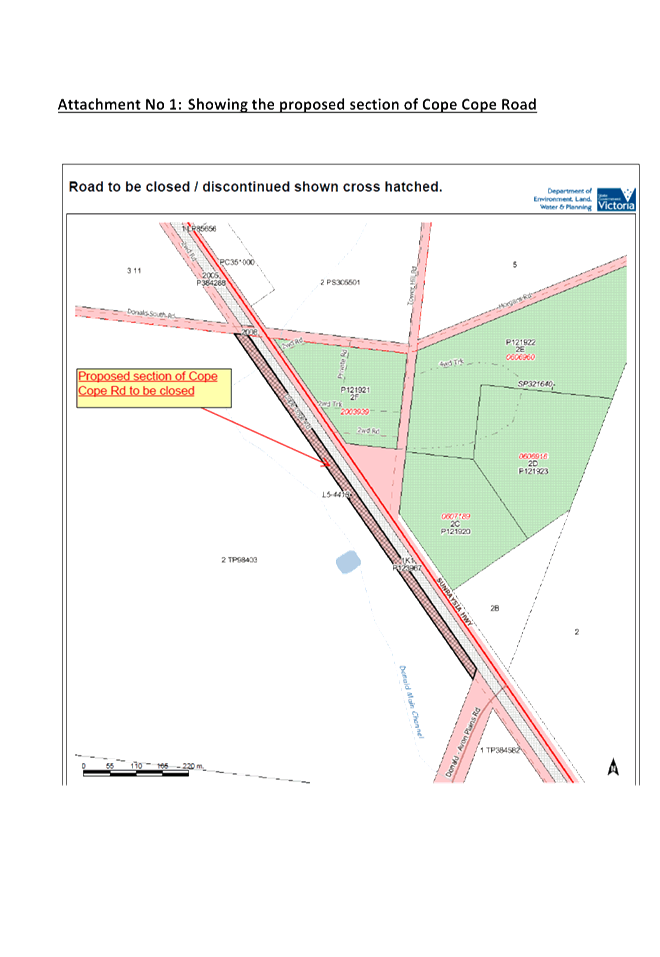
7.2.2 Request From Department of Environment, Land, Water & Planning (DELWP) For Section of Cope Cope Road Closure, Donald
Author’s Title: Senior Assets Engineer
Department: Works and Technical Services File No: RO/21/02
|
1 Attachment No 1: Showing the proposed section of Cope Cope Road |
Relevance to Council Plan 2015 - 2019
Strategic Objective: A Buloke community where people of all ages, backgrounds and abilities, are embraced and supported and can access the Council services they need to help live healthy and fulfilling lives.
|
That Council:
1. Commences the statutory procedures pursuant to Section 206 Clause 3 of Schedule 10 of the Local Government Act 1989 (the Act) for the proposed section of Cope Cope Road reserve discontinuance (as shown on attached plan), and the planned sale of that section by the Department of Environment, Land, Water & Planning (DELWP) and invites submissions on the discontinuance.
2. Writes to land owners adjoining the road reserve advising them of the proposed discontinuance and sale of the section by DELWP and invites them to make a submission on the matter.
3. Considers any submissions received in accord with the provisions of s223 of the Local Government Act 1989
4. After completion of the actions above, considers its response to the DELWP request for agreement to discontinue the road.
|
1. Executive Summary
This report advises Council on the intention to publish a notice of the proposed section of Cope Cope Road closure, and the planned sale by the Department of Environment, Land, Water and Planning (DELWP), and invite submissions on this matter.
2. Discussion
Council received a letter from the DELWP requesting agreement to discontinue and sell the section of Cope Cope Road, Donald adjoining properties Lot 2TP98403 and railway reserve. The adjoining land owner has applied to DELWP to purchase the road. DELWP requires consent from Council before a road can be closed and dealt with under the Local Government Act 1989.
The section of the road is listed in Council’s Road Register. Currently Council is maintaining the earth formed road, which is approximately 0.935 km in length.
Council’s Assets Engineer has inspected the road and closure of this section is unlikely to have any impact. The road runs alongside the Sunraysia Highway, which is the road that vehicles should be utilising (see attached map). As a result of the inspection, staff consider it appropriate to discontinue the road as it is not required for carriageway purposes.
The Local Government Act 1989 contains provisions to allow the discontinuance of sections of road. The provisions require Council to publish a notice in the local papers and the Government Gazette advising details of the proposed sections of the road to be closed, the planned sale of the land by DELWP and invite submissions on the closure.
Council will also write to and advise adjoining property owners about the proposed closure and sale, and invite submissions.
Council will consider any submissions received in accordance with s223 of the Local Government Act 1989.
After completion of the actions above, a further report will be tabled to Council to consider a decision on the DELWP request for agreement to discontinue the road.
3. Financial Implications
There are no financial implications in this report.
4. Cost Shift Considerations
The closure of lanes in metropolitan municipalities sees Councils close and sell the lanes themselves and retain the proceeds from the sale. In the rural areas Councils are required to close the roads to enable the sale to occur but the Victorian government sells the land and retains the proceeds of the sale of the Crown Land. There is still a benefit to Council from the reduction in maintenance liability and the benefit that accrues to its rate paying landowner, however this does not include the purchase proceeds.
5. Community Consultation
Council will call for submissions through advertisements placed in the local paper and the Government Gazette, and will write directly to adjoining and local land owners.
6. Internal Consultation
Staff have completed an internal review, including on-site inspections.
7. Legislative / Policy Implications
Local Government Act 1989
Road Management Act 2004
Land Act 1958
Crown Land (Reserves) Act.
8. Environmental Sustainability
There is no environmental impact from this report.
9. Conflict of Interest Considerations
The officers preparing this report have no direct or indirect conflict of interest.
10. Conclusion
Officers consider that the road is not required for access or other purposes. It is therefore considered appropriate to commence the public consultation process associated with closing roads. Should any submissions to the proposal be received, they will be considered by Council under the provisions of Section 223 of the Act.
Buloke Shire Council Ordinary Meeting Agenda Wednesday, 13 May 2015
7.2.2 Request From Department of Environment, Land, Water & Planning (DELWP) For Section of Cope Cope Road Closure, Donald
Attachment 1 Attachment No 1: Showing the proposed section of Cope Cope Road
7.2.3 Request To Rename a Section of Scrubbery Lane, Litchfield to McGrath Road
Author’s Title: Senior Assets Engineer
Department: Works and Technical Services File No: RO/21/02
Relevance to Council Plan 2015 - 2019
Strategic Objective: A Buloke community where people of all ages, backgrounds and abilities, are embraced and supported and can access the Council services they need to help live healthy and fulfilling lives.
|
That: 1. Council commences the consultation process following the request for renaming a section of Scrubbery Lane, Litchfield to McGrath Road.
2. After completion of the above consultation, Council considers its response to the request for renaming the section of Scrubbery Lane, Litchfield to McGrath Road prior to submitting the proposed name change to the Place Names Registrar. |
1. Executive Summary
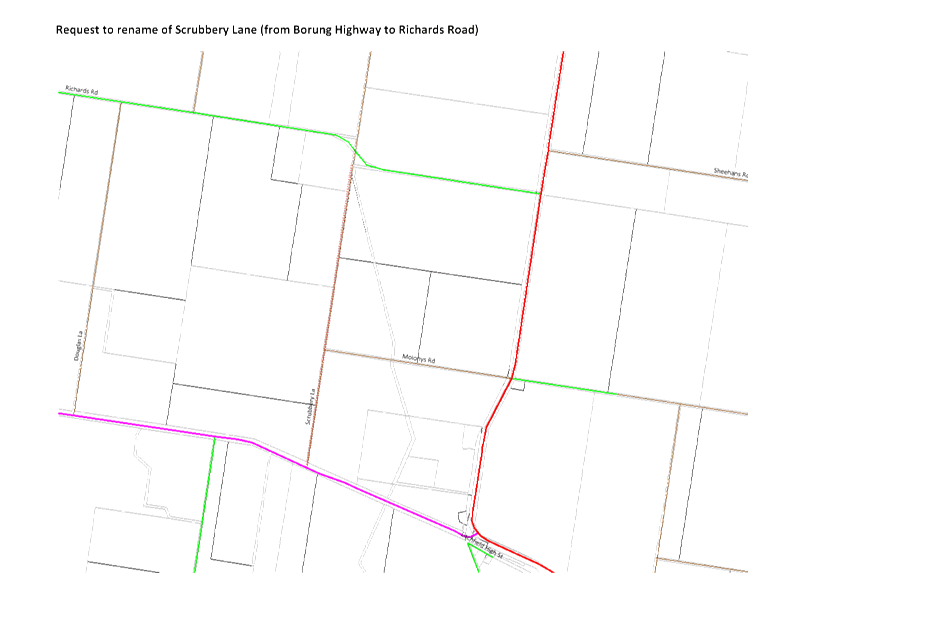
This report advises Council on the intention to commence the public consultation process for renaming the section of Scrubbery Lane, Litchfield between the Borung Highway and Richards Road to McGrath Road.
2. Discussion
Council has received a request from Mr Brian Downs to rename a section of Scrubbery Lane, Litchfield to McGrath’s Road. The proposed section of the road to be renamed runs from the Borung Highway to Richards Road and is 2.7km in length. Mr Downs claims that this section has historically always been called McGrath Rd, as Mr McGrath owned a property on the west side of that road many years ago.
Mr Downs stated that “he is a great believer in the pioneers of this Shire for all their hard work for us” and wishes to recognise Mr McGrath as a pioneer, who lived in West Litchfield. Mr McGrath lived along this road for many years before later moving to Donald and he contributed immensely to the Litchfield community.”
Brian further declared, during his discussion with the local community, no objections were raised for the name change proposal.
Council, as the coordinating road authority, can name or rename a road subject to the provisions of the Road Management Act 2004 and the Local Government Act 1989. However these Acts state that in all instances the road authority must act in accordance with the state government Guidelines for Geographic Names 2010. The Guidelines indicate that renaming should only be considered if the Council can demonstrate that the proposal is made in the interests of the community.
Prior to publishing a gazette notice related to name change, Council must act in accordance with these Guidelines and ensure the proposal conforms to naming principles and procedures. Importantly, the road authority must consult with the local community and emergency services agencies and ultimately seek the Registrar’s approval for the proposed name prior to publishing a gazette notice.
Council will write to affected residents, publish public notices in local papers and seek the Registrar’s approval for the proposed name.
After completion of the above action, a further report will be tabled to Council to consider a decision on the renaming request.
3. Financial Implications
There is no capital impact from this report
4. Cost Shift Considerations
There is no cost shift consideration in this report
5. Community Consultation
The renaming process is must be undertaken in accordance with the Geographic Names Act 1998 and the Guidelines for Geographic Names 2010 which requires consultation with affected property owners, residents and the community.
6. Internal Consultation
Staff have completed an internal review, including on-site inspections.
7. Legislative / Policy Implications
Guidelines for Geographic Names 2010
Local Government Act 1989
Road Management Act 2004
8. Environmental Sustainability
There is no environmental impact from this report.
9. Conflict of Interest Considerations
The officers preparing this report have no direct or indirect conflict of interest.
10. Conclusion
In accordance with the Road Management Act 2004, the Local Government Act 1989 and Guidelines for Geographic Names 2010, it is recommended that Council commence the process for renaming Scrubbery Lane, Litchfield to McGrath’s Road.
A further report will be presented to Council following the consultation for decision on the request.
Buloke Shire Council Ordinary Meeting Agenda Wednesday, 13 May 2015
7.2.3 Request To Rename a Section of Scrubbery Lane, Litchfield to McGrath Road
Attachment 1 Scrubbery Lane, Litchfield Map
7.2.4 2014/15 Capital Works Program Report
Author’s Title: Director Works and Technical Services
Department: Works and Technical Services File No: GS/03/01
Relevance to Council Plan 2015 - 2019
Strategic Objective: Delivering our services in a financially sustainable way
|
That Council notes the 2014/15 Capital Works Program report.
|
1. Executive Summary
This report is provided to Council as an update on the 2014/15 capital works program.
2. Discussion
Council staff have been progressively working on the 2014/15 budgeted capital projects and have made substantial progress towards completion of the program.
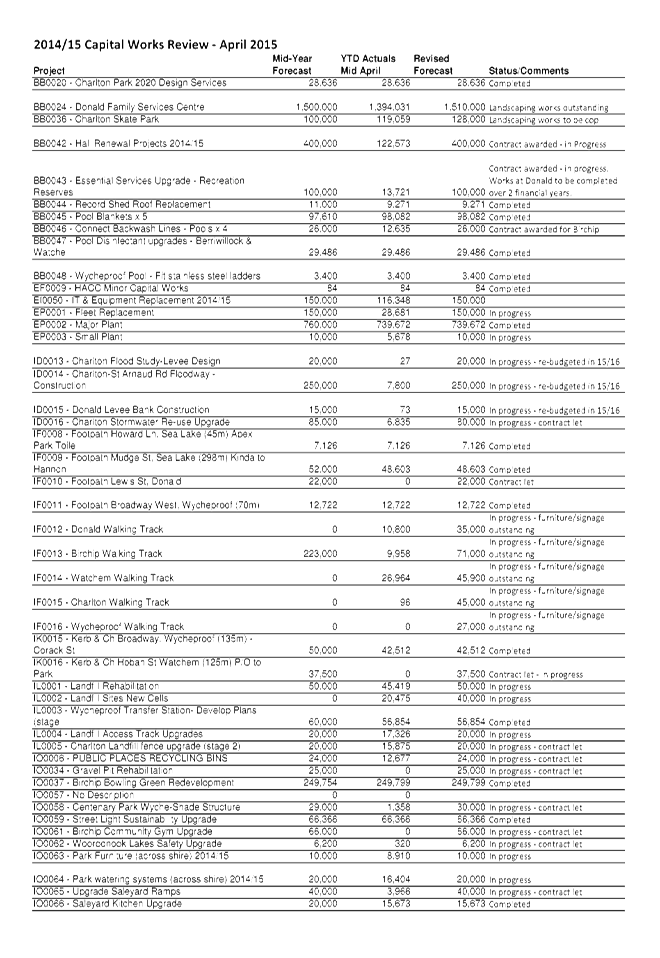
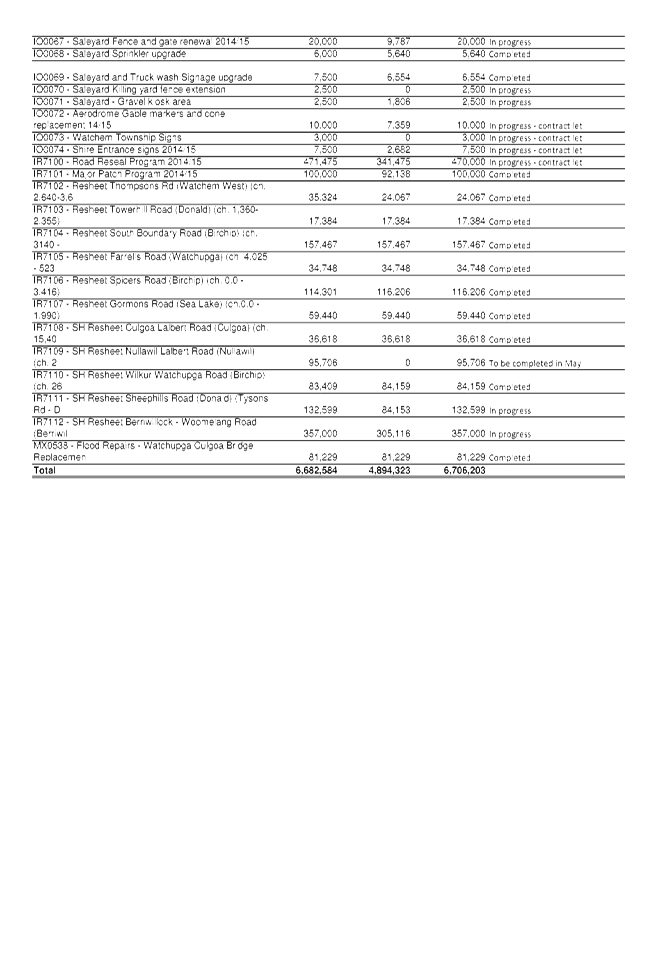
Following an initial reforecast in January, staff have completed a review of each capital project. The attached spreadsheet outlines status and end-of-year forecast for each project.
Some of the key successes in 2014/15 include:
· Anticipated completion of the $400,000 Hall Renewal Project by 30 June 2015. Funding of $300,000 was received from the state government in October 2014.
· Anticipated completion of the $225,000 Walking Track Upgrade Program by 30 June 2015. Funding of $175,000 was received from the state government in October 2014.
· Completion of $1.06m of gravel re-sheeting projects by grading team and cartage staff.
· Completion of the $2.2m Donald Family Services Centre, which opened in term 1, 2015.
· Completion of the $56,000 Wycheproof Transfer Station in February 2015.
In addition, a number of kerb and channel, footpath, parks and urban, swimming pool, saleyard and landfill projects have been completed and given some of our community assets a significant boost.
It is anticipated that all projects, except for the three flood mitigation projects (the Donald Flood Levy Project, the Charlton St-Arnaud Road floodway installation, and detailed design of the Charlton Levy Bank) will be completed by 30 June 2015. The three flood mitigation projects are all multi-year projects and significant progress is expected in the first quarter of 2015/16.
3. Financial Implications
The attached report indicated that the capital expenditure is in line with the mid-year review completed in January, with an end of year expenditure estimated at $6.7m.
The three flood mitigation projects have been carried-forward into the 2015/16 budget.
4. Cost Shift Considerations
There are no cost shift considerations in this report.
5. Community Consultation
Community consultation is not required.
6. Internal Consultation
Staff with allocated capital projects to manage have provided input into this review.
7. Legislative / Policy Implications
There are no legislative or policy implications in this report.
8. Environmental Sustainability
Projects such as the upgrade of street lights to more sustainable LED lights and inclusion of recycled plastic furniture and solar light bollards on walking tracks have incorporated environmentally sustainable design principles.
9. Conflict of Interest Considerations
The officers preparing this report have no direct or indirect conflict of interest.
10. Conclusion
Council is on track to complete the capital works program in line with the mid-year reforecast.
Buloke Shire Council Ordinary Meeting Agenda Wednesday, 13 May 2015
7.2.4 2014/15 Capital Works Program Report
Attachment 1 2014/15 Capital Program Review - April 2015
7.2.5 Maitreya Festival compliance with Planning Permit 580 and Place of Public Entertainment Occupancy Permit.
Author’s Title: Manager Planning and Community Support
Department: Planning and Community Support File No: LP/09/10
|
Nil |
Relevance to Council Plan 2015 - 2019
Strategic Objective: An organisation that is responsibly governed and values and supports the development of its people
|
That: 1. Council officers commence negotiations with the event organiser at least six months prior to the event if it is to be held in 2016. 2. Initiate enforcement action for non-compliance with the Place of Public Entertainment Occupancy Permit. |
1. Executive Summary
Planning permit 580 was issued for a Place of Assembly (Maitreya Festival) that was held at Wooroonook Lakes over the March Labour Day weekend. A Place of Public Entertainment Occupancy Permit was also issued for the event. This report summarises compliance with the statutory permit conditions and makes recommendations for enforcement action in relation to non-compliance.
2. Discussion
Planning Permit 580 was issued on the 2 February 2015 with twenty-five conditions. These conditions included a number of pre-event plans that needed to be submitted, event duration controls and post-event requirements.
Planning permit conditions included:
- Traffic Management Controls:
A traffic management plan was submitted with the application and included consent from VicRoads. The traffic management plan was implemented, however deficiencies were uncovered by event organisers and Victoria Police during the mass exodus from the event on the Sunday that necessitated further action around speed controls on the Borung Highway. Any future event would need to consider this in the traffic management plan.
- Site Layout Plans:
Layout plans were submitted four weeks prior to the event in accordance with the planning permit conditions however they were altered in the weeks and days leading up to the event due to ongoing consultation between the event organisers and the CFA.
- Crowd Management Plan:
A crowd management plan was submitted by the ACES group by a qualified officer.
- Event Management Plan:
An event management plan was submitted with the application for a planning permit. It covered the waste and environmental controls for the event.
- Site manager and complaints register:
Council staff met with the site manager whilst carrying out inspections on the 6 March 2015 and no complaints were registered for the duration of the event.
- Reinstatement of the site:
An inspection of the site was carried out with the Assistant Manager of Urban Works and Environment on the 19 March, ten days post-event, and the site was generally in accordance with pre-event conditions. Some minor earthworks and removal of infrastructure such as water tanks still require attention. Post-event consultation with the foreshore committee indicated general consensus that the site was left in a satisfactory state.
- Aquatic management:
The lifesaving was carried out by qualified staff as per the conditions.
Condition 19 of Planning Permit 580 required that:
Ambulance Victoria must be engaged to provide static support to the festival, a copy of the engagement contract must be provided to the Responsible Authority no less than two weeks prior to the festival commencement.
Consultation between Council planning staff and Ambulance Victoria on the 19 February, 2 March and 6 March indicated acceptance of an Ambulance Victoria quote by the event organiser but ongoing negotiations around the contract terms. The proponent advised Council that the contract was still being negotiated with Ambulance Victoria prior to the event. Also, Ambulance Victoria did not advise Council until 3:45pm on the 6 March, following the commencement of the event, that they would not be in attendance.
A Place of Public Entertainment Occupancy Permit was issued on 5 March 2015 with nineteen conditions that included pre-event plans, event duration controls and post-event requirements.
Conditions for the POPE included fire safety measures, the engagement of safety officers, clean-up of waste from site, emergency access, amenity facilities and temporary structures.
Inspections carried out by the Municipal Building Surveyor found that compliance with the majority of POPE conditions had been met.
However, condition (k) stated that:
A dedicated Ambulance Victoria ambulance is to be provided on-site for the duration of the event, subject to the need for that ambulance to transport patients to a hospital or other medical facility for treatment. The ambulance must be attended by qualified personnel as required by Ambulance Victoria.
This condition was not met and is a breach of Section 51 of the Building Act which makes it an offence for the occupier of a place of public entertainment to permit the place to be used in contravention of the occupancy permit.
This non-compliance could have resulted in a risk to event patronage safety and also community safety due to the limited Ambulance Victoria resources in the geographical area around the event location.
In the likely event that the applicant applies for a planning permit and POPE to host the festival at Wooroonook Lakes again in 2016 it is strongly recommended that timeframes for the submission of reports and plans be brought forward to allow the Responsible Authority to appropriately respond to the applications and adequately respond should non-compliance occur.
Engagement with a range of stakeholders such as the CFA, Victoria Police, local health services and Ambulance Victoria as well as with the Charlton community will also need to commence at least six months prior to the event.
3. Financial Implications
Council has a statutory obligation to assess and make determinations on planning and building permit applications and recovers fees for these services. If Council elects to initiate enforcement action for non-compliance with the POPE, legal costs will be incurred.
If the event proposes to continue, discussions with the applicant to ensure full cost recovery for Council activities will need to take place.
4. Cost Shift Considerations
There are no cost shift considerations.
5. Community Consultation
There has been some feedback from the community post-event, generally supportive of the festival. Community consultation was undertaken in accordance with the Planning and Environment Act 1987 prior to the issuing of planning permit 580 and no submissions were received.
6. Internal Consultation
Internal consultation has taken place between the building and planning department, Economic Development officer and the Assistant Manager of Urban Works and Environment. Further consultation with a number of work officers will be required should the event proceed in 2016.
7. Legislative / Policy Implications
The event will continue to require a planning permit for Place of Assembly and a Place of Public of Public Entertainment Permit under the Building Act. These permits will need oversight by the authorised council officers to ensure compliance.
8. Environmental Sustainability
If the event is to continue and increase in patronage then environmental sustainability provisions will need to be incorporated in to the planning permit land use considerations. These include native vegetation considerations, waterway management and disposal of waste products.
9. Conflict of Interest Considerations
No conflict of Interest considerations.
10. Conclusion
It is recommended that enforcement action be initiated in response to non-compliance with the POPE condition (k). In the likely event that an application be made to Council for a planning permit and POPE in 2016, adequate time and resources will be needed to ensure it can be appropriately responded to. The applications will need to be assessed as per the relevant legislation, however preliminary meetings with the event organiser will assist Council as the Responsible Authority.
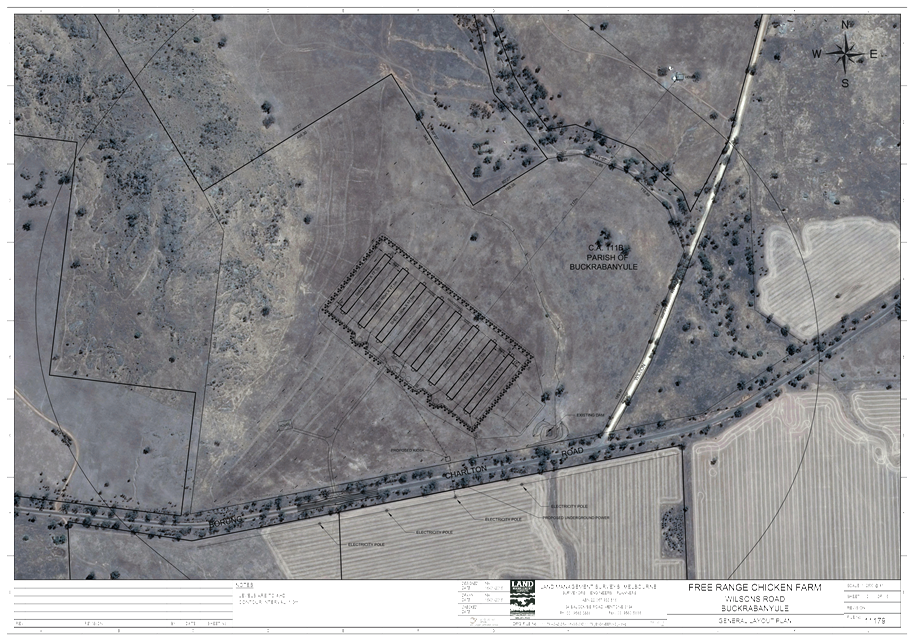
7.2.6 Notice of Decision to Approve Planning Permit 599/15 for Intensive Animal Husbandry at Crown Allotment 111B Parish of Buckrabanyule.
Author’s Title: Manager Planning and Community Support
Department: Planning and Community Support File No: LP/09/01
Relevance to Council Plan 2015 - 2019
Strategic Objective: Supporting and enhancing our local economy
|
That Council issue a Notice of Decision to Approve Planning Permit 599/15 subject to the following planning permit conditions: 1) This permit will expire if the development and the use are not started within two years of the date of this permit and the development is not completed within four years of the date of this permit. The Responsible Authority may extend the periods referred to if a request is made in writing before the permit expires, or within three months afterwards. 2) The layout of the site and the size of the buildings and works and the nature of the use as shown on the endorsed plans, including the transport management plan, shall not be altered without the consent of the responsible authority. 3) The capacity of the intensive animal husbandry free range chicken farm hereby approved must not exceed 400,000 birds at any one time. 4) External lighting must be designed, baffled and located so as to prevent adverse effects on adjoining land, to the satisfaction of the responsible authority. 5) The finished floor level of the sheds must be a minimum of 600mm above the natural surface level. 6) Existing trees on the site must be retained. Permission from the Responsible Authority must be obtained before the lopping or removal of any native vegetation. 7) Adequate water supply for domestic use, commercial use and fire fighting use must be available on the site. 8) All buildings in the permitted development must comply in all respects with the provisions of Building Regulations and a building permit must be obtained. 9) All trees and shrubs included on the endorsed landscape plan shall be planted within six (6) months of completion of the first shed unless with the written approval of the Responsible Authority. Landscaping shall be maintained to the satisfaction of the Responsible Authority. 10) Contractors are to comply with guidelines specified in the EPA publication Environmental Guidelines for Major Construction Sites 1996, to minimise the risk of soil erosion during construction. 11) The managers dwelling must only be used in conjunction with the chicken farm 12) Landscaping is to be of a minimum width of 15 metres (trees at 3 metres apart) and planting is to be five trees deep at intervals of 4metres. 13) To the satisfaction of the Responsible Authority, a physical treatment must be applied to the retention basin that prevents the access in to and on to the basin by wild avian and other animals. 14) A hydraulic assessment of the run off of the land outside the building envelope that will accumulate around the earth berm and an appropriate hydraulic design to prevent concentrations off site must be provided to the Responsible Authority prior to the commencement of construction. 15) Should any artefacts be uncovered during development of the site including earthworks, works must cease immediately and Aboriginal Affairs Victoria must be notified immediately. Environmental Management Plan 16) The Environment Management Plan (EMP) for the operation of the chicken farm as submitted to the Responsible Authority is endorsed and will form part of this permit. The EMP includes provision for periodic audit in accordance with the following measures: a) Any revision to the EMP must be submitted to, and be to the satisfaction of, the Responsible Authority. If required, the revised EMP shall be endorsed and then form part of this permit. b) The use must be undertaken in accordance with the most current version of the endorsed EMP. c) Topsoil stripped from the site must be stored during construction in a suitably stable condition to the satisfaction of the Responsible Authority and spread on any exposed batters as part of the final landscaping works. Exposed soils shall be revegetated as soon as practicable after construction. d) Prior to the commencement of the use, areas set aside for parked vehicles and access lanes, as shown on the endorsed plans, must be constructed with crushed rock or gravel to an appropriate engineering standard to carry vehicles associated with the use and to minimize dust generation to the satisfaction of the Responsible Authority. Concrete aprons must be provided at the entrance of the chicken sheds to the satisfaction of the Responsible Authority. e) All external wall and roof finishes of the sheds shall be colour treated and maintained to muted non-reflective tones to the satisfaction of the Responsible Authority. f) Exposed batters are to be protected from erosion by the use of silt fencing or hay bale retaining walls until permanently protected by grasses or other vegetation to the satisfaction of the Responsible Authority. g) Litter of a type capable of rendering droppings dry and inoffensive is to be used in the sheds where birds are kept. The litter must not exceed 15-40% moisture content. Wet litter must be removed from the shed (or sheds) immediately it is detected and placed in a sealable covered receptacle and must be removed from the land within 72 hours. h) The removal of litter from the sheds by use of machinery may occur only between the hours of 7.00am and 10.00pm, and no removal shall be undertaken during school bus route times, Christmas Day, Easter or Good Friday. i) No litter spreading, litter stockpiles, composting of dead birds and spreading of dead birds can occur on the subject land. j) If the Responsible Authority determines that the amenity of nearby residents is adversely affected by the emission of an unreasonable level of offensive odour from the chicken farm, the operators must immediately take remedial actions and/or undertake works, which may include adjusting stock density, removing unsatisfactory spent litter promptly, or any other actions to rectify the emission of offensive odour. The owner of the land and the operation of the chicken farm must comply with all written directions by the responsible authority in this regard. k) External cladding materials of the dwelling and associated outbuilding(s) must be of finishes with low relative reflectivity levels and in colours selected to blend into the surrounding landscape to the satisfaction of the Responsible Authority. l) Stock must be excluded from the landscaped areas provided under this Permit. m) All effluent or waste water generated on the chicken farm must be contained and treated onsite and effluent and untreated waste water must be prevented from entering any waterways, to the satisfaction of Grampians Wimmera Mallee Water and the Responsible Authority n) Waste water from the washing and disinfecting of sheds must not be allowed to be discharged from the sheds o) Other than the placement and collection of live birds, no deliveries to or removals from the site shall take place after 10.00pm or before 6.00am on any day without the prior written approval of the Responsible Authority. p) All vehicles associated with the chicken farm use must be maintained in accordance with the manufacturer’s specifications unless fitted with high performance mufflers or other noise reduction devices to minimise noise impacts from the site. q) Any external lighting installed must be shielded to minimise light spill and to ensure that luminaries do not emit direct light above horizontal and are not visible from any off-site dwelling or public land and must not cause nuisance to surrounding properties or any user of roads surrounding the site, to the satisfaction of the Responsible Authority r) Sheds are to be closed (and ventilation equipment turned off) for a minimum of four hours after spraying with odorous or toxic substances. Airborne sprays or chemical odours must not be transmitted beyond the site to the detriment of any person, to the satisfaction of the Responsible Authority. s) All goods and materials must be stored out of view, or so as not to be unsightly, when viewed from nearby roads or land in other occupation, to the satisfaction of the Responsible Authority. t) Section 2.14 is to include a specific
objective to reduce the occurrence of wheel cactus on the site. Traffic Management 17) Access to, and egress from, the site for all vehicles (including waste collection vehicles) must only be from the Borung Charlton Road and be via the vehicular access shown on the endorsed site map. 18) Use of Wedderburn Buckrabanyule Road and Barakee Road is prohibited, other than in an emergency 19) The entrance gate to the property must be located 30 meters from the Title boundary to allow for a truck to park completely off the road whilst waiting to entre the site. 20) Traffic will not be permitted on school bus routes between 7:30-8:30am Mon – Fri and 3:30-4:30pm Mon-Fri 21) Prior to the commencement of the proposed development, the permit-holder must submit a plan of the preferred truck/transport routes to and from the site for the approval of Council's Works and Technical Services Department. Such approval will form part of the permit and must be adhered to. 22) Prior to the commencement of any works, the applicant must submit detailed internal road and access construction plans associated with the development to the satisfaction of Council's Works and Technical Services Department 23) Prior to the commencement of the use the permit-holder must carry out, or cause to be carried out, the construction of all internal and external roads and access point works to the satisfaction of Council's Works and Technical Services Department in accordance with the approved plans. Pavement depths to be in accordance with the subgrade conditions and latest AUS roads Publications as approved by Council’s Works and Technical Services Department. All works are to be undertaken at the permit-holder's cost. 24) Adequate warning signage on the approach to the development’s driveway entrance must be installed at the applicant’s cost to the satisfaction of the Council’s Works and Technical Services Department. 25) The entrance of the development is to be located further east along the property boundary to the satisfaction of the Responsible Authority.
Water Management 26) All storm water discharged from the intensive animal husbandry building envelope must be conveyed by means of drains to a retention dam in accordance with an engineer designed Storm water and Drainage Management Plan as approved by the Responsible Authority prior to works commencing. 27) Potentially contaminated storm water and drainage from hardstand areas, and the areas around the sheds, must be directed to the retention dam which shall be designed with a capacity and additional freeboard to enable the run-off from a I in 100 year storm to be retained. 28) The sheds must be at least 100 meters from a designated waterway. 29) The onsite retention dam needs to provide for collection of runoff from all impervious surfaces within the development. The requirements of this retention dam are: a) The construction of the retention dam shall provide for no less than 450mm free board above the designed water level. b) The outlet from the retention dam is to be controlled at 3 litres/second / hectare of impervious catchment area (including dam area.) c) The proposed stormwater dam must be constructed in accordance with plans submitted and must not have a wall height exceeding 5.0 metres above natural ground level and must have a capacity greater than 8 megalitres. d) The dam must be constructed in a way that demonstrates it is impervious so as to prevent seepage of groundwater. e) The works must not interfere with any nearby waterway being a watercourse, drainage line or a natural channel with a regular flow. f) The overflow from the retention dam must be designed such that no water is discharged off-site or to any waterways and must not cause erosion. g) A suitable treatment of water in the retention basin to the approval of the Responsible Authority must demonstrate that odour is being addressed in both anaerobic and aerobic microorganisms. 30) The internal drains and dam must be designed to hold runoff from the site from storm events up to and including the 1 in 100 years AEP storm event. 31) A permit to install a Septic Tank must be obtained and installed prior to occupation of the dwelling and amenity building. |
1. Executive Summary
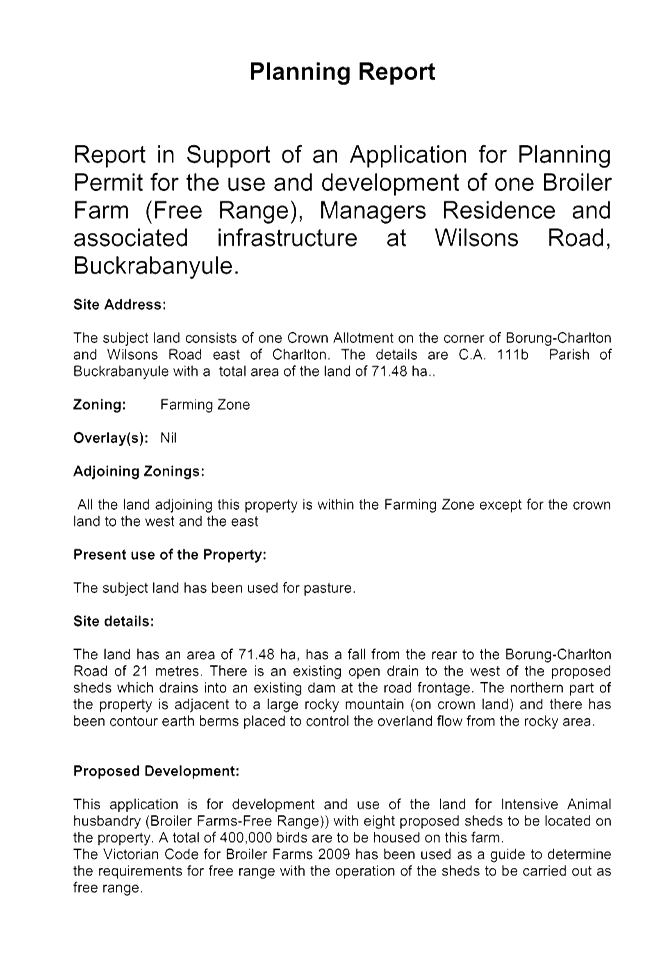
A planning permit application was received by Council on 15 March 2015 for a 400,000 free range chicken bird intensive animal husbandry development at Crown Allotment 111B, Parish of Buckrabanyule. Thirteen submissions were received objecting to the proposed planning permit application.
2. Discussion
Site description:
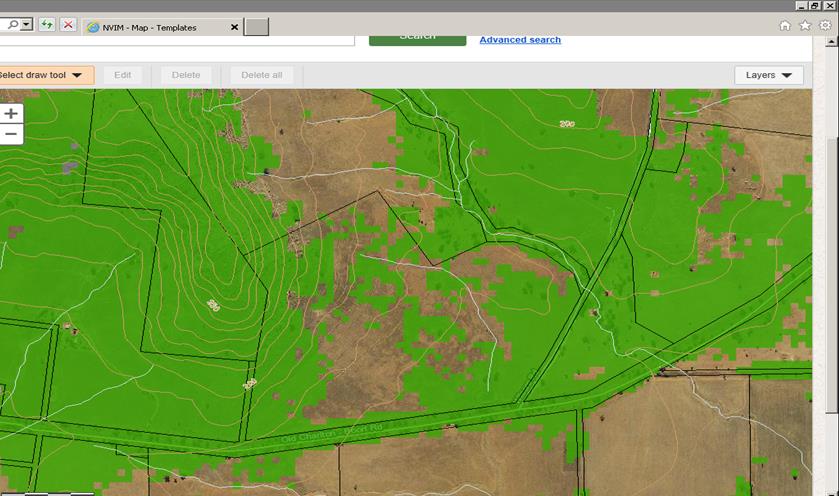
The subject land consists of one Crown Allotment on the corner of Borung-Charlton Road and Wilsons Road, east of Charlton. The details are C.A. 111b Parish of Buckrabanyule.
The subject land is zoned farming with no applicable overlays and has been used for pasture. The land has an area of 71.48 ha and has a fall from the rear to the Borung-Charlton Road of 24 metres over an approximate distance of 500 meters. Vegetation on the site consists of primarily grazing pasture with limited vegetation over of the proposed development building envelope. There are no dwellings or outbuildings on site, however there is a dam requiring rectification works.
There is an existing open drain to the west of the proposed sheds which drains into the existing dam at the road frontage. The northern part of the property is adjacent to a large rocky mountain (on crown land) and there have been contour earth levees placed to control the overland flow from the rocky area.
The predominant land use of the surrounding area is broad acre agriculture, being cropping or grazing. Dwellings associated with individual properties are sparsely distributed throughout the area.
Planning permit application:
The planning permit application is for:
· Eight broiler sheds being 17.1 m wide and 160 m long located within the property, to house 400,000 birds
· Miscellaneous support buildings including machinery shed, workshop, amenities building, water tanks, gas storage tanks, generator sheds and silos
· Roadways and access road from the Borung-Charlton Road constructed to provide all weather access to the sheds and buildings.
· One managers residence
Decision Guidelines:
Council must consider the matters at Clause 65 of the Buloke Planning Scheme which refer to the relevant sections of the Planning and Environment Act 1987, State Planning Policy Framework, Local Planning Policy Framework, Municipal Strategic Statement, local policies, zones, overlays and any other provisions that apply to the planning permit application. The orderly planning of the area, the proximity of the land to any public land, land degradation, salinity and water quality issues, native vegetation management, flood erosion and fire hazards, and the management of such hazards also need to be assessed in concluding whether to approve or refuse a planning permit application. The relevant sections of the scheme in relation to this application are set out in Attachment 4, Relevant Matters.
Objection issues raised:
Following advertisement of the applications in accordance with Section 52(I)(d) of the Planning and Environment Act 1987, thirteen objections were received , they can be summarised in to the following categories:
Odour:
Objections raised concerns regarding the impact that odour would have on surrounding land uses.
The proposed farm has a separation distance from the nearest sensitive use (dwelling) being 717 metres from the sheds. If the application was for a Broiler Farm the separation distance required would be 686 meters for 400,000. The distance is considered sufficient to minimise risk of offensive odour impacting on existing sensitive uses
Response:
Consideration has been given to the purpose of the separation distance used in the Broiler Code despite it not applying to the application as its purpose is to minimise the risk of offensive odour and dust impacting the amenity of existing sensitive uses. It is relevant to note that the separation distance calculation assumes that litter stockpiling, litter spreading and composting will all be conducted within the subject site. As none of these activities are proposed as part of the application and the proposed planning permit conditions prohibits them, it is considered that the risk of adverse odour emissions on existing sensitive uses is further reduced. This may be offset by the presence of an outdoor range which is not used in the calculation of the separation distance in the Code because it does not apply to free range farm applications.
The potential impact of odour on adjoining agricultural uses, and hence workplaces, is not considered a relevant consideration. The separation distance is assumed to be separation from a sensitive use and Agricultural use is not generally considered a sensitive use. The majority of agricultural uses can generate a range of amenity impacts such as noise, dust and odour. This is one of the reasons that such activities are generally separate from more sensitive residential land uses
It is a clear policy decision that certain broiler farms do not require an Odour ERA, however in a recent VCAT determination Lewis vs Central Goldfields SC 2015, in which the application was for a Broiler Farm and therefore had to meet the Code, it was argued that prevailing meteorological conditions and topography need to be taken in to account when demonstrating compliance with separation distance.
For this proposed application the wind rose diagrams indicate that the prevailing winds blow from the south and the exhaust fans on the sheds blow exhaust air from the sheds in a north easterly direction. The proposed development has topographical features including being placed on the slope of Mount Buckrabanyule and the sheds are placed on several contours at the north western section of the property, however with a level of 188.52 at the northern end of the development down to a level of 169.37AHD at the southern end of the development the slope is proposed at 1 in 20 or 5% which is not considered a significant topographical impact on odour emissions .The closest sensitive use is 717 metres from the development and significant landscaping is proposed as a planning permit condition to contribute to less odour emissions from the development.
Impact due to increase in heavy vehicle traffic:
Submitters were concerned that the use and development proposed by the applications will create a significant increase in heavy vehicle traffic both during the construction phase and ongoing operations.
Traffic
related objections to the application included:
- Dust and noise created by truck movements.
Rural roads currently accommodate a range of heavy vehicles such as those picking up stock, vehicles delivering fuel, agricultural equipment and the like, all of which are legitimate road users. Heavy vehicles are not considered out of keeping with a typical rural environment.
- Impact on road safety for both people who use the surrounding roads for transport, school bus or recreation; and the potential danger to stock which is often moved along roads
An increase of truck movements does not automatically equate to a more dangerous environment for other road users. All road users have the responsibility to exercise caution and to undertake safe driving practices whilst using rural roads.
- Impact on the road pavement structure and the economic cost on ratepayers for upgrades and maintenance.
The analysis of Council's Asset Unit has determined that the increase of heavy truck movements will have a negligible effect on the Borung Charlton Road. This road is considered a Link Road under the Buloke Road Management Plan. This is the highest road classification in the Shire’s road hierarchy.
- Potential placement of the entrance to the development
Concerns were raised that the entrance to the site was too close to a slight bend in the road and that vehicles travelling at the 100 kph speed limit may have trouble slowing down. Whilst Council infrastructure assessment officers did not determine that this was an issue, two planning permit conditions have been included that relocate the driveway entrance further east and require the proponent to install warning signage at the approach to the development entrance.
The general application submission estimated an additional 1,065 truck movements will be generated per year as a result of the operation of the farm. However, it is not considered that the proposal will see an increase of heavy vehicle traffic sufficient to result in a detrimental impact to the area for the reasons outlined above.
Noise generated from fans and machinery:
Objections raise concerns that the operation of the farms, specifically the noise of fans and machinery operating at night, will have a detrimental impact on the amenity of the area
Response:
The applications separation distance to the closest sensitive use as well as need for the proposed farm to comply with the most recent EPA guidelines assist with the reasonable mitigation of noise impacts The relevant guideline is “Noise from Industry in Rural Victoria” or any updated version, similar to all industry in regional Victoria. It is considered that there is limited potential for noise to impact the amenity of surrounding sensitive uses
Impact on the flora, fauna and general biodiversity of the area including wild bird population and wheel cactus:
Objections have highlighted a range
of impacts on the natural environment as a result of the proposed development.
Response:
An assessment of the site using the Department of Environment Native Vegetation Information Management tool describes the site as sparsely vegetated where the building envelope of the development is proposed. The remainder of the site has native vegetation cover considered to be in condition ranging from 20-60 out of 100. The development site’s Ecological Vegetation Classification (EVC) is 175 Grassy Woodlands Goldfields bio region and any landscaping would be subject to the species list applicable to the EVC. No native vegetation removal is proposed in the application.
The site and immediate surrounding area does have an ongoing issue with wheel cactus and it is proposed that any planning permit issued would incorporate weed management of the pest.
The Australian Government Department of Agriculture, Fisheries and Forestry document National Farm Bio security Manual for Poultry Production is incorporated in the applicant’s proposed Environmental Management Plan. The manual identifies areas of risk common to poultry production including conventional and free range operations and wild birds are considered a potential major route for disease and pathogen transmission and sets out requirements to address these issues.
The manual suggests good fencing to prevent entry of animals into free range areas as well as a clearly defined bio security zone. A baiting program for rodents is required and manure deposits outside the hatch openings must be removed after each batch and ramps to free range areas must also be scraped and cleaned after each batch. Sheds and outdoor ranges must be adequately drained to prevent accumulation of water which may attract wild avian species. There are also additional plans in place in the event of a high risk bio-security threat. In addition the proposed planning permit conditions require a mutually agreeable physical barrier to be placed over the retention barrier to prevent wildlife accessing the water contained within it.
General destruction of the
rural environment:
Response:
The agricultural area of Buckrabanyule is a rural activity area, and as such, is a generally highly modified environment which has undergone significant change through activities such as land clearing, cropping, grazing, damming, irrigation and the like. The proposal for agricultural production is consistent with the surrounding agricultural environment
Risk of storage, use and disposal of chemicals used for cleaning out of sheds
Response:
The use of chemicals is controlled by the Australian Pesticides' and Veterinary Medicines Authority and is administered under various acts and codes. Environmental and nuisance legislation is administered by the Environmental Protection Authority. Council's Environmental Health Department also controls the storage and disposal of chemicals .This combined with controls proposed within an approved EMP are considered to adequately address issues of chemical use, storage and disposal.
Amenity impacts:
Objections include that the farm will impact on the amenity of the area in the following ways
- Visual impact of the sheds due to their size and the issues of glare during the daytime and artificial light spill during the night-time.
While the proposed sheds are large in comparison to structures on surrounding land, they are still agricultural buildings and therefore a legitimate part of agricultural landscapes. Issues relating to glare and artificial light spill can be managed by appropriate use of non-reflective materials and baffled lighting which is contained in the proposed planning permit conditions.
- Disruption of views and location on the side of Mount Buckrabanyule
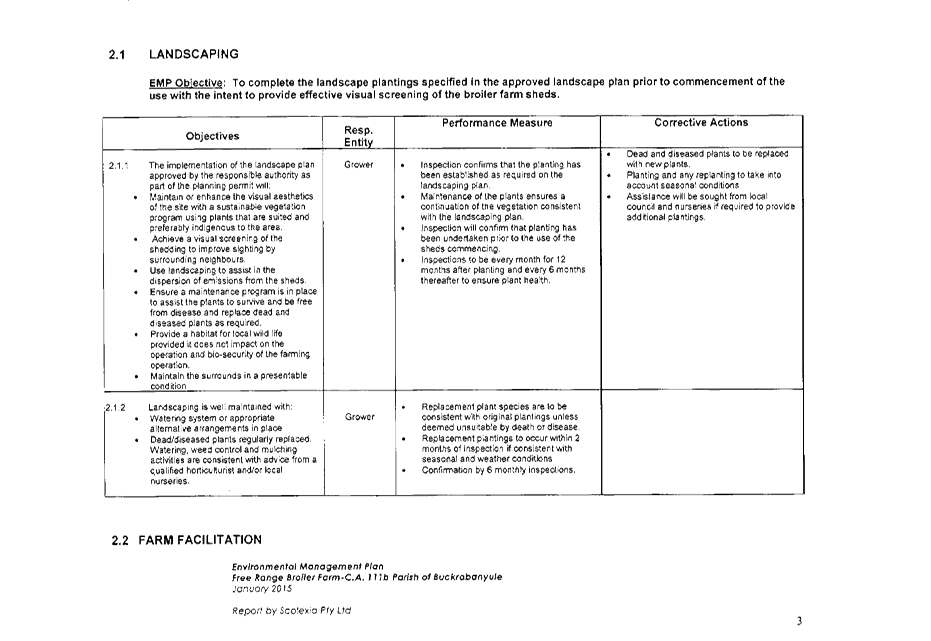
The area is not identified as a significant landscape in the planning scheme. However, the visual impact of development must still be considered under the decision guidelines of the Farming Zone, clause 22.15 and also Elements I and 2 of the Code. The development will be visible from a number of points in the surrounding landscape including from the Mount and from the Borung Charlton Road. The application includes a number of measures to mitigate the visual impact including landscaping, siting and building finishes. A levee around the site will also mute many of the mechanisation products being visible. It is not the intent that vegetation completely blocks buildings from view, only that vegetation provides substantial visual screening of the sheds.
- Spoiling rural or residential amenity
In relation to rural and residential amenity, the proposal is consistent with the level of amenity expected of the area. It is important to note that the application relates to a level of amenity which may be expected in a working agricultural environment and not that expected within a residential setting. The proposal, although more intense than existing surrounding uses, is still an agricultural activity and as such is consistent with the level of amenity expected in an agricultural area
Impact on the water supply of the area:
Objectors have raised concerns regarding the proposal’s potential impact on water supply, specifically that dust generated from the fans will fall on roofs of nearby dwellings and contaminate drinking water supply.
Response:
Adequate separation
distance and the boundary setback distance are the primary measure relied on to
address issues of dust during both routine and adverse weather conditions.
Landscaping and screen plantings along with ensuring proper litter moisture content also have a role to play in minimising dispersion of dust from the chicken farm. The proposal has boundary setback of 100 metres and greater and a separation distance of 717 metres form the closest sensitive use. Landscaping and screen planting are also included as part of the application and the EMP requires regular monitoring of litter moisture content. Given these combined factors, it is considered that potential impact of dust will be sufficiently mitigated
Runoff will contaminate dam water on downstream properties:
Response:
The construction of the farm sheds and the associated stormwater system results in an almost completely closed system. Requirements by Council controlling stormwater treatment and dam construction requirements will act to ensure contaminated runoff remains on site
Pipeline water access by the proposed farms will result in reduced access for others and loss of pressure:
Response:
Access to water is a vital consideration for agricultural activities. As with all agricultural activities, a licence will be required to source water from the pipeline and Grampians Wimmera Mallee Water
is the authority responsible of assessing and issuing these licences. Grampians Wimmera Mallee
Water has not raised any concerns regarding limits to licences and water purchasing for this proposal and as such it is considered that access to water will be adequate
Reducing property values:
Response:
The effect of any use or development on property values is not a planning permit consideration. This is a long standing position in implementing planning legislation. Property values are determined by the market which is influenced by a wide range of factors outside the scope of land use planning
Affecting the use and viability of nearby farms as businesses and workplaces:
Response:
As outlined above, the proposed farm has a separation distance of 717 meters from a sensitive use. It is not the purpose of separation distances to protect the viability of adjoining farms as workplaces. The separation distance applies to sensitive uses, not other types of agriculture, which itself is recognised to potentially result in a range of amenity impacts
Restricting the use of fertiliser on nearby properties resulting in negative economic outcome:
Response:
The suggestion that the presence of a chicken farm would restrict use of
fertiliser on nearby properties is unfounded. There is a separation distance to
address amenity issues for existing sensitive uses and in no way acts to
restrict agricultural use of land within the separation distance
Application inadequacies:
There have been a number of issues raised in relation to the application itself and also specific aspects of the proposal. Issues which have been raised relate to;
- Proposed farms are industrial and not agricultural
The planning scheme clearly identifies the proposed use as intensive animal husbandry which falls within the agricultural land use nesting group
- The separation distance should not be allowed to cover adjacent properties
Separation distances aim to balance the needs of the industry with expectations of the community, as are EPA documents and other standards. It is outside the scope of land use planning to determine if the methodology within documentation prepared by other relevant government agencies is adequate
The application was not advertised correctly:
Response:
In accordance with Section 52 of the Planning & Environment Act 1987 the proposal was included in the locally circulating newspaper The North Central News on Wednesday 15 April. In addition to letters sent to adjoining properties, letters were also sent to properties within a three kilometre radius of the development including twelve properties in the Loddon Shire.
A meeting with a number of submitters was held in Charlton on Thursday 30 April 2015 between 2pm and 7pm to discuss issues raised and five persons attended.
Health and bio-security:
A
range of objections have been received which raise concerns over the potential
physical and psychological health impacts as a result of the broiler farm
operation. A number of issues relating to bio-security risks have also
been raised. Issues raised relate to;
- Live birds and composting dead birds will transmit diseases to wild bird populations and humans
Composting of dead birds on-site will not occur and is not part of the proposal. Dead birds are to be frozen and removed from site at the end of each batch. Transmission and/or contraction of disease from livestock are unlikely but are an issue which requires constant monitoring and should be managed similar to other chicken farm operations
- Impact of dust on people suffering with pulmonary conditions and other illnesses
The separation distance achieved by the proposal to sensitive uses is considered adequate to mitigate impact of dust from the sheds. Additionally, many agricultural activities are inherently dust producing. It is not a requirement that an intensive animal husbandry farm produces no dust, only that it is effectively managed and mitigated
- The scale and proximity of farms poses a risk to bio-security
While the spread of diseases from livestock can be a risk to human health and the economy, it is considered that this risk can be effectively managed by the adherence to the permit conditions and the required operational codes and guidelines. . State and federal bio-security guidelines apply to the production of chicken meat for all chicken meat producers.
The use of veterinary chemicals is controlled at the state level through the Victorian Agricultural and Veterinary Chemical (Control of Use) legislation. All chicken farm operations must comply with this legislation and it is beyond the power of Council to question or assess these requirements, particularly within a land use planning context
The farm is in close proximity to an area of Aboriginal cultural heritage sensitivity:
Response:
The farm is in not in an area defined as being culturally sensitive. As the proposal is not located within an area defined as culturally sensitive, there is no statutory requirement for the preparation of a cultural heritage management plan. The applicant has been informed of their responsibility under the Aboriginal Heritage Act 2006 if any cultural heritage is found on site.
Conclusion:
Having considered relevant matters in relation to the applicable zoning, state and local planning policy framework and other decision guidelines it is determined that the use and development of an intensive animal husbandry development is consistent with the stated purpose and decision guidelines of the Buloke Planning Scheme.
3. Financial Implications
If the Notice of Decision is contested by the applicant or submitters in VCAT there will be legal costs incurred.
4. Cost Shift Considerations
There are no cost shift considerations.
5. Community Consultation
Community consultation was undertaken in accordance with Section 52 of the Planning & Environment Act 1987 and included Notice in the locally circulating newspaper The North Central News on Wednesday 15 April. Letters were sent to properties within a three kilometre radius of the development including twelve properties in the Loddon Shire.
A meeting with a number of submitters was held in Charlton on Thursday 30 April 2015 between 2pm and 7pm to discuss issues raised.
6. Internal Consultation
Internal consultation has taken place with the Works and Technical Services Department in relation to a number of traffic management issues, as outlined in the discussion of this report.
7. Legislative / Policy Implications
The planning permit application is in keeping with the Planning & Environment Act 1987 as well as the Buloke Planning Scheme State Planning Policy Framework, Local Planning Policy Framework, Farming Zone schedule and the Victoria Broiler Code of Practice,
8. Environmental Sustainability
The planning permit application includes an Environmental Management Plan that addresses a number of elements including protection of waterways and air sensitivity. Further to that, the application does not propose any native vegetation removal and the landscaping proposed is in keeping with the ecological value classifications of the land.
9. Conflict of Interest Considerations
No officer involved in the preparation of this report had a conflict of interest.
10. Conclusion
It is recommended that a Notice of Decision to Approve planning permit 599/15 be granted in accordance with the proposed planning permit conditions.
Buloke Shire Council Ordinary Meeting Agenda Wednesday, 13 May 2015
7.2.6 Notice of Decision to Approve Planning Permit 599/15 for Intensive Animal Husbandry at Crown Allotment 111B Parish of Buckrabanyule.
Attachment 1 Site Plan
Buloke Shire Council Ordinary Meeting Agenda Wednesday, 13 May 2015
7.2.6 Notice of Decision to Approve Planning Permit 599/15 for Intensive Animal Husbandry at Crown Allotment 111B Parish of Buckrabanyule.
Attachment 2 Native Vegetation Map
Native Vegetation Map showing Title boundaries, contour lines and the green highlighted area denotes vegetation coverage which includes native grasses.
Buloke Shire Council Ordinary Meeting Agenda Wednesday, 13 May 2015
7.2.6 Notice of Decision to Approve Planning Permit 599/15 for Intensive Animal Husbandry at Crown Allotment 111B Parish of Buckrabanyule.
Attachment 3 Applicants planning report
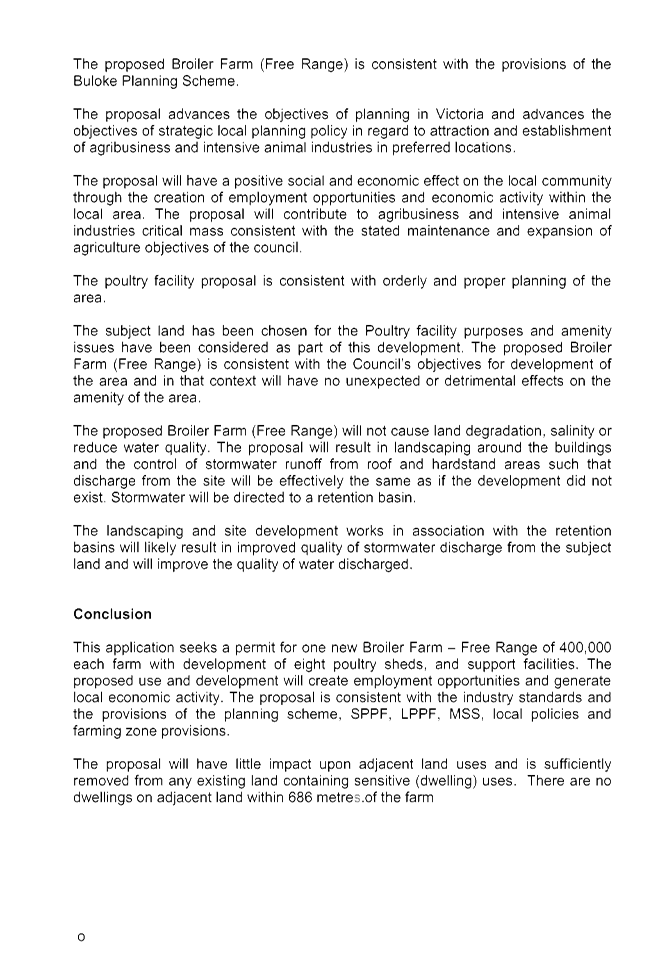
Buloke Shire Council Ordinary Meeting Agenda Wednesday, 13 May 2015
7.2.6 Notice of Decision to Approve Planning Permit 599/15 for Intensive Animal Husbandry at Crown Allotment 111B Parish of Buckrabanyule.
Attachment 4 Relevant matters
RELEVANT MATTERS
1. State Planning Policy Framework:
a. Clause 11.05-3 Rural Productivity
This clause aims to manage land use and development in order to promote agricultural and rural production. Strategies include limiting isolated housing development in rural area and directing them to existing settlements and encouraging consolidation of small lots in rural zones
b. Clause 12 Environmental and landscape values
This policy relates to the protection of ecological systems and conservation of areas with identified environmental and landscape values. Relevant objectives and strategies refer to biodiversity and the need to consider any impacts which use or development may have upon adjoining significant areas such as wetlands. The risk-based approach to managing native vegetation is applied to ensure no net loss of native vegetation
c. Clause 14.01-2 Sustainable agricultural land use
This clause aims to encourage the sustainable use of agricultural land. Strategies to achieve this objective include supporting production and processing infrastructure and rural industries to adjust flexibly to market changes. This clause also actively supports facilitating the establishment and expansion of cattle feedlots, piggeries, poultry farms and other intensive animal industries in a manner consistent with proper planning and protection of the environment.
2. Local Planning Policy Framework:
a. Municipal Strategic Statement:
i. 21.03 Environment and Natural Resources
This section of the MSS relates to the need to protect the natural environment from inappropriate development and acknowledges the reliance which agriculture has on the natural environment. In particular objectives include protecting agricultural land and supporting, promoting and facilitating sustainable, diverse and viable agriculture to provide for the long-term economic, social and environmental health of the municipality.
b. Local Planning Policies:
i. 22.02 Rural Land and sustainable Agriculture;
The objective of this local policy aims to protect agricultural industry due to its significance in the municipality. The policy details the Buloke Shire reliance on broad acre agriculture but acknowledges that Rural Dependent Enterprises opportunities may arise and should be considered in relation to the suitability of the application.
In particular the policy requires that the unsustainable use of agricultural land which fragments and limits the full productive potential of the land should not be encouraged. It also states that the agricultural industry is reliant on a land resource that needs to be sustainably managed and protected from conversion to non-soil based use and development.
In the recent Lewis vs Central Goldfields SC VCAT case, the relevant local planning policy for intensive agriculture was encouraged to be located having regard to soil and water quality and the adequacy of infrastructure services as well as the potential to affect the amenity of surrounding land uses and developments. There policy, like Buloke’s, also strongly discourage the conversion of land to no soil based use and development. A chicken farm is not soil based but the tribunal found that the local policy needs to be applied in the context that intensive agricultural industries are expressly encouraged. Agricultural quality has not been demonstrated to be of such high value on the subject land that the tribunal reached the conclusion the proposal should be rejected in principle for reasons relating to loss of high quality soil based agriculture.
The proposed development is on land that is not utilised for broad acre cropping and due to topographical features is unlikely to be utilised for that purpose.
ii. 22.03 Intensive Animal Husbandry;
The objective of this local policy is to ensure that intensive animal husbandry is suitably located, does not impact on the environment, protects residential amenity in residential areas and encourages quality design and siting.
It is policy that the buildings and yards holding the animals are appropriately located and fenced; this is proposed as part of the development.
It is policy that the area used is not less than four hectares (the site is 71.4 Hectares) and that the total area for buildings and yards that enclose the animals does not exceed 10% (the area proposed is 6.5Hectares or 9%).
Further policy requirements include landscaping, which is proposed in the application and included in recommended planning permit conditions, as well as the treatment of run-off water, which is also detailed in the application and included in the recommended planning permit conditions.
3. Zones: Clause 35.07 Farming Zone (FZ)
The primary purpose of the Farming Zone is to implement state and local planning policy and to provide for the use of land for agriculture. Additionally, the purpose of the Farming Zone encourages retention of production land, retention of employment and population in rural communities and the development of land based on comprehensive and sustainable land management practices. The Farming Zone also aims to ensure non-agricultural uses do not adversely affect the use of land for agriculture
The Farming Zone is one of a limited number of zones within the State where intensive animal husbandry is permitted. The Farming Zone contains a list of decision guidelines, in addition to the decision guidelines of clause 65, which must be considered before deciding on an application. The decision guidelines refer to a number of issues including: general issues, agricultural issues, dwelling issues, environmental issues and design and siting issues
In considering the Farming Zone decision guidelines, it is considered that the proposal is consistent with the guidelines given that it is a legitimate agricultural use and is compatible with adjacent agricultural uses, which consist of cropping and grazing
The Farming Zone decision guidelines also require consideration of state and local planning policy. As outlined above, there is significant state policy support for the establishment and expansion of intensive animal husbandry and also support within local policy for expansion and diversification of agricultural industries in the Shire
4. Additional information to inform decision making in the application:
The application is for a free range chicken farm and as a result the Victorian Code for Broiler Farms 2009 does not apply as it explicitly excludes developments in which the chickens have access to an outdoor range. In the Victorian Civil and Administration Tribunal decision of Heath Hill Poultry Pty Ltd vs Cardinia SC the tribunal determined the key issue for free range chicken farm applications was how any new permit applications would demonstrate environmental compliance in respect to dust and odour and what their separation distances from sensitive uses should be given the Code will not apply.
The main difference between the VCAT case and this proposal is that the Heath Hill proposal did not meet the boundary setback and separation minimum in the Victorian Code for Broiler Farms 2009 of 686 metres to the closest sensitive use whereas the application currently before Buloke does meet it and exceeds it The Heath Hill proposal relied on the Recommended Buffer Distances for Industrial Residual Air Emissions AQ2/86 of 500 metres.
The tribunal discussed at length in their decision that if Code buffers are to be departed from by a free range chicken farm then there is need to establish an evidentiary basis for doing so, they also concluded that it is relevant to compare the buffer distances that would be applicable under the code to the free range proposal and that according to the Environmental Protection Agency a Council may find it helpful to do so.
In conjunction with the above mentioned VCAT decision, the Department of Planning Practice Note 63 Applying for a planning permit to farm chickens notes that where the broiler code does not apply (such as to free range applications), it may still be a useful reference for identifying relevant issues and responses to inform the preparation and consideration of a proposal however it cannot be used as a statutory assessment tool.
In considering the VCAT determination, and practice note, and with the absence of any other assessment framework, the Code and its relevance to this proposal have been considered below. The planning permit application included an assessment of the development against the measures within the Code and demonstrated an ability to achieve compliance with all measures.
5 The Victorian Code for Broiler Farms 2009 (the Code)
The Code is an incorporated document in all Victorian planning schemes and the purpose of the Code is to:
I. deliver sound environmental performance in the planning, design, construction, operation and management of broiler farms
2. protect local amenity from adverse impacts, including offensive odours, dust, noise and visual Impacts
3. protect the surrounding environment from adverse Impacts
4. permit an economically viable, competitive and sustainable broiler farm industry
The Code, therefore, aims to balance the needs of the chicken meat industry as a whole, the needs of consumers within the State which are provided with their products, and the needs of communities within which broiler farms are situated.
The Code contains a number of sections, each of which address specific aspects of the broiler farms, including application requirements, classification of broiler farms, design and ongoing operation and auditing requirements. Under the Code, broiler farms are classified as one of four types; Class A, Class B, Special Class or a Farm Cluster. Section 5 of the Code specifies criteria for determining the classification of farms and also assessment requirements for certain classifications. The classification of a farm is determined by three factors;
- the number of birds kept on a farm,
- the ability to contain the specified separation distance wholly within the farm boundary and;
- the proximity to other broiler farms
The separation distance referred to is calculated using a defined formula which is provided within the Code and refers to the distance from the external edge of the broiler farm shed to the nearest location where a sensitive use is located
The proposed planning permit application is for a farm which will have 400,000 birds, therefore the separation distance from the outside edge of the nearest broiler farm shed to a sensitive use as per the Broiler Code formula is calculated as being 686 metres. For this application, there are no sensitive uses within the separation distance. The separation distance is not however wholly contained within the farm title boundary and in using the Broiler Code farm classification requirements, the proposal would be classified as a Class B farm. This is significant because a Class B farm has no mandatory requirement for the preparation of an Odour ERA.
Farm Design and Operation Elements
This section of the Code outlines the six best practice elements of broiler farm siting, design and operation. Each of these six elements contains objectives, standards and approved measures. An objective describes the desired outcome to be achieved and all permit applications must satisfy the objectives. Standards contain requirements to meet each objective. All permit applications must comply with relevant standards. Approved measures are certain actions or practices which permit applicants should incorporate into their proposals.
The Code states that "where the development proposal adopts all of the approved measures for a standard, the application is deemed to comply with the standard', however the approved measures are not mandatory. A full assessment against the requirements of section 7 of the Code was provided by the applicant to assist with Councils assessment and is attached to this report.
5. National Farm Biosecurity Manual for Poultry production
A copy of the Bio security manual was provided with the application and Routine and High Risk bio security procedures are incorporated in to the Environmental Management Plan.
6. Code of Accepted Farming Practice for the Welfare of Poultry
A copy of the code was provided with the application and addresses the accepted standards for chickens access to food, water, movement, housing and protection. All elements applicable to a free range chicken farm are incorporated in to the Environmental Management Plan.
Buloke Shire Council Ordinary Meeting Agenda Wednesday, 13 May 2015
7.2.6 Notice of Decision to Approve Planning Permit 599/15 for Intensive Animal Husbandry at Crown Allotment 111B Parish of Buckrabanyule.
Attachment 5 Environmental Managment Plan
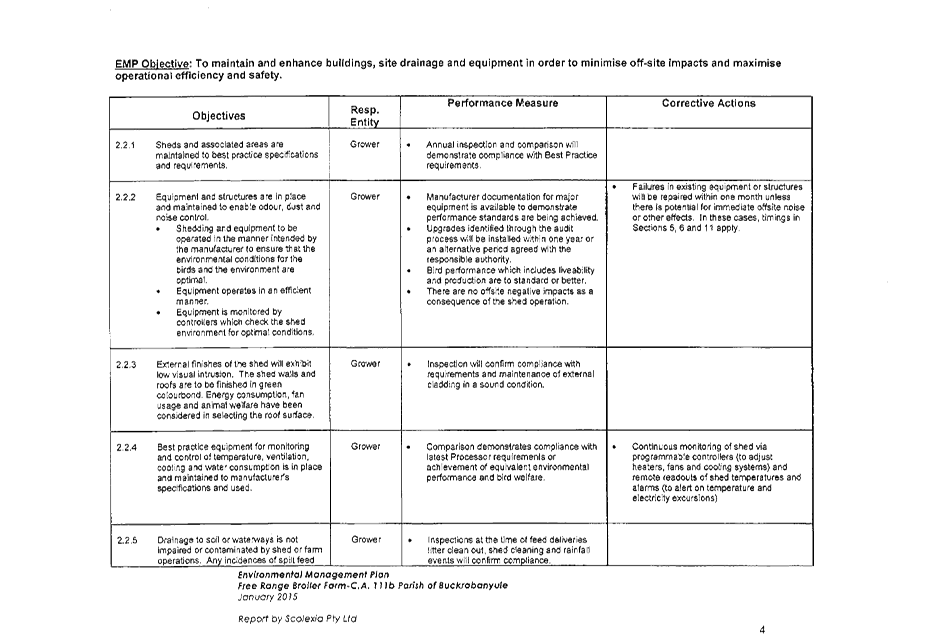
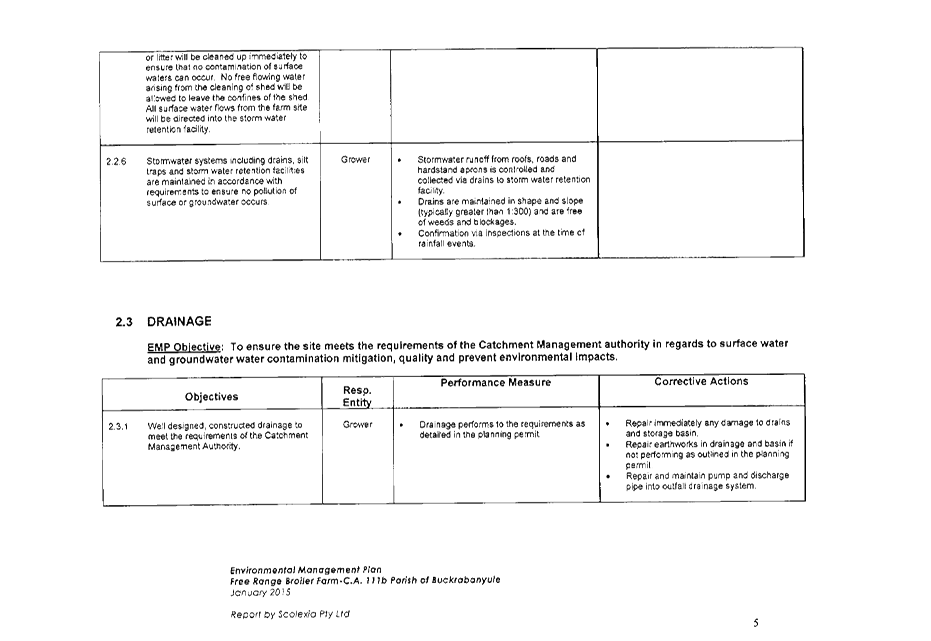
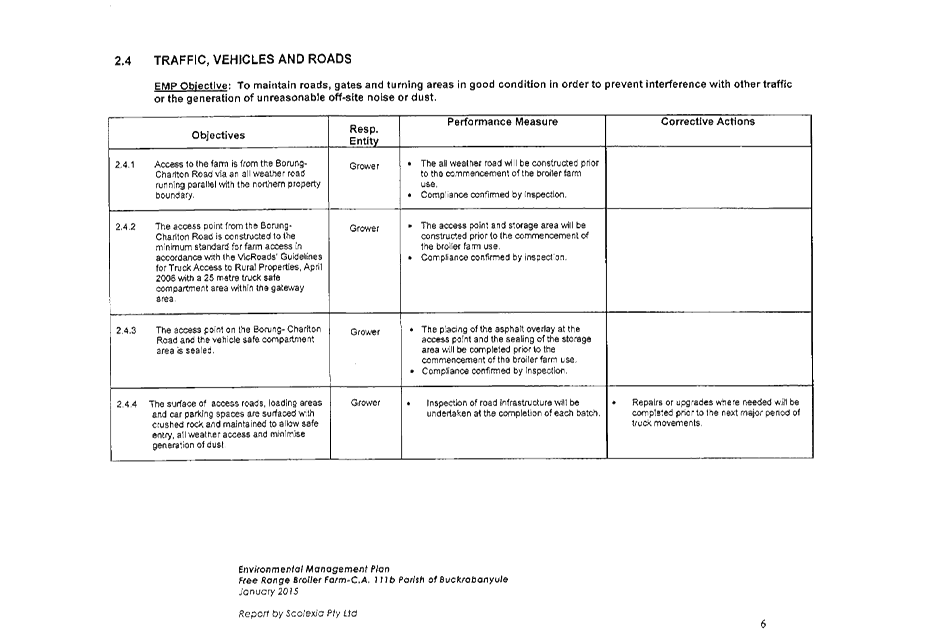
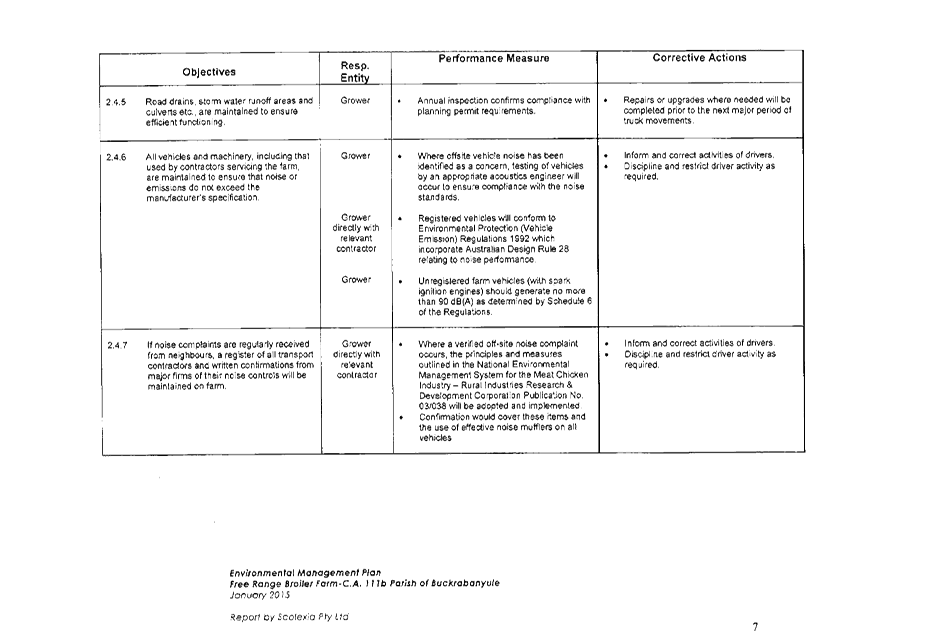
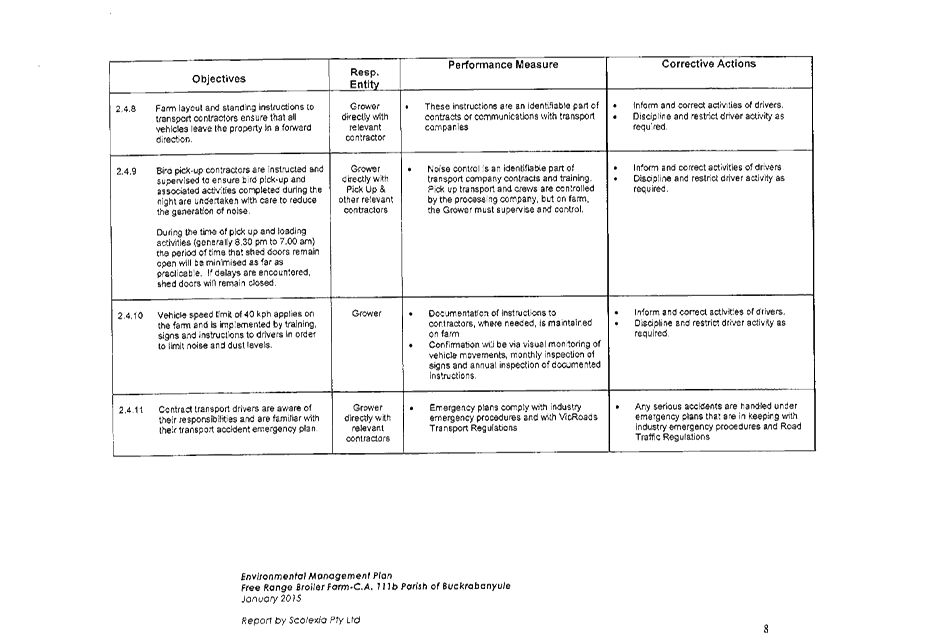
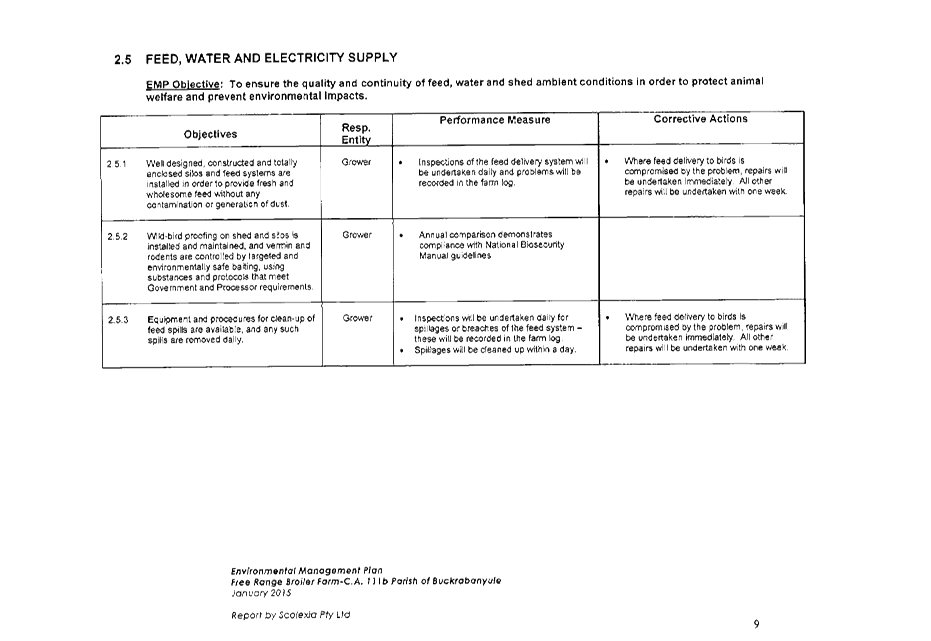
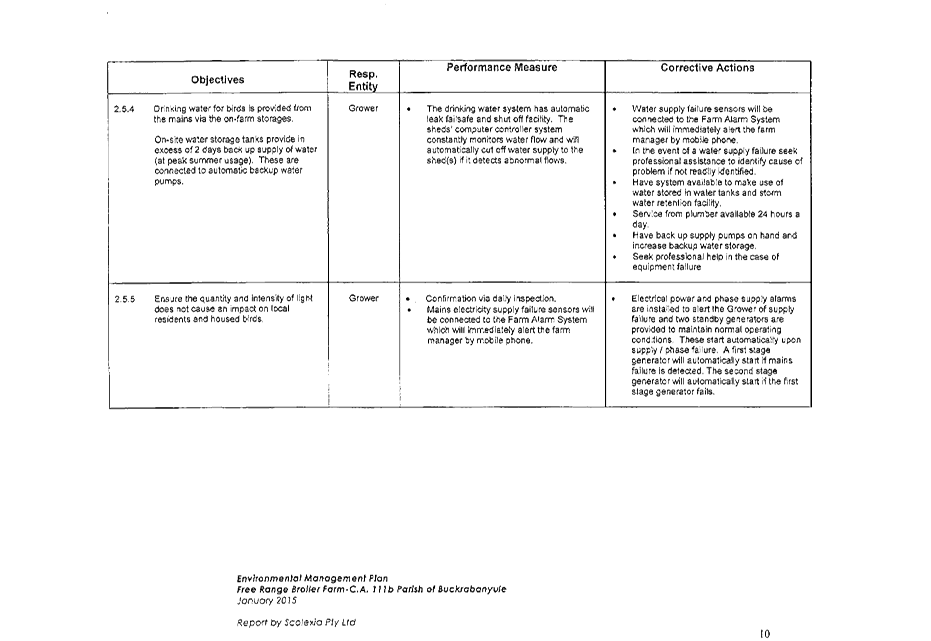
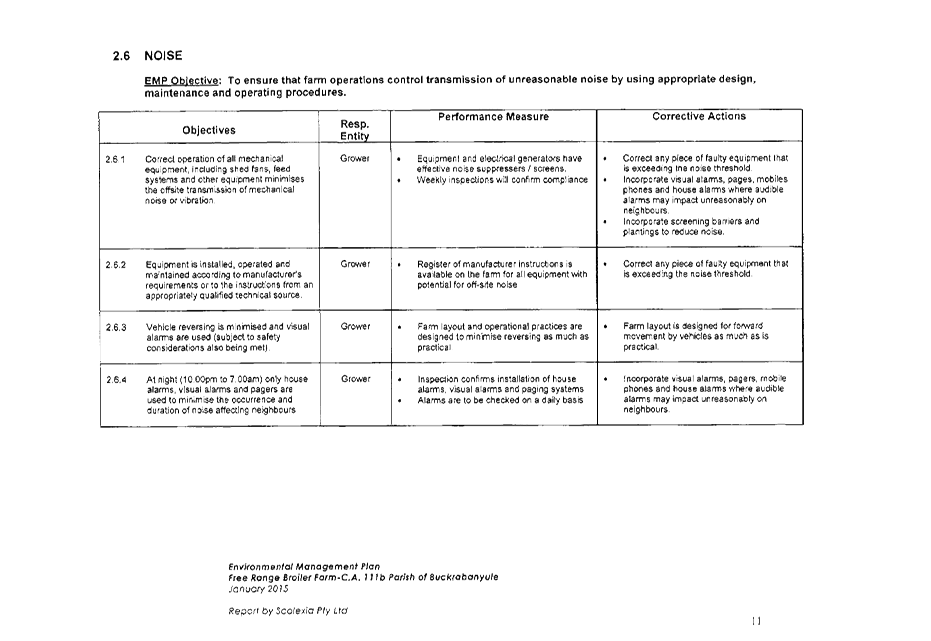
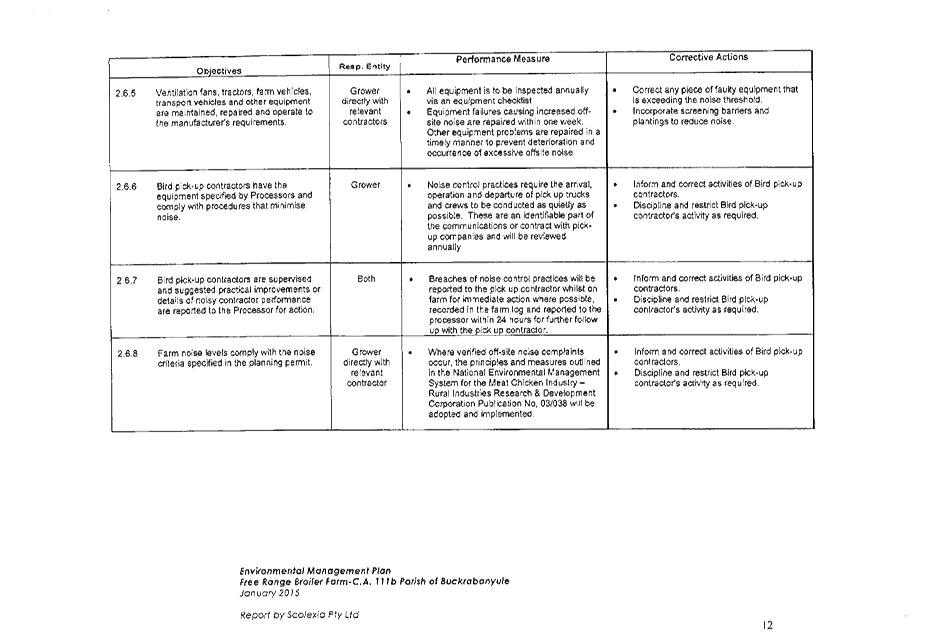
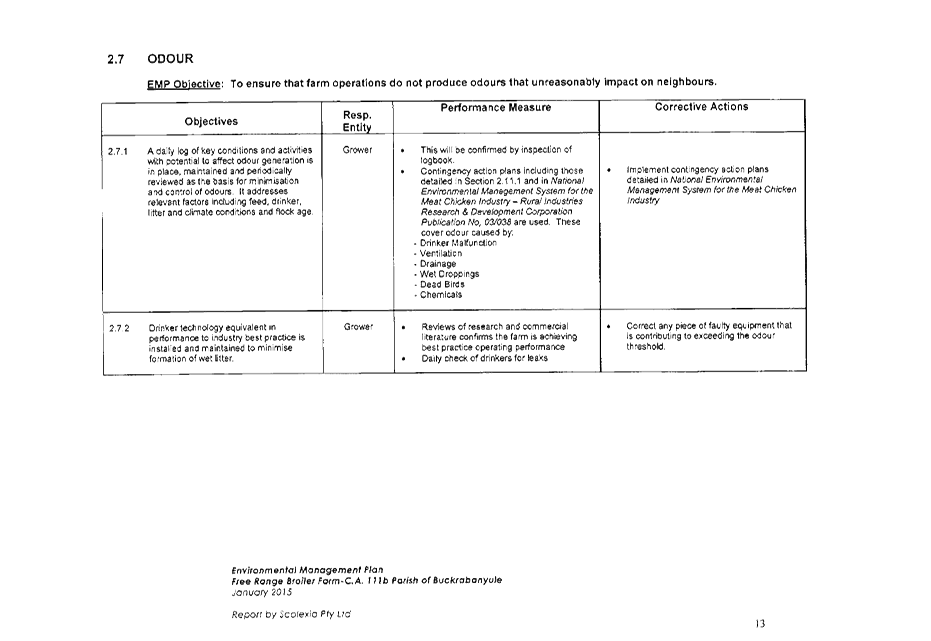
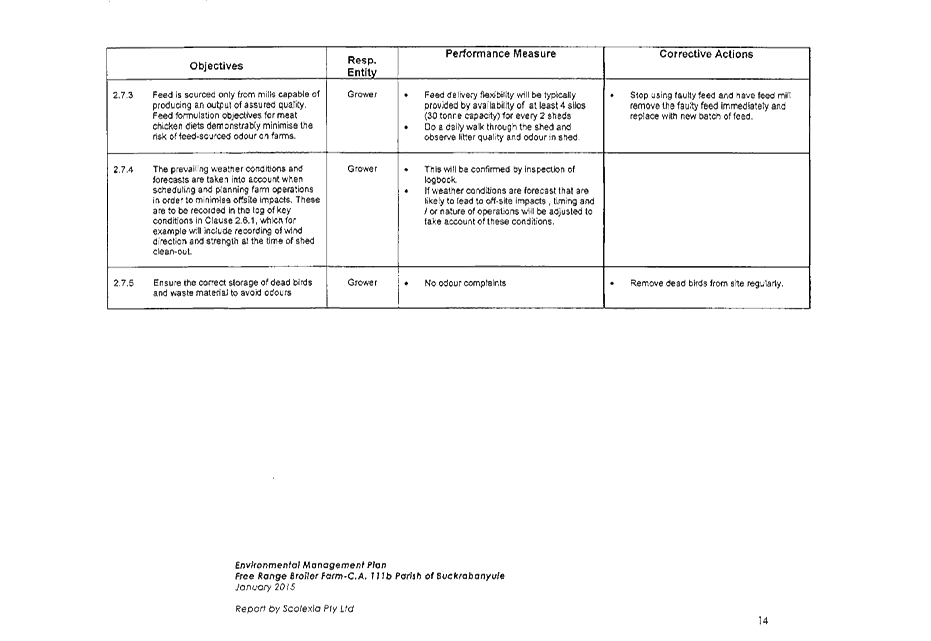
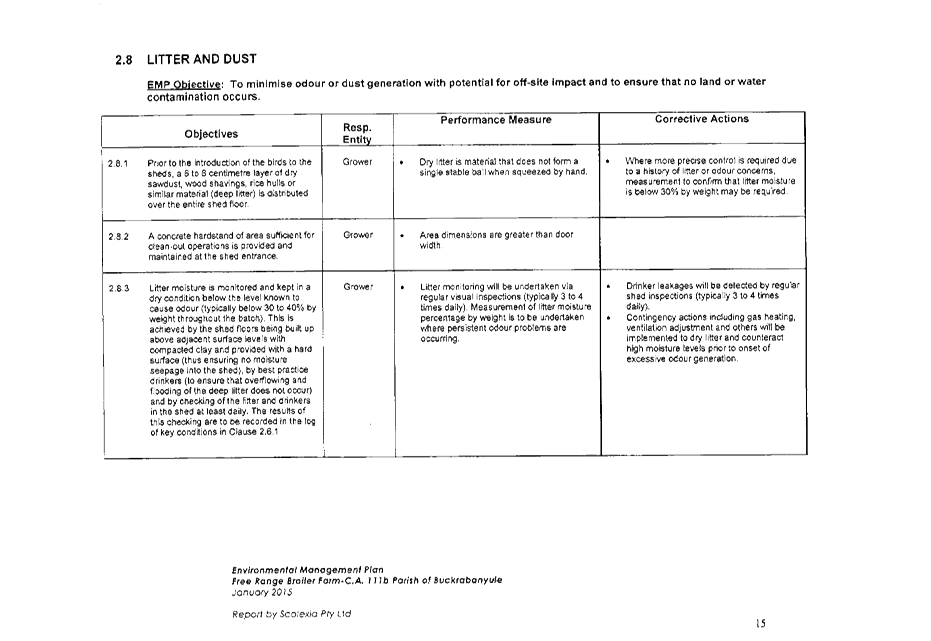
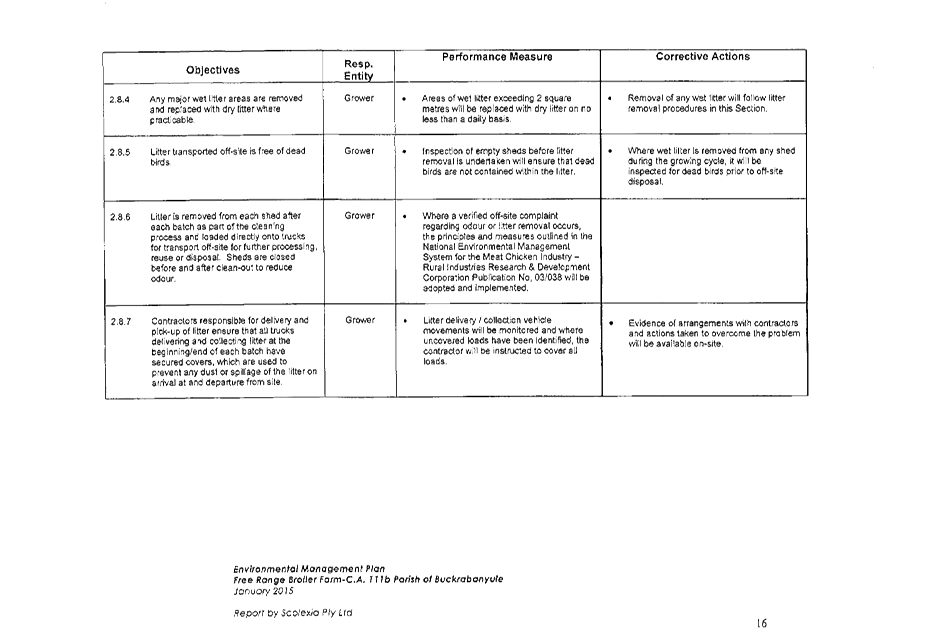
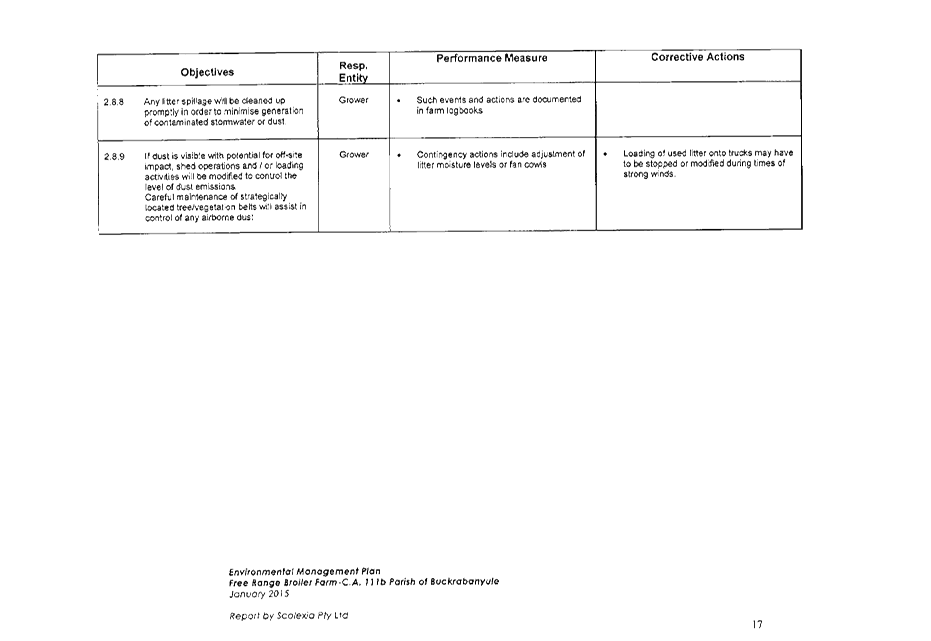
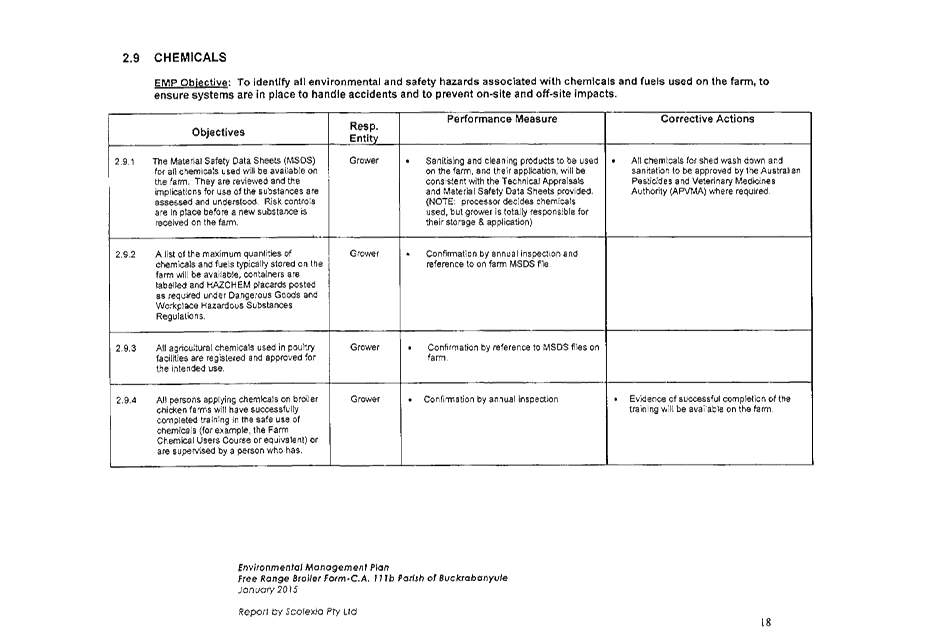
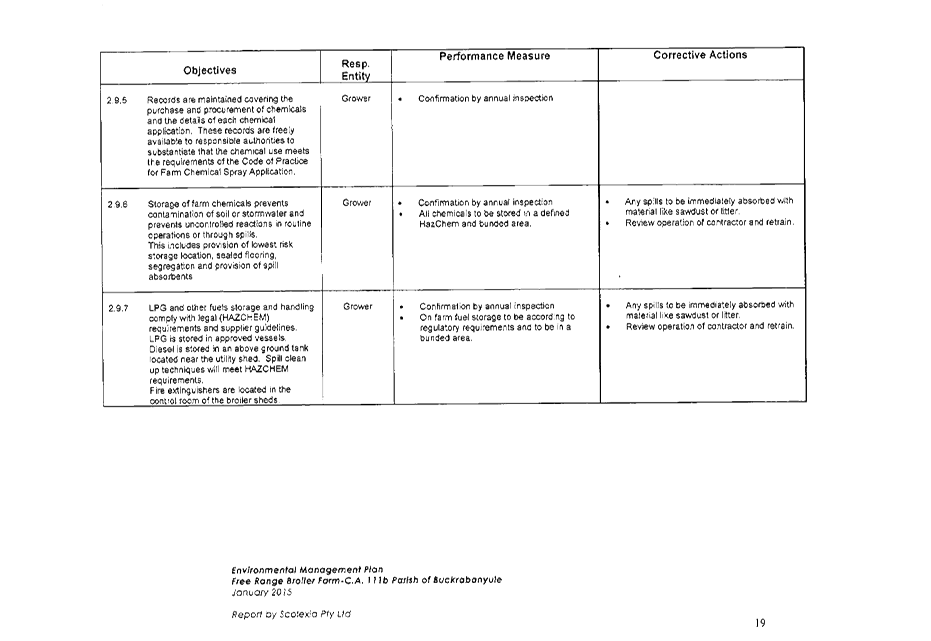

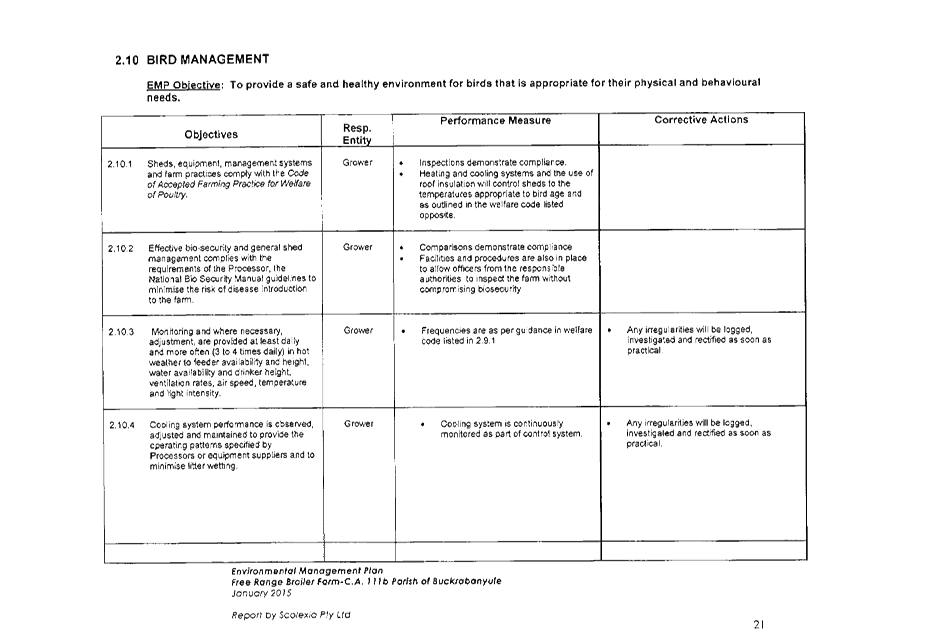
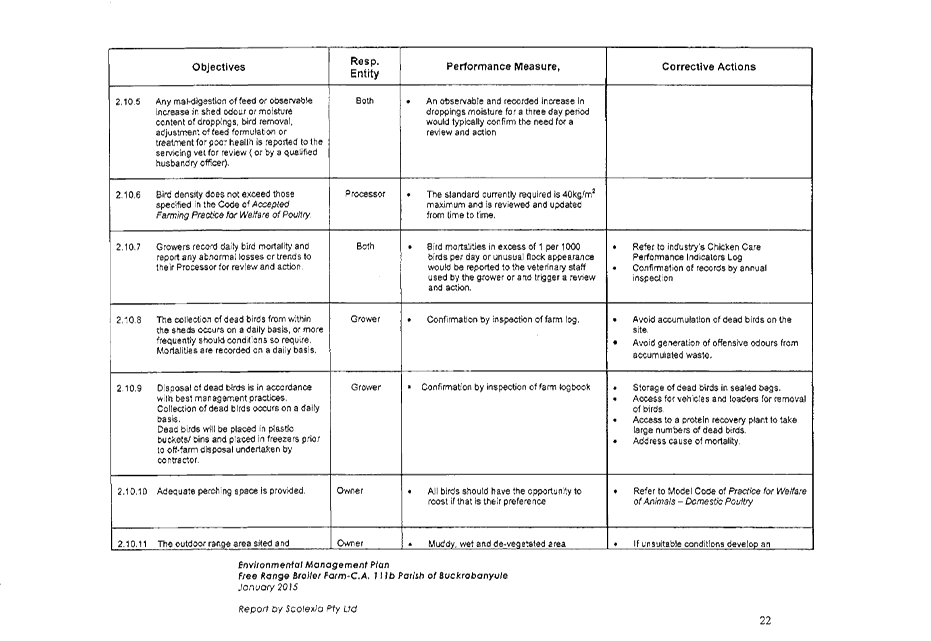
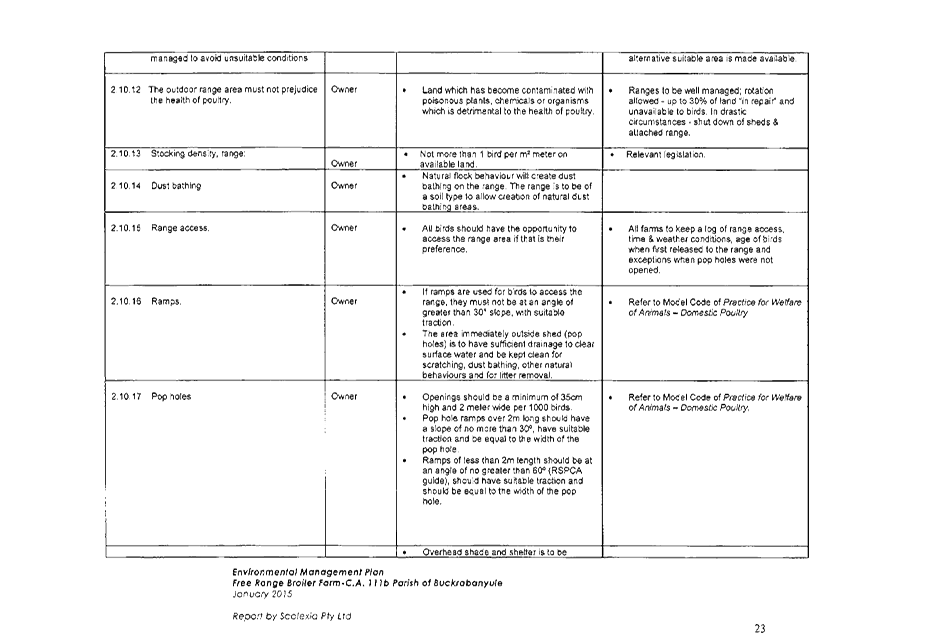

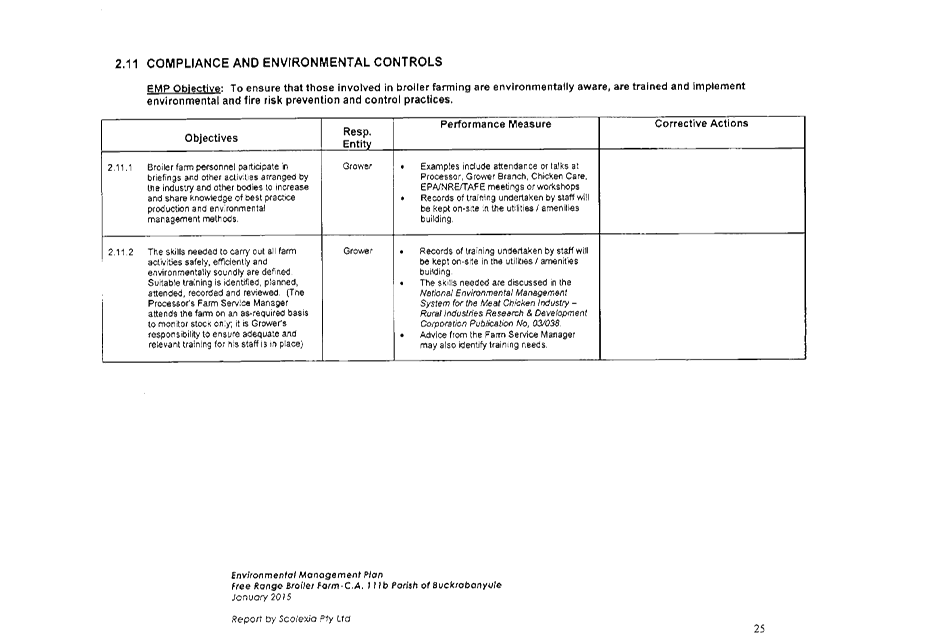
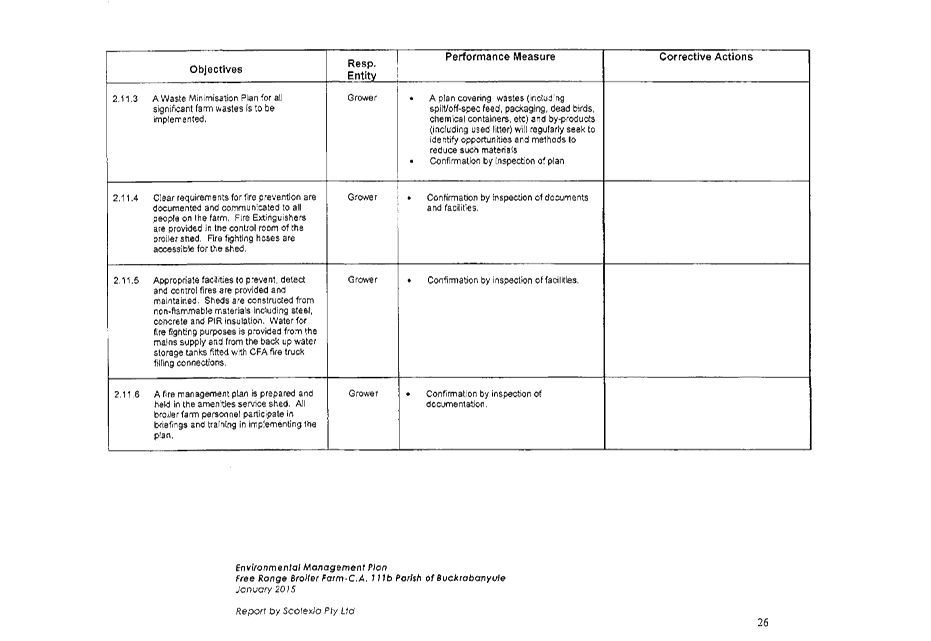
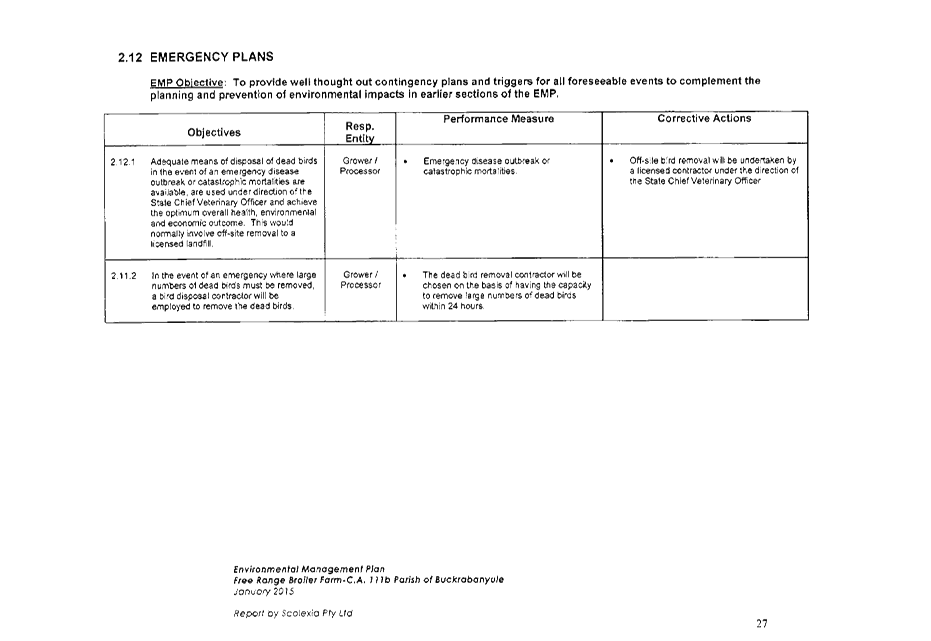
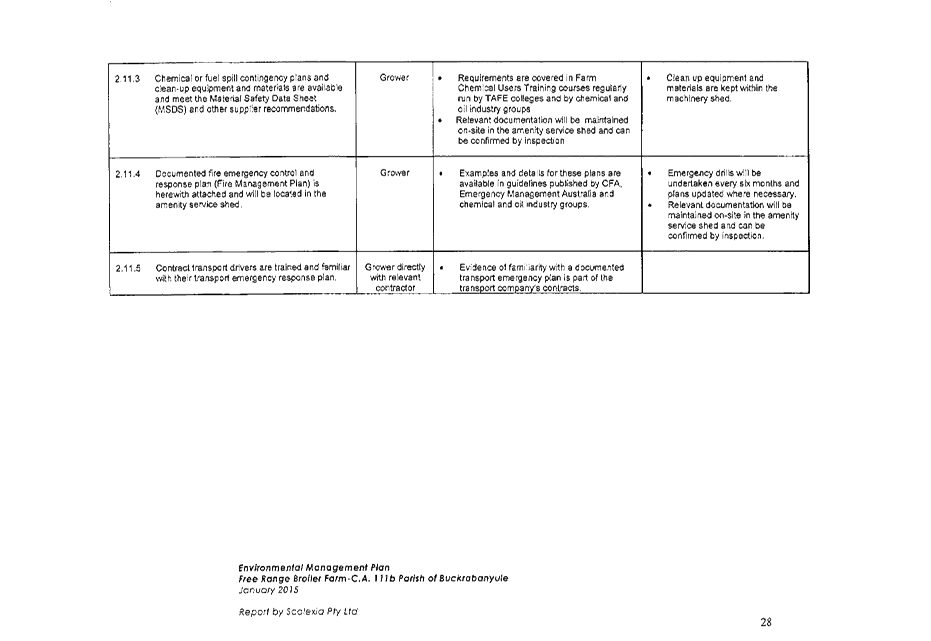
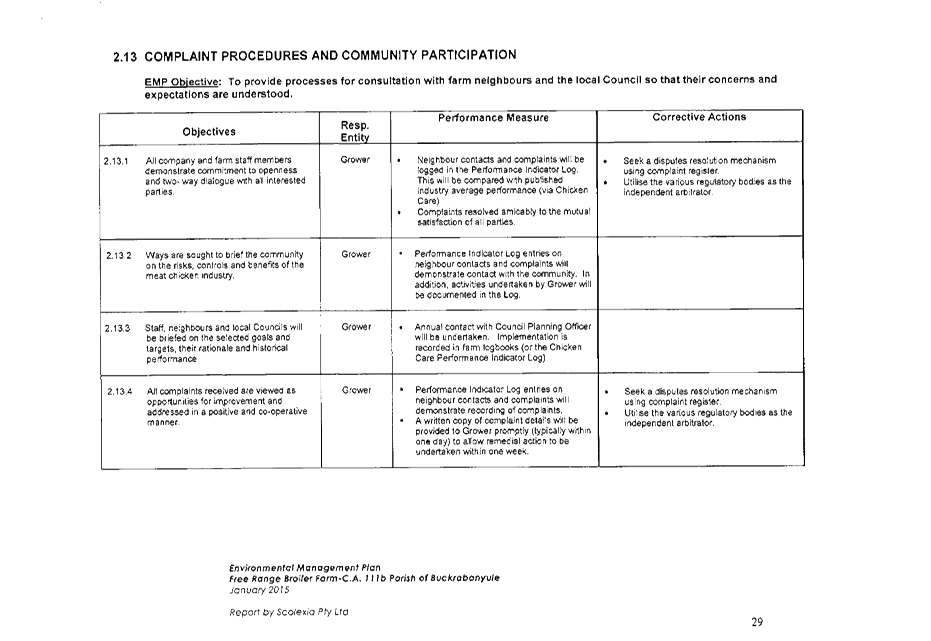
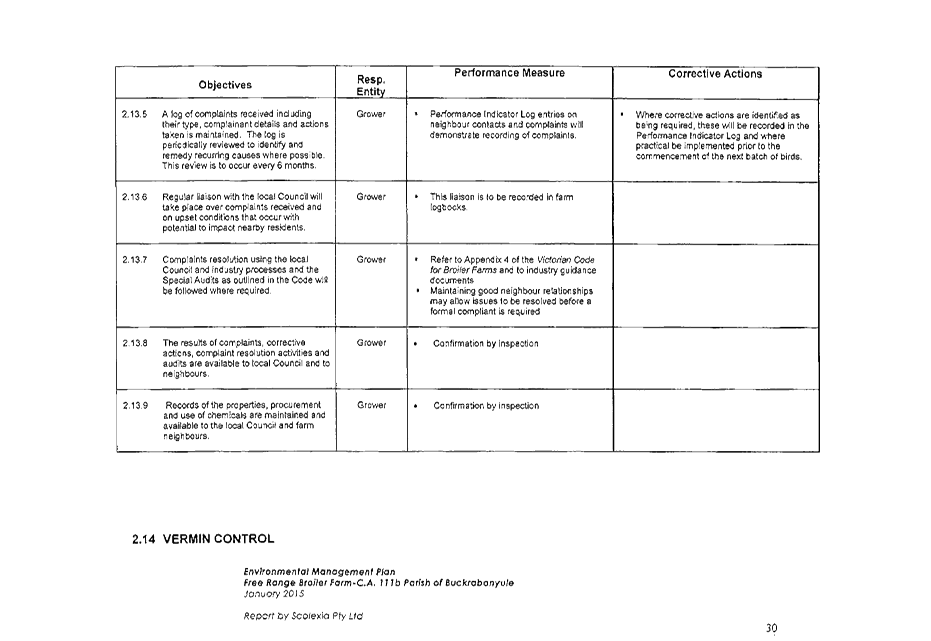
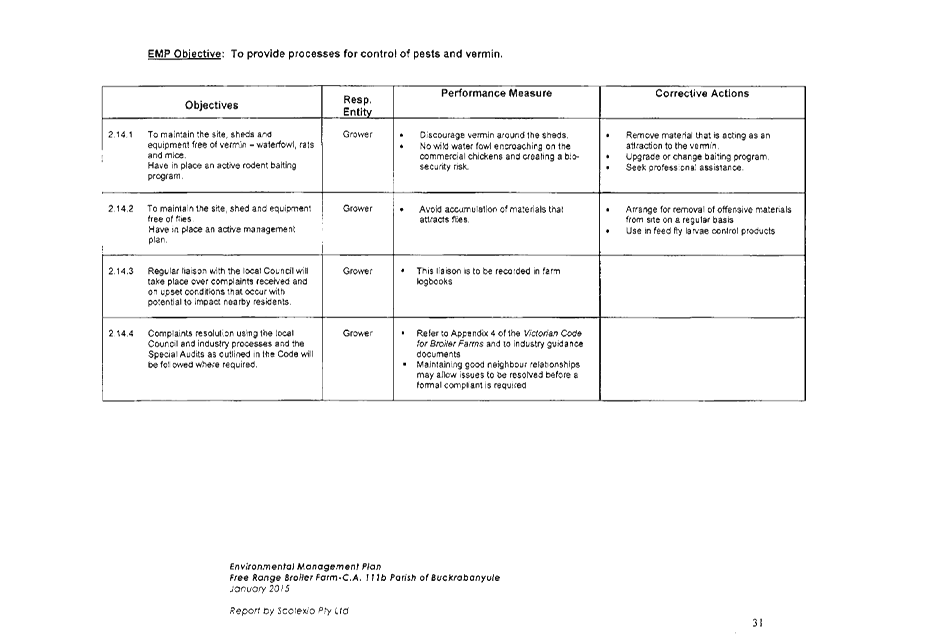
7.2.7 Submission to the Review on Local Government Rate Capping
Author’s Title: Chief Executive Officer
Department: Office of the CEO File No: xxx
|
1 Submission to the Local Government Rates Capping and Variation Framework Consultation Paper |
Relevance to Council Plan 2015 - 2019
Strategic Objective: Influencing governments to improve liveability for rural communities
|
That Council submit the attached submission on the Essential Services Commission Rate capping consultation paper. |
1. Executive Summary
The Victorian Government has announced its intention to implement a rate capping mechanism across Victoria. This will require Councils to submit applications for approval for any rate increases in excess of a yet to be specified level. It is understood that the level is most likely to be the Consumer Price index.
The rate cap is to be developed and administered by the essential Services Commission which has put out a consultation paper for comment. A submission to this consultation paper has been developed and is attached to this report.
2. Discussion
Small rural shires have major barriers to their capacity to provide basic services to their residents. A number of reports have demonstrated this in the past and small rural shires have responded positively by focussing on improving efficiencies, sharing services, innovative service provision and enhanced management. A great deal of progress has been made, and continues to be made, with many of these shires reaching high levels of efficiency but the problem remains.
The major barriers include communities with a capacity to pay typically half of the capacity of metropolitan communities and inherent costs that are typically 3.5 times per unit higher than those of metropolitan municipalities. These costs and lack of capacity arise from a range of factors outside the control of Council including:
Ø Lack of economies of scale
Ø Large distances and time required to deliver services.
Ø More people with lower incomes and other socio-economic factors.
Ø A higher proportion of aged people in the population.
Ø Lack of competition from service providers and suppliers.
Ø Difficulties in the recruitment of staff and skilled contractors.
Ø Frequent market failure resulting in premium prices for goods and services.
Ø Small population sizes and a consequent lack of capacity to pay for services.
When these matters are factored in, even with the typically higher grant revenues received by small rural shires, the financial circumstances of Buloke Shire are the worst in the State (Whelan Model, 2013). Many small rural shires are similarly hamstrung in the long term and cannot provide a decent level of services under the current financial arrangements.
Over the years the Shire has seen high levels of rate increase as these issues have continued to be addressed by increased calls on ratepayers to make up for these barriers to financial sustainability. It is doubtful that the previous rate of rate increase could be sustained by the Shire’s population in any case.
These matters are addressed in the submission. A key matter that needs to be addressed by the ESC is the potential for rate capping to introduce yet another cost resulting in a further deterioration of services.
3. Financial Implications
The implementation of rate capping would see an extra cost arising for the development and submission of applications to increase rates above CPI if necessary.
4. Cost Shift Considerations
The Victorian Government is likely to seek payment from Councils for the operation of the capping framework.
5. Community Consultation
Nil
6. Internal Consultation
Senior Management Team was consulted at the drafting stage.
7. Legislative / Policy Implications
Nil at this stage
8. Environmental Sustainability
Nil
9. Conflict of Interest Considerations
No officer involved in the preparation of this report has a conflict of interest.
10. Conclusion
That Council make any amendments to the submission and approve it for submission.
Buloke Shire Council Ordinary Meeting Agenda Wednesday, 13 May 2015
7.2.7 Submission to the Review on Local Government Rate Capping
Attachment 1 Submission to the Local Government Rates Capping and Variation Framework Consultation Paper
SUBMISSION TO THE LOCAL GOVERNMENT RATES CAPPING AND VARIATION FRAMEWORK CONSULTATION PAPER
Introduction:
Buloke Shire Council’s submission needs to be considered within the context of the general environment it operates within.
Small rural shires have major barriers to their capacity to provide basic services to their residents. A number of reports have demonstrated this in the past and small rural shires have responded positively by focusing on improving efficiencies, sharing services, innovative service provision and enhanced management. A great deal of progress has been made, and continues to be made, with many of these shires reaching high levels of efficiency but the problem remains.
The major barriers include communities with a capacity to pay typically half of the capacity of metropolitan communities and inherent costs that are typically 3.5 times per unit higher than those of metropolitan municipalities. These costs and lack of capacity arise from a range of factors outside the control of Council including:
Ø Lack of economies of scale
Ø Large distances and time required to deliver services.
Ø More people with lower incomes and other socio-economic factors.
Ø A higher proportion of aged people in the population.
Ø Lack of competition from service providers and suppliers.
Ø Difficulties in the recruitment of staff and skilled contractors.
Ø Frequent market failure resulting in premium prices for goods and services.
Ø Small population sizes and a consequent lack of capacity to pay for services.
When these matters are factored in, even with the typically higher grant revenues received by small rural shires, the financial circumstances of Buloke Shire are the worst in the State (Whelan Model, 2013). Many small rural shires are similarly hamstrung in the long term and cannot provide a decent level of services under the current financial arrangements.
Over the years the Shire has seen high levels of rate increase as these issues have continued to be addressed by increased calls on ratepayers to make up for these barriers to financial sustainability. It is doubtful that the previous rate of rate increase could be sustained by the Shire’s population in any case.
These matters are addressed in the submission. A key matter that needs to be addressed by the ESC is the potential for rate capping to introduce yet another cost resulting in a further deterioration of services.
There comes a time when it becomes apparent the residents of these shires have been left with inferior services and poor community outcomes and liveability. The residents of these shires make a considerable contribution to the nation’s GDP, as well as paying rates, income tax and GST in the same manner as their metropolitan colleagues but do not receive the minimum level of services. This is clearly inequitable.
This situation reflects poorly on the Victorian Local Government Sector, as the small rural municipalities created at amalgamation are not financially sustainable under the current funding models if they are to deliver a reasonable standard of services to their constituents.
General Comments:
Within the paper there is an inference that generally Councils lack discipline and have not vigorously pursued the efficient delivery of services. In actual fact, small rural shires have been keen advocates of innovation and continuous improvement for decades; principally arising from the discipline necessitated by their heavily disadvantaged financial circumstances and their role as a “price taker” of other levels of government.
Small rural shires have seen levels of funding continuously reduced or withdrawn and have been keen to continually become more efficient and cut their cloth accordingly. Compared to the discipline exerted by these continual reductions in real revenue, the rate cap is unlikely to be able to create any significant further efficiencies that would not have occurred in any case, no matter how well intentioned the rate cap might be.
Local governments are set up as separate entities and provide audited annual accounts as going concerns. They cannot continue to spend more than they receive. The level of rate increases in small rural shires has been too high but even this level of rate increase has not been sufficient to maintain a minimum set of service levels. The pressure of being able to provide these services generates discipline and efficiencies far more effectively than any rate cap will.
There is very little benefit that small rural shires will receive from the operation of a rate cap that would not have occurred in any case. There are, however, significant costs and these will see a reduction in services.
Council would also like to have the following matters taken into account:
· The paper notes the constrained financial environment for Councils but does not appear to mention two key elements:
o The loss of the Country Roads and Bridges fund. This was a key flexible funding source for small rural shires and its loss alone is equivalent to 10% of Buloke Shire’s annual rate revenue p.a. In comparison, the freezing of FAGS is equivalent to a loss of 2% of rate revenue p.a.
o The gradual reduction over time of the proportion of the overall tax take provided to Local Government. Over the past 20 years this has halved. This is a key driver of the need for Council rates to increase. The other key driver being the shifting of costs to local government from other levels of government.
· Rate capping will interfere with communities’ decisions in regard to priorities, resource allocation and service delivery. At the current time small rural communities do not receive basic needed services even with rate increases. The imposition of a cap will see further reductions to services.
· Rate capping will involve an extra cost, both for submissions and for the actual ESC mechanism involved. Given the process provides no benefits that do not already occur, this will see a further loss of resources and, therefore of service provision, for the residents of small rural shires.
· In Principle 4 the case for above cap increases should also include the provision of basic services that are not currently being provided.
Response to the Specific Questions contained in the Paper:
In regard to the questions raised in the paper the following comments are made:
A. THE FORM OF THE CAP
1. While a cap based on CPI is simple to understand and apply, are there any issues that we should be aware of?
The Local Government Cost Index would be a more accurate and appropriate measure. The CPI is not linked to costs in the sector.
2. What are some ways to refine the cap (for example, alternative indices), in line with the Government’s objectives?
See 1.
3. Should the cap be set on a single year basis? Is there any merit in providing an annual cap plus indicative caps for the next two to three years to assist Councils to adopt a longer term view in their budgeting and planning, particularly when maintaining and investing in infrastructure often takes a longer term perspective? How should such a multi-year cap work in practice?
Councils are already required by the Local Government Act to provide planned rates for years 2, 3 and 4 in line with their four-year Strategic Resource Plan (SRP). The SRP is provided to the Minister each year.
4. Should the cap be based on historical movements or forecasts of CPI?
The cap should be based on forecasts of the cost index as this will be used for the SRP.
5. Should a single cap apply equally to all Councils?
Multiple caps could apply to different types of Council, e.g. small rural shires.
B. THE BASE TO WHICH THE CAP APPLIES
6. What base should the cap apply to? Does it include rates revenue, service rates/charges, municipal charges and special rates/charges?
The cap should only apply to rates revenue and municipal charges.
Garbage charges are cost neutral (full cost recovery) to Council and reflect the requirements of the EPA and government policy in relation to demands for recycling and greater requirements in relation to disposal of waste. The majority of these costs are outside the control of Councils and have increased at a much higher rate than CPI; reflecting government policy and charges.
Garbage and other fees and charges should be market based and not included within the cap.
Special charges are negotiated with a segment of the community and should be excluded.
7. Should the cap apply to total revenue arising from these categories or on average rates and charges per assessment?
The cap should apply to total revenue arising from rates revenue and municipal charges.
8. How should we treat supplementary rates? How do they vary from Council to Council?
No Response.
9. What are the challenges arising from the re-valuation of properties every 2 years?
Revaluation does not affect the amount of rates collected.
10. What should the base year be?
The base year should be the year 2015/16 which is the year immediately prior to the introduction of rate capping, and the base rate figure should be the actual amount of rates collected and not the budgeted amount. So this may need to be a forecast figure at a specific point in time.
C. THE VARIATION PROCESS
11. How should the variation process work?
The variation process should provide for a simple application by Council outlining the reasons for the proposed rate increase based on the SRP. Given the few benefits and the costs that will accrue to small rural shires from the process, the least resource intensive process possible is critical.
ESC should prepare and provide a template submission for use by the sector in order to reduce duplication of effort and bureaucracy.
12. Under what circumstances should Councils be able to seek a variation?
No Response
13. Apart from the exceptions identified by the Government (namely, new infrastructure needs from a growing population, changes in funding levels from the Commonwealth Government, changes in State Government taxes and levies, increased responsibilities, and unexpected incidents such as natural disasters), are there any other circumstances that would justify a case for above cap increases?
Other circumstances include the provision of basic services not currently being provided, the diseconomies occurring for small rural shires with diminishing populations and addressing the infrastructure gap.
14. What should Councils need to demonstrate to get a variation approved? What baseline information should be required for Councils to request a variation? A possible set of requirements could include:
· the Council has effectively engaged with its community
· there is a legitimate case for additional funds by the Council
· the proposed increase in rates and charges is reasonable to meet the need
· the proposed increase in rates and charges fits into its longer term plan for funding and services
· the Council has made continuous efforts to keep costs down.
We would like stakeholders’ views on whether the above requirements are adequate.
This should be the maximum set of requirements.
D. COMMUNITY ENGAGEMENT
15. What does best practice in community engagement, process and information look like? Are there examples that we can draw from?
No Response
E. INCENTIVES
16. How should the framework be designed to provide Councils with incentives to pursue ongoing efficiencies and respond to community needs? How could any unintended consequences be minimised?
Efficiencies will not be driven by this process. Far greater incentives already exist in the system.
F. TIMING AND PROCESS
17. A rates capping and variation process should ensure there is enough time for Councils to consult with their ratepayers and for ratepayers to provide feedback, and for us to review Council’s applications. To ensure the smooth functioning of the rates capping and variation framework, it is particularly important that it aligns with Council’s budget processes. We are interested in stakeholders’ views on how this can be achieved.
Council must adopt a draft budget for consultation in May to allow the adoption of the final budget by the end of June. Approval of variations will need to be provided by the end of Feb, leaving March and April for budget preparation and adjustments, May for Consultation, June for the standard ratepayer submissions process before approval by 30 June. It will be critical to have a quick approval process because the forecast outcomes for the previous year will be needed prior to the setting of a proposed rate increase. Thus the earliest a proposed rate increase could be set would be February and an approval will be needed prior to March.
G. TRANSITIONAL ARRANGEMENTS
18. What transitional arrangements are necessary to move to the new rates capping and variation framework? Is there merit in phasing in implementation over a two year period to allow for a smooth transition?
No Response
H. ROLES
19. What are stakeholders’ views on the respective roles of the key participants? Should the Commission’s assessment of rates variations be advisory or determinative?
The ESC should be determinative so as to remove any potential for political interference.
I. OTHER MATTERS
20. Is there a need for the framework to be reviewed to assess its effectiveness within three years’ time?
This will be critical.
21. How should the costs of administrating an ongoing framework be recovered?
The Victorian State Government should bear all costs to prevent further loss of services by the residents of small rural shires.
Yours faithfully
John Hicks
Chief Executive Officer
7.3 Financial Reports
7.3.1 Financial Performance As At 31 March 2015
Author’s Title: Finance Manager
Department: Finance File No: 0615
Relevance to Council Plan 2015 - 2019
Strategic Objective: Delivering our services in a financially sustainable way
|
That Council receive and note the Financial Performance Report for the period ending 31 March 2015 |
1. Purpose
The purpose of this report is for Council to assess its year to date financial performance as at the 31 March 2015. In addition, a comprehensive mid-year review of the Council’s financial performance has been undertaken, resulting in updated forecast projections to 30 June 2015 now being included into the reports, along with the original adopted 2014-15 Budget.
2. Discussion
As at the end of March 2015 Council continues to achieve the ambitious budget it has set for itself. The budget is in fact travelling better than expected and will see Council in a stronger cash position at the end of the year. This position will then become a strong platform on which the 2015/16 budget will be based. The following is an explanation of the various financial statements.
The Income Statement (Attachment 1) provides a summary of the total income and total expenditure relating to the Council’s annual recurrent operations. It also specifically includes capital income e.g. flood grants, but never includes capital works expenditure.
For the period ending 31 March 2015, the year to date (YTD) actual Surplus of $5.78m shows an overall positive surplus of $1.89m above the YTD budget. Total income excluding capital grants reflects a positive variance $459k mainly due to the receipt of additional unbudgeted grant income. Operating expenditure reflects a substantial positive variance of $1.96m under the YTD budget. At the end of March, there was a reduction of 19.8 EFT employee positions, of which 16.3 will result in permanent savings as they will not be replaced.
The Balance Sheet (Attachment 2) effectively shows a summary of the value of Assets (what we own) and our Liabilities (what we owe), both of which balance off against each other to show Equity (our net worth).
At the 31 March 2015, the Balance Sheet shows Council’s bank balance at $4.32m. Council continues to make this money work for us and has it prudently invested to provide a return for Council.
The Cash Flow Statement (Attachment 3) is formatted to show a rolling 12 month forecast. At 31 March 2015, the Cash Flow Statement shows Council with a bank balance of $4.32m. This positive bank balance is due to Council receiving the majority of its rates payments in February. During March 2015, funds in excess of operating requirements were invested in short-term deposits yielding higher interest rates than the ‘at call’ market rate. A comparison with previous years is shown in Attachment 4.
The Capital Works Program report (Attachment 5) reflects 59% i.e. $4.61m net capital works has been expended as at the 31 March 2015. The reduction in forecast by $737k is primarily due to the multi-year levee bank projects being carried forward to 2015/16. All other projects are expected to be completed by the end of financial year – the remaining variances relate to timing differences.
The cash position in March has improved significantly since the receipt of majority of rates and the third quarter payment of $1.375m from the Victoria Grants Commission. During March 2015, funds in excess of operating requirements were invested in short-term deposits yielding higher interest rates than the ‘at call’ market rate.
During March, the third quarter claim of $360,000 for the Roads to Recovery allocation was received. Payment (offset by trade-in) for the two new graders received in February was made in March as per the tender agreement. These new items of plant will result in efficiencies in Council’s road building and maintenance programs.
3. Financial Implications
This report continues to show that Council’s tight financial management is placing it in a more sound position. It is critical that Council continues to have a positive cash flow and at present it is ahead of budget.
4. Community Consultation
No consultation with the community was required for the production of this report.
5. Internal Consultation
The reports have been prepared in consultation with Budget Managers directly responsible for Council budgets.
6. Legislative / Policy Implications
The report is consistent with the requirements of the Local Government Act 1989.
7. Environmental Sustainability
This report has no direct impact on environmental sustainability.
8. Conflict of Interest Considerations
Nil
9. Conclusion
The Financial Performance Reports reinforce that Council is successfully managing its challenging financial position and is well positioned to both achieve and positively exceed its 2014-15 adopted budget. Council has a clear understanding of its finances and has implemented its adopted borrowing strategy, allowing it to prudently manage its finances going forward.
Buloke Shire Council Ordinary Meeting Agenda Wednesday, 13 May 2015
7.3.1 Financial Performance As At 31 March 2015
Attachment 1 Income Statement March 2015
Buloke Shire Council Ordinary Meeting Agenda Wednesday, 13 May 2015
7.3.1 Financial Performance As At 31 March 2015
Attachment 2 Balance Sheet March 2015
Buloke Shire Council Ordinary Meeting Agenda Wednesday, 13 May 2015
7.3.1 Financial Performance As At 31 March 2015
Attachment 3 Cash Flow Statement
Buloke Shire Council Ordinary Meeting Agenda Wednesday, 13 May 2015
7.3.1 Financial Performance As At 31 March 2015
Attachment 4 Cash Flow Graph
Buloke Shire Council Ordinary Meeting Agenda Wednesday, 13 May 2015
7.3.1 Financial Performance As At 31 March 2015
Attachment 5 Capital Works Program
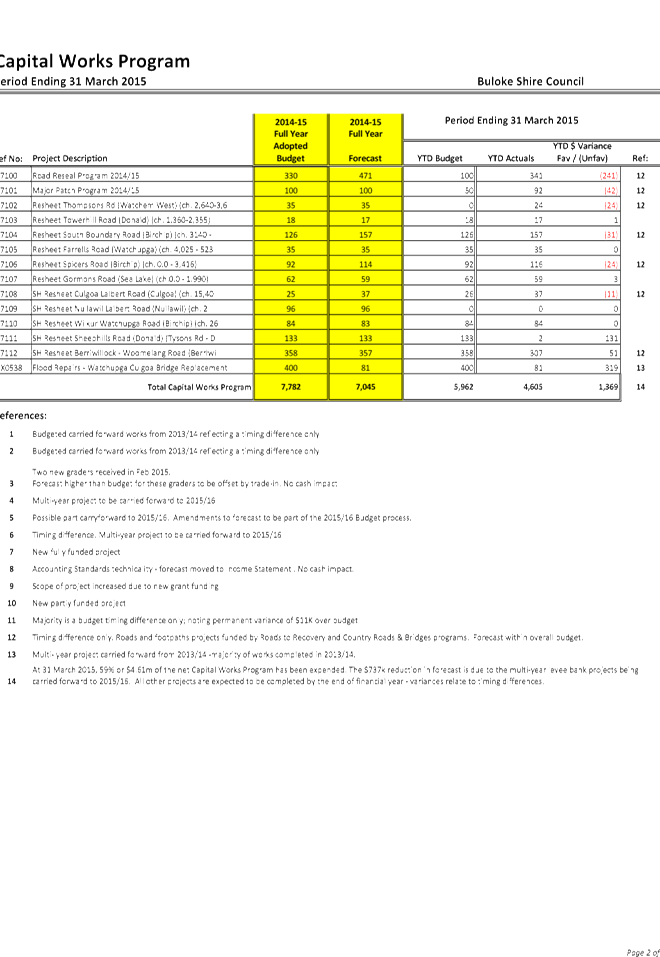
Buloke Shire Council Ordinary Meeting Agenda Wednesday, 13 May 2015
7.3.1 Financial Performance As At 31 March 2015
Attachment 6 Capital Works Progress Graph
8. REPORTS FROM COUNCILLORS
9. OTHER BUSINESS
9.2 Notices of Motion
9.2.1 Notice of Motion - Cr Milne - Victoria Police Stations
Author’s Title: Executive Assistant
Department: Office of the CEO File No: CS/15/02
|
Nil |
|
That Council contact Victoria Police and request that all police stations in Victoria should remain open, including all one man stations, in order for Victorians to feel safe in their communities. |
Background
A recent edition of the Weekly Times has suggested that one man police stations across Victoria are under threat. This is a particular worry to Buloke Shire and it's residents as currently Sea Lake, Culgoa, Birchip and Wycheproof were named as being a "one man" stations. This would leave Donald and Charlton as the only stations in our Shire.
Over recent times Council has voiced its concern to the Police and political representatives when un-filled positions have occurred for any length of time in the Shire. In these conversations, Council has expressed its concern as to the impact of lack of a " local" police person on communities and the wider district. Impacts include longer response times, less frequent visits, and more potential for law breakers including drug related crime, farm thefts and other crimes manifesting and growing into significant problems. Police officers have limited capability and need to be stationed within the communities they police. With all this in mind it is vital for small rural and somewhat remote communities to have quick and reliable access to a police in their time of need.
Minyip, Beulah, Woomelang, Speed, Quambatook, Boort and more, are all "one person " stations in the areas just outside the borders of our Shire and these would also have a huge impact on representation and response times to our residents if they were to close.
Buloke Shire Council Ordinary Meeting Agenda Wednesday, 13 May 2015
9.3 Questions from Councillors
9.5 Any Other Procedural Matter
10. MATTERS THAT MAY EXCLUDE THE PUBLIC
Nil